Marvel has entrusted Kadokawa with a program of five original manga, including a Spider-Man by tokitokoro and a Spider-Gwen by Ryusei Yamada, under the editorial direction of C.B. Cebulski, now based in Japan as head of Asian creations. The launch will take place on KadoComi, Kadokawa's digital reading service, before the end of 2026. The previous agreement, which tied Shueisha and Disney's Japanese subsidiary, ended on September 30, 2026, and five titles were removed from digital catalogs in the days before. For an English-language collector, the consequence is clear: no English or French edition has been announced, so there is, to date, nothing to buy, nothing to shelve and nothing to get graded. What remains to be done is to prepare your tracking sheet.
There is a category of announcements that excite readers a great deal and give strictly nothing to collect. Marvel's manga program at Kadokawa is the perfect example, and that is precisely what makes it interesting. While the discussion revolves around the unveiled drawings and the pleasure of seeing Spider-Man wander through Shibuya, the real information for someone who keeps a collection is elsewhere: in what has just disappeared, and in the nature of what is going to appear.
It is October 2, 2026. The announcement is fresh, the launch is announced for the coming months, and most of the available information concerns a market, the Japanese market, in which we do not buy. The reflex would be to file the subject under "foreign curiosity". That would be a mistake, because the episode contains a lesson that holds for all digital editions of a collection, including our own.
This article therefore does three things, in this order. It recaps what has been announced, sticking to the terms used and without extrapolating. It explains why the chain of rights makes an edition in another language unlikely in the short term. And it deals with the concrete problem nobody states: how do you keep track of a work that exists neither in your language nor as an object.
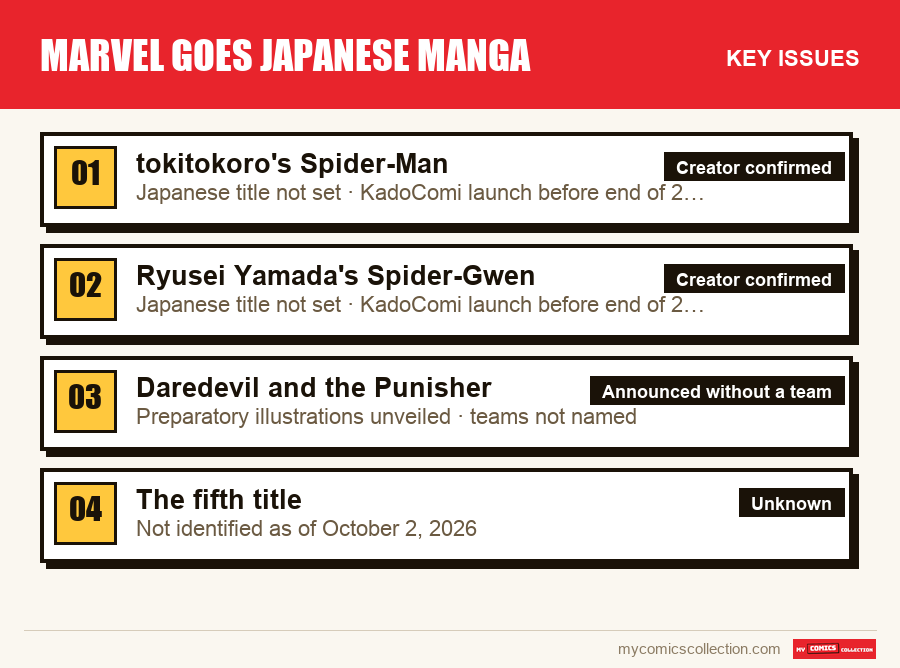
What was announced, word for word
Let us start with the exact scope, because the difference between what is established and what is assumed is considerable here.
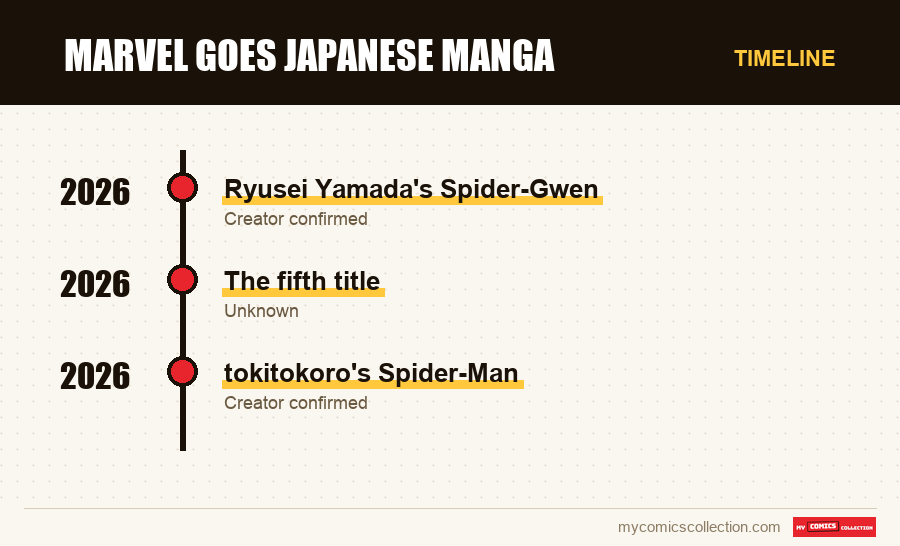
The program has five titles. Two are publicly attributed. The Spider-Man is the work of tokitokoro, a creator who has already collaborated with Marvel, and the hero is not Peter Parker: it is a Japanese high schooler, Haruto Hachidori, who gains spider powers in Shibuya. The Spider-Gwen is entrusted to Ryusei Yamada and follows a high-school Gwen Stacy who plays drums. The final Japanese titles have not been set.
Preparatory illustrations have also been shown for Daredevil and the Punisher, without the creative teams being named. The fifth title has not been identified. In other words, of five announced series, two have a known creator, two have a silhouette, and one has nothing at all.
Supervision falls to C.B. Cebulski, who left the editor-in-chief position at Marvel for a role devoted to Asian creations, held from Japan. Stephen Wacker replaces him at the head of the editorial team. This org-chart detail is not decorative: it indicates that this program is not a trial entrusted to a side department, but an activity with its own head, based on site.
The launch platform is KadoComi, Kadokawa's manga reading service, accessible free of charge and exclusively in Japanese. The launch is announced before the end of 2026. The program has also been described as set to yield five original volumes, which matches the usual outcome of a serialization on this type of platform, but no schedule for bound publication has been communicated.
And here is the point to remember above all: nothing has been said about any edition outside Japan. No English edition, so a fortiori no French edition. This is not a communication oversight that could be filled in with optimism, it is the state of the file.
On September 30, 2026, five titles ceased to exist
The most instructive part of this affair is not the announcement. It is what happened just before, and which nobody talks about, because it was not a novelty but a subtraction.
The previous arrangement entrusted Marvel's manga to Shueisha, by contract with Disney's Japanese subsidiary. That contract came to its term on September 30, 2026. In the days immediately before, between September 28 and 30, five titles from this collaboration were removed from digital stores. Not downgraded, not discounted, not transferred: removed.
Let us take the measure of what that means for someone who had bought these chapters. A reader who had paid for digital access to these series saw the catalog empty out in three days. Depending on each store's own terms, an already completed purchase sometimes remains viewable in the personal library, and sometimes does not, but in every case it is no longer possible to complete the series, nor to rebuy a lost chapter, nor to recommend the title to someone who would like to start. The series did not become scarce: it became inaccessible, which is not at all the same thing.
It is the cleanest demonstration you could wish for of a principle we keep repeating without always convincing: a license that expires can make an entire digital catalog disappear, whereas it has never made a single paper comic disappear from a shelf. A printed copy published under an expired agreement stays in its owner's collection. It keeps its place, its pagination, its condition, and the possibility of being resold. A chapter viewable under license has none of these properties. Our detailed comparison between digital reading and physical collecting develops the mechanics, and our guide on how to dematerialize a collection explains which precautions to take up again when you switch to formats with no physical medium.
The moral is not "digital is bad". Digital is often the only way to read certain things, and this program is the illustration. The moral is that you need to know what you are buying: a revocable right of access, not an object.
KadoComi, and why the platform changes the nature of the project
The choice of platform is not a technical detail. It conditions what this program can become for us.
KadoComi is the manga reading service operated by Kadokawa. Its model is free reading by chapters, with a mobile app and a website, and both its interface and its catalog are in Japanese. It serves as a launching pad for series which, when they find their audience, are then gathered in bound volumes. It is a classic circuit of Japanese publishing, and you need to understand it to anticipate what follows.
Three consequences follow directly.
The first is a question of unit of account. A serialization produces chapters, and a chapter is not an issue. It has no cover of its own, no cover price, no legal deposit date, no commercial code. A comics collector reasons in identifiable single issues, and that grid does not apply here. Our article on the classification of comics, European comics and manga details why these three families are not counted the same way.
The second is that the only collectible version of a title in this program will be the bound volume, if it comes out. Until then, there is no object. That means no first printing to watch for, no cover variant, no ratio to chase, and therefore no reason to rush.
The third concerns certification. There is nothing to submit for grading as long as there is no printed publication, and our pages on CGC grading recall this obvious point that is easily lost sight of in the enthusiasm of an announcement: you do not get a file graded.
The five titles, in the current state of information
Here is what is known, series by series, with the associated level of certainty. Anything not listed there has not been announced.
tokitokoro's Spider-Man
The hero is not Peter Parker but a Japanese high schooler, Haruto Hachidori, who gains spider powers in Shibuya. Illustrations were unveiled in late September 2026. It is therefore an original creation in a Japanese setting, and not the transposition of an existing story, which makes it a character first appearance in the strict sense.
Ryusei Yamada's Spider-Gwen
The series follows a high-school Gwen Stacy who plays drums. The choice of character is coherent: Gwen Stacy as Spider-Woman was born of a reality shift, she has always been a character designed to be reinterpreted, and her musical culture gives her a natural ground in the school manga register.
Daredevil and the Punisher
Two series are identified by their character, not by their creators. It is impossible, at this stage, to say whether the approach will here too be that of an original creation with new protagonists, or that of a rereading of the existing characters. Both figures lend themselves to it, and our knowledge of the program does not allow us to choose.
The fifth title
The program is presented as having five titles, and only four have been sketched. One slot therefore remains empty, to be filled by a later announcement. A major North American convention runs from October 8 to 11, 2026 and announcements are expected there, but as of this article's writing nothing has been said there yet.
Why a French-language edition is not on the agenda
The question every French-language reader asks is simple: when will we be able to read it? The honest answer is that we do not know, and it is worth understanding why.
A work like this stacks two layers of rights. There is the ownership of the characters, which belongs to Marvel. And there is the ownership of the derivative work, that is, of the story and the pages, which falls under the agreement concluded with the Japanese publisher and the creators. Any publication elsewhere therefore requires a second agreement, distinct from the one that permits Japanese publication, negotiated territory by territory or at least language by language.
In practice, the usual chain goes through English first. A Japanese title licensed by an American publisher very generally finds an English-language edition before finding one in French, because the market is wider and the character holder is at home there. Yet no English-language edition has been announced. We are therefore at least two steps before the first one that would concern us, and the first of those two steps has not even started.
Let us add a factor that works both ways: digital serialization precedes bound volumes. A French-language publisher interested in the title would very probably wait to see those volumes come out in Japan before deciding, because that is the unit it would publish. That pushes the horizon further away, but it also makes the decision more likely if the volumes sell.
Operational conclusion: the only reasonable thing to do today is to wait, keeping a written record. We do not recommend trying to get the Japanese edition. The site does not assume you read Japanese, and a collection built around a language you do not read is a collection of decorative objects, which is a legitimate choice but has nothing to do with reading and completing a series.
Keeping track of a series you do not own
Here is the concrete problem, and it is more common than you would think. Many collections include watched titles: announced series, awaited editions, hoped-for reprints. Poorly managed, these titles pollute lists and skew counters.
The classic mistake is to create an entry in your collection for a series that does not yet exist in your language, then leave it lying around. Six months later, you no longer know whether you own it, are waiting for it, or have given up on it. The missing-issue counter becomes wrong, and a wrong counter is no use anymore.
Separate watching from owning
An awaited series does not go into the inventory. It goes into a watch list, with a review date. It is the fundamental distinction detailed in our issue-by-issue tracking method: the inventory describes what is at your place, not what interests you.
Note the targeted edition, not the title
"tokitokoro's Spider-Man" is not enough. What interests you is a precise edition: a bound volume, in a given language, by a given publisher. The same story can exist in four editions of which only one suits you. Our article on how a foreign edition carries a different number shows how costly this confusion is in practice.
Fix the storage format in advance
A bound volume is not shelved like a single issue, is not protected with the same bag and is not stored in the same box. If your collection already hosts manga, the space is planned. If not, now is the time to think about it, and our guide to a mixed collection of comics, European comics and manga gives the standards by format.
Set the language of your tracking
If you follow editions in several languages, management quickly becomes unmanageable without a clear convention. Our guide to managing a collection across several countries and languages explains how to configure it once and for all.
Date your next check
A watch with no deadline is not a watch, it is an intention. Set a check date after the Japanese volumes are announced, and another if an English-language edition is announced. In between, there is nothing to do, and that is good news.
For the general mechanics of these lists, and notably how to keep them without spending your evenings on it, our collection app and our page devoted to the case of Japanese manga describe what the tool can do and, just as important, what it cannot do on this type of title.
What this program does not say about value
One last question must be addressed, because it inevitably comes up: will it gain value?
Nobody can say, and any quantified claim on the subject would be made up. What we can do, on the other hand, is recall the conditions under which a publication ends up mattering on the secondhand market, and note which are met here.
A first appearance matters when the character settles durably into a main continuity and becomes useful to adaptations. The Shibuya hero is an original creation, which is a point in his favor, but he is born in a separate setting. Nothing says he will be picked up elsewhere, and Marvel's parallel universes contain hundreds of creations that never left their point of origin.
An edition matters when it is both the first and hard to find again. Here, the first publication is digital and free, so neither scarce nor collectible, and the first printed publication will not be a first publication at all. It is exactly the configuration that produces pleasant objects with no tension on the secondhand market, a subject developed in our feature on manga as a collectible.
Finally, the hierarchy remains what it is. On Spider-Man as on Spider-Gwen, the issues that structure value are all old and all American, for reasons detailed in our comparison between original English version and French version: the world market references itself on the first worldwide publication, and an edition in a foreign language, however beautiful, sits in a different register.
The right way to approach this program is therefore to take it for what it is: a reading offer, designed for a Japanese readership, with creators worth following. If an edition in your language ends up coming out, you will buy it because you like the pages. If you want to know what your current collection really represents, our estimate and our list of missing comics are more useful than speculation on a title whose final name we do not even know.
Mistakes to avoid in the coming months
Four reflexes are going to appear, and none withstands scrutiny.
Believing a complete list of the five titles. Four have been sketched, one is unknown. An exhaustive list today is a partly invented list. The same reasoning holds for the final Japanese titles, which are not set.
Attributing an announcement to a convention that has not happened. The October 2026 convention runs from the 8th to the 11th. Anything presented as "announced" before that date comes from the publishers' communications, not from a panel.
Confusing the end of the Shueisha contract with a failure. A license contract reaches its term, that is its normal operation. What deserves attention is not the end of the agreement but the removal from digital catalogs that accompanied it, and the lesson it gives about the fragility of a library with no physical medium.
Opening an inventory line for an object that does not exist. It is the costliest in the long run, because it damages the data on which all your future decisions rest. A watched title is not an owned title, and our management method insists on this point for a reason: it is the mistake that comes up most often in poorly kept collections.