In 2026, My Comics Collection will manage a comic collection in seven languages: French, English, German, Dutch, Spanish, Italian and Portuguese. The interface switch is done in one click from the profile menu, the preference persists on all synchronized devices, and the internal catalog automatically translates the series titles and the names of writers when the local edition exists (Strange for Doctor Strange in VF Lug, Estraño in VE, L'Uomo Ragno for Spider-Man in VI). The rating sources follow the active language: eBay US and MyComicShop for English, leboncoin and eBay.fr for French, Catawiki Germany for German. A multi-country collector thus moves from one environment to another without losing a single number of his inventory.
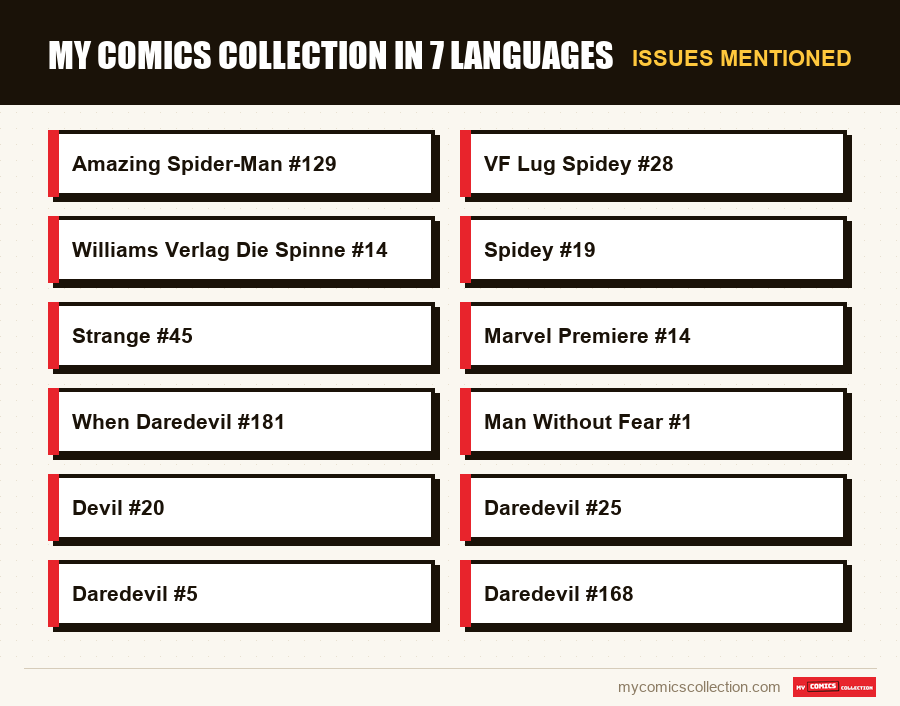
A serious collector rarely owns comics in just one language. The American VO of Amazing Spider-Man #129 coexists with the VF Lug Spidey #28, the German edition Williams Verlag Die Spinne #14, and sometimes the Dutch translation Juniorpress De Spektakulaire Spiderman. Cataloging this diversity in monolingual software requires painful compromises: title entered in English while the dust jacket bears a French title, writer registered under his Anglo-Saxon name while the cover credits a pseudonym, sales price compared to a single market while the issue is negotiated differently depending on the geographical area.
My Comics Collection (MCC) responds to this reality with seven interface languages, a self-translated catalog according to the active language, and rating sources aligned with the connected collector market. This guide details the operation of the multi-language MCC for 2026: the UI toggle, the persistence of preferences, the translation of the catalog, the routing of quote sources, and two practical cases of real use at a mixed VO+VF collector and at a multi-market seller.
The multi-country collector problem
The French comic book collector has never collected in just one language. From the 1970s, the arrival of the Lug editions (Strange, Spidey, Nova) raised the question of cohabitation between the original American issue and its French equivalent. The following generation multiplied the sources: Semic took over from Lug in 1989, Marvel France launched Top BDs in 1995, Panini France regained the rights in 1997, Urban Comics launched on the French DC in 2012. At the same time, the collector bought UK issues from specialized retailers in London, trade paperbacks from US sellers, German Panini DE editions, and Dutch hardcovers from local shops.
This diversity creates a cataloging headache. The same character has different names: Daredevil remains Daredevil in original version, Daredevil the man without fear at Lug, Devil in the classic Italian edition, Daredevil at Panini DE. The same title comes in variations: Amazing Spider-Man #129 was released on November 7, 1973 by Marvel US, appeared partially in Spidey #19 in 1980 by Lug, was translated in full in Spider-Man Magazine no. 2 by Marvel France in 1997, and reappears in Marvel Masterworks Amazing Spider-Man volume 14 in original version in 2012.
Without multi-language software, the collector chooses: either he catalogs everything in English and loses the nuance of the local editions, or he catalogs in French and misses the reference VO, or he cobbles together an illegible mixture which mixes Strange #45 and Marvel Premiere #14 without a clear hierarchy. The issue is not cosmetic. For import US comics into France ou export abroad, customs declarations require a title consistent with the language of the physical edition. To sell on eBay.de or .uk, the listing must use the local title recognized by German or British buyers.
The 7 languages MCC 2026
In 2026, MCC will offer seven interface languages, chosen to cover the main markets for translated American comics: French, English, German, Dutch, Spanish, Italian, Portuguese. Each language was added in response to a concrete request from collecting users, not as a cosmetic layer. The details of the choices deserve comment.
Le French is the historical language of the product, designed from the outset for French-speaking users (France, French-speaking Belgium, French-speaking Switzerland, Quebec, French-speaking Maghreb). The vocabulary follows market habits: we talk about complete stories, volumes, special editions, limited variants, soft copies, hardbacks. French publishers (Lug, Semic, Marvel France, Panini France, Urban Comics, Delcourt, Glénat, Hi Comics, Bliss) are natively recognized in the catalog.
L'English is the reference language of the global market. It covers the United States, United Kingdom, Australia, English-speaking Canada, Ireland, and is the default language for communication between international collectors. Publishers Marvel, DC, Image, Dark Horse, IDW, Boom! Studios are processed natively, and the vocabulary uses US market terms (key issue, run, omnibus, hardcover, trade paperback, single issue, slabbed).
L'German opens use to Germany, Austria and German-speaking Switzerland. The German translated comics market is dominated by Panini Verlag (Stuttgart), Cross Cult and Splitter, which publish hardcover and softcover series such as Spider-Man, Batman, The Walking Dead. The German technical vocabulary distinguishes Sammelband (complete), Sonderband (special issue), Variant Cover, Erstausgabe (first edition). The German collector connected to MCC in German sees his catalog displayed with local titles: Spider-Man becomes Die Spinne for the pre-1979 Williams editions, then Spider-Man for the Condor and Panini editions.
Le Dutch covers the Netherlands and Belgian Flanders. Dutch publishing of American comics has a short but rich history: Juniorpress in the 1980s, Z-Press in the 1990s, and more recently Standaard Uitgeverij for modern reissues. Local vocabulary uses stripverhaal, hardcover, paperback, eerste druk. The Dutch language also serves as a bridge for Flemish collectors who juggle between Dutch and French editions.
L'Spanish covers Spain, Mexico, Argentina, Chile, and more broadly the global Spanish-speaking market. Panini España dominates distribution in Spain, ECC Ediciones handles the DC catalog, and several Latin American publishers reissue locally. The vocabulary uses grapa for soft, tomo for hardback, limited edition for limited editions. The translation of the titles follows local usage: Spider-Man becomes El Hombre Araña in Argentina then Spider-Man in modern Panini ES reissues.
L'Italian covers a strong historical market. Panini Comics Italy has been the dominant publisher since the takeover of Marvel Italia in 1995, and the local vocabulary uses albo (soft issue), cartonato (hardback), variant cover, prima edizione. The traditional Italian titles persist in the catalog: L'Uomo Ragno for Spider-Man until 2012, Devil for Daredevil until 2010, then gradually shifts towards VO titles.
Le Portuguese covers Portugal and Brazil, two markets with different practices. In Brazil, Panini Comics Brasil and the historic publisher Abril Jovem dominate the catalog, with a specific vocabulary (revista, encadernado, edição especial). In Portugal, the market is more limited but active via the Devir and Goody editions. The Portuguese language in MCC serves both variants with a pt-BR or pt-PT vocabulary switch depending on user preference.
One-click UI toggle and persistence
The interface toggle is designed to be instantaneous. The collector opens the profile menu at the top right, selects the target language from the drop-down list, and the interface switches without page reloading. The operation takes less than a second on an average residential connection, and remains seamless on mobile, in the MCC iPhone and iPad app as in a phone's browser.
The mechanism is based on three technical layers. The UI layer loads interface labels (buttons, menus, form labels) from a local translation file cached on first load, eliminating network latency. The data layer dynamically translates the catalog fields (series titles, writer names, editorial descriptions) via a call to the MCC reference base, which contains the equivalences for the seven languages. The rating layer redirects valuation requests to sources geographically consistent with the active language.
Language preference persistence is managed at the account level, not the browser level. When a collector chooses German on their PC in Munich, their preference is synchronized to their phone in Berlin and their iPad in Vienna. The active language at the time of connection corresponds to the last chosen language, regardless of the device. This logic avoids the trap of scattered preferences and ensures a consistent experience between sessions. The same logic applies to users who travel: a French collector traveling to Madrid keeps his interface in French without automatic switching to Spanish, unless he explicitly chooses to switch to adopt the local context.
The UI toggle comes with an advanced option for multilingual users. A French collector who catalogs mainly in French but who wants to consult English price sources can activate a mixed mode: interface in French, price sources weighted towards the American market. This finesse responds to the real case of a VO collector residing in France who follows the ComicConnect and Heritage auctions in USD while working on his inventory in French. The logic is detailed in the pillar comics manager.
Self-translated catalog (titles and writers)
Catalog translation is the feature that sets MCC apart from a simple interface switch. When a collector switches the UI to Italian, his 1850 cataloged comics do not remain displayed in English: the titles, names of writers and descriptions also switch to the active language, according to the equivalences recorded in the reference catalog.
The mechanism is based on a base of editorial equivalences built from official documentary sources: ISBN, EAN barcodes, publisher catalog files, national library. Each comic issue has a master file linked to its recognized translations in the seven languages. When Daredevil #181 was released in original version in April 1982, its master file referred to Daredevil the Man Without Fear #1 at Marvel France (1995), Devil #20 at Marvel Italia (1983), Daredevil #25 at Panini Deutschland (2001), and Daredevil #5 at Panini España (2006). When the user catalogs a number and switches its interface language, the system displays the title corresponding to the target language.
The names of writers and cartoonists follow a similar logic. Frank Miller remains Frank Miller in all languages, but Klaus Janson is credited as Klaus Janson in French, German and Dutch, and Klaus Janson in all other languages, because his name is unique. The distinction becomes more relevant for historical pseudonyms: Jean Frisano signs some Lug covers under his real name, and Stan Lee is credited Stan Leeber in some early German reprints. The catalog preserves these variants, which helps identify the exact version of an issue.
Translating editorial descriptions is more difficult. MCC does not automatically translate story summaries (that would be imprecise and legally questionable), but displays official descriptions published by the local publisher when they exist. For a Lug issue, the description written at the time by the Lug editorial team appears. For a Panini DE number, the German Panini description is displayed. When no local description exists, the catalog keeps the original English description rather than producing a dubious machine translation.
Numerical example: A collection of 2,100 cataloged issues covering Spider-Man, Daredevil and X-Men averages 1,380 issues with recognized equivalence in at least one European language. For others, the system retains the VO title while awaiting enrichment of the catalog or manual entry by the user.
Rating sources by market
Promoting a multi-language collection requires crossing several markets. A VO comic is trading on eBay.com, specialized retailers, ComicConnect, Heritage Auctions. A VF comic is sold on leboncoin, eBay.fr, Vinted, BDovore, Catawiki. A German comic is circulating on eBay.de, Catawiki Germany, Comicshop.de. Aligning the rating sources with the collector's active language avoids comparing a Strange Lug No. 45 to a US price, which makes no commercial sense.
MCC routes rating requests according to the interface language, with priority logic by market. For the French language, the main sources are eBay.fr, leboncoin, Vinted and BDovore, supplemented by Catawiki France sales for quality pieces. For English, the main sources are eBay.com, specialized retailers and ComicConnect for high-end auctions, as detailed inthe specialized retailers comparison. For German, eBay.de and Catawiki Germany are the references.
The system is not limited to a change of source site. The price displayed takes into account the specificities of the market: a raw Amazing Spider-Man #129 in average condition is worth 180 to 250 USD on eBay.com, or approximately 165 to 230 EUR at the June 2026 rate, but the same issue sold directly in France via leboncoin often trades between 140 and 200 EUR, due to the scarcity of local demand. The French collector connected to MCC in French sees the valuation weighted towards the French market, which corresponds to the realistic local resale rating.
For export sales, the comparison between markets is yours to make: a collector hesitating between selling his Daredevil #168 raw on eBay.fr (French buyer, EUR payment) or on eBay.com (US buyer, USD payment, shipping costs and customs risk) should set the estimated price on each market against the typical shipping costs, the platform commission and the resulting net income. This calculation helps to arbitrate between simplicity (local sale in FR) and gross added value (US export sale, sometimes 30 to 50% higher before costs), as analyzed in the Midtown Comics file delivery France applied in the other direction.
Collecting this series?
Track what you own, what you are missing and what your collection is worth. 7 day trial.
Start my trial →Practical case: mixed VO+VF collection
The most common case in France is the mixed VO+VF collector. He started young with the Strange Lug and Nova Lug bought at the newsagent, discovered the Marvel Knights Daredevil Panini France at 16, then moved towards the American original version at 25 by ordering his single issues from specialized retailers. At 40 years old, his inventory mixes 700 Lug and Semic issues (1974-1996), 350 Marvel France and Panini France issues (1997-2015), 500 VO single issues Marvel and DC issues (2010-2026), 80 Absolute Urban Comics hardcovers (DC France), and 60 English Image Comics trade paperbacks ordered from Forbidden Planet UK.
Cataloged in monolingual software, this inventory poses immediate problems. The Strange Lugs appear under approximate titles (Daredevil mixed with Marvel Premiere according to the summaries), the Panini France use the reference VO titles without preserving the French editorial identity, and the valuation mixes everything in a single currency without taking into account the real markets.
With MCC in French mode, the catalog displays the original Lug titles (Strange #45 and not Daredevil #97), recognizes the Panini France under their local title, and crosses the valuations between the French market for vintage issues and the American market for modern VOs. The collector finds his inventory in the terms that accompanied it, without renouncing the international rating of his VO pieces.
Mixed mode is particularly useful here. The user can activate an English secondary view to compare their Panini Marvel Knights Daredevil VF with their VO Marvel Knights equivalents, which helps spot missing variants or parallel editions. This double reading sheds light on the trade-offs: should we sell the Panini VF to buy back the VO omnibus, or keep both as witnesses to the original French edition? The decision depends on the collector's strategy, and MCC provides the figures to decide. For a long-term conservation strategy, the pillar collector France details typical trade-offs.
Practical case: multi-market seller
The second case concerns the multi-market seller. A collector who regularly resells his duplicates and coins that he no longer wishes to keep benefits from posting his ads on several marketplaces in parallel. An ad in French on leboncoin, eBay.fr and Vinted reaches the French-speaking market. An English ad on eBay.com and MyComicShop reaches the American and British market. A German-language ad on eBay.de hits the German market.
Without multi-language software, writing three different ads for the same comic takes time: writing in French, translating into English, translating into German, checking the consistency of the titles, adjusting prices according to the markets. With MCC, the seller generates from their comic file an ad description in the target language, which automatically includes the local title, the name of the local publisher, and the corresponding market valuation. The time saving is measurable: approximately 8 to 12 minutes saved per ad, and 25 minutes saved on a broadcast to three markets.
The function includes an ad export module for common platforms. For leboncoin, the export generates a text in French with the original Lug or Panini title, the short description, the declared condition and the price in EUR. For eBay.com, the export switches to English with original title, description in US terms (FN, VF, VF/NM), price in USD. For eBay.de, the export switches to German with title Panini Verlag, description in local terms. These exports can be copied and pasted into the ad form, which eliminates manual re-entry.
The multi-market seller must also manage administrative constraints. Selling to the European Union involves intra-community VAT and declaration of thresholds. Selling to the United States involves commercial invoice, US customs declaration, and sometimes HS Code tariff harmonization. MCC does not replace an accountant but displays for each projected sale the applicable reporting thresholds, as recalled in the France 2026 export guide. This convenient assistance avoids surprises when it comes time to ship.
Figured case: A French seller who resells 60 issues per year on three markets (FR, US, DE) saves around 15 hours of ad writing over the year, and increases his turnover by 18 to 25% thanks to optimal market weighting compared to a French single-market distribution.
Reco language by strategy: collection or sale
The choice of main language depends on the collector's strategy. For a heritage collection intended to remain in France and possibly be passed on to French-speaking children, the French language is the obvious basis, with a one-off mixed mode for one-off export sales. For an investment oriented collection, followed in international markets with potential sales to the US and UK, English becomes the primary language, with French serving as a secondary layer for vintage French pieces.
For a German-speaking collector residing in France (common case in the East and the Paris region), German can be the main language of the MCC account, with French as a secondary language for French pieces. The logic applies symmetrically for a Dutch person living in Belgium, an Italian in Lyon, or a Spaniard in Bordeaux. The multi-language MCC serves those cross-border situations where the collector's native language does not coincide with their country of residence.
The professional or semi-professional seller generally adopts the opposite strategy of the heritage collector: he chooses the language of his main sales market, not that of his personal comfort. A French reseller who generates 70% of his turnover on the US market works his catalog in English, even if he is French-speaking. This discipline avoids entry errors that impact ad conversion.
A third situation concerns the collectors club or the multi-market dealer. A French comic shop that sells in physical stores (FR customers), on eBay.fr (FR customers), on eBay.com (US customers) and via its multilingual e-commerce site (EU customers) has an interest in maintaining a reference catalog in English (technical language) with translation layers that can be activated for customer communication. MCC serves this case via linguistic exports and the VO baseline maintained in parallel with translations, as indicated in the pillar Marvel universe terminology side.
For those who are starting out and are hesitant, the pragmatic advice is simple: start with the native language, take the time to master the tool, then activate mixed mode or change the main language depending on the evolution of the strategy. The catalog is preserved without loss when changing language: only the display switches. No risk, therefore, of testing several configurations before making your choice. A free trial is offered to assess the relevance of multi-languages on your own collection, as mentioned in free estimate before subscription.
Test multi-language on your collection
Seven interface languages, self-translated catalog, market rating sources: 7-day free trial.
Start free trial, 7 daysNo obligation, cancellation at any time, immediate access
FAQs
Can I change language without losing my catalog?
Yes, the language toggle is purely a display change. The internal catalog remains identical: comic sheets, images, purchase prices, acquisition dates, personal notes are never modified by a change of language. Only displayed titles, writer names and interface labels switch. You can test each language without risk to your data.
Do rating sources automatically follow the active language?
Yes, routing is automatic. In French, the ratings displayed prioritize eBay.fr, leboncoin and Vinted. In English, eBay.com and specialized retailers. In German, eBay.de and Catawiki Germany. A mixed mode allows a French collector to keep the interface in French while weighting the ratings towards the American market, useful for export sellers and VO investors.
Does the self-translated catalog cover the Strange Lug and Nova Lug?
Yes, the Lug, Semic, Marvel France, Panini France, Urban Comics, Delcourt, Glénat, Hi Comics and Bliss editions are natively recognized in the reference catalog. A Strange #45 displays its title Lug in French mode, and switches to Daredevil #97 (VO Marvel US equivalent) in English mode. The mapping is documented and correctable by the user in the event of imprecise equivalence.
How do I generate an eBay ad in German from my French catalog?
From the comic sheet, the ad export button offers the available target languages. Select German to generate a German language description with Panini Verlag title, local terminology (Sammelband, Sonderband, Erstausgabe), and estimated price in EUR for the German market. The text can be copied and pasted into the eBay.de form, without manual re-entry.
What happens if a title doesn't have a translated equivalent?
The catalog retains the original VO title when no local equivalence exists. For example, a recent Image Comics trade paperback never translated into French remains displayed under its English title even in French UI mode. The user can manually enter a personal translation if necessary, which will be kept in their private catalog without changing the shared baseline.