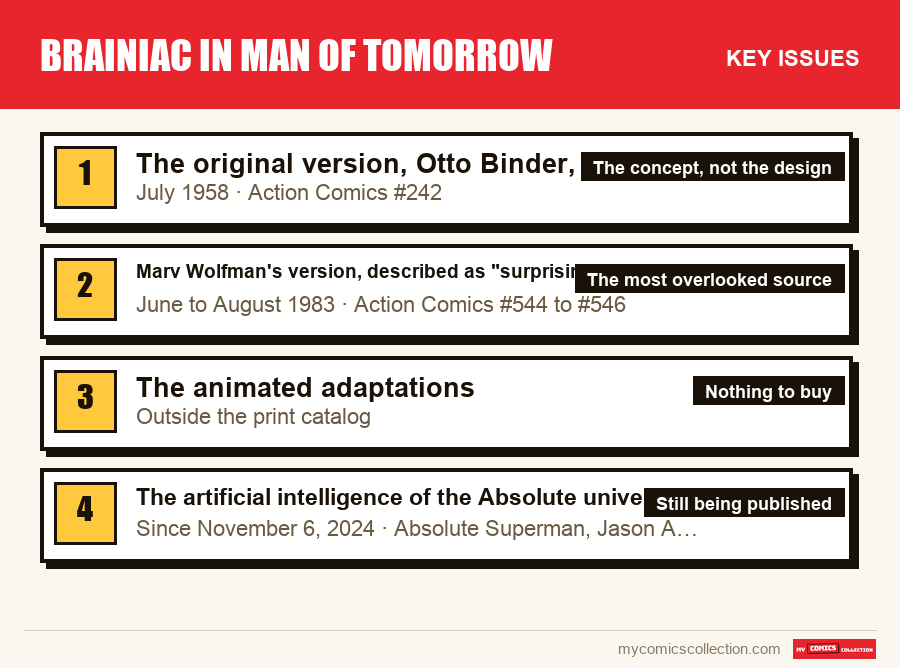
Man of Tomorrow, written and directed by James Gunn, comes out on July 9, 2027 and makes Brainiac its main antagonist, played by German actor Lars Eidinger, cast in late December 2025 after an international search. The film does not draw on a single incarnation: Gunn has publicly named four sources, the original version by Otto Binder in the 1950s, the one by Marv Wolfman in the early 1980s, the animated adaptations, and the artificial intelligence of the Absolute universe. It is this list, and not a list of first appearances, that tells which periods of the catalog the film will put back in the spotlight. For the character's own key issues, see our dedicated selection: this article deals with the adaptation and what it shifts.
A casting announcement changes nothing about a comic book. It changes what people will go looking for, and in what order. Between the moment a studio names an actor and the moment the film comes out, eighteen months go by here, during which the only usable information is not a price guide but a list of references: the ones the director claims. When these references are public and named, they are worth more than any price forecast, because they point to specific, dated, identifiable issues, and those issues are not always the ones you expect.
It is October 2, 2026. Filming is finished, the movie is in post-production, no trailer has been released, and no official image of the character has circulated. Everything that follows therefore rests on production facts, dated statements and a survey of the publishing catalog. Nothing else. Anyone who tells you today what a given issue will be worth in July 2027 is making it up.
What is established about the film's Brainiac, and nothing more
The project was announced in September 2025 through three drawings published simultaneously by Gunn, David Corenswet and Nicholas Hoult, signed by Jim Lee, Jorge Jiménez and Mitch Gerads, with the title and the release date. Gunn specified from that moment that the film would be "as much a film about Lex as a film about Superman", with the two characters working together against a larger threat. In late September 2025, he published the cover of his second script draft: an anatomical plate of a brain. The public identified the villain several weeks before the official announcement.
Brainiac was then confirmed as the main antagonist, and Lars Eidinger was cast in late December 2025 after an international search from which he emerged as the favorite. The actor described an audition filmed remotely, then an in-person session in Atlanta, a three-dimensional body scan and two hours of makeup and mask tests. Filming began on April 20, 2026 under the working title Exodus, mainly at Trilith Studios in Georgia, with sequences in Cincinnati, and wrapped in August 2026.
The character sheet released is remarkably sober: a highly intelligent extraterrestrial android, originating from the planet Colu. Two words that already settle a sixty-year-old debate, since the 1958 Brainiac was neither an android nor a Coluan, those two attributes coming from a later rewrite. The film therefore keeps the retroactive foundation rather than the very first version, while claiming inspiration from the latter. This is not a contradiction: it is exactly the way the character was built, by accumulation, as detailed in our analysis of his successive origins.
Two statements complete the picture, and they are the only ones that say anything about tone. Eidinger described his character as "the embodiment of Satan" combined with the Shakespearean jester, in contrast with a Superman whom he places on the side of the Nietzschean superman. Gunn, for his part, summarized the opposition differently: what intelligence becomes when it loses all connection to humanity. Neither of these sentences describes a plot. Both describe a reading of the character, and that reading has precise antecedents in the catalog.
The four sources the director named
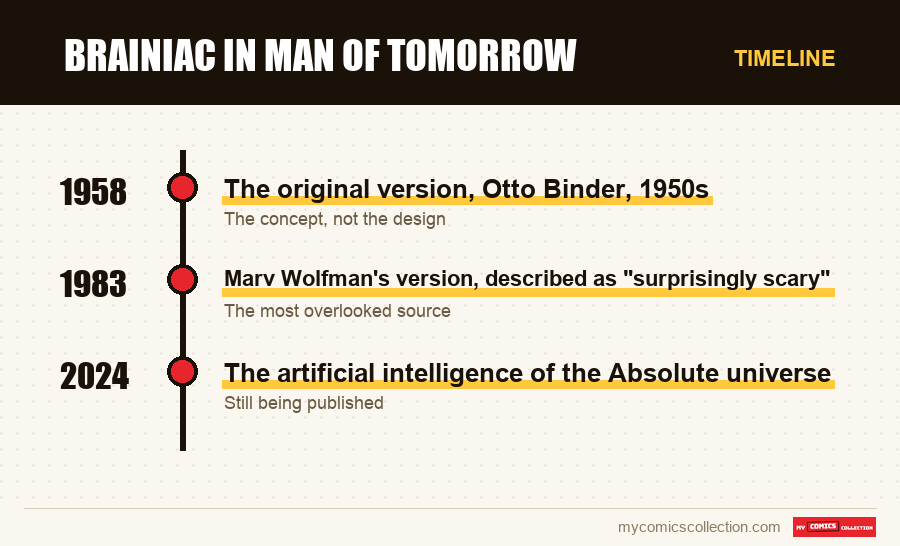
Questioned in December 2025 then in February 2026, Gunn said he had read nearly all the stories featuring Brainiac, and had kept what seemed to him to work in several incarnations. He named four anchor points. It is rare, it is dated, and it is actionable.
The original version, Otto Binder, 1950s
Gunn cites Binder, not the artwork. The nuance matters: what is taken from 1958 is the idea of the collector of civilizations, the one who takes entire cities and preserves them, and who treats an inhabited planet as a specimen. The look of this first version, for its part, barely survived the character. The film therefore takes up the character's oldest narrative engine, and it is the only one of its four sources that belongs to the Silver Age market.
Marv Wolfman's version, described as "surprisingly scary"
This is the most interesting citation, because it is the least sought-after period of the character. In 1983, DC overhauled several elements of the Superman universe: Wolfman on script and Gil Kane on art reinvented Brainiac in the story "Rebirth", with a look designed by Ed Hannigan. The result is a frankly robotic body, a skull face, an iridescent honeycomb-patterned cranium, and a skull-shaped ship extended by tentacles, which readers nicknamed the skull-ship.
The animated adaptations
Gunn mentions animation without naming a series. It is the only one of his four sources that points to no issue. It matters because it is often through animation that an audience discovers a character, and it fixes a voice and a silhouette in the shared imagination. But it creates no collectible: an animation citation never converts into an issue to hunt for.
The artificial intelligence of the Absolute universe
Gunn describes this version as frankly sinister and successful, and it is the only one of his four sources that you can still follow in real time. In this parallel continuity, Brainiac is no longer a single individual but a cog in an immense collective: he was first a rank-zero executor, with a six-digit serial number, assigned to the task of disposing of the corpses of his own kind, who went mad from isolation before proclaiming himself the one and only Brainiac and setting off to bottle cities.
Action Comics #544, the issue that two elements of the film trace back to the same place
Here is the most concrete point of this file, and it comes down to a coincidence of publishing calendar forty-three years old.
Wolfman's overhaul of Brainiac appears in Action Comics #544, dated June 1983. Yet this same issue contains a second event: Lex Luthor puts on his battle armor for the first time, drawn by George Pérez, in the story "Luthor Unleashed", which continues in Superman #385 and #386 until August 1983. This armor had actually been designed at first for a line of early-1980s action figures before entering the comics.
And it is this armor that Man of Tomorrow brings to the screen for the first time in live action. A workable version was built to be actually worn during filming, by Judianna Makovsky on costumes and the Legacy Effects workshop, with a green tone more pronounced than the purple. Commentators have noted its fidelity to the paper model.
In other words: the two visual elements the film takes from the catalog, Luthor's armor and a reading of Brainiac claimed as scary, both originate in one and the same issue, a 1983 issue of Action Comics that appears in no usual selection of the character's key issues, not even ours. There is no promise of value here: the 1983 print runs are high, the secondary market is full of them, and our examination of the catalog trough of this period shows how little these years are in demand. But for anyone who wants to read what the film read, it is the cheapest address in the file.
Close the 1983 arc in full
Three issues, two different titles: Action Comics #544 for the pivot, then Superman #385 and #386 for the immediate continuation of the Luthor side. An arc split across two series is easily lost when you buy as you go.
Read the Absolute universe in collected editions, not single issues
The first volume covers issues 1 to 6 and came out on August 19, 2025, the second covers issues 7 to 14 and came out on March 3, 2026, the third covers issues 15 to 21 and is announced for November 3, 2026. The current arc is not yet closed.
Do not touch the Silver Age on a rumor
The only old issue actually pointed to by the director's statements is the character's first appearance, and it is also the most expensive and the hardest to preserve. A purchase at this level is decided on verified condition, not on a movie release date.
Record your acquisitions as you go
An adaptation file spreads purchases over more than a year. Without an inventory, duplicates and gaps always show up in the same place: in the middle of an arc. Our collection tracking app is made for exactly this.
What the film does not adapt, and why that is information
An adaptation file is also judged by its denials. There is one, and it is explicit.
When it was reported in April 2026 that Adria Arjona had been cast, after a series of auditions in Atlanta against three other finalists, several commentators pointed to the role of Maxima, warrior queen of the planet Almerac who first appeared in Action Comics #645 of September 1989, created by Roger Stern and George Pérez. This role was never officially confirmed, and specialist press reports still diverge on this point.
This hypothesis fed a second speculation: the adaptation of the story "Panic in the Sky", published in early 1992 across the Superman titles, in which Brainiac takes control of the planetary fortress Warworld and allies with none other than Maxima before she betrays him. Asked about it, Gunn answered that he had not specifically drawn on it. The denial is dated February 2026, and it concerns the point most picked up by commentators.
Three other absences close off reading paths rather than open them. The official sheet mentions neither the human host who carried the character in the continuity of the 1980s and 1990s, nor the heroic thirtieth-century descendant whose name differs by only one digit, and whom our file on this namesake shows to durably muddy searches. And no public element ties the film to the great Kryptonian saga of the late 2000s.
What an actor announcement actually does to demand
Let us be direct: no numerical price guide is published for this character over the recent period, and we will not make one up. What is observable, however, are mechanisms, and they repeat from one adaptation file to the next.
The first is a funnel effect. An announcement does not wake up an entire catalog: it concentrates attention on two or three issues, almost always the same ones, the first appearance and the issue that carries the look shown on screen. The rest of the corpus does not move. That is why a 1983 reading cited by a director does not mechanically move the 1983 issues: the public still has to be able to connect them to what it sees.
The second is a calendar effect: demand does not rise in a straight line, it reacts to images and not to press releases. The first trailer, which does not yet exist as of October 2, 2026, will therefore matter more than the December 2025 announcement, because it will finally show the makeup and the mask.
The third is a substitution effect, and it is the costliest for a hurried buyer. On a highly sought-after old issue, the uncertified supply empties of its subject and fills with substitutes: reprints announced as such, bound collected editions, foreign editions, blank covers. Our survey of this phenomenon on the 1958 issue gives the figures, and it is exactly the type of trap set when a release approaches.
Practical conclusion: an actor announcement guarantees only that competition on two or three references will intensify. Not a rise, nor its duration, nor its survival once the film is out. For the real hierarchy of the character's market value, independent of any film, our file on the value of his comics remains the reference.
What to watch between now and July 2027
Here are the dated milestones that will tell us something, in order of arrival.
The New York convention, October 8 to 11, 2026. The panels are scheduled but nothing had been said there yet at the time of writing. It is the first credible window for an official image or an editorial clarification. To follow, then, without inferring anything in advance.
The end of the Absolute Superman cycle. Issue 24 comes out on October 7, 2026, and issue 25 on November 4, 2026, announced as a conclusion opening a new era for Jason Aaron's series. Since this is the version the director cited in so many words, how this arc closes is the editorial signal most directly tied to the film.
The Luthor side. The 1983 armor makes its live-action debut, and DC continues in parallel its origin story devoted to the character, whose sequel is scheduled in Action Comics #1105 on December 9, 2026. The link is not causal, but the two calendars answer each other: the Lex Luthor character page centralizes what relates to it.
The first trailer. This is the real trigger. It will fix the look chosen, therefore the issue the public will attach to the character, therefore the address actually sought. Until then, any ranking of issues proposed in the film's name is a hypothesis.
One last remark on method: this file was written without any image of the character, and that is what makes it readable. The four sources named by the director are stable, dated information, whereas an image triggers within hours a noise that nobody untangles. Reading now what the film read costs the price of three 1980s issues and a collected edition. On the comics side, the Superman character page and the Brainiac character page group the available references.