Brainiac's origin does not exist in the singular. It has been told, then retold, then added to several times over four decades, and each new version has piled on the previous ones without erasing them. The ad survey carried out on August 29, 2026 shows this in a very concrete way: a search for the origin of the character brings back forty-six seller proposals, and these cover at least 1979, 1994 and 2008. Three different decades answer the same question. None of these forty-six announcements concerns a certified copy. The amounts requested that day ranged from $1.00 to $299.21, with a midpoint at $18.27: prices claimed by sellers, never recorded transactions.
When a reader searches for “the origin of Brainiac,” they unknowingly formulate a poorly posed question. It supposes that there is a founding booklet, a reference text to which everything else is linked, just as there would be a birth certificate in a register. On a character who appeared several editorial generations ago, this assumption falls. What the research returns is not a document but a stack: several distinct stories, produced decades apart, each claiming to explain where the antagonist comes from, what he really is, and what link attaches him to Superman's home world. These stories cannot replace each other. They coexist.
This is exactly what the count of August 29, 2026 shows. Out of forty-six announcements responding to this thematic research, the proposals are distributed over issues from 1979, 1994 and 2008 at least. A seller who posts a 1979 booklet online describing it as dealing with the origin of the character is not wrong. Anyone who does the same thing with a 2008 booklet is not wrong either. Both are true at the same time, and this is precisely what the uninitiated reader cannot guess from a results page.
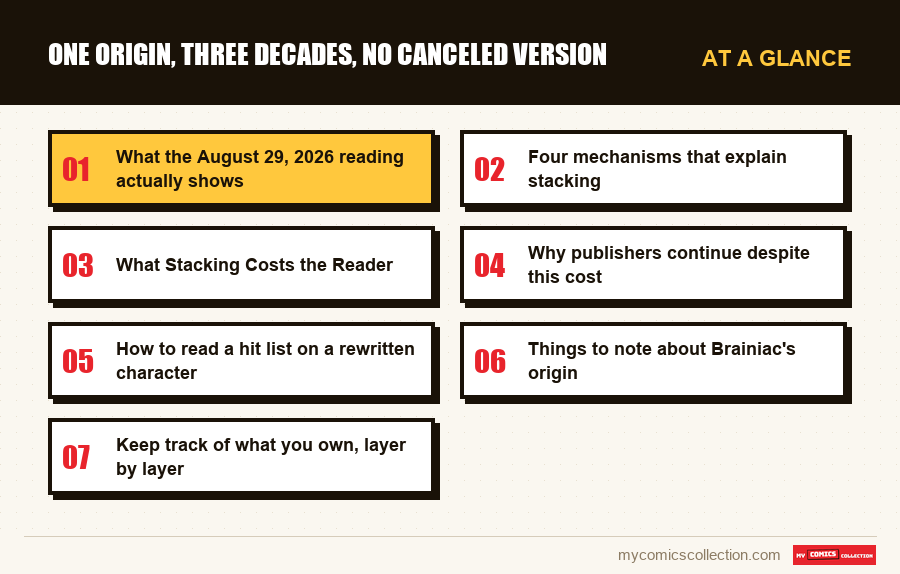
What the August 29, 2026 reading actually shows
Forty-six announcements are not many. This is not a sample on which we can build a numerical demonstration, and this must be said immediately to avoid the most frequent misinterpretation. The midpoint observed that day, $18.27, proves nothing about the value of the character or any trend. The highest amount of the lot, $299.21, says nothing other than the ambition of a private seller: no one paid this amount, it appears on a file, period. The difference between $1.00 and $299.21 mainly reflects the heterogeneity of what sellers classify under this search, not a scale of rarity.
What is exploitable, on the other hand, is the composition of the result. A list of forty-six offerings with vintages spanning 1979, 1994 and 2008 tells something that neither the price nor the volume would tell: the question "where does Brainiac come from" received editorial answers at three very distant points in time, and these answers circulate today side by side on the same second-hand market, indexed under the same title. Superposition is not an analytical hypothesis. It is visible in the results list itself.
Four mechanisms that explain stacking
Add costs less than cancel
A creative team that takes on an old antagonist inherits recognition capital. Removing it to start from scratch would mean throwing away this capital. Adding a layer of explanation, on the other hand, allows us to keep the name, the silhouette and the symbolic charge while establishing a new reading. This is the most economical calculation, and that is why it is repeated.
Each era demands its own plausibility
What seemed credible as an explanation at the end of the 1970s is no longer so twenty years later, and even less so thirty years later. Rewriting the origin means bringing the character back into line with the expectations of the moment: what seems threatening, what seems modern, what seems scientifically acceptable for the existing readership.
Formal annulment is rarely pronounced
A publisher can publish a version that contradicts the previous one without ever declaring that the previous one is no longer valid. Both texts remain in circulation, reprinted, resold, cited. The reader is therefore faced with incompatible assertions, none of which has been officially withdrawn.
The relationship with the hero's home world is the point of tension
It is on this precise link, what the antagonist has to do with the planet from which Superman comes, that the versions diverge most visibly. Redefining this relationship means redefining the entire character, which makes it the most used and most contested rewriting lever.
These four mechanisms reinforce each other. Because adding costs less, we add. Because each era has its demands, we often add. Because the cancellation is almost never pronounced, what has been added remains. And because the point of divergence concerns what defines the character, the layers are not mutually compatible details but rival propositions. After four decades, the result is not an enriched biography: it is a contradictory file.
None of the forty-six announcements noted on August 29, 2026 concerned a copy that had passed certification. Zero out of forty-six. This is an unusual figure and it deserves to be read correctly.
This does not mean that these fascicles would be without interest. It means that the market does not treat them as objects to be preserved under shell. A point of origin that no one has certified is a point of origin whose importance is debated: if the community agreed on a single founding booklet, this booklet would mechanically go back to the preservation circuits. Here, the total absence of certification is consistent with the dispersion of versions.
What Stacking Costs the Reader
Aucune porte d'entrée fiable
There is no short answer to “where do I start”. Each possible recommendation is defensible and contestable, because it favors one stratum to the detriment of others. The reader who asks for advice receives three different answers from three equally competent interlocutors.
Documentation that is out of date
A guide written after one rewrite becomes partially wrong the next time it is rewritten. The online articles, factsheets and summaries are from different layers and no one is updating them. The reader consults sources which, without saying so, describe different states of the character.
Sales wordings that all look the same
Of the forty-six propositions from August 29, 2026, the descriptions converge towards the same original vocabulary even though they refer to distinct decades. The title of the announcement does not allow us to decide: we have to look at the year.
Redundant purchases without knowing it
Believing to complete a missing piece, a collector actually buys a second version of the same narrative moment. The redundancy only appears upon reading, once the booklet has been received and put away.
Numbering that doesn't help
The numbering marks do not read from one period to the next. A low number does not indicate a beginning, and two issues thirty years apart can carry visually close markers without any connection of continuity.
The impossibility of saying « lis ça »
The simplest service an experienced reader can perform-pointing out a single text to a beginner-becomes impractical. Any recommendation must come with a warning about what it leaves out, which discourages most newcomers.
Collecting this series?
Track what you own, what you are missing and what your collection is worth. 7 day trial.
Start my trial →Why publishers continue despite this cost
It would be comfortable to conclude that piling is negligence. This is not the case: it is a rational decision, taken and revisited for reasons that hold. Creating a new antagonist requires making him exist in the public's mind, a long, uncertain and costly operation. Resuming an installed antagonist allows you to skip this step. Recognition has been achieved, all that remains is to adjust what has aged. Rewriting an origin is therefore, from an editorial point of view, an operation of renovation, not construction.
Added to this is a compatibility constraint. A character must be able to be used by the authors in place, within the narrative framework of the moment. If its starting point renders it unusable: because the premises no longer work, because they conflict with more recent developments, because they assume a bygone state of the publishing world: the least destructive solution is to restate that starting point. Not to deny it, but to make it exploitable again.
Finally, there is a direct commercial benefit to publishing a story presented as illuminating the origins. This type of proposition attracts occasional readers, those who do not follow the monthly publication but who want to understand. A rewritten origin is a loss leader. She promises to explain everything, which is precisely what someone who is reluctant to enter is looking for. That the promise has already been kept three times before does not diminish its effectiveness, since each new generation of readers discovers it for the first time.
What the publisher externalizes in doing so is the cost of reconciliation. He does not assume it: he transfers it to the reader, to the sellers, to the guide editors and to the people who keep catalogs. The count of August 29, 2026 is a photograph of this transfer. Forty-six sellers each offer a piece of the answer, none mentions that there are others, and it is up to the buyer to piece together the whole at his own expense.
How to read a hit list on a rewritten character
The first thing to do when faced with a list of this type is to sort by year rather than by price. The asking price is not informative here: it reflects the individual assessment of a seller, the material condition of the booklet and the age of the posting online. The year indicates which layer of rewriting we are dealing with. On the statement of August 29, 2026, this sorting immediately reveals the three outbreaks from 1979, 1994 and 2008 where sorting by amount would have mixed them.
The second thing is to be wary of extremes. An amount of $1.00 generally indicates a very common copy or one in degraded condition, sometimes an ad where most of the price depends elsewhere than on the amount displayed. An amount of $299.21, at the other end, signals a seller's intention which has not been validated by anyone. Neither provides information on what the issue in question is actually worth, and we must refrain from drawing conclusions from it.
The third is to consider the absence of certification as a given in its own right. On this statement, none of the forty-six advertisements concerned a verified copy. This information is not used to evaluate a price, it is used to qualify a status: these booklets circulate as readings, not as conservation items. This is useful to know before incurring an expense just because you are buying a milestone.
The fourth, finally, consists of accepting that it will probably take several fascicles. Not to complete a series, but to cover competing proposals. A reader who wants to understand why the versions diverge must read at least two layers. This changes the way we budget: the question is not “which one to take” but “how many layers do I want to cover”.
Things to note about Brainiac's origin
The origin is a stack, not a document. Looking for the founding booklet amounts to looking for an object that does not exist. What exists are several competing founding texts, produced at different times, and the survey of August 29, 2026 shows them in simultaneous circulation over at least three decades. Accepting this form from the start saves a lot of unnecessary research.
Contradictions are not errors. When two versions of the origin conflict on what the character really is or on his relationship to Superman's home world, it is not a blunder to be corrected but the normal functioning of an old property. Finding which one is “the right one” is a dead end: the relevant question is which one a given source presupposes.
The year of the issue is the most useful information in the ad. Faced with a list where the labels are all similar, the vintage is the only reliable discriminator. It is he who indicates the stratum. Of the forty-six propositions noted, the descriptions did not make it possible to distinguish the periods; the years made it possible immediately.
The complete absence of certified copies is a status signal. Zero out of forty-six does not read as a lack of interest, but as an indication that the market has not designated a single milestone to preserve. Where the community agrees on a founding piece, this piece migrates towards certification. Here, it does not migrate anywhere, because there is no agreement.
No numerical conclusion holds on forty-six announcements. The midpoint of $18.27 observed that day, like the range from $1.00 to $299.21, describes a snapshot of sellers' intentions on August 29, 2026 and nothing more. These amounts establish no value, no direction, no comparison. What is solid about this survey is its composition: three decades for a single question.
No. Several stories published at different times each present themselves as explaining where the character comes from. The announcement list of August 29, 2026 provides a direct illustration of this: the forty-six proposals referring to this question cover at least 1979, 1994 and 2008. None of these years renders the others obsolete.
Because formal cancellation is rarely pronounced and because old texts continue to be reprinted, resold and cited. A new version is added to the file without removing the previous documents. This is what produces the stack effect rather than a replacement effect.
That these are sums claimed by sellers that day, no transactions observed. They ranged from $1.00 to $299.21 with a midpoint at $18.27, on a roster of forty-six ads too small to support any conclusion about the value of the character. The composition of the result is instructive; his level is not.
Above all, she must inform him. Zero verified announcements out of forty-six indicate that these booklets circulate as readings and not as objects of conservation. This does not detract from their reading interest; this simply invites you not to buy them in the belief that you are acquiring a milestone recognized as such by the market.
By telling him straight away that there are several strata and by designating two rather than one. A single recommendation will seem simpler but will leave him helpless as soon as he comes across a source attached to another layer. Better to give him the map than the shortcut.
Keep track of what you own, layer by layer
On a character whose origin has been rewritten several times, the only protection against redundant purchasing is an up-to-date inventory, viewable at the moment you are in front of an ad. My Comics Collection lets you know immediately if the booklet you are looking at completes your reading or repeats a layer already covered.