On the booklet which introduced Brainiac in 1958, the announcement list of August 29, 2026 gives an unusual result: twenty-four proposals relate to verified copies, only eight to unverified copies. The raw segment, the one where we usually look for a good deal, has become a minority, and of these eight proposals, several are not even the booklet we are looking for: a blank cover at $9.99, a bound collection at $27.45, a 2026 reprint announced as such at $34.95, a Brazilian edition at $249.00 and an Italian edition at $275.00. In other words, on an old key number, the unverified segment ends up emptying itself of its object, and what comes to occupy it is no longer the booklet but its substitutes.
We almost always think about presence: how many copies are offered, at what level, with what gap between the lowest and the highest. The case noted here requires the opposite reasoning. What informs is not what the unverified segment contains, it is what it no longer contains. Twenty-four copies passed through certification compared to eight raw proposals, which means that almost everything openly circulating about this title has been submitted for review before being put on sale. The seller who holds an authentic copy of this booklet does not publish it as is: he has it checked first, because the difference in valuation between the two states of presentation justifies the approach and the delay.
The consequence is mechanical and it deserves to be stated clearly, because it changes the way of reading a page of results. A buyer who sorts from least expensive to most expensive on this issue does not arrive at modest copies of the original booklet. It arrives on something else: a medium without a printed image, a volume which reproduces the story between two cardboard covers, a recent printing which itself announces its nature, two booklets published under license in foreign countries. Sorting by price, on this type of number, does not classify copies of the same object: it brings up a family of neighboring objects which share the name of the character without sharing its original edition. All values cited in this article are amounts claimed by sellers on August 29, 2026, never concluded transactions.
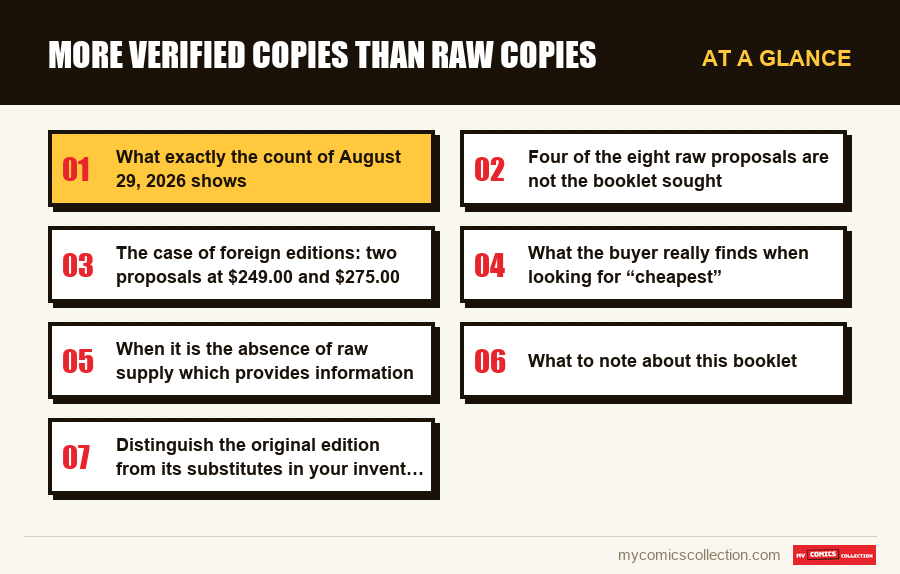
What exactly the count of August 29, 2026 shows
The survey separates two populations without mixing them. On one side are twenty-four proposals for verified copies, ranging from $350.00 to $8,100.00, with a midpoint at $1,722.50. On the other, just eight unverified proposals, ranging from $9.99 to $9,900.00, with a midpoint at $262.00. The first number to remember is neither of these amounts: it is the ratio between twenty-four and eight. On most issues, the proportion is reversed: the raw segment abounds, the verified segment is a neat minority. Here the report is turned around, and frankly it is. Three out of four proposals go through certification.
Four of the eight raw proposals are not the booklet sought
A blank cover for $9.99
The lowest amount in the entire statement does not correspond to a complete copy in poor condition, but to a cover without associated content. It is a restoration or supplementary medium, not a booklet. However, it occupies the first place in an increasing sorting by price, and it is therefore what the buyer in a hurry sees first.
A hardcover collection for $27.45
A volume which brings together the story with others, in a binding and a format which have nothing to do with the periodical publication of 1958. The story is there, the object is not. A reader finds what he wants immediately; a collection inventory cannot replace it.
A 2026 reprint at $34.95
It is announced as such by the seller, without ambiguity. This is the best proof that the raw segment is not populated by attempts at deception but by honestly described objects that are simply different. The printing date is enough to decide: nothing that comes off the presses in 2026 belongs to the original print run.
Two foreign editions at $249.00 and $275.00
A Brazilian edition and an Italian edition. The same story, published under license outside the United States, on a different date and often in a different format. These are real issues, but from another editorial chain, and they occupy the upper part of the raw segment without being the intended object.
Add up: out of eight propositions, five titles noted explicitly designate something other than the original American edition. There remains a handful of announcements whose nature is not decided by their title alone, and the gap between the floor at $9.99 and the peak at $9,900.00 alone shows that no coherence unites this small group. We do not have a market segment there: we have a background where heterogeneous objects are placed that research has brought together because they have the same name.
Avertissement méthodologique. Out of eight advertisements, several of which are not the specification in question, the median of $262.00 does not describe any real object. It is the central value of a composite whole which combines a support without content, a bound book, a recent printing and two foreign publications. What matters here is the counting and composition of the segment, never its price level. Never turn that $262.00 into a buying guide: it points to nothing.
The verified segment calls for its own caution. Twenty-four listings remain a small number: the median of $1,722.50 is an indication, not a measurement. And the entire reading comes from a single day of observation. A photograph taken on a single date does not show any movement: it does not allow us to say that these amounts are rising, nor to say that they are falling, only to note what was requested that day. The isolated high at $9,900.00 reflects a seller's hope, nothing more.
Why does the raw segment become empty on an old key number?
The presentation gap pays for the approach
When presenting a copy in verified form significantly changes the amount a seller dares to charge, verification ceases to be an option and becomes the normal step before listing. The owner of an authentic copy no longer has any reason to offer it raw.
Seniority makes the state unreadable remotely
On a 1958 booklet, the written description and a few photographs no longer reassure anyone. The buyer cannot decide alone between two similar examples, and the seller knows it. Verification solves the problem for both parties, and it eventually becomes the segment entry condition.
Character name attracts neighboring objects
A search by title and number returns anything containing those words. Reprints, collections, licensed editions, restoration accessories: none of this is hidden, but it is all in the same list. The raw segment fills with these neighbors as it empties from the object itself.
Modest examples leave the visible circuit
A very tired copy of an important issue does not disappear, but it changes channel: direct sale between collectors, local sale, lot. It does not appear in the counting of a market place, which further accentuates the apparent emptiness of the raw segment.
The small workforce breaks all statistics
Eight lines, including several off-topic, produce no usable average. Any attempt to calculate a market price on this basis fabricates a figure from incomparable objects. The only legitimate use of these eight lines is to read them one by one.
The reader and the collector are not looking for the same object
The bound collection and the foreign editions respond perfectly to a reading request. They respond very poorly to an inventory request. The same results page serves two opposing needs, and nothing about sorting by price separates them.
The case of foreign editions: two proposals at $249.00 and $275.00
Two of the eight gross proposals noted on August 29, 2026 concern editions published outside the United States: a Brazilian edition at $249.00 and an Italian edition at $275.00. We must take the time to say what these objects are, because they are poorly understood and often brushed aside even though they have their own and legitimate existence.
A foreign edition is the same story, published under license by a local publisher, in another country, on a date other than the original publication: sometimes several years later. The format almost always changes: different dimensions, different paper, reorganized pagination, story sometimes grouped with other stories in the same issue to adapt to local publishing habits. The cover can be revised, redesigned or replaced. The text is translated. These are not counterfeits or late reprints from the same publisher: they are independent publications, with their own numbering, their own calendar and their own editorial history in the country concerned.
Their price level is explained without mystery. They do not carry the rarity of the original print run, they do not carry chronological primacy, and the demand for them is concentrated in their national market rather than dispersed globally. A licensed edition therefore costs a fraction of what the original edition charges, and the statement shows it: at $249.00 and $275.00, these two proposals sit well below the floor of the verified segment, which starts at $350.00. The comparison is instructive: the entry point for a verified copy of the original edition exceeds the amount requested for these two foreign issues.
For whom do they have a real interest? For two well-identified profiles. The first is the reader: someone who wants to keep the story in a booklet, not in a bound volume, without committing the budget of an original copy. The second is the collector who is interested precisely in the international circulation of a title: in the way in which an American story from 1958 was taken up, translated, recut and sold elsewhere. It is a coherent, documented and often exciting collection area, which has its own rarities and its own supply difficulties.
What they are not, however, must be said without nuance: they do not replace the original edition in an inventory. Consigning a Brazilian edition to the line reserved for the American issue of 1958 distorts the entire inventory: not out of malice, but because the line then ceases to describe what it purports to describe. A foreign edition deserves its own entry, with its country, publisher, local date and format. This is exactly what a méthode d'inventaire structurée: distinguish objects that the search confuses.
Collecting this series?
Track what you own, what you are missing and what your collection is worth. 7 day trial.
Start my trial →What the buyer really finds when looking for “cheapest”
The reflex is universal and it is reasonable in most situations: we open the page, we sort from the least expensive to the most expensive, we look at the first lines. On a current issue, this maneuver isolates the most damaged examples of the same object, and it is useful. On this 1958 booklet, she produces something completely different.
The first line is the blank cover at $9.99. The next, the hardcover collection at $27.45. Then the 2026 reprint at $34.95. A buyer unfamiliar with the title sees three two-digit amounts and draws the wrong conclusion: that this number is accessible. It is not; he's just not there. The first three lines do not describe any copies of the original print run. Sorting by price, applied to a set of heterogeneous objects, does not sort states: it sorts object natures, systematically placing substitutes in front.
We must emphasize one point: none of these advertisements are misleading. The reprint is advertised as a reprint. The cover is described as cover. Foreign editions indicate their country. The confusion does not come from the sellers, it comes from the sorting gesture, which places things that do not have a comparable price on the same axis. It's the reader of the page who has to do the work that the ranking doesn't do.
The practical discipline can be summed up in one sentence: on an old key number, do not sort by price, read the titles. Eight lines can be read in two minutes. This reading immediately reveals what a sort hides: that the bottom of the page is occupied by something else, and that the item searched for begins, in this statement, at $350.00 in the checked segment. The list of numéros-clés du personnage helps to know on which this reflex is essential.
When it is the absence of raw supply which provides information
Information is not always read in what is present. Here, the main information is an absence: there are almost no more unverified copies of this booklet offered openly. This absence is not a neutral void, it is the result of collective behavior of the holders. Each of them, separately, judged that having their copy checked before offering it was worth the cost and time. Twenty-four converging individual decisions produce the observed landscape.
This reasoning has immediate practical significance. It provides a simple test applicable to other old numbers known to be important: count the verified propositions, count the raw propositions, then read the headings of the second group. If the second group is thin and populated by substitutes, you are looking at a number whose raw supply has been emptied. If, on the contrary, it remains provided and coherent, the dynamic is not the same and your benchmarks must be different.
It is necessary to immediately mark its limits, otherwise the statement will say more than it contains. This count measures neither the absolute rarity of the booklet, nor the number of existing copies, nor what buyers actually pay. It says nothing about the evolution of anything: an observation made on a single day cannot describe a movement, only a state. And thirty-two proposals in total, all segments combined, remain a number that the withdrawal or addition of a few announcements would be enough to move. What the statement firmly establishes is the composition of the gross segment on that date, and this composition speaks for itself.
There remains one question to which the statement does not answer and which we should not pretend to resolve: knowing why this precise number, in l'histoire éditoriale du personnage, focuses this attention. The count notes a state of supply; it does not explain what made this booklet a point of convergence. The two questions are separate and it is best not to mix them.
What to note about this booklet
The twenty-four to eight ratio is the main information. Before any amount, remember this proportion: three out of four proposals concern verified copies. This is the reverse of the ordinary configuration, and it is this reversal which should guide your reading of the results page on this specific number.
The raw segment almost no longer contains the fascicle. Out of eight proposals, the titles noted designate a blank cover, a bound collection, a reprint dated 2026 and two foreign editions. Five objects that are not the American edition of 1958. Look for the good deal there and you will systematically find something else.
The median of $262.00 does not designate any items. It is the central value of a composite whole, not the price of a copy. Citing it as a purchasing guide would be a methodological error. In the verified segment, the median of $1,722.50 is more consistent but remains calculated on twenty-four lines: an indication, not a measurement.
Foreign editions are recorded separately, never as a replacement. At $249.00 and $275.00, the Brazilian and Italian proposals are real and interesting objects: to read the story, or to document the international distribution of the title. They occupy their own inventory line, with country, publisher and local date. They do not fill the line of the original edition.
None of these amounts are sales prices, and none describe a trend. These are amounts requested by sellers on August 29, 2026, recorded only once. The isolated high at $9,900.00 reflects a seller's hope and nothing else. A single date observation shows neither increase nor decrease: it notes, it does not tell. To place this number among the others, the value of the character's comics is read number by number, never by extrapolation from a single reading.
Because the holders of authentic copies have them checked before offering them. The difference in valuation between a raw presentation and a verified presentation justifies the cost and time of the process, on an old booklet where no one can arbitrate the state remotely. The result is that the raw segment is gradually emptied of the object itself, and what remains there is mainly composed of substitutes.
No. It is a blank cover, that is to say a medium without associated content, useful for restoration or supplementation but which is not a booklet. However, it is the first line that appears when you sort the results from least expensive to most expensive, which is enough to give a false impression of accessibility to anyone who does not read the titles.
Not in an inventory. These are licensed publications, published in another country, on another date and most often in another format, with their own local numbering. They are ideal for anyone who wants to read the story or document the international circulation of the title, and they deserve their own entry with country, publisher and date. They do not fill the line reserved for the 1958 American issue.
No, and this is the main pitfall of this survey. A median calculated on eight lines, several of which designate different objects, does not correspond to any real specimen. The verified segment, with twenty-four lines ranging from $350.00 to $8,100.00, gives a more coherent indication, but the number remains small and a median is not worth measuring.
The statement does not allow us to say this. It was carried out on August 29, 2026, only once, and a single date observation describes a state without describing a movement. It does not contain any comparison with a previous date or concluded transaction. What it establishes is the composition of the raw segment that day, and that is already usable information: provided you don't make it say what it doesn't contain.
Distinguish the original edition from its substitutes in your inventory
Reprints, collections, foreign editions: these are legitimate objects, but they do not occupy the same line. My Comics Collection allows you to log each copy with its edition, country and condition, so your inventory says exactly what you own.