The name Brainiac does not only belong to an antagonist: a descendant also bears it, except for one digit, and fights on the side of the heroes within a team of the future. Direct consequence for those who search, buy or store: the two characters respond to each other in the same bag of results. On August 29, 2026, a survey of advertisements explicitly targeting the heroic side and his team gave 178 proposals without certification, between $1.29 and $154.99, with a midpoint at $15.00, against only three verified copies, between $239.95 and $375.00. Three out of one hundred and seventy-eight: verification practically does not take place here, and no price level can be concluded from such a small number.
There are few such clear-cut cases in superhero comics: a villain's name taken as is, augmented by a simple number, to designate a hero. The collector who discovers this configuration first believes in a variant of writing, in a seller's typing error, in a duplicate catalog. It's about something else. Two distinct characters, separated by centuries of internal chronology, opposed by narrative function, coexist under an identical root. One is the cold threat, the unscrupulous intelligence, the recurring adversary. The other is a team member, a strategist, an ally. And yet, when you type in the name, you get both.
This is not a scholarly detail. It is a practical constraint that weighs on each stage of the life of a collection: research, purchase, storage, resale, reading recommendation. A search engine does not distinguish a root from a derivative when the derivative only adds one character. Neither is a sales title. An inventory sorted alphabetically even less. This article tackles the problem from both ends: why a publisher deliberately creates a hero bearing the name of one of its villains, and what this editorial decision costs, today, to anyone who handles booklets.
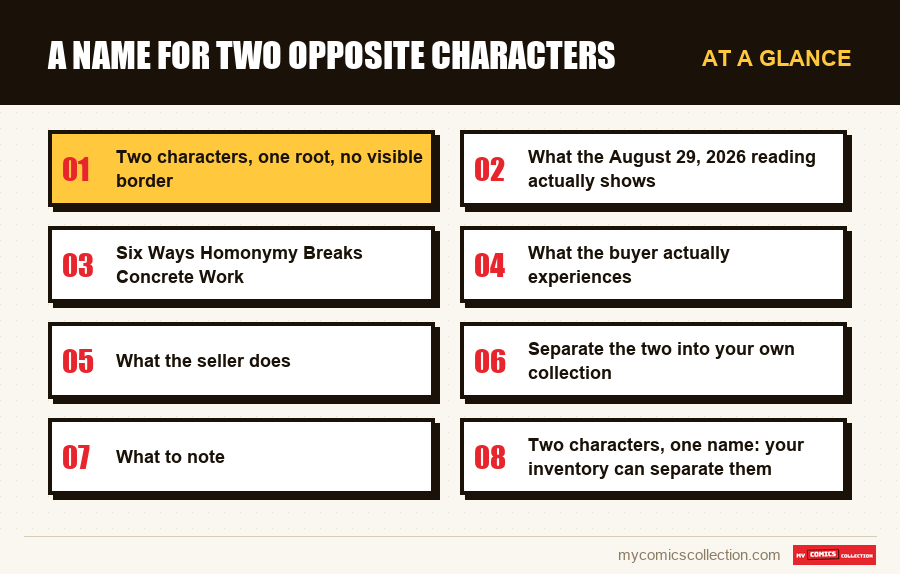
Two characters, one root, no visible border
The difficulty does not come from a vague resemblance. She comes from an almost perfect identity. Take away the final number and you get exactly the name of the antagonist. No prefix, no qualifier, no adjective of distinction: the only thing that separates the hero from the villain, in a string of characters, is a sign. However, a single sign does not survive any automatic processing. Search engines often erase single numbers, sellers carelessly omit them, databases treat them as noise, and readers who talk about memory don't always pronounce them. The result is mechanical: everything that concerns the hero comes up when we look for the villain, and the opposite is also true.
What the August 29, 2026 reading actually shows
178 proposals without certification
By explicitly questioning the heroic side and its team, we obtained that day one hundred and seventy-eight advertisements for which the seller provided no external verification. These are amounts claimed on this date, not recorded transactions. No one can say that any of them have found a buyer.
From $1.29 to $154.99, with a center at $15.00
The gap between floor and ceiling is two orders of magnitude, but the midpoint remains very low. The large mass of requests is therefore far from the posted peak; this isolated peak tells of the hope of a seller, not a value observed on the market.
Only three copies verified
Three out of one hundred and seventy-eight listings relied on certification, asking between $239.95 and $375.00, with the center at $349.99. A headcount of three does not support any price level conclusions. It indicates only one thing: the verification process practically does not take place on this name.
The hero is almost never alone in a title
The cheapest proposals, those running between $1.29 and $2.10, list the character in the middle of a list of other members of his team. Its name serves as an additional keyword, not as a subject. This is the sign of a character sold as part of a set.
These four observations hold together and paint a coherent situation. A character whose name appears mostly in lists, whose asking median is modest, and who almost no one checks, is a character that the market treats as part of a group rather than as an autonomous entity. There is nothing shameful about this: it is the ordinary condition of members of large teams. But this further complicates the separation from the antagonist, whose name regularly occupies the position of main subject in a title.
All amounts cited in this article are sums requested by sellers on August 29, 2026, recorded at a given time. These are never closed sales, and nothing here describes a trajectory, an increase or a decrease.
An isolated maximum in a list of announcements measures the optimism of the person who posted it. It does not measure scarcity, demand, or what a buyer would actually be willing to pay.
Six Ways Homonymy Breaks Concrete Work
Research does not split
Questioning the root of the name brings the antagonist and his descendant back into the same flow. Adding the number is not enough: many titles omit it, and many engines treat it as a negligible character. No single query produces two clean populations.
Two decades mixed together
The survey traces fascicles from several different series to neighboring titles, spread over at least two decades. A buyer targeting a specific period must sort by hand, because the name alone carries no date information.
Cannot filter by role
No marketplace filter offers “hero” or “antagonist”. We filter by publisher, by period, by state, never by narrative function. The buyer who wants to exclude the opposing half of the results does not have a tool to do so.
An alphabetical inventory sticks them
Sort by name: the hero and his opponent find themselves side by side, separated by a number. A collection organized on this sole criterion juxtaposes two completely opposite characters, and loses the readability that the classification was supposed to provide.
The number is fragile data
A numerical suffix is lost when typing, confused with issue numbering, or disappears from an abbreviated title. It is the worst possible discriminator: the one that humans forget and that machines ignore.
The recommendation becomes ambiguous
Telling a reader to “start with this character” means nothing until you specify which one. One is approached through stories of confrontation, the other through the collective adventures of a team of the future: these are not the same readings.
Why does a publisher give a hero the name of one of his villains?
The choice seems counterintuitive. It is actually economical and extremely effective. A new character must construct everything: his presentation, his motivation, his reason for existing in an already populated story. A character who inherits an already loaded name arrives with some of the work already done. The reader who sees this name immediately knows what it evokes: a superhuman intelligence, a cold calculation, a threat that has already put heroes in difficulty. Putting that name on an ally creates a tension in a single line that ten pages of exposition would not have produced.
The lineage then provides a permanent engine. A descendant who bears the name of a hated ancestor does not need to invent conflicts for him: he brings one with him wherever he goes. Each new encounter can reactivate distrust, each error on his part can be read as a return of heredity, each success takes on the value of a refutation. He is a character who must redeem a name, and this obligation follows him indefinitely, without ever exhausting itself as a one-off plot exhausts itself. No narrative device is more profitable than conflict that recharges itself.
Finally there is a sewing function. A catalog of superheroes spans decades and periods that, over time, cease to communicate. The characters of one era lose their link with those of another, and the recent reader no longer has any reason to be interested in the old material. A name shared between two periods reestablishes this link of strength. He tells the reader that the universe he discovers today extends the one he has not read, and he gives the ancient reader a reason to follow what is published now. The name serves as a thread stretched between two sections of the catalog.
Added to this is the benefit of pure memorization. A name already established is easy to remember. The publisher who reuses it saves the investment necessary to make an entirely new designation memorable, and in the process captures the attention of all those who already followed the original bearer. What works perfectly on the level of attention produces exactly the disorder that anyone who wants to buy, catalog or recommend suffers today. Yesterday's narrative gain has become today's documentary noise.
What the buyer actually experiences
Let's take the most banal situation: someone wants to acquire a booklet featuring the team member, not the opponent. He types the name. It obtains a mixed flow where the two characters alternate without marking. He adds the figure: he loses at the same time all the ads where the seller has not written it, and there are many left. He removes the figure: he recovers the entirety of the antagonistic side, which is by far the most abundantly represented. Neither query gives him what he's looking for.
The only escape is to use peripheral terms, the name of the team for example. But the statement from August 29, 2026 shows precisely the limit of this method: the cheapest ads, those between $1.29 and $2.10, mention the character in the middle of a list of teammates. Searching by the team therefore brings up a very large number of booklets where the target character is just one name among others, often without a significant presence in the story. We exchanged one ambiguity for another.
The third obstacle is temporal. The results cover several series with similar titles, spread over at least two decades. A reader who wants a given period must distinguish titles that are similar within one or two words, which neither a filter nor sorting by price will do for him. He will have to open the ads one by one, read the descriptions, compare the covers. It's manual labor, and it's exactly the labor that a distinct name would have avoided.
Finally, the buyer has no reliable price reference. One hundred and seventy-eight uncertified claims, scattered between $1.29 and $154.99 around a center at $15.00, describe a heterogeneous set where the character's state, series, and actual presence vary enormously. The only three certified advertisements, requested between $239.95 and $375.00, are too small to serve as a reference for anything. The buyer therefore navigates without a marker, on a name which does not even designate a single character.
Collecting this series?
Track what you own, what you are missing and what your collection is worth. 7 day trial.
Start my trial →What the seller does
On the advertising side, homonymy is not imposed: it is exploited. A seller who writes the root of the name without the number mechanically captures the research intended for the antagonist, which is much more numerous. This is not necessarily a maneuver: most of the time, it is simply the way the name is remembered and copied. But the effect is the same: the two ad populations contaminate each other, and the contamination always benefits the better-known term.
Listing team names in a title follows the same logic. Listing six or eight characters multiplies the entry points for the same ad, which explains why the one or two dollar propositions are precisely those where the character is never alone. A title that cites the hero in a single subject position is rare; However, it is the only one that indicates that the booklet really concerns him. For the attentive buyer, this distinction, subject or mention, is better than any filter.
The virtual absence of certification is explained by the same movement. Having a copy checked represents a cost and a delay that no one incurs for a booklet worth fifteen dollars. Three verified announcements out of one hundred and seventy-eight therefore do not signal a market anomaly, but a simple calculation: verification is only economically justified well above the level usually requested here. No conclusion of value can be deduced from these three lines.
The fact remains that the seller, like the buyer, comes up against the same wall when describing his lot. If he has booklets from both sides, he will describe them under a common root, and his own announcements will compete in the results. Homonymy does not penalize one camp over the other: it degrades the readability of everyone, including the one who gains additional visibility from it.
Separate the two into your own collection
The response to external disorder is internal. If the marketplaces cannot distinguish the two characters, a personal inventory can: provided you do not rely on the name alone. The rule is simple: the name should never be the only field that carries identity. As soon as a second criterion accompanies each entry (the series, the period, the role of the character in the story) the confusion suddenly disappears, because none of these criteria is shared by the two bearers of the name.
The role is the most robust discriminator, because it does not depend on any spelling. A booklet features either the opponent or the team member; there is no possible ambiguity once you open it. Noting this information when entering the collection takes a few seconds and definitely avoids having to reconstruct it later, when you will no longer remember what you bought or why.
The series comes next. Since the record shows neighboring titles spread over at least two decades, recording the exact series rather than the character's name resolves both the question of homonymy and that of the period. Two booklets bearing the same name on the cover but belonging to distinct series cease to be interchangeable as soon as they are arranged by series. This is the classification closest to the material reality of objects.
Finally, the distinction between “the character is the subject” and “the character is mentioned” deserves its place. It corresponds exactly to what the statement shows: the cheapest ads cite the hero among others, the most expensive give him his own place. Reproducing this distinction in your own inventory means giving yourself the means to know, without reopening the boxes, what you really own. The complete method for managing your collection details the field logic that makes this kind of separation durable.
What to note
The final figure is the only discriminator, and it is the most fragile there is. The entire separation between a major antagonist and a team hero is based on a single character at the end of the name. This character is lost when typing, omitted in conversations, confused with numbering, and disappears from queries. No search system built on name alone will make two populations clean, and one should not hope that a better worded query will achieve this.
The heroic side is sold in groups, not solo. On August 29, 2026, the cheapest proposals, $1.29 to $2.10, mentioned the character in the middle of a list of teammates. It is almost always one name among others in a title. This means that most of the announcements that cite it do not relate to issues where it really matters, and that you should read the description before concluding anything.
Three checks out of one hundred and seventy-eight advertisements do not establish any price level. The three certified copies were asked between $239.95 and $375.00, with a center at $349.99, while the other one hundred and seventy-eight were distributed between $1.29 and $154.99 around $15.00. These two sets do not compare: the first is too small. What it indicates is that verification is almost never engaged here, nothing more.
The results cover several series with similar titles over at least two decades. The name therefore carries no period information, and two fascicles equally relevant to the query may be separated by years and belong to different series. A buyer targeting a specific era must sort manually, because no marketplace filter does this job for them.
The solution is internal, not external. Since neither search engines nor sales titles will ever separate the two bearers of the name, the separation must be created in its own inventory, adding to each entry a criterion that the name does not carry: the role of the character, the exact series, and the fact that it is subject or simple mention. These three fields are enough to completely cancel ambiguity at home, even if it remains intact elsewhere.
Because the name instantly brings a charge that the story doesn't need to install. The lineage creates a permanent tension, gives the character a reason to exist, redeem a name, which never runs out, and connects two distant periods of the publisher's catalog. It is an economical device: a single word does the work of several pages of exposition.
No simple query achieves this. With the figure, we lose the announcements which omit it; without it, we recover the entire antagonistic side. The most practicable workaround is to go by the name of the team, but this then brings back a lot of booklets where the character is only a mention. In all cases, you must read the descriptions.
One hundred and seventy-eight uncertified offerings were priced between $1.29 and $154.99, with a midpoint at $15.00. Three certified listings were asking between $239.95 and $375.00, center at $349.99. These are sums claimed that day, not sales concluded, and the isolated maximum reflects the hope of a seller rather than an observed price.
No. A low demand median describes what sellers are hoping for at a given time on a heterogeneous set, where the condition, series and actual presence of the character vary a lot. No statement of value can be deduced from a list of advertisements, and three verified copies are not enough to establish a benchmark.
By refusing that the name is the only bearer of identity. Add to each entry the role: opponent or team member -, the exact series rather than the name alone, and the distinction between a booklet where the character is the subject and a booklet where he is simply mentioned. These three pieces of information make the classification readable even when the external titles remain ambiguous.
Two characters, one name: your inventory can separate them
My Comics Collection lets you record the exact series, the role of the character and your own references on each issue, so that two entities that share a root stop getting confused in your lists. Your grades remain yours, and the ranking follows your logic rather than that of sales titles.