An autograph gains value only if the proof follows the object. Two regimes exist at CGC: the signature observed at the moment it is made by an authorized representative, which gives the yellow Signature Series label, and the signature authenticated after the fact on a copy already signed, which gives a black and yellow Authentic Autograph label. Outside these two circuits, the ink exists but the proof does not: CGC mentions it as unverifiable on a blue label, or isolates the problem on a green Qualified label. Hence the rule nobody likes to hear: on an already rare copy, a signature without proof often takes away more than it adds.
A collector's reflex in front of a signed comic is to look at the signature. The market's reflex is to look at the line of text that says who signed, when, and above all who vouches for it. Between the two lies most of the price gap, and it is a gap the eye does not see.
This guide deals neither with label colors in general, nor with calculating a resale premium, two subjects covered elsewhere on this site. It deals with the chain of proof of an autograph: how it is built, what it writes in black and white, what happens when it is broken, and the fairly frequent situations where having a copy signed amounts to devaluing it. An October 2026 sale around a signed Teenage Mutant Ninja Turtles #1 by its two co-creators serves as the common thread.
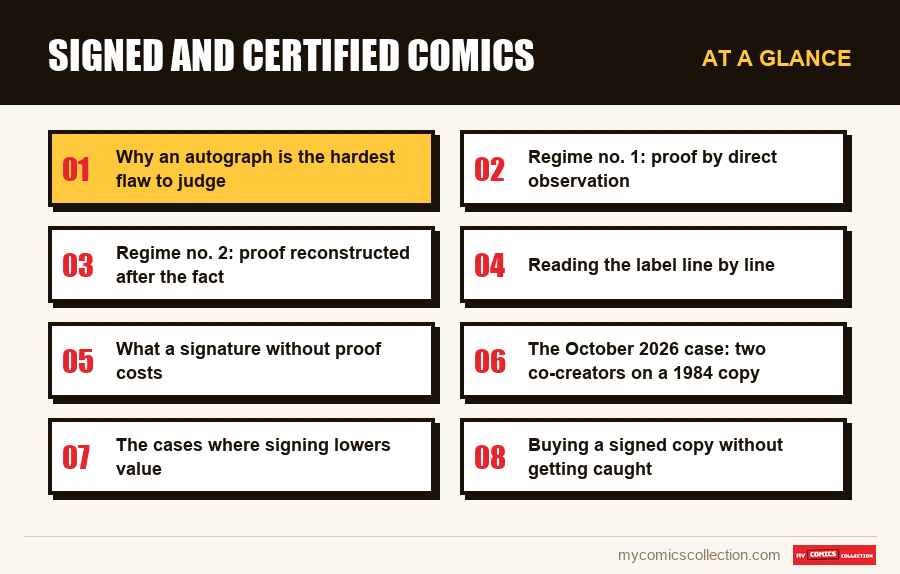
Why an autograph is the hardest flaw to judge
In the grading scale, everything added to the paper after printing is treated as an alteration. A crease, a rusted staple, a name written in pen by a 1972 reader: so many modifications of the object as it left the printer. An autograph technically belongs to this family. What sets it apart is that it can be desirable. What makes it unmanageable is that it is impossible to judge by the naked eye: a crease is measured, a tear is photographed, a missing page is counted, but two strokes identical to the millimeter can come from the artist's hand or from a diligent forger's. No magnifying glass settles it.
It is this void that produced a separate apparatus. The grading company CGC was launched on January 4, 2000 in New Jersey, with a simple promise: a third party looks, assigns a grade and seals the object in a case. For autographs, there was nothing to grade. The point was not to assess a condition, but to attest to an event: such a person signed, on such a day. A fact, not a measurement. And attesting to an event presupposes having been there, or having expertise capable of reconstructing it. These are the two regimes of proof that exist today, and they are not worth the same.
Regime no. 1: proof by direct observation
The first circuit consists of never taking your eyes off the object. The copy is presented to an authorized representative, who witnesses the signature being made, immediately takes the object into custody and sends it to grading without it passing back through the owner's hands. CGC states the condition unambiguously on its own pages: labels of this program are as a rule issued only to items signed under the direct observation of one of its representatives, and items are submitted immediately after signing for grading and encapsulation.
The result is the yellow Signature Series label, whose official definition deserves to be read word for word: it applies to items for which all signatures were observed by an authorized representative, and which are therefore certified as bearing an authentic, witnessed signature. The word "all" is the trap. A copy signed by three creators of whom only two were observed does not get a partial yellow label: it falls out of the regime. Hence the difficulty of a multi-signed copy, where each hand must pass before a witness, sometimes years and several continents apart, without ever breaking custody of the object between two sessions.
The yellow label carries the elements of the event: who signed, when the signature was made, and in some cases where. These three pieces of information are not decorative. They are the proof itself, and that is what the buyer pays for. The mechanics of this direct observation, its costs and practical constraints are detailed in our guide to the yellow label and the witnessed signature, and in the one devoted to signing sessions accessible from France.
Regime no. 2: proof reconstructed after the fact
The second circuit answers the awkward question: what about copies already signed? A comic signed in 1991 in the back room of a bookshop was observed by nobody authorized, and for a long time there was no way to bring it into the system. CGC settled this by building an autograph authentication competence, and now offers a certification called Authentic Autograph for items already signed. These copies receive a distinct, black and yellow label, which visually separates them from witnessed copies. The logic is reversed: instead of recording an event live, an expert examines the stroke, compares it with references and gives an opinion.
This inversion has three consequences that the market integrates spontaneously. The certainty is not of the same nature, a witnessing being factual and an expertise a qualified judgment. The signing date is often unknown, whereas the witnessed circuit provides it. And the result can be negative: a copy sent for after-the-fact authentication can come back without the hoped-for notation, which never happens in the observed circuit, where the question is settled before grading. This second route nonetheless remains valuable: it is the only way to give a defensible market value to the signature of a deceased creator, whom no witness can ever observe again. But it does not reconstitute the yellow label, and an informed buyer does not confuse them.
Reading the label line by line
In front of a case, the beginner's mistake is to read the number and look at the cover. The useful information on a signed copy is in the text, and each zone answers a precise question.
The color of the banner
It announces the regime before anything else. Yellow: signature observed when made. Black and yellow: signature authenticated after the fact. Blue: ordinary grading, and if there is ink on the cover, it will be mentioned as such, with no guarantee. Green: an identified problem was taken out of the grade calculation, and an unauthenticated signature is part of it.
The signer's name
Check that it is written plainly, and that it corresponds to someone whose signature makes sense on this copy. A name you have to look up to identify is rarely a name that lifts a price guide value.
The signing date
On the observed circuit, it is there. Its absence on a copy presented as witnessed is a signal to dig into. Its absence on an after-the-fact authentication is normal.
The place, when indicated
It does not always appear. When it does, it tells the object's story and reinforces traceability, which weighs on high-end pieces.
The added notations
An original drawing, a personalized inscription, a particular note: all of this can be recorded. An inscription addressed to a named person almost always restricts the resale market, whereas a signature alone remains neutral.
The certification number
It is the only element that lets you check the label against the grading company's record. A case whose number does not point to the expected description is not a case to buy. The complete method is in our guide to verifying a certification number.
If the general grammar of colors still escapes you, first read our inventory of labels and their meaning: this article assumes that base.
What a signature without proof costs
The most common case is neither yellow nor black and yellow. It is the signed copy, authentic in good faith, but whose authenticity nothing establishes. Two treatments exist.
The first is the notation on the ordinary label. The definition of the blue label provides for it explicitly: it covers items whose grade is the one indicated, with any particular information, for example an unverifiable signature, being noted on the label. The word used is that one, unverifiable. In other words, the company records that there is ink, describes what it sees, and refrains from saying where it comes from.
The second is the green Qualified label, reserved for items with a significant flaw requiring a specific description. The unauthenticated signature falls in this category, alongside a clipped coupon or a missing page. The numeric grade remains honest on everything else, the problem is described in plain terms, and it is up to the buyer to factor it into their price. The situations where this label is nonetheless a good buy are examined in our guide dedicated to the green Qualified label.
One point deserves emphasis that optimistic sellers pass over in silence: these two treatments are not half-authentications. Neither says the signature is genuine. The first describes, the second isolates. In both cases, the buyer buys a signature that nobody vouches for, and pays for it, or rather does not pay for it.
There is finally a lesser-known combination, the mixed yellow and green label, for an object that carries both an observed signature and a flaw to describe. It shows well that the two axes are independent: the proof of the signature on one side, the condition of the object on the other.
The October 2026 case: two co-creators on a 1984 copy
A public sale in October 2026 involves a copy that concentrates everything above. The object is a number 1 of a series whose editorial history alone explains the market tension.
Teenage Mutant Ninja Turtles #1
The inaugural issue is presented in May 1984 at a convention in Portsmouth, New Hampshire. It is printed on cheap newsprint, in black and white, in an oversized format close to a magazine, at 3,275 copies. Kevin Eastman and Peter Laird are its two co-creators: one draws the masked turtle that launches the idea, the other proposes making it a team of four.
A copy signed by both, certified with signature authentication, is offered in a public sale in October 2026, and expected at six figures.
Three lessons emerge. First, the scarcity at play is not that of the issue but that of the combination: out of 3,275 starting copies, of which only a fraction survived forty years in presentable condition, the subpopulation that also carries both signatures can be counted on the fingers. Next, a six-figure estimate can only be formulated because the signatures are authenticated: with the same paper, the same ink and a simple notation of an unverifiable signature, no house would risk this range. Finally, signatures made in the 1980s necessarily fall under the second regime, no authorized witness being present at the time, which shows that after-the-fact expertise is not a by-product: properly carried out, it supports first-rank pieces.
The phenomenon goes beyond paper, moreover. The public records set in 2026 on other families of collectibles, playing card, sports magazine, sealed video game, all concern certified copies, never raw ones. When an entire segment starts paying for the documentation rather than the object, the undocumented piece does not really go down: it drops out of the game. It remains sellable, but to an audience that buys for pleasure, not for value. It is a silent discount, visible on no report.
The cases where signing lowers value
Here is the part you rarely read, because it runs against an emotional gesture. Having a comic signed is not neutral. In several configurations, it is a net destruction of value, and it is better to know it before the convention than after.
The rare copy in very fine condition. It is the costliest case. On a sought-after issue kept almost flawless, the value comes from the near-perfection of a mass-produced object. The autograph turns it into a unique object, but removes the copy from the comparable population on which the market takes its bearings. If the signature is not observed, the result combines the worst: a more modified object, and a narrower market.
The signer with no link to the copy. A signature carries weight when it tells something about the signed object: the creator of the character appearing for the first time, the artist of the cover, the writer of the story. A name chosen because it was available that day adds no story. It adds ink.
The personalized inscription. A first name addressed turns the object into a gift. It is charming and it is final: the next buyer inherits an inscription not meant for them, and takes it into account.
Placement and medium. A signature made on a very dark printed zone, or with an ink that reacts badly to old newsprint, can become illegible or migrate with time. The proof will remain written on the label, but the object will no longer have the visual appeal that justified the effort.
The poorly planned multiple signature. Since the observed regime requires that all signatures have been, starting a series of inscriptions outside the witnessed circuit permanently rules out the yellow label, even if the following ones are perfectly carried out. The order of operations cannot be made up.
In most of these situations, the right decision is to have a second copy signed, bought for that purpose, and to leave the fine copy alone. Our analysis of the signed comic considered as an asset details the selection reasoning, and the guide on the right time to have a copy graded helps you avoid chaining two costly decisions.
Buying a signed copy without getting caught
The secondhand market is full of copies presented as signed, with a sharp photograph of the signature and a vague description of its provenance. Four checks are enough to rule out most bad deals.
The first is to refuse approximate vocabulary. "Signed," "authentic," "with certificate" are not regimes of proof. The only wordings that commit anyone are those on the label of a sealed case. A certificate provided by the seller attests only to the seller's good will.
The second is to check the certification number against the official record, and to compare each element: the title, the number, the grade, the signer, the date. A discrepancy on a single field is enough to stop the purchase. Fakes often consist of pairing a photograph of an authentic label with another object: our guide on counterfeit cases and buying traps describes the physical signs to examine.
The third is to check the consistency of the signer and copy pairing. A signature dated after the creator's death, or made on an issue he never worked on, can be spotted in a few minutes of reading.
The fourth is never to buy with the intention of opening the case. Opening a case destroys the proof: the signature becomes undocumented ink again, and you will have to go back through the after-the-fact authentication circuit, with no guarantee of result. The rare cases where the operation is justified are covered in our guide on opening a certified case, and they almost never concern a signed copy.
Recording what proves, not just what shows
A signed, certified copy carries more information than an ordinary copy, and this information is exactly what makes its value. The minimum to record comes down to six fields: the certification number, the regime of proof, the signer's name, the signing date when it exists, the grade assigned, and the exact nature of the added notations. These six lines are what a buyer, an insurer or an heir will ask you for, and none can be deduced from a photograph of the cover.
In a collection tracking app, good practice is to treat the signed copy as an entry distinct from the raw copy of the same issue, and not as a variant of the same object. They are two markets, two levels of liquidity and two reasons to keep. Confusing them amounts to overestimating one and forgetting the other.
What to remember before holding out a comic to a creator
The question is never "does this signature have value." It is "will this signature be proven, and by which regime." If the answer is the observed circuit, the operation is generally sound on a well-chosen copy. If the answer is after-the-fact authentication, it remains defensible, notably for a historic signature, provided you accept a different kind of certainty and a risk of a negative return. If the answer is "by nothing," then the autograph is a keepsake, and that is perfectly fine, but it must not be entered in the assets column. The rest is a matter of discipline: choose the copy you sacrifice, do not have the one you keep intact signed, prefer a signer who has something to do with the issue, refuse the personalized inscription on a piece meant to circulate, and record the proof on the day it is created rather than the day it is requested.