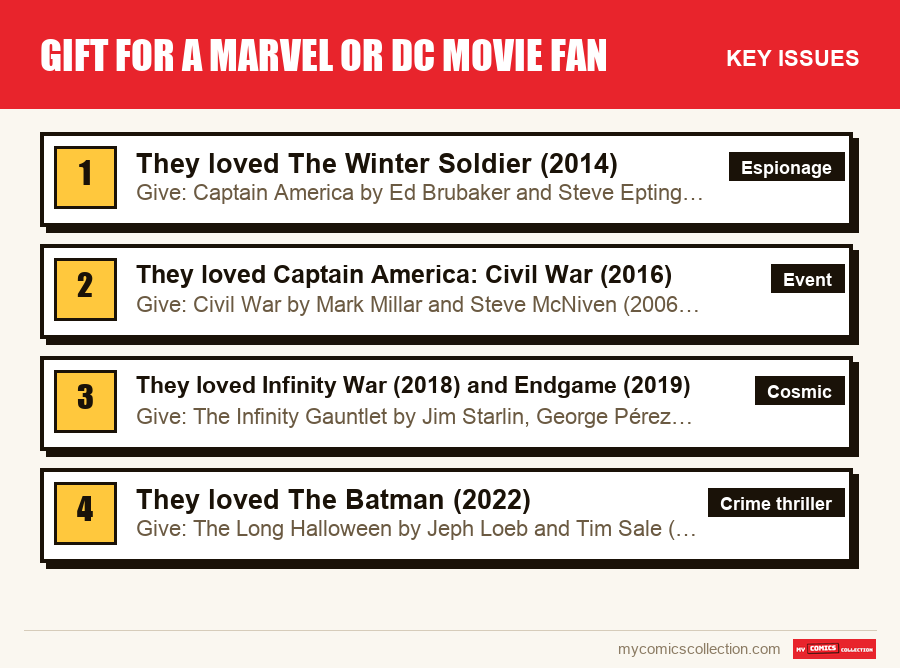
For a fan of Marvel or DC movies, the best gift is the collection that inspired their favorite film. They loved The Winter Soldier: give Ed Brubaker and Steve Epting's Captain America. Civil War: Mark Millar and Steve McNiven's Civil War miniseries. Infinity War and Endgame: Jim Starlin's The Infinity Gauntlet. Logan: Old Man Logan. Thor: Ragnarok: Greg Pak's Planet Hulk. On the DC side, The Batman calls for The Long Halloween by Jeph Loeb and Tim Sale, Joker calls for The Killing Joke, and the 2025 Superman calls for All-Star Superman. For Avengers: Doomsday, expected December 18, 2026, give Jonathan Hickman and Esad Ribić's Secret Wars (2015). Always prefer a complete story in a single volume.
A viewer who likes a superhero movie has already come halfway to comics: they know the characters, they have preferences, they know what moved them. The ideal gift turns that taste into reading. It is not about giving "a Marvel comic" at random, but the precise story that gave their film its scenes, its plot or its tone.
This guide therefore works film by film. For each, it indicates the collection to give, what the reader will find there and what may surprise them. It does not rank the films against each other, which our ranking of the best adaptations does. It prescribes a reading, with a sidebar devoted to the year-end film, Avengers: Doomsday.
The principle: one film, one collection
A superhero film rarely adapts a comic to the letter. It borrows a premise, an arc, an image, and recomposes it. The collection to give is the one the film took the most from. The reader will find familiar scenes there, and will also discover that the original story is often longer, darker or stranger than its movie version. That is precisely what makes the gift valuable: it extends the film instead of repeating it.
A format rule, valid for the whole list: give a collection that contains the entire arc, never a standalone issue. The French editions of Marvel are published by Panini Comics, those of DC by Urban Comics. Check the edition available at the time of purchase, as titles and formats change with reprints.
Marvel: the Avengers-era films
They loved The Winter Soldier (2014)
Brubaker's run, launched in 2005, brings back Bucky Barnes, whom everyone believed dead since 1945, in the form of a Soviet assassin. The film takes up its central revelation and the tone of a paranoid thriller.
Our comparison of the Winter Soldier film and comics details the borrowings. For a Bucky fan in particular, this collection is the best possible gift: it is the work that made the character what he is today.
They loved Captain America: Civil War (2016)
Seven issues in which a superhuman registration law divides the heroes into two camps, led by Captain America and Iron Man. The film keeps the opposition and the heartbreak between friends.
They loved Infinity War (2018) and Endgame (2019)
Six issues. Thanos gathers the six gems, erases half the universe with one gesture and defies the surviving heroes. The film takes up the premise, the snap and the figure of the Titan.
Both films are detailed in our comparison of Infinity War and the comics. The sheet on the first issue of Infinity Gauntlet will interest the fan who would one day like to own the original issue.
Marvel: the stand-alone films
They loved Thor: Ragnarok (2017): give Planet Hulk, by Greg Pak (2006-2007). Exiled into space by the other heroes, Hulk lands on a planet where he becomes a gladiator, then a rebellion leader. The film draws its whole Sakaar part from it. The comic is more serious and more epic, without Thor. Our comparison of Ragnarok and the comics says more.
They loved Logan (2017): give Old Man Logan, by Mark Millar and Steve McNiven, published in Wolverine #66 to #72 and a special issue (2008-2009). An aged Wolverine crosses a devastated America held by the villains. The film borrows the title, the age and the twilight, much less the plot. The comic is crazier, more western, more violent still.
They loved Guardians of the Galaxy (2014): give the Guardians of the Galaxy by Dan Abnett and Andy Lanning (2008). It is the modern team, with Star-Lord, Rocket, Groot, Gamora and Drax, that served as the basis for the film. The tone there is already that of a band of misfits.
They loved Black Panther (2018): give Christopher Priest's Black Panther (from 1998) for the strategist king and Wakandan politics, or the one by Ta-Nehisi Coates and Brian Stelfreeze (2016) for a more recent and more political reading. Our comparison of the film and the comics helps choose.
They loved Iron Man 3 (2013): give Extremis, by Warren Ellis and Adi Granov (six issues, 2005-2006). The film's technological virus comes from there, and the story redefined Tony Stark for a decade.
They loved the Spider-Verse films (2018 and 2023): give the beginnings of Miles Morales by Brian Michael Bendis and Sara Pichelli (2011), then Dan Slott's Spider-Verse crossover (2014), which gathers Spider-Men from all realities. The Gwen fan will also want to know Edge of Spider-Verse #2, where Spider-Gwen is born.
They loved The Fantastic Four: First Steps (2025): give a collection of the series' beginnings by Stan Lee and Jack Kirby, and in particular the Galactus trilogy, in Fantastic Four #48 to #50 (1966), where the Silver Surfer and the world devourer appear. The film draws directly from that period.
They loved Thunderbolts* (2025): give Kurt Busiek and Mark Bagley's Thunderbolts (1997), for the idea of a team of antiheroes with a murky past, and The Sentry by Paul Jenkins and Jae Lee (2000), for Bob Reynolds. The film's team differs from the 1997 one, but the principle of redemption under supervision comes from there. Our comparison of Thunderbolts* and the comics details the gaps.
DC: Batman, Superman and the others
They loved The Batman (2022)
Thirteen chapters, a killer who strikes on every holiday of the calendar, a young Batman investigating with Gordon and Harvey Dent. The film shares its crime-thriller atmosphere and the central place of Gotham's mob.
Both stories are compared with their adaptations in our sheets on The Long Halloween and on The Batman.
They loved Joker (2019): give The Killing Joke, by Alan Moore and Brian Bolland (1988). The story proposes a possible origin for the Joker, a failed comedian tipped over by a single bad day. The film borrows that idea and develops it. Beware, the comic is short and very harsh, notably toward Barbara Gordon.
They loved The Dark Knight (2008): The Long Halloween and The Killing Joke also fit, the first for Harvey Dent, the second for the Joker. For a fan who wants the most striking Batman of all, Frank Miller's The Dark Knight Returns (1986) is the founding story, to reserve for a reader who accepts an aged and brutal Batman.
They loved Superman (2025): give All-Star Superman, by Grant Morrison and Frank Quitely (twelve issues, 2005-2008). A doomed Superman devotes his last year to feats and acts of kindness. It is the story most often cited as the model of the luminous character the film defends. Our comparison of the 2025 Superman and the comics spells out the links.
They loved Wonder Woman (2017): give George Pérez's relaunch (1987), which redefined Diana, Themyscira and its gods for the modern era.
They loved Watchmen (2009): give, of course, Watchmen, by Alan Moore and Dave Gibbons (twelve issues, 1986-1987). The film is faithful, but the comic contains whole layers (nested stories, end-of-chapter documents) that no adaptation has kept.
Sidebar: a gift for the release of Avengers: Doomsday
Avengers: Doomsday, directed by the Russos, is expected in theaters on December 18, 2026, just before the holidays. Robert Downey Jr. plays Victor von Doom, Doctor Doom. Marvel Studios has announced a very large cast, bringing together notably Thor, Sam Wilson as Captain America, Bucky Barnes, Loki, Shuri, the Fantastic Four, the team seen in Thunderbolts* and several X-Men played by the actors from the Fox films, including Patrick Stewart and Ian McKellen. Chris Evans's return as Steve Rogers was confirmed by the first teaser. Everything else about the plot is unknown.
The main gift: Secret Wars (2015)
Jonathan Hickman and Esad Ribić. Doom, having become a god, rules over a world recomposed from destroyed realities. It is the Marvel story most directly tied to the film's name and to Downey Jr.'s character.
To understand Doom: Books of Doom
A miniseries by Ed Brubaker and Pablo Raimondi (2005-2006) that tells his life, from childhood in Latveria to the mask. The best portrait of the character for a reader who knows him only by name.
For the Fox X-Men fan
A collection from the Chris Claremont era, and in particular Days of Future Past (Uncanny X-Men #141 and #142, 1981), a story the films have already adapted.
For the Fantastic Four fan
The Lee and Kirby beginnings, where Doom appears as early as the fifth issue (1962). The link between Doom and Reed Richards, a former college mate turned archenemy, is the heart of the character's mythology.
Our complete guide to the comics to read before Avengers: Doomsday details these readings and a few others. A calendar tip: the film comes out a week before Christmas. Giving the collection before the screening lets the fan recognize what they will see; giving it afterward lets them extend the film. Both are defensible, but a story given after the fact runs no risk of "spoiling" the surprise of a plot that remains secret.
Three mistakes to avoid
Giving the original issue rather than the story. A film fan wants a story. A character's first-appearance issue is a collector's item, often short, old and unrelated to the film's plot. It will please a collector, not a viewer.
Giving an ongoing series because of a cover. Publishers put out covers inspired by the films at the time of release. The content, for its part, is often an episode in the middle of a series, incomprehensible without what precedes.
Promising the film in paper form. None of the collections cited tells the film exactly. Present them as "the story that inspired" rather than "the film's story": the reader will be surprised by the differences instead of disappointed by them.