To give a first comic to an adult who has never read one, start from what they already like in novels, shows or movies, not from superheroes. A crime fan: Criminal (Brubaker and Phillips) or Batman: Year One (Miller and Mazzucchelli). A science fiction reader: Saga (Vaughan and Staples) or Y: The Last Man (Vaughan and Guerra). A fantasy fan: Sandman (Gaiman). A reader of true stories: Maus (Spiegelman). If they want superheroes: All-Star Superman (Morrison and Quitely) or Hawkeye (Fraction and Aja). Give a collected edition (the first volume of a series, or a complete story), never a single floppy or a thousand-page omnibus. And avoid anything that starts in the middle of a continuity.
Giving a comic to someone who does not read them is a bet on two things at once: the story must appeal to them, and the form must feel natural. The second is the more fragile. An adult opening their first comic does not know in what order to read the panels, does not know the codes, and quickly drops off if the first page asks them to know thirty years of history. The right gift is the one that poses none of these difficulties.
This guide is not for those who want to please a collector: for a seasoned reader the rules are reversed, and our gift ideas for collectors cover that. Nor is it for someone starting out for themselves: our beginner collector's guide handles that. Here, the person receiving has asked for nothing. You have to make them want it.
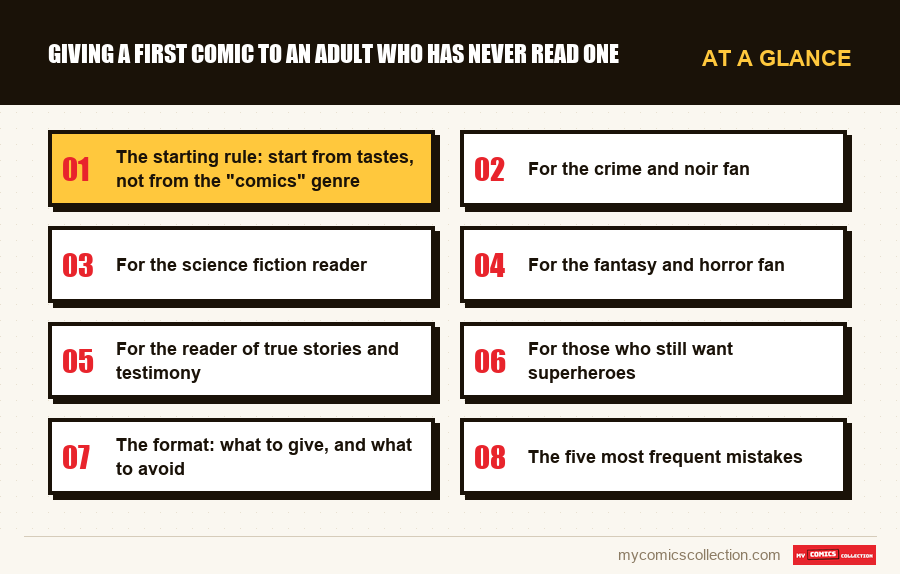
The starting rule: start from tastes, not from the "comics" genre
The most widespread mistake is to think "comics" the way you would think of a genre. It is not a genre, it is a medium, like the novel or the film. You find crime, science fiction, horror, testimony, romantic comedy, and also superheroes. For a first gift, the costumed character is often the worst entry point, because it drags decades of continuity behind it.
So first ask yourself the question you would ask for a book. What does this person read, watch, listen to? What is the last novel or show they told you about with enthusiasm? The answer points you to a family of stories, and each family has its obvious doors in.
For the crime and noir fan
Criminal
A series of crime stories independent of each other, sharing a city and a few characters. Burglars, tired cops, gambling debts: nothing superheroic, everything noir novel.
Batman: Year One, by Frank Miller and David Mazzucchelli, published in 1987 in Batman #404 to #407, is the only superhero story to recommend without reservation to a crime fan. Four chapters, a corrupt city, an honest Commissioner Gordon in a rotten police force, a vigilante just starting out and getting things wrong. No prior knowledge is needed, and the story fits in one slim volume.
Sin City, by Frank Miller, is the other great option, to reserve for a reader who appreciates the heavy style, the contrasty black and white and unflinching violence. Our Sin City reading order says which volume to start with. More broadly, our guide to approaching Frank Miller helps choose among his stories.
For the science fiction reader
Saga
Two soldiers from enemy sides fall in love, have a child and flee a galactic war. The story is told by their daughter. Humor, violence, sexuality, family life: it is a series for adults, in the full sense.
Y: The Last Man, by Brian K. Vaughan and Pia Guerra, published from 2002 to 2008 in sixty issues, starts from a crystal-clear premise: every male mammal on the planet dies at the same time, except one young man and his monkey. The story is complete, which makes it ideal as a gift: you know the story has an end.
Descender, by Jeff Lemire and Dustin Nguyen (2015), will please those who like melancholy science fiction: a young robot on the run in a galaxy where machines are hunted. Nguyen's watercolors reassure a reader who fears the overloaded style of comics.
Paper Girls, by Vaughan and Cliff Chiang (2015-2019), will suit those who liked nostalgic 1980s science fiction shows: four young newspaper delivery girls caught in a time war.
For the fantasy and horror fan
Sandman, by Neil Gaiman, published from 1989 to 1996 in seventy-five issues, remains the surest entry point for a reader of literature. The master of dreams, a prisoner for decades, rebuilds his kingdom. Some arcs are self-contained short stories, others a long fresco. A fan of Gaiman the novelist immediately feels at home. For a first contact, the first volume can be unsettling with its horror tone; the second or a short-story collection may suit some readers better.
Locke & Key, by Joe Hill and Gabriel Rodríguez (from 2008), tells of a family settling into a house where keys open impossible doors. The story is closed, accessible, and recalls family fantasy novels.
For a fan of more outright horror, Something is Killing the Children, by James Tynion IV and Werther Dell'Edera (2019), is one of the most effective titles of recent years. Our guide to starting with horror comics details the other options, by subgenre.
For the reader of true stories and testimony
Maus, by Art Spiegelman, awarded a special Pulitzer Prize in 1992, is the surest gift for an adult who "doesn't read comics." The author gathers the testimony of his father, an Auschwitz survivor, depicting Jews as mice and Nazis as cats. It is a book of history, memory and father-son relationship that changed how the medium is viewed.
For a reader who likes the intimate over History, Daytripper, by brothers Fábio Moon and Gabriel Bá (2010), tells the life of a man through ten possible deaths, each at a different age. Blankets, by Craig Thompson (2003), is an autobiographical story of first love and lost faith. Neither needs any comic book culture at all.
For those who still want superheroes
Some recipients want precisely what the movies showed them. In that case choose complete stories, written to be read without baggage.
- All-Star Superman, by Grant Morrison and Frank Quitely (twelve issues, 2005-2008): a doomed Superman who devotes his last year to accomplishing the impossible. The most beautiful story of the character, and the most accessible.
- Watchmen, by Alan Moore and Dave Gibbons (twelve issues, 1986-1987): the great novel of the genre. To reserve for a patient reader who likes dense books. Our guide to approaching Alan Moore explains its keys.
- Hawkeye, by Matt Fraction and David Aja (2012): an archer without powers, his neighbors, his dog. Funny, inventive in layout, and totally independent from the rest.
- Ms. Marvel, by G. Willow Wilson and Adrian Alphona (2014): a New Jersey teenager discovering her powers. Ideal for a young adult.
- Marvels, by Kurt Busiek and Alex Ross (1994): the history of the Marvel universe seen by a press photographer. The best way to understand the mythology without reading hundreds of issues.
The format: what to give, and what to avoid
The medium counts as much as the title. A bad format can ruin a good story.
The normal-size softcover or hardcover collection
The ideal format for a first contact: a volume of one hundred fifty to three hundred pages, containing a complete arc. You read it like a novel, set it on a shelf, buy the next one if you liked it.
The complete story in one volume
Maus, Batman: Year One, All-Star Superman, Daytripper: the reader knows they have everything in hand. It is reassuring, and often the best choice for someone who is unsure.
To avoid: the single floppy
About twenty pages, a story that stops in the middle, pages of ads. For a collector, it is the king of objects. For a newcomer, it is a frustration.
To avoid: the omnibus
A thousand pages, several kilos, a high price. Given to someone who does not yet know if they like the medium, it is an object that will end up on a shelf without being opened.
On language, the great majority of the titles cited exist in many languages. DC and Marvel editions in French are published by Urban Comics and Panini Comics respectively, and many independent titles have found their publisher. Our overview of comic publishers in France helps find where to look. For an adult who reads English fluently, the original version sometimes offers a wider choice of editions; for everyone else, the translation is the right choice.
The five most frequent mistakes
Giving a collectible issue 1. An old first issue, even a famous one, is a collector's item, not a read. It is read in ten minutes and stops in the middle. Our ranking of the best issue 1s is for collectors, not new readers.
Choosing an event. The big crossovers, those that bring together all of a publisher's heroes, are the worst entry points: they assume you know every character and every related series.
Starting in the middle of an ongoing series. Volume 7 of a series, even an excellent one, will not work. Always check that it is the first volume, or a standalone story.
Relying only on the movie. The comic that inspired a film often does not have the same tone. A viewer who liked an action comedy may find the original story much darker, or the reverse. If the recipient comes from cinema, our ranking of the best comic adaptations helps spot the films that stayed close to their source.
Giving what you like yourself. The best comic in your collection is not necessarily the best first comic for someone else. A demanding story you adore after twenty years of reading can put off a beginner.
Accompanying the gift
A note slipped into the book is often enough to remove the main worry: "you read the panels left to right and top to bottom, like text." Add why you chose this title for this particular person. If the first volume pleases, offer the second rather than giving three in advance: a reader who asks for the next one is a reader won. And if they want to keep track of what they read, a collection app helps from the first volume.