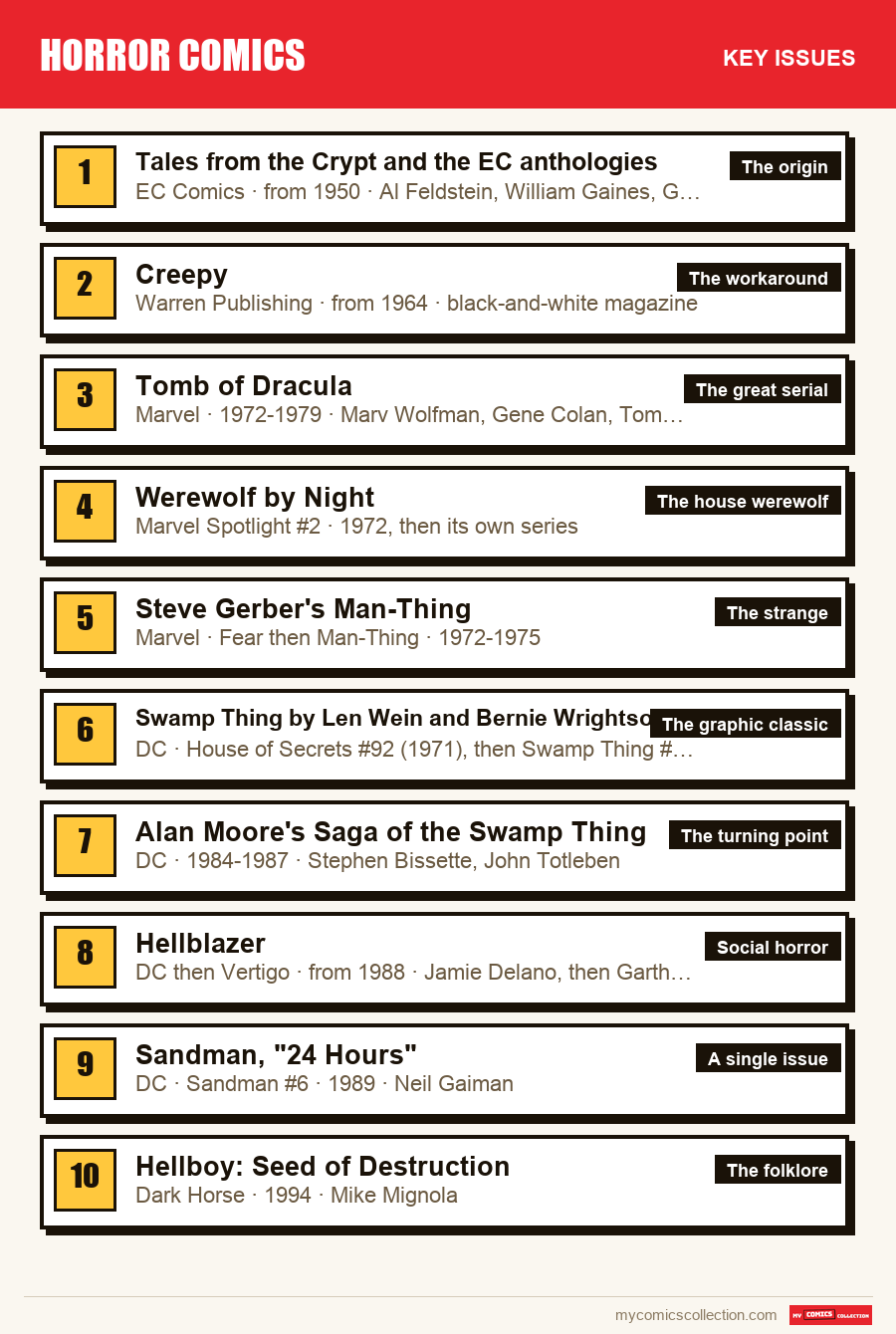
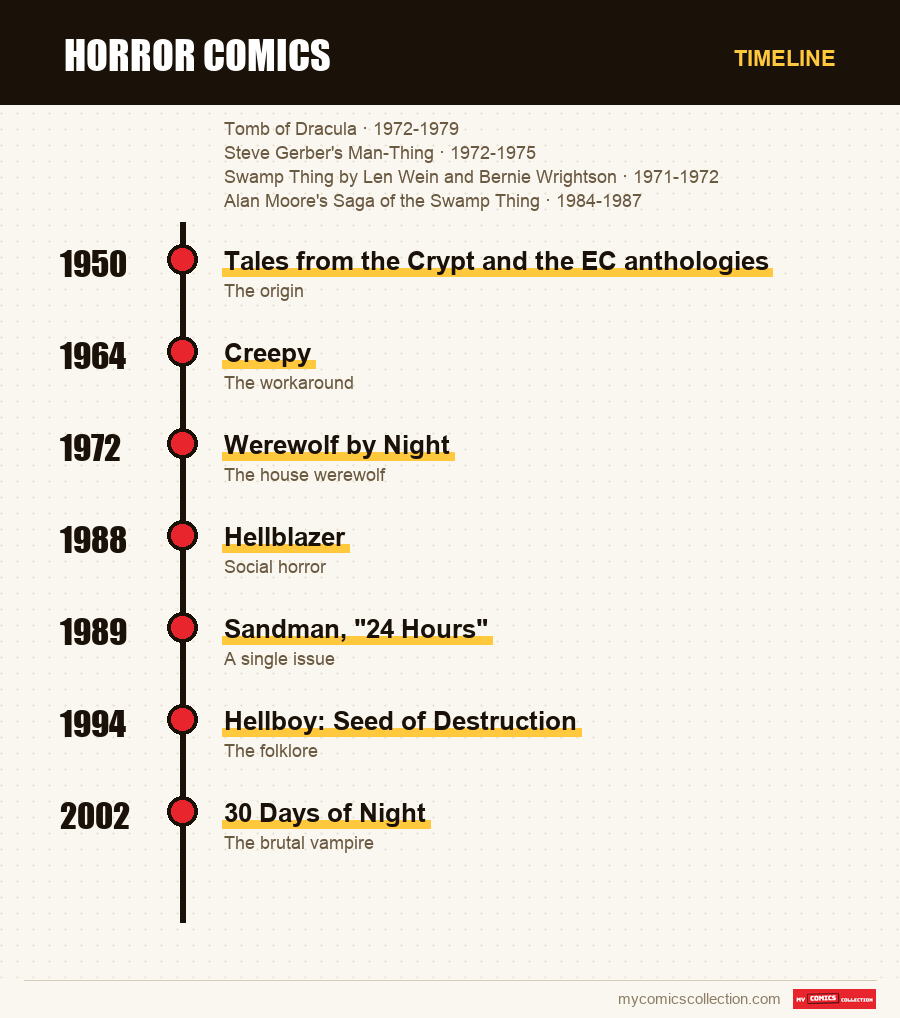
To get started with horror comics, first choose a subgenre rather than a general ranking. For the short story with a twist, read the EC Comics anthologies of the early 1950s (Tales from the Crypt). For superhero gothic, Tomb of Dracula by Wolfman and Colan (1972-1979). For adult horror, Alan Moore's Swamp Thing (1984-1987) then Hellblazer (1988). For contemporary horror, 30 Days of Night (2002), The Walking Dead (2003), Locke & Key (2008) or Gideon Falls (2018). For horror in the Marvel universe, Immortal Hulk (2018). The fifteen stories presented here are ranked by era, with what each one offers and where to open it.
Horror is the oldest and least understood genre of American comics. The oldest, because it dominated newsstands before superheroes even came back into fashion. The least understood, because it was hit with a near-ban in 1954 and only regained real freedom in stages, over several decades. The result: many readers who love horror films or novels do not know where to enter.
This guide is neither a ranking nor a shopping list. Our tier list of the best horror comics takes care of the ranking, and other articles treat horror from the collecting angle. Here, the question is simpler: if you have never read horror in comics, or very little, which stories should you open, in what order, and according to what taste.
Four families of horror, four ways to read
Before choosing a title, you need to know what you are looking for. Horror in comics divides into four large families, which roughly correspond to four eras.
The anthology with a twist, born in the 1950s: stories of six to eight pages, a cruel moral, a last panel that flips everything. You read one story, close it, come back to it.
1970s Marvel and DC gothic: after the Comics Code was relaxed in 1971, publishers put vampires, werewolves and swamp creatures back in the foreground, but in ongoing series, with recurring heroes.
Adult horror of the 1980s and 1990s: British writers, around Alan Moore, use horror to talk about politics, sexuality, the environment. These series will give birth to DC's Vertigo line.
Contemporary auteur horror, from the 2000s on: independent series, often short, that claim the genre without detours.
The 1950s: before the Code
Tales from the Crypt and the EC anthologies
With The Vault of Horror and The Haunt of Fear, Tales from the Crypt forms the trio that defined horror in comics. Each issue brings together several short stories presented by a macabre narrator, and each rests on a revenge or an ironic punishment. The art, notably that of Graham Ingels, has kept all its force.
These series stop in 1955, after the campaign against comics and the adoption of the Comics Code, which practically bans the words "horror" and "terror" in titles, as well as vampires and the undead. For ten years, horror survives only in softened forms.
Creepy
Published in magazine format, and therefore outside the scope of the Code, which only concerned comic books, Creepy relaunches the horror anthology in the mid-1960s with several former EC artists. It opens the way for Eerie and Vampirella.
The 1970s: the return of the monsters
In 1971, the Comics Code is revised and once again allows, under conditions, vampires, werewolves and ghouls "in the classic tradition." Marvel and DC rush in.
Tomb of Dracula
Seventy issues, the vast majority drawn by Gene Colan, a stable team over several years, and a Dracula treated as a complex character rather than a simple monster. It is the best horror serial of its time. It also introduces the vampire hunter Blade.
Werewolf by Night
Jack Russell, a young man struck by a family curse, becomes a werewolf on full-moon nights. Less ambitious than Tomb of Dracula, this title is a good example of B-movie Marvel horror, effective and unpretentious. It also introduces Moon Knight, in 1975.
Steve Gerber's Man-Thing
Created in 1971 in a black-and-white magazine, Marvel's swamp creature finds its voice with Steve Gerber, who makes it a mute witness to the human miseries that wash up in its swamp. It is melancholy horror, sometimes absurd, and it is in these pages that Howard the Duck appears.
Swamp Thing by Len Wein and Bernie Wrightson
A murdered scientist returns in the form of a plant creature. The first ten issues of the series, drawn by Bernie Wrightson, are among the most beautiful horror pages ever published by a major publisher. The story itself stays classic: monsters, mad scientists, castles.
The 1980s and 1990s: adult horror
Alan Moore's Saga of the Swamp Thing
Moore takes over the character and makes it the vehicle for a literary horror that deals with racism, pollution, domestic violence. #21, "The Anatomy Lesson," is one of the most influential issues of the 1980s. It is here that John Constantine is born.
Hellblazer
John Constantine, a cynical magician and inveterate smoker, in Thatcherite Britain. Delano makes it a tale of political horror, Ennis a more intimate drama with the "Dangerous Habits" arc. The series ran three hundred issues, which lets you choose your era.
Sandman, "24 Hours"
Sandman is not a horror series, but its sixth issue is one of its peaks: a bottle episode in a diner, under the sway of a man who holds power over dreams. It is proof that a single episode can be enough to establish terror.
Hellboy: Seed of Destruction
A demon raised by humans investigates the supernatural. Mignola draws on European folklore, Lovecraft and pulp tales, with art made of flat blacks that looks like no other. It is the most accessible horror on this list.
Since 2000: auteur horror
30 Days of Night
An Alaskan town plunged into a month of polar night, and vampires taking advantage of it. Three issues, a simple idea, a suffocating atmosphere. It is the story that brought the savage vampire back into fashion.
The Walking Dead
One hundred ninety-three issues about survival in a world overrun by the dead. The horror there lies less in the zombies than in what the living become. A long-haul read, best taken in collected editions.
Locke & Key
Three children move into a family house whose keys unlock impossible powers, and something is waiting for them there. A complete, well-built, moving story: it is probably the best way in for a novel reader.
Gideon Falls
A black barn that appears and disappears, a priest and a young man obsessed with his city's trash. Sorrentino deconstructs the page to convey madness. See our Gideon Falls guide.
Immortal Hulk
Al Ewing turns Hulk into a body-horror tale, with transformations that Joe Bennett hides nothing of. It is proof that a superhero character can carry horror without losing anything of its identity.
How to build your own path
You like horror short stories
Start with the EC anthologies, then Creepy. Read a little at a time.
You like superhero universes
Tomb of Dracula, then Immortal Hulk, then Gerber's Man-Thing.
You mostly read novels
Locke & Key, then Moore's Swamp Thing, then Hellblazer.
You want a quick thrill
30 Days of Night and Sandman #6: two evenings, two very different anxieties.
To go beyond these fifteen titles, two recent series come up often in readers' recommendations: Something Is Killing the Children, by James Tynion IV and Werther Dell'Edera, and Wytches, by Scott Snyder and Jock. And current events offer an unexpected entry point: Marvel launched an entire horror-focused line in October 2026, presented in our Marvel Midnight guide.