Gideon Falls has 27 issues published by Image between 2018 and 2020, written by Jeff Lemire and drawn by Andrea Sorrentino. A complete horror story, with no sequel or spin-off series, it can be read straight through and in order. This is the series where the layout itself becomes the narrative tool: and one that should be read in paper form rather than digitally.
Gideon Falls has 27 issues published by Image between 2018 and 2020. A complete horror story, without sequel, to be read in order.
It is also the most difficult title to summarize in all of Lemire's work, because its real subject only appears halfway through and most of its effect comes through the form. This article explains what the series contains, why its design is inseparable from its subject, and what you need to know before approaching it.
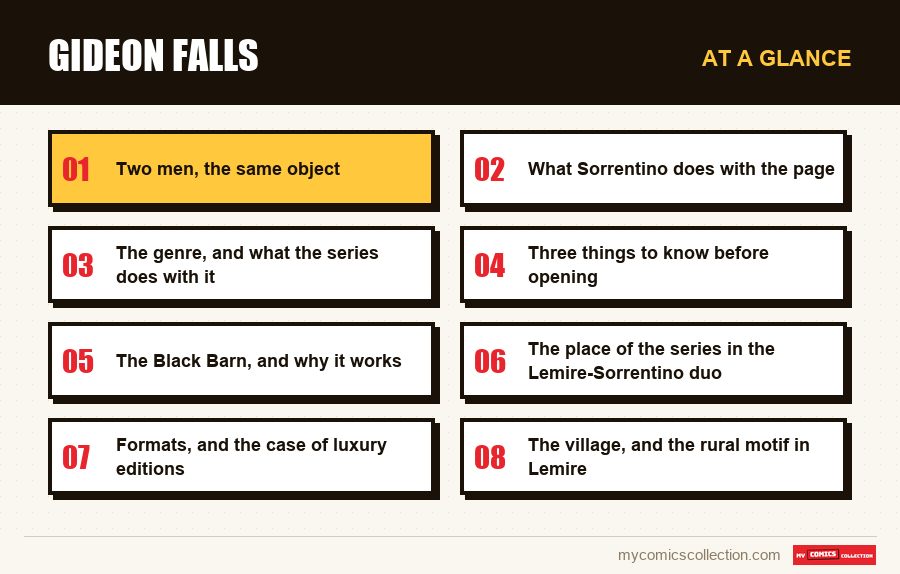
Two men, the same object
The series follows two characters who don't know each other and live in unrelated places.
Norton Sinclair lives in town. He suffers from psychiatric disorders, undergoes therapy, and digs through garbage to recover fragments of wood which he compulsively assembles. He doesn't know what he's building.
Father Fred is a priest sent to the rural parish of Gideon Falls, the village where his predecessor met a dark end. He discovers a closed community, a sheriff who doesn't tell everything, and an ancient history of disappearances.
The two stories alternate number after number, without crossing paths for a long time. What connects them is something locals call the Black Barn: a building that appears, disappears, and doesn't exist in the same place for two people. The series takes around ten issues to bring the two threads together, and this wait is deliberate.
What Sorrentino does with the page
This is where the series sets itself apart from everything published in the genre. Andrea Sorrentino does not use layout as a neutral support: he uses it as an instrument.
Cross boards
Some pages are composed in a cross, or in concentric circles, imposing an unusual reading path. The reader must look for where to put their eyes: voluntary discomfort, which reproduces the disorientation of the characters.
The boxes that fragment
When the Barn approaches, the grid disintegrates: the squares multiply, overlap, lose their borders. The rupture of the graphic device signals the rupture of reality before the text announces it.
Red as the only color
Dave Stewart's coloring uses a reduced palette, where a saturated red occasionally emerges. On mostly gray pages, this apparition functions like a sound.
Two-way double pages
Several sequences read differently depending on the order chosen, and both readings are valid. A process that is rarely found outside of experimental comics, used here in a mainstream genre series.
Conséquence pratique : read this paper series. On screen, the panel-by-panel reading offered by e-readers destroys exactly what makes these boards interesting. This is one of the rare comics where the digital format actually alters the content.
The genre, and what the series does with it
Gideon Falls is presented as horror, and it is. But it belongs to a specific branch of the genre: cosmic horror, where the threat is not a monster but a structure of reality that the human mind cannot contain.
This choice explains the treatment of the characters. Norton is not "crazy" in the sense that a classic horror story would mean-his illness is not the cause of what he sees, nor the convenient explanation that is revealed at the end. Lemire refuses this facility, and the refusal is constant over the 27 issues: psychiatry is never the explanation of the supernatural.
This is also what distinguishes the series from current production of the genre. The horror does not come from an antagonist but from a geometry: a place that does not obey the rules, and people who try to map it despite everything.
Three things to know before opening
The first third is slow
The two threads advance in parallel without coming together, and the reader may have the impression that the series is running on empty. Convergence is coming, and everything that came before makes sense in retrospect.
She doesn't give all her answers
The series concludes its plot, but intentionally leaves areas unexplained. This is a convention of the cosmic genre, not a writing flaw, but it frustrates readers who expect complete elucidation.
Elle demande de l'attention
Complex pages cannot be navigated diagonally. Distracted reading causes one to miss information placed in the composition rather than in the text.
It is graphically harsh
Without being gratuitous, the series contains violent and disturbing images. It's not an atmospheric horror: some boards are explicit.
The Black Barn, and why it works
Horror stories almost always rely on an entity: a creature, a killer, a spirit. Gideon Falls is based on a building, which seems less scary on paper and is much more so when reading.
La Grange has no intention, does not pursue anyone and does not speak. It appears, and its appearance is enough. It is not in the same place according to witnesses, does not appear on any map, and people who look for it end up finding it: which is the worst news.
This movement of the monster towards the location produces two effects. First, it makes the threat impossible to combat: you can neither flee a place that is moving, nor destroy a building that does not permanently exist. Then, it allows Sorrentino to make architecture the real graphic subject: the boards spend their time describing spaces that do not stand up, corridors that turn back on themselves, false perspectives that the eye accepts for a second before rebelling.
This is the reason why the series would not work as a novel. A text can describe an impossible place; only comics can montrer impossible while still making it believable on the page.
Collecting this series?
Track what you own, what you are missing and what your collection is worth. 7 day trial.
Start my trial →The place of the series in the Lemire-Sorrentino duo
The two authors met at Marvel, on Old Man Logan, before developing a collaboration that has become one of the most identifiable in recent American comics. Gideon Falls is the summit, but it is part of a continuity.
A.D. After Death, published before, was already experimenting with mixing graphic registers in the same volume: illustrated prose, classic plates, sketches. Primordial, published later, applies the same formal vocabulary to a space race story. And the Bone Orchard Mythos, from Dark Horse, pursues horror with a shared universe ambition.
What connects them is not a theme, it is a method: looking for what comics can tell that neither cinema nor novels can. Gideon Falls is the title where this research is most readable for an uninitiated reader, because the experimentation always remains in the service of the intrigue.
Formats, and the case of luxury editions
The series exists in 27 softcover issues, in six collections, and in large format library editions bringing together several collections.
The large format is not a simple comfort here. On plates where the composition is the subject, the reproduction size determines what the eye perceives: a cross-shaped double page loses a lot in small format, and certain details placed on the periphery become illegible. If you only have to buy one edition, get the largest one you can.
In French editions, the series circulated in volumes whose division does not exactly follow that of the American collections. Check the number range indicated on the cover pages before completing a collection started in the other language.
Collections remain the economical choice and the easiest to find second-hand. The softcover issues are especially of interest to collectors who are looking for alternative covers, of which there are many in this series.
The point of vigilance in the collection: alternate covers are particularly abundant on early issues. The same number 1 exists under several different illustrations, with very uneven print runs.
Concretely, a catalog which only notes “Gideon Falls #1” doesn’t say which version is on the shelves, and the distinction changes everything, for resale and insurance. Save the cover, not just the issue.
The village, and the rural motif in Lemire
Gideon Falls is a small, isolated farming community, with its church, its sheriff, its long-settled families and its distrust of outsiders. We have already read this setting in Lemire: it is the county of Essex County, it is the city in decline of Royal City, it is even the countryside where the farm of Black Hammer holds back his superheroes.
The constant is more than a favorite decoration. At home, the rural community is always a place where the past has not been resolved and where collective silence takes the place of social order. The difference in Gideon Falls, is that this silence literally produces a monster: where Essex County was content to waste lives.
For a reader who discovers the author through this series, it is a useful reference: this village is not a cliché of the horror genre borrowed from Stephen King. It's the same place as in all his other books, this time filmed with a horror camera.
Should we start Lemire there?
No, unless you come from horror rather than comics. It's an excellent book, but a bad entry point to the author: Lemire doesn't draw in it, and Sorrentino's very marked visual style dominates to such an extent that we come away with a false idea of what Lemire writes elsewhere.
On the other hand, if you are looking for a complete adult horror series, without a sequel to buy and without an extended universe to follow, this is one of the best possible recommendations of the genre over the last decade.
Questions fréquentes
Yes, it ends at number 27 with a conclusion desired by the authors. There's no sequel, spinoff series, or expanded universe to follow: making it a finite purchase, unlike Black Hammer du même scénariste.
On paper, without hesitation. The e-readers offer panel-by-panel reading which destroys cross layouts and double pages, that is to say precisely what makes the series valuable. This is one of the rare comics where the digital format really cuts out the content.
No, and it is an explicit choice of the authors. The series refuses the easy solution which would consist of reducing everything to a hallucination. Norton's troubles are treated as a fact of his life, never as key to the plot.
No, no narrative continuity. These titles share the same duo of authors and similar formal research, but they are independent works. You can read them in any order, or read just one.
By recording them as distinct copies and not as a simple number. The first issues of the series exist in several illustrations with uneven print runs, and the difference counts for resale. A catalog that only notes “#1” will leave you without an answer the day the question arises.
Save your covers, not just your numbers
On multiple variant sets, knowing which version you own changes the value of your collection.