Jeff Lemire has signed more than forty series in fifteen years, for Vertigo, Image, Dark Horse, Marvel, DC and Valiant. Commencez par Essex County if you want to understand the author, by Sweet Tooth if you want to be caught, and by Black Hammer if you come from superheroes. These three doors open into three different Lemires, and none of them are a bad start.
Jeff Lemire has signed more than forty series in fifteen years, for Vertigo, Image, Dark Horse, Marvel, DC and Valiant. Commencez par Essex County if you want to understand the author, by Sweet Tooth if you want to be caught, and by Black Hammer if you come from superheroes.
It is precisely this volume that is discouraging: it is impossible to know which way to take a bibliography which ranges from intimate rural drama to space opera, including Marvel runs and a universe of retired superheroes. This article sorts this work by entry point, depending on what you're looking for: not chronological order, which doesn't help anyone.
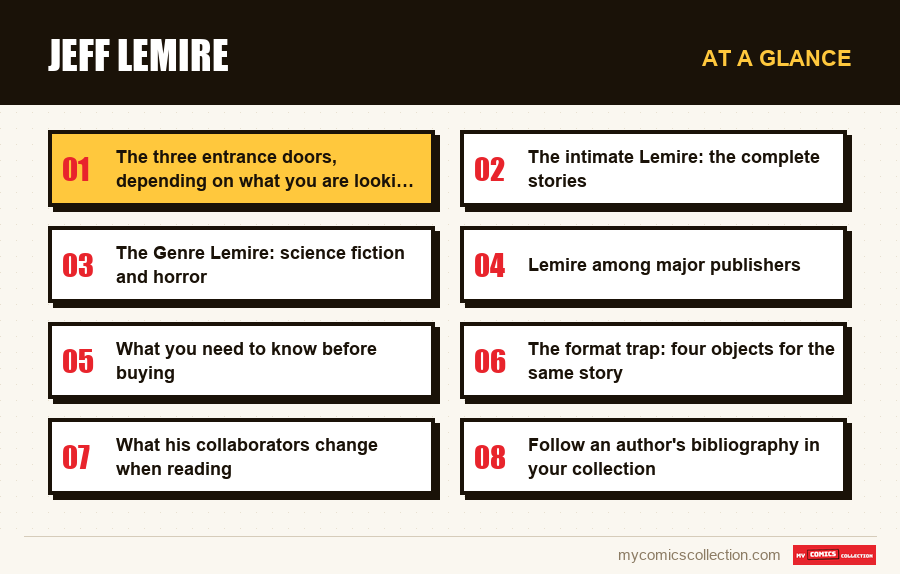
The three entrance doors, depending on what you are looking for
There is no single reading order for Lemire, because his series almost never share continuity. Each can be read in isolation. The real question is therefore not "where to start chronologically", but "which Lemire I want to meet first".
Porte 1:Essex County
The trilogy that revealed him, published by Top Shelf between 2007 and 2008. Three linked stories in the rural Ontario county where Lemire grew up: an orphan child, two brothers separated by hockey, a country nurse. Black and white, shaky lines, very little dialogue.
Choisissez-la si you want to understand where everything else comes from. Lemire's themes (filiation, mourning, silence between men) are all already there.
Porte 2:Sweet Tooth
Forty issues from Vertigo, from 2009 to 2013. A pandemic has decimated humanity and given rise to half-human, half-animal hybrid children. Gus, a little boy with deer antlers, comes out of the forest where his father had hidden him.
Choisissez-la si you want a series that sticks with you. It is the most accessible, the most rhythmic, and the one that the Netflix adaptation made known beyond comic book readers.
Porte 3:Black Hammer
At Dark Horse since 2016, designed by Dean Ormston. A team of superheroes disappears after saving the world and finds themselves stuck on a farm that no one can escape from. The superheroic genre reread through rural drama: the synthesis of the two Lemires.
Choisissez-la si you come from Marvel or DC. It is the most direct bridge between the genre and his personal writing.
The intimate Lemire: the complete stories
A significant part of his work is contained in one volume. These are often the most personal books, and the easiest to offer or test without committing to a long series.
The Underwater Welder
An underwater welder, future father, haunted by the disappearance of his father. Published by Top Shelf in 2012. Damon Lindelof presented it as an episode of The Fourth Dimension in comics: the comparison is apt.
Roughneck
A former professional hockey player, an alcoholic, finds his sister on the run. Return to register Essex County, in color and harder.
Trillium
Eight issues at Vertigo in 2013-2014. A love story between a botanist from the future and an explorer from 1921, built with boards that must be turned over. The most advanced formal experimentation of his work.
The Genre Lemire: science fiction and horror
It is the most read half of his bibliography, and the one which established him at Image and Dark Horse as author of long-term series.
Descender et Ascend
Space opera drawn in watercolor by Dustin Nguyen. A robot child, TIM-21, wakes up in a galaxy that has banned machines. Ascend picks up the story a decade later, switching from science fiction to fantasy.
Gideon Falls
With Andrea Sorrentino, at Image. A black barn appears and disappears, a priest and an outcast converge on it. The formal summit of the Lemire-Sorrentino collaboration: the layout disintegrates to the rhythm of madness.
Royal City
A family reunites in a declining industrial town, each haunted by the same missing brother, but at a different age. The bridge between intimate Lemire and genre Lemire.
Lemire among major publishers
His commissioned works are often dismissed by readers who discovered him independently. This is a mistake: several are among his best texts, and they are easier to find second-hand.
D.C.Animal Man
His retelling of Buddy Baker during the New 52 is a family horror story disguised as a superhero series. The most recommendable entry point into his time at DC.
Marvel:Moon Knight
With Greg Smallwood, a reading of the character through his mental health rather than through his struggles. Short, complete, and cited as a reference by readers from the television series.
Valiant:Bloodshot Reborn
A programmed killer deprived of his nanotechnology tries to live like an ordinary man. Often considered the best run of the modern Valiant era.
Dark Horse:Bone Orchard Mythos
The return to horror with Sorrentino, in the form of a shared universe. The most recent, and the least explored by French-speaking readers.
What you need to know before buying
Lemire sometimes draws, often writes. This is the distinction that structures his entire bibliography. The books he draws himself:Essex County, Sweet Tooth, The Underwater Welder, Roughneck, Royal City: have this trembling, imperfect trait, which is initially displeasing and ends up becoming inseparable from its themes. The series he entrusts to others: Nguyen on Descender, Sorrentino on Gideon Falls, Ormston on Black Hammer: are visually much more polished.
If you test Lemire with a book that he doesn't draw, you discover the screenwriter without meeting the author. The opposite is also true. Know which of the two you have in your hands.
Collecting this series?
Track what you own, what you are missing and what your collection is worth. 7 day trial.
Start my trial →The format trap: four objects for the same story
This is Lemire's own difficulty, and it is more concrete than the choice of a front door. Almost all of his series exist in several forms, and the editorial vocabulary does not clearly indicate which one you have in hand.
Let's take Sweet Tooth. The series was first published in forty softcover issues, then in collections bringing together five to seven issues, then in three bound volumes called “Deluxe”, then in a single complete. Four objects, one story. A collector who buys as he goes, without keeping a register, automatically finds himself with partial duplicates: numbers 1 to 12 in softcover, numbers 13 to 25 in collection, and a Deluxe which covers both.
The same mechanism operates on Descender, on Black Hammer: whose derived series each have their own division, and on Essex County, available sometimes in three separate volumes, sometimes in full. The practical rule: decide on the format before starting a series, and stick to it. Mixing formats on the same work is the only sure way to never know where you are.
What his collaborators change when reading
Lemire chooses his designers according to the register, and the gap between two of his series is often more due to the designer than to the text. It's a useful reading key when you're hesitating between two titles.
Dustin Nguyen: watercolor
On Descender et Ascend, he works entirely in watercolor, without traditional inking. The result softens a story that, written, would be much drier: a space opera about machine genocide read through pastel washes. It’s this contrast that makes the series.
Andrea Sorrentino: the layout
Sur Gideon Falls, Primordial et Bone Orchard, the box itself becomes the narrative tool: cross-shaped boards, boxes that fragment, double pages to be read in two directions. If you're looking for what comics can do that cinema can't, start there.
Dean Ormston: the classic line
Sur Black Hammer, a dark and angular trait, inherited from British comics. This is what allows the series to cite the silver age of superheroes without ever falling into pastiche.
Follow an author's bibliography in your collection
Collecting by author poses a problem that collecting by character does not pose: the series are scattered between six publishers, over fifteen years, with heterogeneous formats: softcover issues, collections, complete, deluxe editions. The same story can exist in four different objects.
This is exactly what tracking by creator rather than by series solves: knowing at a glance what Lemire you have, in what form, and what's missing. Otherwise, you buy a collection that you already have in issue: the most common mistake when following a prolific author.
Trois erreurs courantes en découvrant Lemire
Start with a current series. Black Hammer et Bone Orchard continue to expand, and their derivatives appear without obvious order. Entering there exposes you to purchasing a volume which requires reading two others. The complete stories:The Underwater Welder, Roughneck, Essex County: do not have this defect.
Judge the drawing on a board. Lemire's line is disconcerting at first glance: unstable proportions, sketched faces, deliberately dirty inking. It works on the scale of the story, not the isolated image. Many readers give up Essex County on the third page and return to it years later wondering what they had missed.
Confusing the screenwriter and the complete author. This is the error that distorts reviews the most. Test Lemire by Descender, is to meet an excellent science fiction screenwriter and completely miss what makes him unique. The opposite also applies: read Essex County says nothing about its ability to sustain a genre series over thirty issues.
Questions fréquentes
No, the two are independent and do not share characters or universes. Essex County however, sheds light on the themes that Lemire would later take up everywhere: damaged filiation, silence, the countryside as a place of confinement. Reading it first enriches everything else, but does not condition anything.
No, and not just for reasons of loyalty. The adaptation considerably softens the tone: the comic is a harsh post-apocalyptic story, drawn in a deliberately fragile register which creates a contrast that the series does not seek to reproduce. They are two separate works that share a plot.
Yes, unlike the rest of his work. The universe has several spin-off series that intersect, and the main series must be read first. The derivatives are then read in the order of publication, each shedding light on a specific character.
Plusieurs, oui. Animal Man chez DC et Moon Knight at Marvel are regularly cited among its best texts, and can be read without knowing the continuity of these publishers. They also have the advantage of being widely available second-hand, where some of its independent series are becoming rare.
The problem arises from the tenth series, because the formats overlap: the same story exists in soft issues, in collections, sometimes in full. Cataloging by creator rather than by title avoids the most common duplicate: buying into a collection what we had in numbers.
Follow the complete bibliography of your authors
Save what you have from Jeff Lemire, across all publishers and formats, and immediately see what's missing.