To read Neil Gaiman's Sandman , start with volume 1, Preludes and Nocturnes (which collects issues #1-8, including Sleep of the Just, January 1989), then go in order: The Doll's House , Dream Country , Season of Mists , A Game of You , Fables and Reflections , Brief Lives , World's End , The Kindly Ones , and finally The Wake (#70-75): the full 75 issues published between 1989 and 1996. The prequel Overture stands apart.
Sandman is ten collected volumes that form one long story around Dream (Morpheus), one of the seven Endless. The best way in isn't the most expensive issue: it's the first volume, read in order. This guide lays out the verified reading order, then flags the standalone issues that matter to a collector.
We stick to the verifiable: real-time eBay medians (via our estimator, all editions and grades combined) and documented facts. When a figure rests on too few listings, we treat it qualitatively rather than inventing it.
The ten-volume reading order (verified)
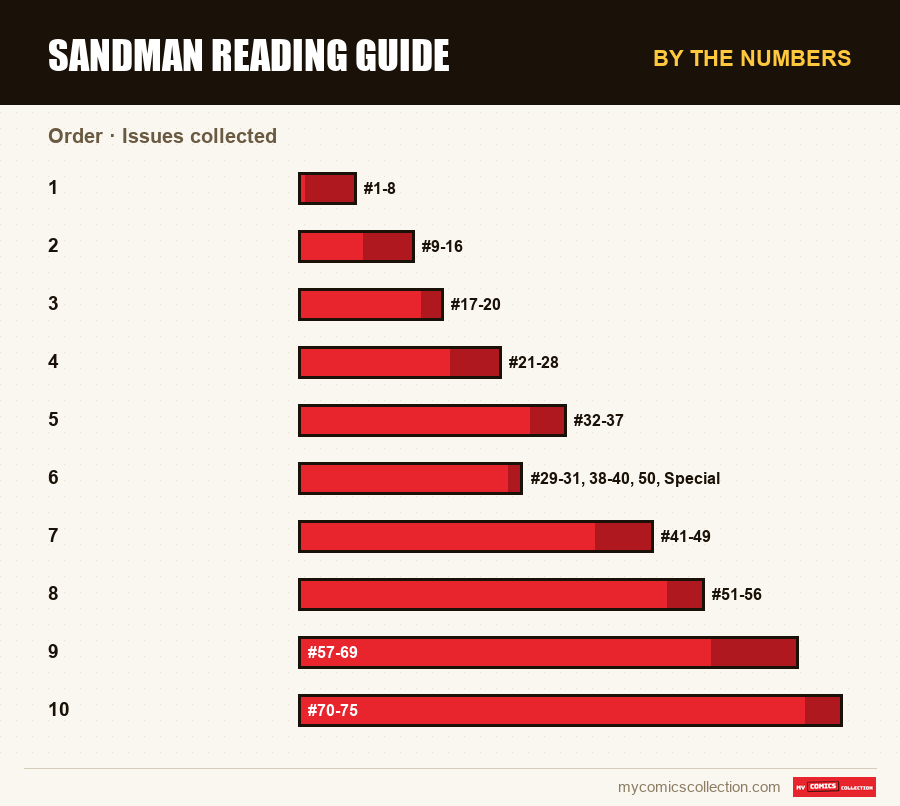
Sandman was built to be read in collected order. Each volume gathers one arc and a range of issues from the original run (1989-1996).
| Order | Volume | Issues collected |
|---|---|---|
| 1 | Preludes and Nocturnes | #1-8 |
| 2 | The Doll's House | #9-16 |
| 3 | Dream Country | #17-20 |
| 4 | Season of Mists | #21-28 |
| 5 | A Game of You | #32-37 |
| 6 | Fables and Reflections | #29-31, 38-40, 50, Special |
| 7 | Brief Lives | #41-49 |
| 8 | World's End | #51-56 |
| 9 | The Kindly Ones | #57-69 |
| 10 | The Wake | #70-75 |
One nuance: Fables and Reflections gathers issues published across scattered dates (notably #29-31 and #50), even though it sits at number 6 in editorial order. Read in the sequence above, it all holds together cleanly.
So when do you read Overture?
Sandman: Overture is a six-issue miniseries written by Neil Gaiman with art by J. H. Williams III, published from 2013 to 2015: seventeen years after the regular series ended. It's a prequel: it tells what comes before the opening of #1. Two schools of thought: read it last (recommended for a first pass, since it nods to the whole saga), or read it before volume 1 on a reread. The deluxe edition collecting all six issues came out in November 2015.
The issues to know for collecting
Beyond reading, a few standalone issues carry real historical weight. Values = median of active eBay listings (our estimator, all editions and grades combined), June 2026.
- #1:Sleep of the Just (January 1989). Gaiman's first issue, art by Sam Kieth then Mike Dringenberg, covers by Dave McKean. A median of €8 across 76 listings: very accessible and liquid, the logical starting piece.
- #8 (August 1989): first appearance of Death, Dream's sister and one of the most beloved Endless (created by Gaiman and Dringenberg). It's the series' most sought-after key. Listings are scarce and the market thin: when buying, check condition and live value rather than trusting a fragile median.
- #4: appearance of Lucifer, who would later get his own spin-off series. A median of €6 across 16 listings: accessible.
- #19:A Midsummer Night's Dream, the only comic ever to win the World Fantasy Award (Best Short Fiction, 1991). The win was so controversial that the rules were later changed to make comics ineligible in that category. Too few active listings for a reliable median: its value rests mainly on its aura.
Heads-up: three different characters share this name
If you're hunting for older Silver- or Bronze-Age "Sandman" issues, know that they do not belong to Gaiman's series. The Golden-Age Sandman is Wesley Dodds (first appearance in Adventure Comics #40, 1939). Another Sandman, created by Jack Kirby and Joe Simon, dates to 1974 (Bronze Age). Gaiman's Morpheus is a Modern-age character (1989): his series therefore has no Silver- or Bronze-Age issues. To collect "the" Gaiman Sandman, target the 1989-and-after keys: not these same-name characters.
Tips to get started right
- Start with the collected volumes, not single issues. The story was designed in volumes; that's the smoothest and least expensive read.
- Read in the table's order. Sandman builds by accumulation: skip a volume and you miss threads that tie off in The Kindly Ones and The Wake.
- For collecting, aim for #1 as a single (€8, very liquid) before chasing #8, which is rarer and pricier. And always check live value: the medians above are from June 2026 and they move.
Own a Sandman issue? Get a free valuation with our tool based on real eBay sales to find its low, median and high value.
Frequently asked questions
With volume 1, Preludes and Nocturnes, which collects issues #1 to #8, including Sleep of the Just (January 1989). The best entry point is not the most expensive issue but the first collected volume, read in order.
Preludes and Nocturnes, The Doll's House, Dream Country, Season of Mists, A Game of You, Fables and Reflections, Brief Lives, World's End, The Kindly Ones, then The Wake (#70-75). Skipping a volume means missing threads that tie together in The Kindly Ones and The Wake. Fables and Reflections gathers issues published at spread-out dates, but reads well in that spot.
It is a six-issue miniseries written by Neil Gaiman and illustrated by J. H. Williams III, published from 2013 to 2015. It tells what precedes the opening of #1. For a first read, reading it last is recommended, since it winks at the whole saga. The deluxe edition collecting the six issues came out in November 2015.
#1 (January 1989), the logical starting piece, very accessible. #8 (August 1989), the first appearance of Death, is the most sought-after key. #4 presents Lucifer, who would get his own spin-off series, and #19, A Midsummer Night's Dream, is the only comic to have won the World Fantasy Award (1991).
Yes, three characters bear that name. The Golden Age Sandman is Wesley Dodds (Adventure Comics #40, 1939), another, created by Jack Kirby and Joe Simon, dates from 1974, and Gaiman's Morpheus is a modern character (1989). To collect Gaiman's, target issues from 1989 onward.