On this work, the collection is not a convenience: it is the only economically defensible path. As of August 29, 2026, a volume of the flexible line is expected to be $26.99 median: barely more than a single original issue, the median of which is $19.99, even though it brings together a large number of them. High-end hardcover editions go up to $59.75 median. Buying in numbers only makes sense here to own the object, never to read.
This is the exact opposite of the situation observed on other authors of this campaign, and the discrepancy deserves to be explained.
This article compares the three access routes, explains what the survey shows with its limits, details the successive divisions, and indicates what to buy according to use.
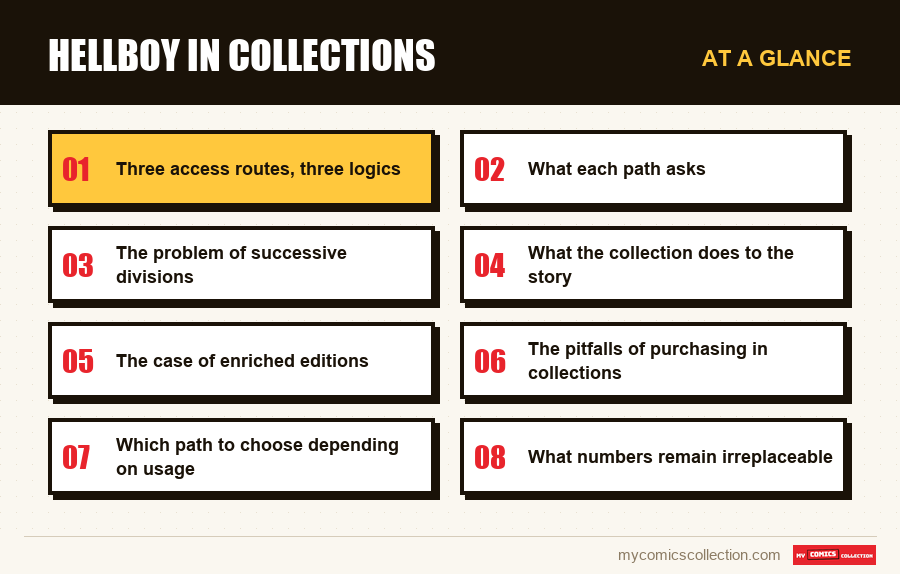
Three access routes, three logics
You must place the objects before comparing them, because they are not intended for the same use.
The original numbers. The initial publication form, with its period covers and period manufacturing. This is the historical object.
The flexible collection line. Volumes that bring together the stories in large blocks, in a handy format and at a reasonable price. This is the way of reading.
Large format bound editions. Neat volumes, better printed, often enriched. This is the way of conservation and rereading.
These three paths coexist on the market without replacing each other. Choosing comes down to deciding what you want to do with the work, not to decide on value for money.
What each path asks
The values below come from fixed price announcements noted on August 29, 2026. These are asking prices. Searches are carried out on entire rows and not on a single reference, which widens the ranges.
The flexible line
199 ads, of $8.95 to $549.99 requested, median $26.99. Several volumes are between $9 and $13.
The maximum is an isolated value unrelated to the current market of the line.
The bound editions
118 ads, from a few dollars to $600.00 requested, median $59.75. Superior manufacturing, larger format.
The research also goes back to neighboring works, which stretches the bottom of the range.
The numbers, for comparison
Raw median $19.99 out of 124 ads, and $19.98 for the first number out of 112 ads.
The resulting calculation
A $26.99 softcover volume contains the equivalent of many issues at $19.99 each. The relationship is not tight: it is overwhelming.
Why is the calculation so clear-cut here?
On other works from this campaign, the arbitration between numbers and collections required discussion. Here, no, and the reason comes down to a single number.
The price of the isolated number is high. A median of $19.99 per issue puts single purchase out of reach for continued reading. On series at $3 per issue, the question was posed differently.
The price of the collection is not. The flexible line remains within an ordinary edition range, with no premium linked to the status of the work.
The relationship between the two is therefore unparalleled in what this campaign has identified. A single issue costs almost the price of an entire volume, which settles the question for any reader.
There remains one case where the numbers retain their meaning: that of stories never repeated in volume. They exist on any branched work, and they are the only defensible single purchases.
A reservation of method on these figures. Searches cover entire lines, dozens of different volumes, and not a specific reference.
Medians therefore describe the general level of a collection, not the price of a given title. A depleted volume will require significantly more, a tidal volume significantly less. These figures are used to compare access routes, not to evaluate an example.
The problem of successive divisions
This is the real difficulty of this collected work, and it is structural rather than accidental.
The stories have been brought together according to several logics over the decades: first by narrative arc, then by larger groupings, finally in prestigious editions with even different divisions.
These lines largely overlap without anything indicating it. The same story appears in three volumes of three collections, with different titles and unrelated numbering.
A reader who buys based on what he discovers therefore accumulates duplicates of content while leaving gaps elsewhere: a configuration that is exactly the opposite of what he believes to constitute.
The solution is simple but it requires a prior decision: choose a line and stick to it, even if it means supplementing later with the stories that it does not cover.
What the collection does to the story
Beyond the price, the increase in volume modifies the experience, and the effect here works in favor of the collection for a specific reason.
This work alternates long stories and stories of a few pages. In monthly publication, this alternation was endured: we received what appeared, and the short stories arrived between two arcs without us having chosen them.
In collection, the alternation becomes a composition. The volumes group the short stories together and the long arcs together, which allows you to choose your reading regime. We read twenty closed stories in a row, or just one out of two hundred pages: two very different experiences of the same work.
The benefit is particularly clear for short stories, which benefit from being read in series: the folklore motifs echo from one story to another, and this resonance was invisible at the rate of one issue every two months.
This is an argument that the price does not say and which carries as much weight as it does. The collection does not just cost less: it provides access to reading that the original publication did not allow.
The case of enriched editions
A clarification on what prestige editions actually add, because the argument is often vague.
They generally include pages of sketches, collected covers, sometimes author's comments on the creation of the stories. This material is real and it has unequal interest.
Sketches are worth more than comments on this precise designer, because they show the stage where the black masses are decided: that is to say the exact place where his method takes place, invisible on the finished board.
The collected covers have less documentary value, these images circulating widely elsewhere.
For a reader curious about the method rather than the object, this is therefore the decisive argument in favor of bound editions, more than the format or the binding. It's worth checking what's in an edition before paying the spread.
Collecting this series?
Track what you own, what you are missing and what your collection is worth. 7 day trial.
Start my trial →The pitfalls of purchasing in collections
Collections that overlap
Three lines bring together the same stories under different titles and numbering, without cross-mention.
Out of print volumes
A non-print volume wonders well above the median of its line, regardless of its content.
Variable print quality
On a drawing based on solid areas, a mediocre print makes the blacks dull. Not all editions are equal.
Incompatible formats
Soft, bound, large format: a collection put together at random does not line up on the shelves and is difficult to handle.
Finally, a remark on the pace of purchase. The soft line is regularly reprinted, which means that waiting costs nothing on current volumes: they come back into stock, and their asking price remains stable. The reasoning is reversed for volumes out of print, the supply of which is not renewed: these are the only ones on which hesitation has a real cost, and it is better to identify them before looking for them.
Which path to choose depending on usage
Three profiles, three clear answers.
To discover: the flexible line, a volume. At $9 to $13 for the cheapest, the essay costs less than a single original issue and gives a complete narrative rather than a fragment.
To read the whole thing: the flexible line, in full. It is the best content-price ratio, and the homogeneity of format facilitates reading followed by a branched work.
To reread and keep: bound editions. The median at $59.75 is justified by superior manufacturing, which is what really counts for this designer: the solid colors are better rendered.
This last point is not an argument for comfort. On a design built on the sharpness of the edges, the print quality is part of what we judge, and the gap between a careful edition and an ordinary print run is visible to the naked eye.
What numbers remain irreplaceable
It would be unfair to dismiss them entirely, and two reasons hold.
The stories never repeated. On a work available in numerous titles, certain one-off publications have never been included in a volume. They can only be obtained in numbers, whatever their price.
The period object. Possessing the first issue in its original edition is for a legitimate reason which has nothing to do with reading: provided you name it as such, and check the year, an anniversary reprint bearing the same title and the same number.
Apart from these two cases, purchasing in numbers amounts to paying an entire volume for a fragment. It's a collector's decision, not a reader's decision, and the two are not confused here.
What to record
On this work in collections, the decisive field concerns the content and not the container.
The list of stories contained in each volume, under their proper title. Three lines of collections bring together the same stories under titles and numbering without correspondence: only a sheet at the level of the story allows you to know if a volume seen in the bookstore adds something or repeats what you already have.
It is tedious at the time of purchase and it avoids the most frequent expense on this work: repurchasing content in another packaging.
The editorial line of the volume, noted separately from the title: it is this which determines the format, the printing quality and the perimeter, three pieces of information that no collection number restores.
These two fields address the one costly problem in this collection, which is neither rarity nor price, but the invisible overlap between competing lines.
Frequently asked questions
The collection, without discussion. A soft line volume is asking at $26.99 median when a single original issue is at $19.99: the ratio isn't tight, it's overwhelming. The numbers only retain their meaning for the stories never repeated and for the period object.
On this specific designer, yes, and for a technical reason: his drawing is built on the sharpness of the flat areas, which a mediocre print impairs. The median at $59.75 is paid for in truly visible print quality, which would not be true of a designer responsible for hatching.
By noting the stories contained in each volume under their own title, never the only collection number. Three lines bring together the same stories under different titles and unmatched numbering, without any cross-reference.
No, and that’s a limit you need to know. Searches cover entire lines, dozens of volumes, so the numbers describe the general level of a collection. A depleted volume will require significantly more, a tidal volume significantly less.
By a volume of the soft line, the least expensive of which are between 9 and 13 $ requested: less than a single original issue, for a complete story rather than a fragment. The important thing then is to choose a line and stick to it.
Does this volume include what you already have?
Three lines bring together the same stories without ever pointing it out.