Start with the first long Hellboy story, collected, then read the short stories. It is the order which gives the character before giving the world. On the market side, beware of a major trap: on the August 29, 2026 statement, a search on the first number goes back several 2019 anniversary reprints at $1.49 mixed with original copies, for a gross median of $19.98 and a certified median of $375.00. The title and number are the same; twenty-five years separate them.
This author is the first in this campaign whose market reaches levels that make misidentification costly.
This article gives the reading order, explains what the reading shows, details the pitfall of reprints, and indicates what to check before buying.
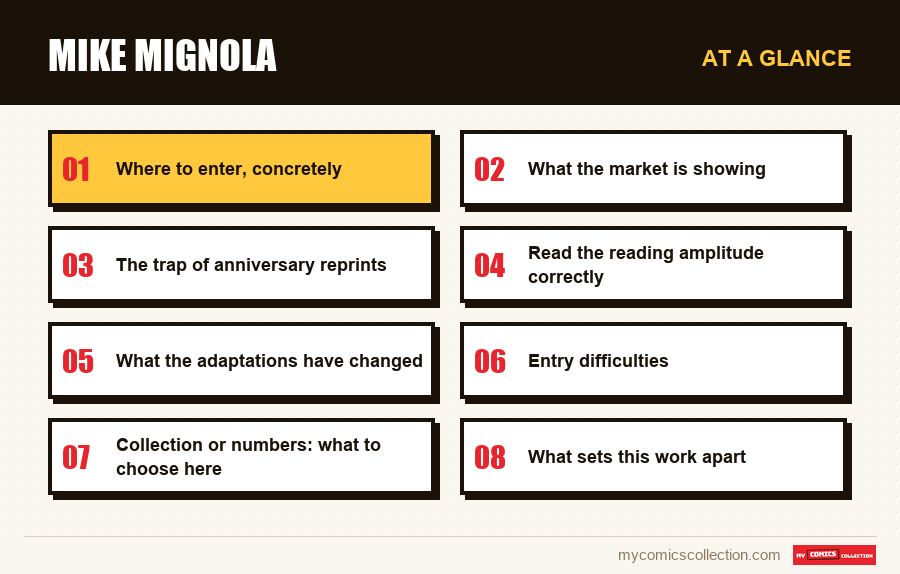
Where to enter, concretely
Three possible entries, and only one really recommended for a first contact.
The first long story, in collection. It establishes the character, his origin and the general framework in a story which concludes. It's self-contained, it's short, and that's enough to know if the registry is right for you.
Collections of short stories, then. They contain the best of the work (stories of a few pages based on folklore, often without explanation) but they are disorienting if you don't have the character in mind.
Spin-off series, later or never. The universe has expanded into several parallel titles, the interest of which presupposes a prior attachment.
The classic mistake is to start with short stories because they are better regarded. They are rightly so, and they do not function as a gateway: these are two compatible observations.
What the market is showing
The following values come from fixed price announcements recorded on August 29, 2026, raw and certified copies counted separately. An asking price expresses a seller's expectation.
The first number
Raw : 112 ads, of $1.49 to $1,599.00 requested, median $19.98. Certified: 10 ads, $115.00 to $480.00, median $375.00.
Raw amplitude is considerable and does not measure state.
The whole series
Raw : 124 ads, of $1.00 to $1,299.00 requested, median $19.99. Certified: 6 ads, median $164.97.
A median significantly higher than anything this campaign has seen so far.
Low entrances
Recent spin-off series numbers at $1.00 to $2.99 requested. They bear the name of the character without being part of the original series.
The certified ratio on gross
A certified median eighteen times higher than the raw median on the first issue. This is the widest gap encountered in this campaign.
The trap of anniversary reprints
This is the most important point of this article, and it is directly verifiable in the announcements.
The first issue was the subject of an anniversary reprint twenty-five years after its publication. This reprint has the same title and number as the original, and a search by title puts them together.
The statement shows the gap: anniversary copies are wondering $1.49, 4.20 and $4.55, when the median of the whole is at $19.98 and the certified portion is at a median of $375.00.
There is no deception on the part of the sellers: the advertisements noted clearly mention the anniversary mention. The risk is on the side of the buyer in a hurry which sorts by increasing price and believes it has found a bargain.
The rule is therefore simple and absolute on this title: check the year first, and be wary of a price that deviates too far from the median towards the bottom. In a market with a $20 median, a copy at $1.49 is not a good deal, it's another item.
This trap is not unique to this title. Any work that achieves lasting status eventually gets reprinted, and recent reprints almost always return to the original numbering.
What makes the case remarkable here is the magnitude of the gap: a factor of more than ten between the reprint and the median, and much more compared to the certified market. Few titles present such a steep slope between two homonymous objects.
Why is this market more expensive?
The difference with the authors covered previously in this campaign deserves to be explained, because it is structural.
Un personnage identifiable. Unlike a fragmented author bibliography, here there is a central figure that buyers are looking for by name. This is what organizes a request.
A dated and unique first appearance. It provides the piece around which a collection is structured-exactly what was missing from the flat bibliographies previously studied.
Un marché certifié réel. Ten certified listings at $375.00 median on a single issue are enough to remove the best copies from the raw market, supporting prices.
A reputation maintained by adaptations. The character has appeared on screen, which periodically fuels demand from outside the industry.
These four factors reinforce each other. They describe the normal functioning of a collection market, of which previous bibliographies on the contrary showed the absence.
Read the reading amplitude correctly
The ranges noted range from a few dollars to four figures, and this range calls for careful reading.
On most series, a difference of this magnitude in rough reflects a difference in condition: a tired copy versus an impeccable copy. This is not the main factor here.
Three different objects coexist under the same title: the anniversary reprint at the bottom of the range, the ordinary original copy around the median, and four-figure requests that are for copies signed, autographed, or simply displayed by optimistic sellers.
High extreme values deserve the same suspicion as everywhere else. A maximum of $1,599.00 isolated among 112 advertisements whose median is $19.98 does not describe a market price but a proposal.
The useful reading is therefore that of the median and the certified slope, one of which is based on 112 observations and the other on 10. The rest is noise, and it is particularly noisy here.
What the adaptations have changed
The character has appeared on screen several times, and it must be said honestly what the data allows us to conclude.
A survey of current advertisements does not measure any evolution: it photographs what sellers are asking for today, without any previous point of comparison. Claiming that the adaptations caused prices to rise would require spaced readings and concluded sales., which I do not have.
What is observable, however, is the structure: a real certified market where most independent series have none, and demand organized around a first identified issue. These two features clearly distinguish this title from previous bibliographies of this campaign.
An adaptation plausibly contributes to this organization, by bringing in buyers from outside the area who are looking for a specific entry point. But it's an explanation, not a measure.
The distinction matters, because “movies drove up prices” is the most widespread and least verified assertion in the industry.
Collecting this series?
Track what you own, what you are missing and what your collection is worth. 7 day trial.
Start my trial →Entry difficulties
Homonymous reprints
Same title, same number, twenty-five years apart and a factor of ten on the asking price.
A branched universe
Many parallel series are named after the character without being part of the original series.
Multiple designers
Some of the stories are drawn by others. The author's name does not guarantee his writing.
Two cuts in collection
The stories have been brought together according to successive logics which do not overlap.
Collection or numbers: what to choose here
The question is asked differently than in the previous series of this campaign, and the answer is clear.
With a median gross of $19.98 for the first issue and original copies rarely below that, compiling the series into issues represents a commitment unlike reading in collections.
To read, the collection is essential without discussion: it brings together a complete story for the price of one or two isolated issues, in generally superior production.
The issues retain their interest for two uses only: owning the original object, or accessing one-off stories never repeated in volume. These are legitimate reasons, provided you name them.
He is the first author of this campaign where the advice is so frankly reversed. In previous bibliographies, the one-dollar issues made purchasing individually reasonable; here it is no longer.
What sets this work apart
A quick assessment, to situate what we are going to read.
A drawing built on black. The shadows do not shape the volumes: they occupy the page as autonomous masses, often larger than what they should cover. This is the most immediately recognizable trait.
A documented use of folklore. The stories draw on real, often obscure, European folk traditions and use them without explaining them.
A refusal to conclude. Many short stories end without resolution, leaving a situation open. It's a constant bias, and it's confusing at first contact.
These three features make the work recognizable as a plate. This is rare, and this explains why it produced a school rather than just a hit series.
What to record
In this series, one field takes precedence over all others and its absence is costly.
The year of printing of each copy, distinct from the year of first publication. It's what separates an original copy from an anniversary reprint with the same title and number: two items whose asking prices differ by a factor of more than ten.
Unlike previous bibliographies in this campaign, where a misidentification cost a few dollars, the error here is in the hundreds.
The actual designer of each story, a part of the universe being drawn by others: this is what allows you to find what is your own hand, information that no collection title gives.
These two fields answer the only two costly questions in this collection: when does this copy date from, and who really drew it?
Frequently asked questions
By the first long story, in a collection: it establishes the character, his origin and frames it in a story which concludes. Short stories, often better considered, do not work as a gateway: they are disorienting until you have the character in mind.
Because it is an anniversary reprint published twenty-five years after the original, bearing the same title and the same number. The sellers mention it correctly; the risk is on the side of the buyer who sorts by increasing price. In a market with a median of $19.98, a copy at $1.49 is another item.
This is the only series of this campaign where the question really arises: ten certified ads at $375.00 median versus $19.98 gross, a difference of eighteen times. On an object where identification is difficult, certification provides a guarantee which has real value here.
No. The universe has branched into numerous parallel series, some of which are drawn by others: this explains the $1.00 or $2.99 numbers noted. The name on the cover does not guarantee its lineage or writing on these titles.
The treatment of black: the shadows do not model the volumes, they occupy the page as autonomous masses often larger than what they should cover. Added to this is a documented use of real European folklore and a frequent refusal to conclude the short stories.
Original edition or reprint?
Same title, same number, twenty-five years apart, and a factor of ten on the price.