To discover Alan Moore, start with a short, complete story rather than his most famous work. The best first step is "For the Man Who Has Everything" (Superman Annual #11, 1985, with Dave Gibbons), followed by the start of his Swamp Thing (Saga of the Swamp Thing #21, "The Anatomy Lesson", 1984). Next comes Watchmen (12 issues, 1986-1987), which reads better once you have seen Moore handle the conventions of superheroes. After that, three directions: the political fable with V for Vendetta, the historical tale with From Hell, and the game with the history of fiction in The League of Extraordinary Gentlemen (1999). Save Promethea and Providence, which are more demanding, for later. This path fits into about ten reads, from the most accessible to the most ambitious.
Alan Moore has a reputation as a difficult author, and that reputation scares off many readers before the first page. It is partly unfair. Moore has written stories of perfect clarity, often short, often funny, and sometimes published in titles you would take for children's reading. The problem is not the author: it is the order in which you approach him.
Opening Watchmen first, as most curious readers do, is like starting a composer with his densest symphony. You can love it, but you miss part of what is going on, because the book comments on forty years of superhero comics that the new reader does not always know. This guide offers another route, step by step. For the author's life, his training and his relations with publishers, see our history of Alan Moore: here, it is only about reading.
The principle of the path
Moore's bibliography sorts fairly naturally into three periods. The first, British, in the early 1980s, in weeklies and anthology magazines. The second, American, from 1983 to the end of the decade, when he took over characters belonging to the big publishers. The third, from 1999, with his own line of series, then more personal projects until his withdrawal from comics in the late 2010s.
The path below does not follow that chronology. It follows difficulty. The first steps are short stories that you can read in one evening and that require no prior knowledge. The last ones assume time, patience and sometimes notes. In between, everyone can stop where their interest leads them.
Step 1: two Superman stories to get in
"For the Man Who Has Everything"
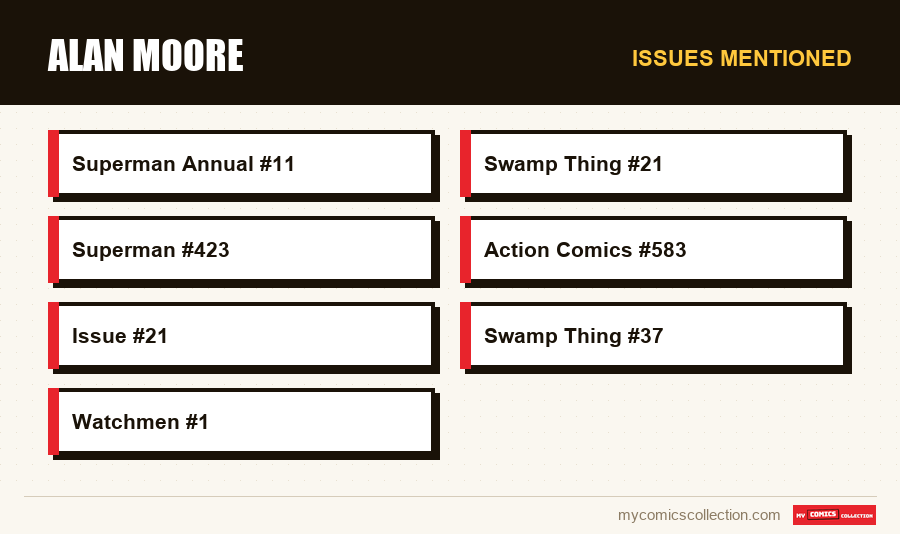
On his birthday, Superman is trapped by a parasitic plant that makes him live the life he would have had if Krypton had never exploded. Batman, Robin and Wonder Woman try to pull him out of the dream. In a single story, Moore already shows everything: respect for the character, the cruelty of the dilemma, and a sense of rhythm that leaves nothing to chance.
"Whatever Happened to the Man of Tomorrow?"
Written to close the historic version of Superman before its 1986 reboot, this two-part story is designed as a "last story". Moore gathers the enemies and friends of three decades, with a tenderness that surprises in an author reputed to be cold.
Step 2: Swamp Thing, horror as a laboratory
Moore took over Saga of the Swamp Thing at #20, dated January 1984, and kept it until #64, in 1987, with Stephen Bissette and John Totleben as main artists. It is the series that made him known in the United States, and it is also the one where you can best see how he works: he takes an existing character, keeps everything that has been published, and changes only the way of looking at it.
Issue #21, "The Anatomy Lesson", is the perfect demonstration. In one issue, without contradicting a single line of what came before, Moore reveals that the creature is not a man turned into a plant, but a plant that believes it was once a man. The whole rest of the run flows from that idea.
For a reader in a hurry, issues 21 to 27 form a first satisfying set. For a collector, #37 counts separately: it marks the first appearance of John Constantine, detailed on our page for Saga of the Swamp Thing #37. The arc leading to that issue, "American Gothic", is also where the series takes on its political dimension, with stories about racism, gun violence and industrial pollution.
Step 3: Watchmen, now
Once these two steps are done, Watchmen reads differently. You recognize the way Moore builds a moral dilemma around a hero, you have seen how he shifts the view on an established character, and you can concentrate on what is unique about the book: its construction.
The twelve issues published between 1986 and 1987, drawn by Dave Gibbons and colored by John Higgins, are organized with rare rigor. Each chapter rests on a nine-panel grid that Gibbons varies, each issue ends with fictional documents, and issue 5, "Fearful Symmetry", is built as a mirror around its central double page. This is not a scholar's detail: it is how the book makes its meaning.
The most useful advice is to read slowly, and not to skip the text pages at the end of each chapter. They contain part of the story, notably about the first generation of vigilantes. For the place of each issue in a collection, see our key issues of Watchmen and the page for Watchmen #1.
Step 4: choose a direction
After Watchmen, Moore's work branches out. Rather than reading everything in order, choose the branch that appeals to you.
The political fable: V for Vendetta
Begun in 1982 in the British magazine Warrior, interrupted when the magazine folded, then completed at DC in ten issues between 1988 and 1989, V for Vendetta is drawn by David Lloyd in black and white that was later colorized. It is the story of a masked anarchist facing a fascist regime in an imaginary Britain. The story is more direct than Watchmen, more angular too, and its first chapters bear the mark of an author still finding himself. It is worth it for its main character, and for Evey, whose journey is the true subject of the book.
History and the occult: From Hell
With Eddie Campbell on art, Moore devoted nearly ten years, from 1989 to the 1999 collected edition, to a reconstruction of the Whitechapel murders. It is a massive black-and-white book, accompanied by dozens of pages of appendices where the author explains his sources and his choices. It is not a detective story: the culprit's name is given early. It is a reflection on how an era manufactures its monsters. Our article From Hell, the film versus the comic measures everything the movie adaptation left aside.
The game with fiction: The League of Extraordinary Gentlemen
Launched in 1999 with Kevin O'Neill, the League brings together characters from Victorian literature, Allan Quatermain, Mina Murray, Captain Nemo, the Invisible Man, Doctor Jekyll, in a team serving the Crown. The first volume is a brisk, accessible adventure story. The following ones become denser and denser, until they turn the series into an encyclopedia of all popular fiction. Read the first volume; then decide.
The superhero, differently: Miracleman and Top 10
Miracleman, begun in 1982 in Warrior, is the brilliant draft of Watchmen: the same question, what would happen if a superman really existed, pushed to its ultimate consequences, with an ending of a violence that marked a whole generation. Top 10, with Gene Ha and Zander Cannon, in 1999, is its bright side: a police precinct in a city where everyone has powers, treated as an ensemble police series.
Step 5: the demanding works
Some of Moore's books demand a real investment. They are not the best to start with, but they are among the most personal things he has done.
Promethea (1999-2005, with J.H. Williams III) starts from a pulp heroine and becomes an illustrated treatise on magic, language and imagination. Williams's pages are among the most inventive in the medium, but the text at times becomes a lecture.
Providence (12 issues, 2015-2017, with Jacen Burrows) is a dive into the universe of H.P. Lovecraft, through a journalist of the 1910s. It is a slow, documented horror story, which assumes a minimum of Lovecraft knowledge to catch its echoes. It closes a cycle begun with shorter stories on the same theme.
The Killing Joke (1988, with Brian Bolland) deserves a separate mention. It is not a difficult book, it is a short, hard book, which Moore himself judged severely afterward. It shaped the portrayal of the Joker for a long time. Our article on the editions of The Killing Joke details its different printings.
The British works, for the curious
Part of Moore's work remains little known outside the United Kingdom, because it appeared in anthology weeklies. Two titles are worth seeking out. The Ballad of Halo Jones, with Ian Gibson, published between 1984 and 1986, follows an ordinary young woman in a distant future: it is one of his most endearing stories, left unfinished. Captain Britain, with Alan Davis, in the early 1980s, is his first important contribution to the Marvel universe, and an excellent classic superhero story.
How to read: single issues or collected editions
For reading, the collected edition almost always wins. Moore's major works were designed as wholes, and most are available in complete editions. The original single issues have another interest: that of the object, the period advertising, the letters pages, and sometimes differences in coloring.
For a collector, the rule is to separate the two approaches. You read in collected editions, you collect single issues, and for the latter you choose the issues that have a reason to be sought: first appearances, first issues of a series, pivotal issues. The Watchmen hub gathers everything about that title in particular.
Recap: the recommended order
Superman Annual #11 (1985)
A complete story, the same team as Watchmen.
Superman #423 and Action Comics #583 (1986)
The farewell story, for its tenderness.
Saga of the Swamp Thing #21 to #27 (1984)
The Moore method at work, then the rest of the run if you feel like it.
Watchmen (1986-1987)
Slowly, with the text pages.
A branch of your choice
V for Vendetta, From Hell, The League, Miracleman or Top 10.
The demanding works
Promethea, Providence, and the British stories.