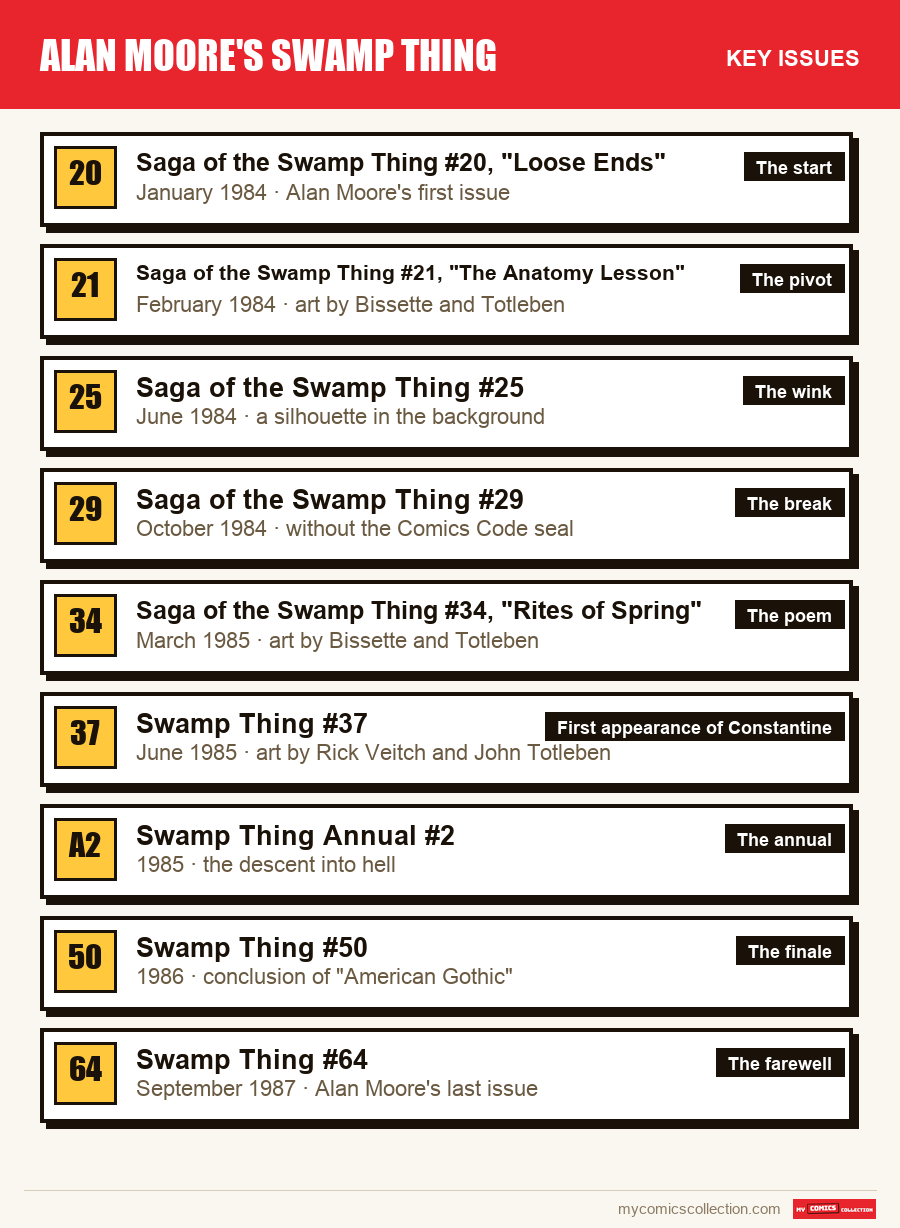
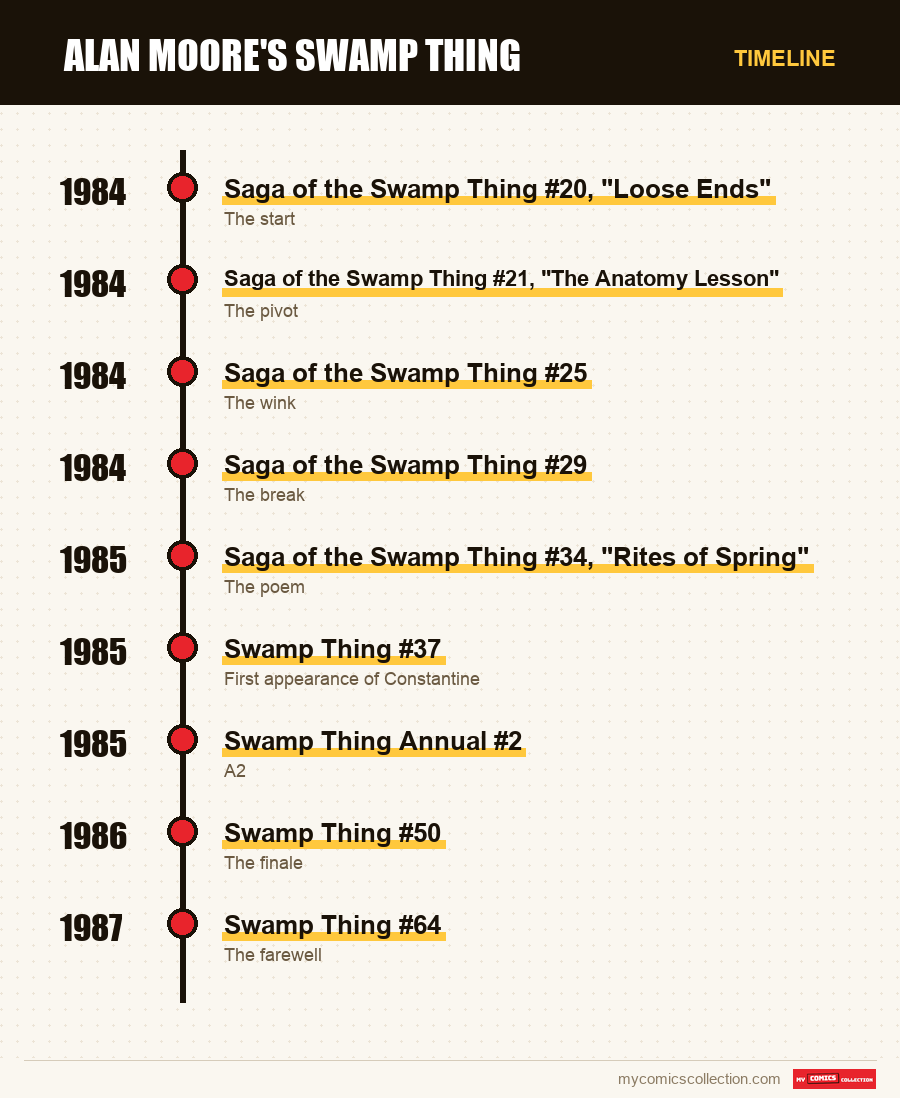
Alan Moore writes Swamp Thing from Saga of the Swamp Thing #20 (January 1984) to Swamp Thing #64 (September 1987), with Stephen Bissette, John Totleben then Rick Veitch on art. The run's key issues are: #21, "The Anatomy Lesson" (February 1984), which rewrites the character's origin; #29, published without the Comics Code seal; #34, "Rites of Spring"; #37 (June 1985), first appearance of John Constantine and start of the "American Gothic" cycle; Annual #2 (1985), the descent into hell; #50, conclusion of "American Gothic"; and #64, Moore's last episode. #37 is the most sought, far ahead of the others; #21 comes next for its literary importance.
In early 1984, Saga of the Swamp Thing is a series relaunched two years earlier to accompany a film, whose sales no longer justify much. DC is about to stop it. The publisher then takes a cheap gamble: entrust the title to a British writer almost unknown in the United States, Alan Moore, and let him do whatever he wants. Three and a half years later, the series has become the matrix of a whole generation of adult comics, and one of its supporting characters has his own series.
This article does not tell Alan Moore's life, which the site already covers in his creator biography, nor the 2019 TV series. It does one precise thing: identify, issue by issue, the issues that matter in this run, for reading and for collecting.
The context: a series on borrowed time
Swamp Thing is born in 1971 in a short story of the anthology House of Secrets #92, signed Len Wein and Bernie Wrightson. The same creators give him his series the following year: Alec Holland, a scientist murdered in a Louisiana swamp, is reborn as a plant creature. The first series stops at #24, in 1976. The character returns in 1982 in Saga of the Swamp Thing, launched to capitalize on Wes Craven's film, with Martin Pasko on script. Pasko leaves the series at #19.
Moore arrives with #20, dated January 1984, titled "Loose Ends." This first episode settles the plots left by his predecessor. The real start is the following issue. On art, Stephen Bissette and John Totleben form the team that gives the run its damp atmosphere, before Rick Veitch and Stan Woch take over, with inks by Alfredo Alcala. Moore writes almost every issue until #64, #62 being entrusted to Veitch.
The key issues, in release order
Saga of the Swamp Thing #20, "Loose Ends"
A transition episode, which closes the threads of the Pasko period and sets the scene. To read to understand where Moore starts from, not for what he invents. For a collector, it is nonetheless Alan Moore's first issue on a regular DC title, which gives it a place of its own in collections devoted to the writer.
Saga of the Swamp Thing #21, "The Anatomy Lesson"
The Floronic Man, a minor villain, performs an autopsy on the creature and discovers that its organs are only plant imitations, with no function. Conclusion: Swamp Thing was never Alec Holland transformed. He is a plant that believed itself to be Alec Holland. In one issue, Moore changes the character's nature, and with it the question the series poses: no longer "will he become human again?" but "what is he?"
Saga of the Swamp Thing #25
Bissette and Totleben slip in a background silhouette with the features of the singer Sting, wearing a striped t-shirt. It is not yet Constantine, and serious sources do not present it as his first appearance. But it is the first sign of the artists' wish to draw a character with this face, a wish Moore will turn into a full character a year later.
Saga of the Swamp Thing #29
The story, which deals with incest and possession by Anton Arcane, is published without the seal of the era's self-censorship authority. For a major publisher's series distributed at newsstands, it is a strong gesture, which announces what follows: from then on, Swamp Thing owns being a horror series for adult readers.
Saga of the Swamp Thing #34, "Rites of Spring"
Abby Arcane and Swamp Thing confess their love and share a hallucinogenic experience by eating a tuber produced by the creature. The episode is almost without action, entirely carried by text and painted pages. It shows how far Moore and his artists could push a major publisher's monthly series.
Swamp Thing #37
John Constantine, a London magician of dubious morality, enters the series as Swamp Thing's guide. This issue opens "American Gothic," the cycle that takes the creature across the United States to face variations of American horror. Constantine then appears in a cameo in Crisis on Infinite Earths #4, released two weeks later. The Saga of the Swamp Thing #37 sheet details its importance.
Swamp Thing Annual #2
To save Abby's soul, Swamp Thing descends into hell in a story built on the model of Dante's Inferno. He meets figures from DC's supernatural universe, including Deadman, the Spectre, Etrigan and the Phantom Stranger. Moore lays the foundations of the cosmology other writers will later take up.
Swamp Thing #50
The anniversary issue closes the cycle opened at #37 with a confrontation between forces of good and evil on a cosmic scale, with a large part of DC's magical cast. It is the culmination of the construction work begun in Annual #2.
Swamp Thing #64
After a long exile in space, of which #60 "Loving the Alien" is the most experimental episode, Swamp Thing finds Abby again. Moore concludes his run on a peaceful epilogue. Rick Veitch, until then the artist, becomes writer from the next issue.
The other episodes not to skip
The sheets above do not say everything. Several issues have no "key" status, but count for reading. #32, "Pog," pays homage to Walt Kelly's Pogo with extraterrestrial visitors with the look of comic-strip animals: a tender parenthesis in a dark series. Issues 22 to 24 extend "The Anatomy Lesson" and set up the creature's relationship to the Green. The "American Gothic" cycle, between #37 and #50, contains remarkable stories on werewolves, the vampires of a reservoir lake or racial violence, which read as almost standalone stories.
Moore also invents over the run a mythology that will outlive him: the Parliament of Trees, assembly of previous plant elementals, and the idea that there were many Swamp Things before this one. He also rereads forgotten DC characters, like Cain and Abel, the Phantom Stranger or the Floronic Man. It is this taste for the nooks of the catalog that Neil Gaiman and others will extend, and that will lead to the creation of the Vertigo label in 1993, told in our history of the Vertigo label.
An inventory trap: the title change
The series starts under the name Saga of the Swamp Thing and keeps it for 38 issues. From #39, the title becomes simply Swamp Thing, with no restart of the numbering. #37, Constantine's first appearance, is therefore sold sometimes under one, sometimes under the other name depending on sellers, while the cover of the time still carries the long title. For your records, the important thing is to keep a single series with continuous numbering, and to note the exact title of each cover.
Another trap: so-called "newsstand" and "direct" editions coexist in these years. The former were intended for newsstands, with a barcode, the latter for specialty shops, with a logo in its place. The content is identical; some collectors have a preference, and the proportion between the two varies by issue.
What to aim for by budget
For a reader, the cheapest solution remains the collection: Moore's run has been reissued several times in albums and bound volumes, and these editions include Annual #2. For a collector who wants single issues, three approaches exist.
The single piece
#37 alone, in the best condition your budget allows. It is the issue that concentrates market interest and resells most easily. Demand photos of the spine and staples, and favor a certified copy if the amount becomes significant.
The four pillars
#20, #21, #29 and #37 form a coherent set: Moore's start, the character's reinvention, the break with the Comics Code, Constantine's birth. The first three remain clearly more accessible than the last.
The complete run
From #20 to #64, plus Annual #2. It is the most satisfying goal for a reader, and often the cheapest per issue if you buy in lots. Issues 40 to 64 are those most often missing.
No price is given here: the gaps between conditions are considerable on 1980s issues, and only a specific copy can be estimated. The estimate tool starts from your issue's real condition.
Swamp Thing after Moore, in a nutshell
Rick Veitch takes over and writes 24 issues until a break with DC, which refuses to publish #88. These unpublished episodes are due out in 2026 under the Black Label imprint, under the title Swamp Thing 1989. The series then continues with Doug Wheeler, Nancy A. Collins then Mark Millar. Constantine, for his part, gets his own series in 1988, Hellblazer. For the screen, our comparison between the 2019 series and the comics shows what it owes to Moore's run, and the one devoted to the 2005 Constantine film follows the run's other heir. Fans of the genre will find other leads in our guide to collectible horror comics.