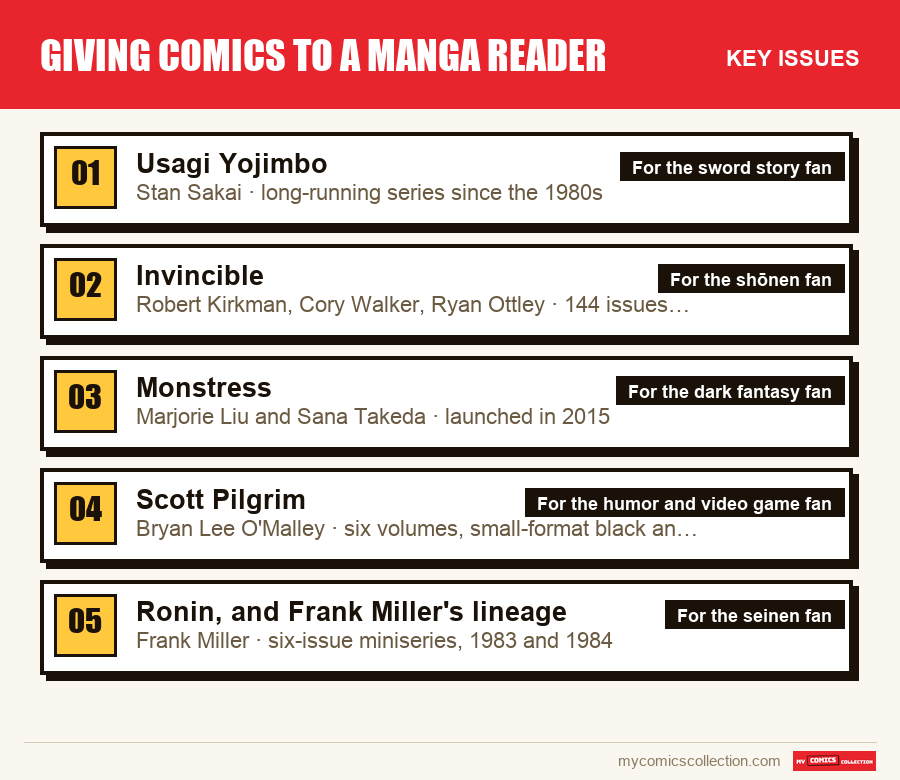
To give comics to a manga reader, look for what they already love in manga rather than a famous superhero. If they like sword stories and Japanese history: Usagi Yojimbo by Stan Sakai, in black and white, a long-running series. If they like long, finished series like a shōnen: Invincible by Robert Kirkman, completed in 144 issues. If they like dark fantasy: Monstress by Marjorie Liu and Sana Takeda. If they like humor and video game culture: Scott Pilgrim by Bryan Lee O'Malley, six volumes in small-format black and white. If they like Japanese art applied to Western characters: the work of Peach Momoko at Marvel. Always favor a collected edition or an omnibus, never an isolated single issue.
A manga reader is not a reader you have to convert. They read a lot, often more than a comics fan, they know the medium, and they have precise tastes. What puts them off in American comics is not the medium, it is the packaging: thin single issues, numbering that restarts at 1 every three years, characters who appear in ten series at once, and a continuity that seems to demand forty years of prior reading. The right gift is the one that removes these obstacles.
This article does not revisit the differences in classification between comics, manga and European comics, which our article European comics, American comics and manga: how to classify them covers, nor the management of a mixed collection, the subject of our guide to a mixed collection of comics, European comics and manga. It offers bridges: titles chosen because they speak a language a manga reader already knows.
What a manga reader expects from a book
Before choosing a title, you need to understand what makes a manga reader comfortable. Four habits come up almost every time.
The bound volume. Manga is read in volumes of nearly two hundred pages, which contain several chapters and form a stage of the story. An American single issue of about twenty pages will seem tiny to them, and they will feel like they are reading an excerpt. The collected edition, which gathers five or six issues, is the natural equivalent of the volume.
One series, one creator, one story. A manga is most often the work of one creator or a duo, who tells a story from beginning to end. The idea that a character changes writers every two years, and that their story has no planned ending, is foreign to many manga readers. Creator-owned works, where a stable team tells its own story, are therefore the best bridge.
Black and white holds no fear. This is an often forgotten advantage: a manga reader has no prejudice against black and white, which a comics reader sometimes associates with a cheap edition. That opens up titles other readers overlook.
A taste for long series. Many manga readers follow series of several dozen volumes. They do not fear length; they fear the absence of an ending. A long but finished series is an ideal gift.
The bridges, by taste
Usagi Yojimbo
A wandering samurai rabbit in a medieval Japan inspired by real history and sword cinema. The art is in black and white, the layout crystal clear, the historical research remarkable. A single creator, from the start. It is the most natural bridge there is between the two traditions.
Invincible
A teenager discovers he has inherited the powers of his father, the most powerful hero on Earth. The series takes up its codes, the power escalation, the spectacular fights, the twists, and it has a real ending. For a shōnen reader, it is the superhero series that looks most like what they love.
Monstress
An Asian-inspired fantasy, in a world ravaged by war, around a young woman bound to a monstrous creature. The art of Sana Takeda, a Japanese artist, blends manga and Art Nouveau influences, with a density that rewards rereading. The series has won several awards.
Scott Pilgrim
A young musician must defeat the seven evil exes of the girl he loves. The story borrows its format, its expressive art and its exaggerated fights from manga, and its codes from video games. Six volumes, a complete story. It is probably the Western comic most directly influenced by manga.
Ronin, and Frank Miller's lineage
A masterless samurai wakes up in a futuristic New York. Miller applies there what he learned from Lone Wolf and Cub by Kazuo Koike and Goseki Kojima: cinematic layout, silences, long sequences without text. Miller even drew covers for the American edition of that manga.
Superheroes, through the Japanese door
Some manga readers will want to discover the big American characters anyway. There are versions that lead them there by a familiar path.
The most obvious is the work of Peach Momoko, a Japanese artist who has reinterpreted many Marvel characters through Japanese folklore, notably in the series Demon Days. Her watercolor, dreamlike line is immediately legible to a manga reader, and her stories take place in a legendary Japan rather than in American continuity. She also writes, with Frank Miller, one of the anniversary stories of Amazing Spider-Man #1000, released on September 30, 2026. Our guide to Peach Momoko variants presents her much sought-after covers.
Another door is the experiment Marvel ran in 2000, which redrew its heroes in a manga style within a parallel universe. Our article on the Marvel Mangaverse takes stock, with its successes and its limits. Older still, a Spider-Man manga was published in Japan in the early 1970s by Ryoichi Ikegami, before being translated into English by Marvel in the late 1990s: a curiosity that will delight a comics history buff.
Finally, for a reader who wants a long-running but readable superhero series, Ultimate Spider-Man by Brian Michael Bendis and Mark Bagley, launched in 2000, has the advantage of a stable team over more than a hundred issues, which recalls the regularity of a manga you follow.
The format to choose
A collected edition, not a single issue
The collected edition is the equivalent of the volume. Giving a manga reader an isolated single issue is giving them a chapter. They will be frustrated, even if the story is excellent.
The first volume, always
Check that you are giving the beginning. The numbering of comics collected editions is less obvious than that of manga volumes, especially when a series has changed publisher or format.
An omnibus for a short series
For a short, finished series, an omnibus edition offers the whole story at once. It is the most comfortable gift for a reader used to chaining volumes.
The reading direction
Remember that comics are read left to right. For a manga reader, the adjustment is immediate, but it is one more reason to prefer a fluid book over a story with a complex layout for a first time.
Mistakes to avoid
Giving an event. The big crossovers between series are the worst entry point for a manga reader. They assume knowledge of dozens of characters and several series, and read like the middle of a story.
Giving a collectible issue. An old issue, even a famous one, is an object for a comics collector. A manga reader has no use for it, and cannot read it comfortably.
Choosing on character fame alone. The best-known character does not necessarily offer the best read. For this profile, the creator and the form are what count: a well-chosen creator-owned work is worth more than a big name picked at random.
For other ideas, for other profiles, our article comics gift ideas widens the selection, and our history of Saga presents another creator-owned series that often appeals to manga readers.