Against current intuition, Usagi Yojimbo's collections form a much more dispersed market and much more expensive at the entrance than isolated issues. As of August 29, 2026, the line of thick collections displays $115.00 median asking, from 11.50 to $649.99, when a number is asked around $14 whatever its era. By the way, the collection often remains less expensive, but the entry ticket and the risk of paying too much are nothing comparable.
“Take the collections, it’s simpler and cheaper” is the advice most frequently given in this series. It's half fake.
This article compares the two paths based on recorded figures, explains where the dispersion of collections comes from, indicates when each is preferable, and specifies what an inventory must distinguish between the two.
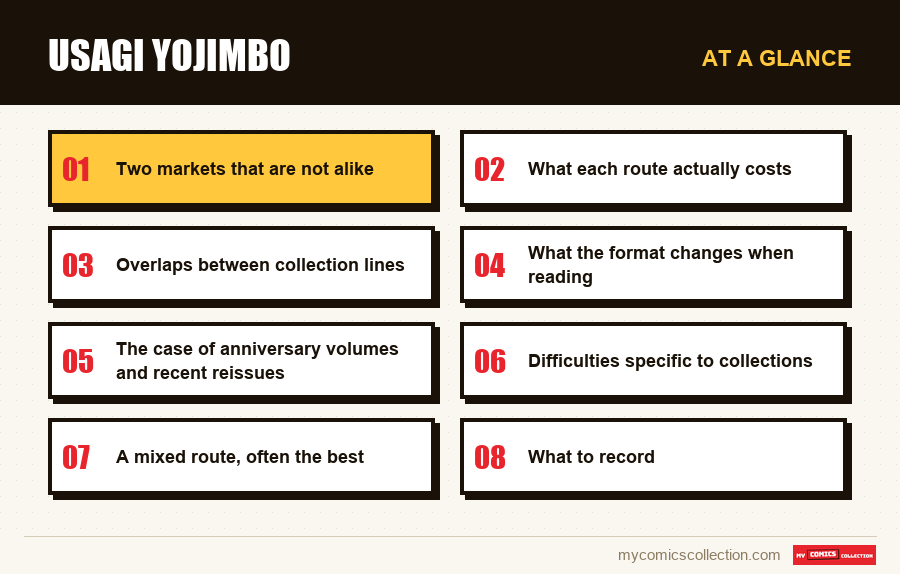
Two markets that are not alike
The following figures are asking prices observed on August 29, 2026. What sellers hope to obtain, not closed sales. The grade is excluded here, the certification does not concern the collections.
The thick collection line
107 ads, of $11.50 to $649.99 requested, median $115.00. Each volume brings together a large number of stories.
The difference between the first price and the median is ten times. This is considerable for the same editorial line.
Ordinary soft collections
186 ads, of $4.99 to $575.00 requested, median $27.47. Thinner, thematic or chronological volumes.
Median four times lower, dispersion just as wide upwards.
Isolated numbers, for comparison
Medians requested between $13.49 and $15.00 depending on the editorial period, out of several hundred advertisements noted.
A remarkable flatness, the complete opposite of what the collections show.
The affordable low end
Collections of $6.99 to $8.64 requested do indeed exist: recent volumes, reprints, or copies marked as damaged.
They coexist in the same statement with three-digit volumes.
Where does this dispersion come from?
A factor explains the main thing, and it has nothing to do with the contents of the volumes.
The collections are out of print, the numbers are not. An issue printed thirty years ago exists in a fixed number of copies which circulate indefinitely on the second-hand market. A collection is reprinted as long as the publisher deems it useful, then ceases to be so.
An out-of-print volume immediately becomes more expensive than an available volume, regardless of what it contains. Two neighboring volumes from the same collection can therefore cost $15 and $300 depending on their printing status alone.
Added to this are the reprints, which coexist with the first printings without the cover always indicating it: the statement shows a volume explicitly described as a third printing at $11.50, when the median of its line is at $115.00.
The price of a collection therefore mainly measures its current availability, not its seniority or its importance. This is the exact opposite of what we observe on numbers, where seniority dominates.
What each route actually costs
You have to be honest about the calculation, because the crude comparison of medians is misleading.
By story, the collection wins by a large margin. A thick volume at $115 contains the equivalent of dozens of issues. Purchased separately at $14 each, these same stories would cost several times that amount. The calculation is beyond doubt.
Per transaction, the number wins. You can start at $3, stop whenever you want, and make a mistake without consequence. A collection immediately involves a sum that is not recovered if the series is not popular.
By risk, the number wins again. The number medians are flat and predictable; those of the collections depend on a printing status that an uninformed buyer cannot check.
The practical conclusion is therefore not “collections” or “numbers” but a question of timing: numbers to try, collections to delve into once you know you like it.
The most costly mistake on this field consists of purchasing an out-of-print volume at full price while a reprint was in preparation, or a more recent volume covers the same content.
Neither information appears on an ad. The only protection is to check what the volume contains before paying a rarity premium on the container.
Overlaps between collection lines
This is the most common pitfall, and is structural rather than accidental.
The series having been republished by several houses, several lines of collections coexist: thin volumes from one era, thick volumes from another, thematic collections, anniversary reissues. These lines largely overlap without declaring it.
A reader who buys through discoveries therefore finds himself with the same story in three different volumes, and holes elsewhere: a configuration that is exactly the opposite of what he believes to constitute.
The statement gives a direct clue: several distinct lines appear in the same searches, with titles which do not allow us to guess their scope. Nothing in "volume 1" says what line it is or what it covers.
A catalog solves this by connecting stories to their containers. A shelf, no.
What the format changes when reading
Beyond the price, the two paths do not give the same experience, and the gap is more marked here than elsewhere.
This series is constructed in closed stories of one issue. Each story begins, unfolds and concludes in the pages of a single issue, with no announced sequel.
Read in numbers, this form is understood. We finish a story, we put the object back, we come back to it later. The pace of publication becomes the pace of reading, and each story retains the weight that its closure gives it.
Read as a collection, the same form fades. Twenty linked closed stories become chapters, and the concluding effect, which is the main effect of this series, is diluted in the next. The reader who swallows a volume in one sitting retains much less than he thinks.
This is not an argument against collections, the economic advantage of which remains overwhelming. This is an argument for reading them slowly: a story, then we close the book. The gesture seems artificial and it reproduces exactly what the original format produced naturally.
Collecting this series?
Track what you own, what you are missing and what your collection is worth. 7 day trial.
Start my trial →The case of anniversary volumes and recent reissues
One category deserves to be isolated, because it confuses the reading of the statement.
Periodically, presentation volumes appear (selections, commemorative reissues, introductory collections) whose role is to attract new readers rather than to complete a collection. They are printed in quantity, sold cheaply, and the statement shows them at the bottom of the distribution, around Asked $8.64.
These volumes are excellent for trying out the series and almost useless for collecting it: their content is entirely taken up elsewhere, by construction.
The risk they create is that of a false start. A reader who buys two or three believes he has started a collection; he bought a selection of the same striking stories three times. Duplication is guaranteed here, not accidental, since these volumes bring together everything that is most recommendable.
The resulting rule is simple: a single volume of this type, chosen as the entry point, then we move on to a followed line.
Difficulties specific to collections
The invisible exhaustion
There is no indication whether a volume is still in print. The asking price is often the only signal, and it comes after the purchasing decision.
Crossing between lines
Several collections include the same stories under titles and numberings that do not correspond.
The successive draws
A third printing costs a fraction of the price of a first, for identical content: when the mention appears on the ad.
Incompatible formats
The lines are neither the same size nor the same binding. A collection built up over occasions does not line up on the shelves.
A mixed route, often the best
Most readers end up adopting a middle ground, and it deserves to be described as a method rather than suffered as a compromise.
The collections for the body of the work. Long series of stories are best read in a row, and their cost per page makes purchasing in volume obviously preferable.
Numbers for what the compendia do not cover. Certain publications (appearances in collective anthologies, derivative mini-series, one-off contributions) have never been reproduced, or have been included in volumes that are themselves out of print.
This distribution has an additional merit: it limits exposure to the dispersed collection market to only widely available volumes, those whose asking price is predictable.
On the other hand, it requires knowing precisely what each volume contains. This is the point where this series calls for an inventory rather than a shopping list, and this is true from the second ten volumes.
What to record
In this area, the decisive field concerns neither the price nor the condition, but the scope of what we hold in our hands.
The line of collections and the rank of the volume in this line. Not “volume 3” but “volume 3 of such collection”, otherwise the sheet does not distinguish three different objects which bear the same number. This is the same requirement as for numbers, applied to hardcovers.
The edition notice when printed. A first and third print run asks for unrelated prices for identical content: the information is sometimes missing from the book, and it is then useful to note that it was.
These two fields serve a unique and very concrete question: when faced with a volume in the store, is what it contains already at my home? In a series reissued by four houses in overlapping collections, no memory responds alone.
Frequently asked questions
By story, yes, and largely: a thick volume at $115.00 median asking price contains the equivalent of dozens of issues that would cost several times that amount purchased individually. By transaction and by risk, no: we can start the issues at $3 and stop, where a collection involves an amount from the outset.
Because they are exhausted. A collection is reprinted as long as the publisher deems it useful, then ceases to be so, and an out-of-print volume immediately becomes more expensive than an available volume, regardless of its content. The price of a collection mainly measures its current availability.
Noting the line of collections and the rank of the volume in this line, never the only number. Several collections coexist and overlap without declaring it: nothing in “volume 1” indicates which line it is or what it covers.
Not for reading, the content being identical: the statement shows a third drawing at $11.50 in a line whose median is at $115.00. You simply have to know what you are buying, as the mention is not always included in the advertisements or visible on the cover.
No, and this is what justifies a mixed approach. Appearances in collective anthologies, certain derivative mini-series and one-off contributions have never been included, or have been in volumes that are themselves out of print. These publications are only available in numbers.
Is this volume already at home?
Four houses, overlapping collections: no single memory answers this question.