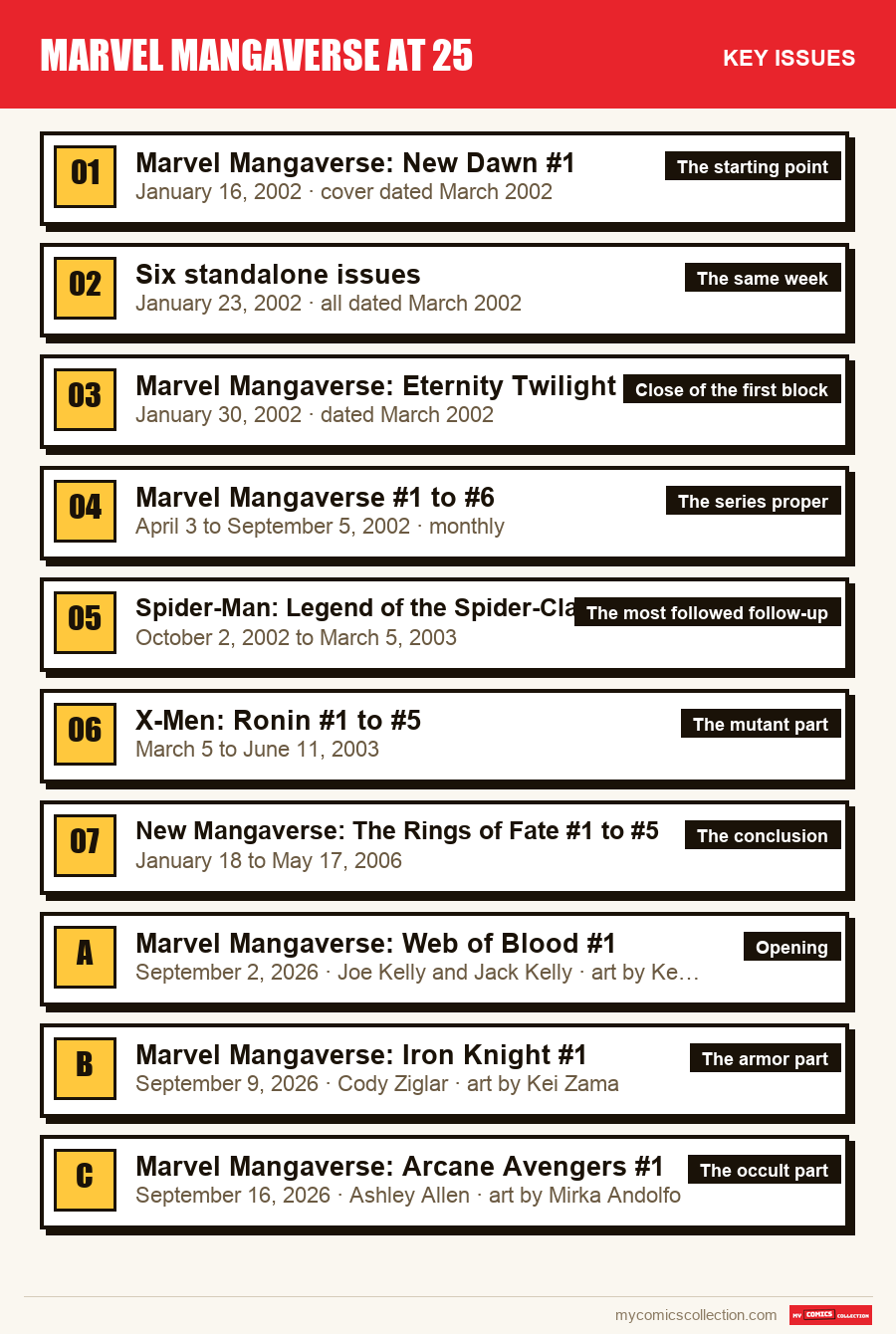
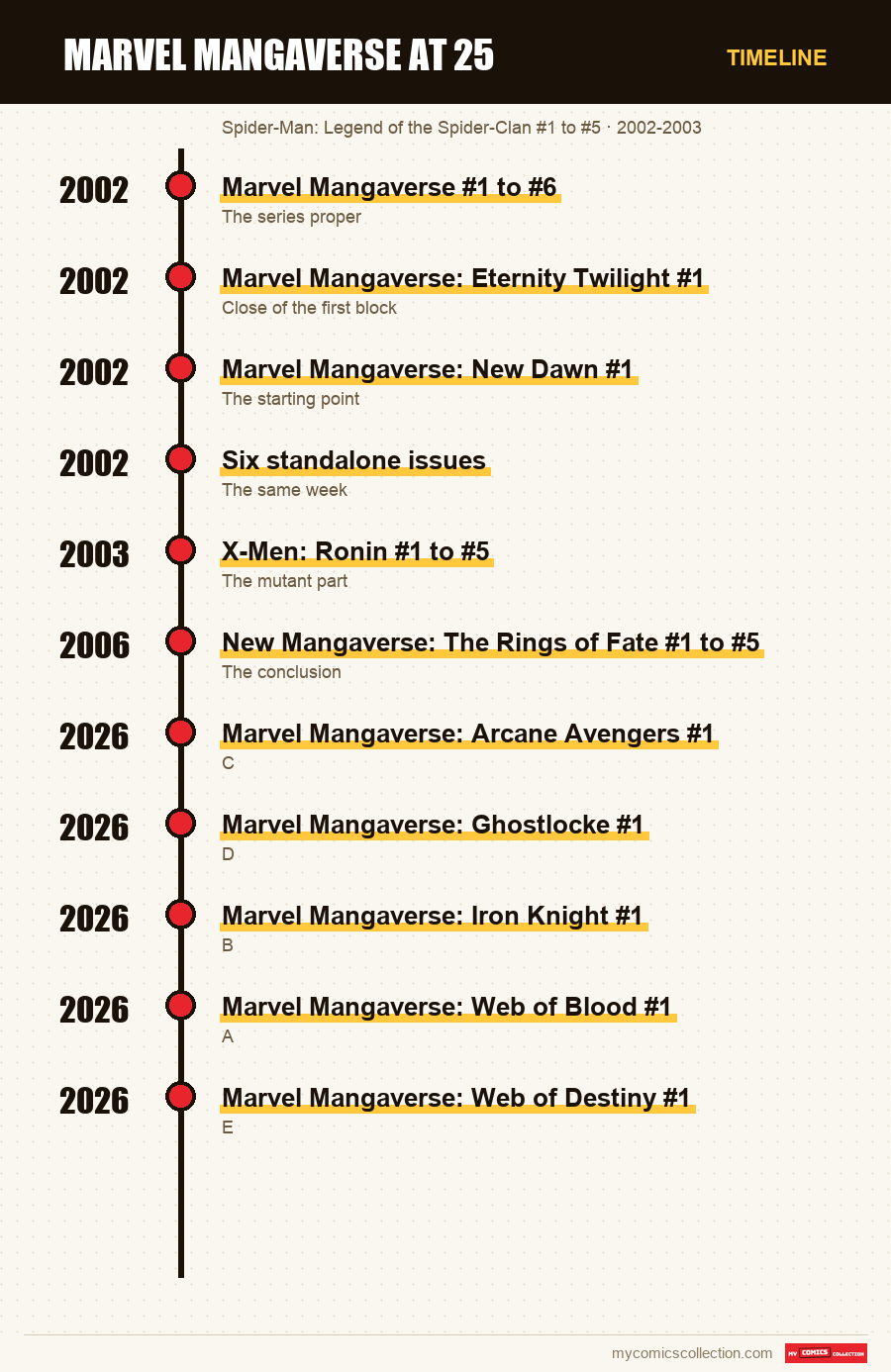
The Marvel Mangaverse is a parallel universe imagined by Ben Dunn, where the Marvel catalog is redrawn according to the codes of manga. It starts with Marvel Mangaverse: New Dawn #1, which reached stores on January 16, 2002, followed by seven other standalone issues in January, then a Marvel Mangaverse series in six issues signed by Dunn from April to September 2002. Three follow-ups come after: Spider-Man: Legend of the Spider-Clan (5 issues, 2002-2003), X-Men: Ronin (5 issues, 2003) and New Mangaverse: The Rings of Fate (5 issues, 2006). The whole carries the code Earth-2301. Marvel relaunched the label in September 2026 for its 25th anniversary, with five weekly issues whose main covers are all by Yuji Kaku. Here is the complete list, the exact creators, and why this line remained a collector's curiosity.
There is in the Marvel catalog a handful of lines nobody talks about for twenty years, and which resurface because an anniversary falls or a film recycles a silhouette. The Mangaverse belongs to this category. The problem, for anyone wanting to build it, is that its catalog is both short and scattered: eight standalone issues released in three weeks, a limited series, two miniseries under another name, a sequel four years later. No continuous numbering links the whole.
It is October 2, 2026. The relaunch has just ended, the last issue came out two days ago, and no market perspective exists on these five releases. Everything that follows about them is editorial description, never pricing.
What the Mangaverse was, concretely
The principle was not to translate Japanese manga, nor to have Marvel drawn by Japanese creators. It was the reverse: entrust the catalog to Western artists trained in the graphic codes of manga, and rebuild the characters in that grammar. Ben Dunn, an American writer and publisher who came through English-language Japanese-inspired comics, is its conceiver.
The result is not a restyling. Iron Man becomes Iron Maiden, that is Antoinette Stark, nicknamed Toni, Tony's sister and owner of Stark Industries; she owns her identity publicly, which her brother had never done. The Hulk is no longer a second personality of Bruce Banner but a colossal spirit in Dormammu's service, whose silhouette borrows from Japanese monster cinema. The Fantastic Four become an administrative response unit, the Megascale Metatalent Response Team. On the X-Men side, Wolverine is Cyclops' brother and it is he who gathers the team, while Charles Xavier runs the Hellfire Club, thus the opposing camp. The Punisher, finally, is a woman, Sosumi Brown, director of a private school in Tokyo whose operational base is hidden in the institution. The line did not tell a variant, it redistributed the roles.
The universe later received an official designation, Earth-2301, assigned by the 2005 edition of the Official Handbook of the Marvel Universe devoted to alternate universes. It is this code, not the word Mangaverse, that lets you find the line in indexes and character databases.
The complete catalog of the original line
Here is the exhaustive list, in order of on-sale date. The dates are those of arrival in stores, not cover dates, which run two months ahead in this period.
Marvel Mangaverse: New Dawn #1
Ben Dunn writes, draws, inks and letters this first issue, with colors by Guru-eFX. It is the birth certificate of Earth-2301 and the first appearance of nearly all its figures: Iron Maiden, the local Bruce Banner, its Captain America, its Doctor Strange, its Hank Pym, its Tigra, its Namor. The story sets up the device that will carry the line, the Energy Well built by Banner and hijacked by Hydra.
Six standalone issues
Marvel releases six titles the same Wednesday. Marvel Mangaverse: Spider-Man #1, "Spider Scroll," is written, drawn and covered by Kaare Andrews alone. X-Men #1, "X-Men: Equinox," is written by C.B. Cebulski, drawn by Jeff Matsuda and A.J. Jothikumar, inked by Andy Owens. The Punisher #1, "Kind to Be Cruel," is written by Peter David and drawn by Lea Hernandez. Fantastic Four #1 is written by Adam Warren, inked by Robert Stull, cover by Keron Grant. Ghost Riders #1 is written by Brian Smith and Chuck Austen, who also draws it. Avengers Assemble #1 is written by Ken Siu-Chong with the Udon collective, drawn by Alvin Lee, Arnold Tsang, Omar Dogan, Shane Law and Erik Ko.
Marvel Mangaverse: Eternity Twilight #1
Third and last Wednesday of the salvo, with an eighth issue written by Ben Dunn and Kevin Gunstone, drawn by Dunn. The eight January 2002 issues will later be gathered in a bound volume.
Marvel Mangaverse #1 to #6
Ben Dunn writes and draws the six issues, released on April 3, May 8, June 5, July 3, August 7 and September 5, 2002. The chapters carry titles: "Hungry Planet," "The Galactus Syndrome," "The Evil Entity," then "Liberty's Doom" in three parts. This is where the local Galactus appears, an anti-life virus made by the Skrulls, a Captain Marvel specific to this universe and a Doctor Doom whose real identity is the Black Panther's sister. Covers of issues 4 to 6 by Takeshi Miyazawa.
Spider-Man: Legend of the Spider-Clan #1 to #5
Kaare Andrews continues his Mangaverse Spider-Man over five issues, drawn by Skottie Young. This universe's Peter Parker is the last survivor of a clan of Spider ninjas, trained by an Uncle Ben turned his weapons master and killed by Venom, himself in the Kingpin's service. The miniseries adds Black Cat, a symbiote of mystical origin presented as a curse, and a Norman Osborn.
X-Men: Ronin #1 to #5
Written by J. Torres and drawn by Makoto Nakatsuka, this miniseries follows the clash between the X-Men and the Hellfire Club, which seeks to enlist Jean Grey. The Phoenix Force, glimpsed in the background of the first salvo, takes its full place there, and the Sentinels become robots piloted by humans. The chapters carry transliterated Japanese titles, from "Hajime No Ippo" to "Shima."
New Mangaverse: The Rings of Fate #1 to #5
Three and a half years after the main series, C.B. Cebulski writes a sequel drawn by Tommy Ohtsuka. The premise is brutal: the Hand, making its first appearance in this universe, has exterminated about ninety-nine percent of Earth-2301's superhuman population. The survivors, including the Spider-Clan Spider-Man, a Spider-Woman, Wolverine and a returned Iron Man, form a new team, and Carol Danvers takes up the costume of a Captain America.
Add an isolated episode published in Spider-Man Family, on sale November 29, 2006 and dated January 2007, written by C.B. Cebulski and drawn by Skottie Young: it takes up the Spider-Clan Spider-Man after his miniseries, but indexes attach it to a different designation than Earth-2301, and its continuity was later bypassed. In total: twenty-four issues published between January 2002 and May 2006, spread over seven titles, two of which do not mention the line they belong to.
Why this line became a niche
It aimed at two audiences without reaching either. The early 2000s are when manga settles into general bookstores, in a cheap bound format, while the superhero single issue remains confined to the specialty shop. The Mangaverse was sold in the second circuit to a readership recruited in the first. Print runs were never high, and above all few copies were kept: nobody set aside an experimental issue from a secondary line.
The titles hide. A collection is completed by keyword. With two miniseries out of three not carrying the line's name, and an issue titled Eternity Twilight devoid of any character name, the line is structurally badly indexed. Many Mangaverse collections are incomplete not for lack of copies but out of ignorance of their existence.
A character came out of it. This is the decisive factor, and it is recent: the Spider-Clan Spider-Man created by Kaare Andrews appeared in cinema in 2023, in Spider-Man: Across the Spider-Verse, as a member of the Spider-Society. What attracts demand is never the line, it is the character who comes out of it and lives elsewhere. The seven other January 2002 issues did not have that effect, none of their characters having found a second life.
We give no figure here, and it is not a facade of caution: public sales of these issues are too scattered and too uneven by condition for an average to mean anything, and no source consulted publishes a dated record. What is describable is the hierarchy: the Spider-Man issue and the launch in front, the others far behind.
The September 2026 relaunch, issue by issue
Marvel chose an unusual format: five standalone issues, one per Wednesday of September 2026, all dated November 2026 on the cover, and all main covers entrusted to the same creator, the manga artist Yuji Kaku. This graphic unity contrasts with the scatter of 2002. The setup rests on two framing issues signed by Joe Kelly and Jack Kelly, drawn by Kenny Ruiz; between the two, three independent stories. Hence a two-speed count you need to know before searching: five issues in the inventory, but four stories, since the first and last, from the same team and with the same trio of heroes, form a single story in two parts. The Kelly pair's two issues are the only ones priced at $5.99 instead of $4.99, a gap consistent with their framing role.
Marvel Mangaverse: Web of Blood #1
The issue features a Spider-Man embodied by Miles Morales, a Laura Kinney turned Weapon X-Tremis and an Illyana Rasputin named Legion, facing the Phoenix's return. Where 2002 rebuilt the historic characters, 2026 starts from the next generation.
Marvel Mangaverse: Iron Knight #1
Riri Williams builds a magic-powered armor after the apparent death of her friend Lunella Lafayette. The parallel with 2002 is striking: the original line had already made Iron Man a pilotable giant robot, the most identifiable mechanic of action manga. The same franchise serves as entry point, but through magic rather than technology.
Marvel Mangaverse: Arcane Avengers #1
Bucky Barnes, Bloodline and Wiccan form a group of sorcerers tasked with hunting yōkai. It is the issue that most frankly embraces Japanese folklore imagery, where the 2002 line mostly went through the robot and the ninja.
Marvel Mangaverse: Ghostlocke #1
Kwannon faces a Carnage who kills humans and yōkai alike. It is the darkest of the five issues, and the one that fits most directly in the horror trend Marvel is pushing in fall 2026, alongside its Midnight line launched in October.
Marvel Mangaverse: Web of Destiny #1
The first issue's trio reunites to save the Earth. A calendar detail deserves noting: this issue came out the Wednesday Marvel also published Amazing Spider-Man #1000, whose main story is signed by the same Joe Kelly. An issue with more than four hundred thousand preorders, sold out on release day, absorbs all the attention of a day.
The 25 years, and what the count does not say
Marvel presents the relaunch as a twenty-fifth anniversary, in September 2026. Yet the line's first issue arrived in stores on January 16, 2002: twenty-five years later, we will be in January 2027. We could not verify the starting point the publisher used, and we do not guess it. Two explanations are possible, neither documented in the sources consulted: either the anniversary is counted from the line's conception, prior to its publication, or it is rounded to land on a free calendar window.
The useful information for a collector lies elsewhere. The date used to date a copy is the on-sale date, not the cover date, two months ahead by the convention of the time. On a line where eight issues carry the same cover date while coming out on three different Wednesdays, the distinction stops being a detail.
Building the line today
Draw up the list before searching
Twenty-four issues, seven titles, two that do not carry the line's name. As long as this list is not written down somewhere, each search starts from zero and you will buy the same issue twice while ignoring the next one's existence.
Start with the six-issue series
The 2002 Marvel Mangaverse series is numbered 1 to 6 and is often found as a block. It is the simplest part to close, and it gives the line's narrative coherence. The eight January issues come next, one by one, as opportunities arise.
Treat the miniseries as full series
Legend of the Spider-Clan and X-Men: Ronin are not found under the Mangaverse label. Log them under their real title, noting their attachment to the line in a comment field.
Be demanding on condition rather than on count
A tired copy of a rare title will resell worse than a clean copy of a common title. Certification, whose cost does not depend on the object's value, only makes sense here on the launch and the Spider-Man issue.
Decide whether the 2026 relaunch belongs to the same set
The five September 2026 issues share with 2002 neither the characters, nor the writers, nor the continuity. Shelving them with the original line or treating them separately is legitimate either way, but this choice must be kept, or your inventory will become unreadable.
The traps specific to this line
Confusing the Mangaverse with other Marvel manga. The catalog contains several objects that come from the manga rapprochement: Japanese adaptations of Marvel characters, animated series produced in Japan, co-published bound volumes. The Mangaverse is none of those objects. It is a line of American single issues drawn with manga codes, designated Earth-2301. It has nothing to do either with the program of original manga announced at Kadokawa, which is the exact opposite movement: Japanese creators, a Japanese publisher, and a release starting in Japan. The distinction between comics, manga and bande dessinée plays out, moreover, on format and circuit, not on drawing style.
Believing the Spider-Man issue is a series issue 1. It is standalone, complete in itself, and there is no issue 2. What succeeds it carries another title, Legend of the Spider-Clan, and restarts from an issue 1.
Buying the 2026 relaunch as an investment. The five issues came out a few weeks ago, in a standalone-story format that builds no series to follow. No sales history exists, and any estimate today would be an invention. What will be decided in the years ahead is whether one of their characters reappears elsewhere.
Forgetting the bound volume. For a reader, it is the simplest access to the text. For a collector, it is a different piece, which does not replace the single issues: the two formats are inventoried separately.
Keeping a scattered line in your inventory
On a hundred-issue series, the inventory is managed by the gaps in the sequence. Here the gaps are invisible, since each issue is an issue 1. In the app, three moves are enough. Create a custom collection named after the line and attach the seven titles to it, including those that do not carry the Mangaverse name: this manual attachment replaces the missing numbering. Fill in the on-sale date as well as the cover date, without which the two-month gap makes any chronological sort wrong. Finally note the actual condition at purchase. The rest is the usual issue-by-issue tracking, with a rare comfort: on a line closed since 2006, your missing list will no longer move.
Should you take an interest?
Yes, if you like the periphery of the catalog or collect Spider-Man variants. The Mangaverse documents a precise moment in American publishing, when the superhero single issue tried to speak the language of its most serious competitor, and its best piece stands up on its own.
No, if your goal is a return. A line of twenty-four issues closed for twenty years, of which a single character found a continuation, is not a strategy. And on the September 2026 relaunch, the only honest answer on October 2, 2026 is that there is nothing to say about it yet. In both cases the move is the same: buy what interests you, keep it properly, and record it with its true date.