In France, Marvel is published by Panini Comics, which has held the license since January 1997 (at first under the name Marvel France). DC Comics and its former Vertigo imprint are published by Urban Comics, a subsidiary of Dargaud (Média Participations group), whose first book came out on January 20, 2012. Image Comics has no single publisher: since its series belong to their creators, each title is negotiated separately, for example Saga at Urban or The Walking Dead at Delcourt, a newsstand comics publisher since 2005. Valiant has been at Bliss since 2016. Before them, Marvel went through Lug (from 1969) then Semic (1989-1996), and DC through Semic then Panini (from about 2005 to 2011). Knowing who publishes what means knowing which collection, which format and which translation you are buying.
A comics reader in France rarely buys a book "from Marvel" or "from DC": they buy a book from Panini or Urban Comics, with its format, its translation, its collection numbering and its reprint policy. Understanding the map of French publishers is not a specialist exercise. It is what tells you where to look for a title, why two editions of the same story coexist, and why a series sometimes stops right in the middle.
This article draws that map, license by license, then goes back through the history of those licenses since 1969. It only talks about publishers: no points of sale, no platforms. For a qualitative ranking of the American publishers themselves, see our ranking of comics publishers.
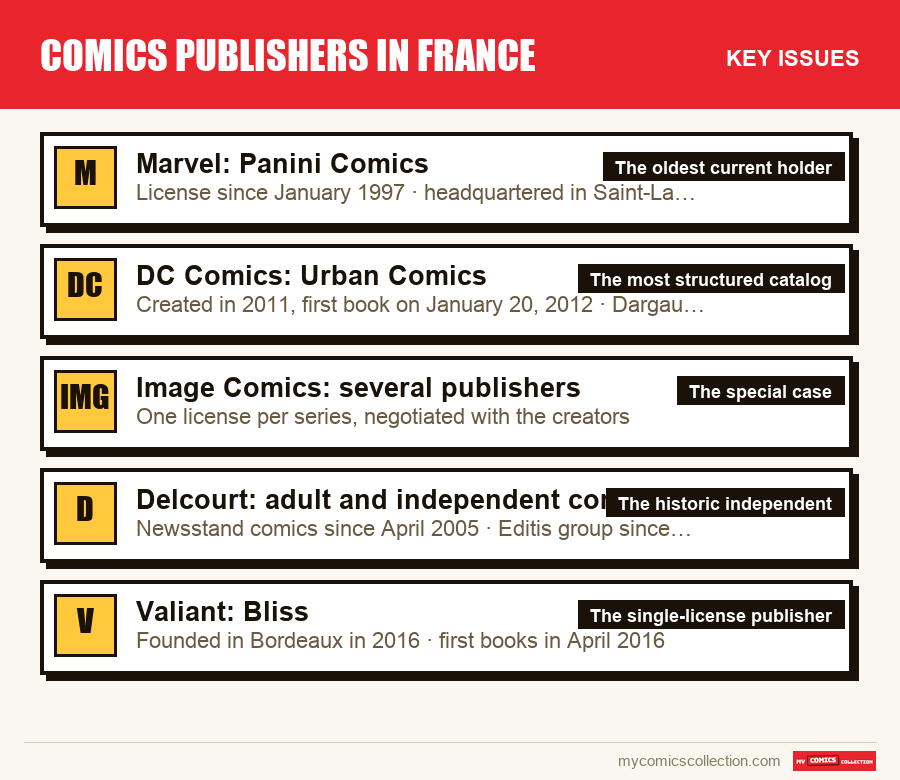
The current map, license by license
Marvel: Panini Comics
Panini obtained the Marvel license in January 1997, through a structure called Marvel France, since renamed Panini Comics France. By February 1997, five magazines were on newsstands, including Spider-Man, Avengers and Silver Surfer. Nearly thirty years later, Panini publishes the whole Marvel universe, in magazines, softcover collections and hardcover editions, as well as the Star Wars license in comics.
DC Comics: Urban Comics
When Panini lost the DC license in summer 2011, Média Participations, Dargaud's parent company, took it over and created Urban Comics. The first title, on January 20, 2012, was a large-format reissue of Watchmen. Urban organizes its catalog into collections by period: "DC Archives" for works from 1936 to 1985, "DC Classiques" for 1985 to 2011, "DC Renaissance" for the 2011 relaunch, then "DC Rebirth". To these are added Vertigo, an indie collection and, since 2018, a "DC Black Label" collection.
Image Comics: several publishers
Image is not a publisher like Marvel or DC: its series most often belong to their creators. So there is no single "Image license" in France. Each series is licensed separately, and Image's titles are spread across several French houses. Urban Comics thus publishes Saga since April 2012, Delcourt publishes The Walking Dead, and smaller houses have taken on other series.
Delcourt: adult and independent comics
Delcourt is first and foremost a Franco-Belgian comics publisher, but it has published American comics for a long time. Its Contrebande collection welcomed adult works, including the omnibus of V for Vendetta in 1999. Since April 2005, under the impetus of Thierry Mornet, formerly of Semic, it also publishes newsstand comics. Its catalog mainly brings together American independent series, including The Walking Dead.
Valiant: Bliss
Valiant was published in France by Panini until September 2015, without great success. Two founders then proposed to the American publisher to devote a whole house to it: Bliss Comics, now Bliss Éditions, released its first books in April 2016, in hardcover. It is the clearest example of a license that changes strategy by changing publisher.
Beyond these five houses, a constellation of small publishers puts out American independent titles, often one by one, as licenses become available. The big manga and Franco-Belgian comics publishers also occasionally publish American comics. For these titles, the rule is the same as for Image: you look for the series, not the house.
How we got here: half a century of licenses
The current map is only the latest state of a history of licenses that have changed hands at regular intervals. Each change has left traces in libraries: interrupted series, different translations, numberings that start over.
1969: Lug, the Lyon publisher
Lug, founded in Lyon in 1950 by Marcel Navarro and Alban Vistel, published small-format adventure titles. From 1969, it introduced Marvel superheroes to France, with Fantask then Strange, launched in 1970. For readers of the 1970s and 1980s, Marvel superheroes arrived through these Lyon magazines. Our article Lug and Strange, the pre-1980 issues covers this period from the collecting side.
1989: Semic takes over Lug
In January 1989, Marcel Navarro retires and sells the Lug titles to the Scandinavian press group Semic. The magazines continue under the name Semic France, which also publishes DC, Image and Italian fumetti.
1996-1997: Marvel moves to Panini
In October 1996, Semic loses the Marvel license. All Marvel translations stop, including in Strange, published for twenty-six years. Semic compensates with DC titles, which it houses in Strange, and Image, like Gen 13 or WildC.A.T.s. In January 1997, Panini picks up Marvel. Semic is bought out at the end of 1998 and disappears in 2005.
2005-2011: DC at Panini
The DC titles, whose French publication has been described as chaotic since the early 1980s, move to Panini for a little over five years. Panini then publishes Marvel and DC at the same time.
2012: Urban Comics
In summer 2011, Panini loses DC. Urban Comics starts in January 2012, just as DC relaunches its whole universe with issues #1. Urban stops some series left unfinished by Panini and starts over from scratch on others, with an organization by periods.
What publisher changes mean for a collector
Interrupted series. When a license changes hands, the new publisher does not necessarily pick up ongoing series. DC's move from Panini to Urban in 2011-2012 is the best-documented example: some series started by Panini were not continued. A collector who owns the first volumes of an interrupted series should know that the rest may not exist in French, or has been reissued in a different split.
Translations. The same story can exist in two French translations, depending on the publisher. V for Vendetta is a good example: the translation by Jacques Collin, used by Zenda, Delcourt then Urban, and the one by Alex Nikolavitch, specific to the 2009 Panini edition. For an attentive reader, it is not a detail.
Numberings. Each publisher numbers its magazines and collections in its own way, unrelated to American numbering. The same story can appear in an issue of Strange at Lug, then in a Panini collection, then in an omnibus. To follow a French collection, you need to note the magazine's title, its number and the American issue it contains. Our guide to getting started with Strange and Marvel magazines in France applies this method.
Value. The French market clearly distinguishes old newsstand editions (Lug, Semic) from modern collections. The former are collectibles, with their own key issues; the latter are mostly reading books, reprintable at will. For the Semic period, our article on Semic's Spider-Man shows how this market is organized.
Three questions to ask before buying
Who publishes the series today?
For Marvel and DC, the answer is simple: Panini and Urban. For everything else, search for the series by its title. An independent series may have changed publisher between two volumes.
Is the edition I am buying complete?
Check that the current publisher has published the series to the end, or that an omnibus covers it in full. Series stopped during a license change are the most frequent trap.
Is it the translation and the format I want?
Softcover or hardcover, magazine or collection, old translation or new: these choices matter more than the publisher's name. Decide them before buying the first volume, to keep a consistent collection.