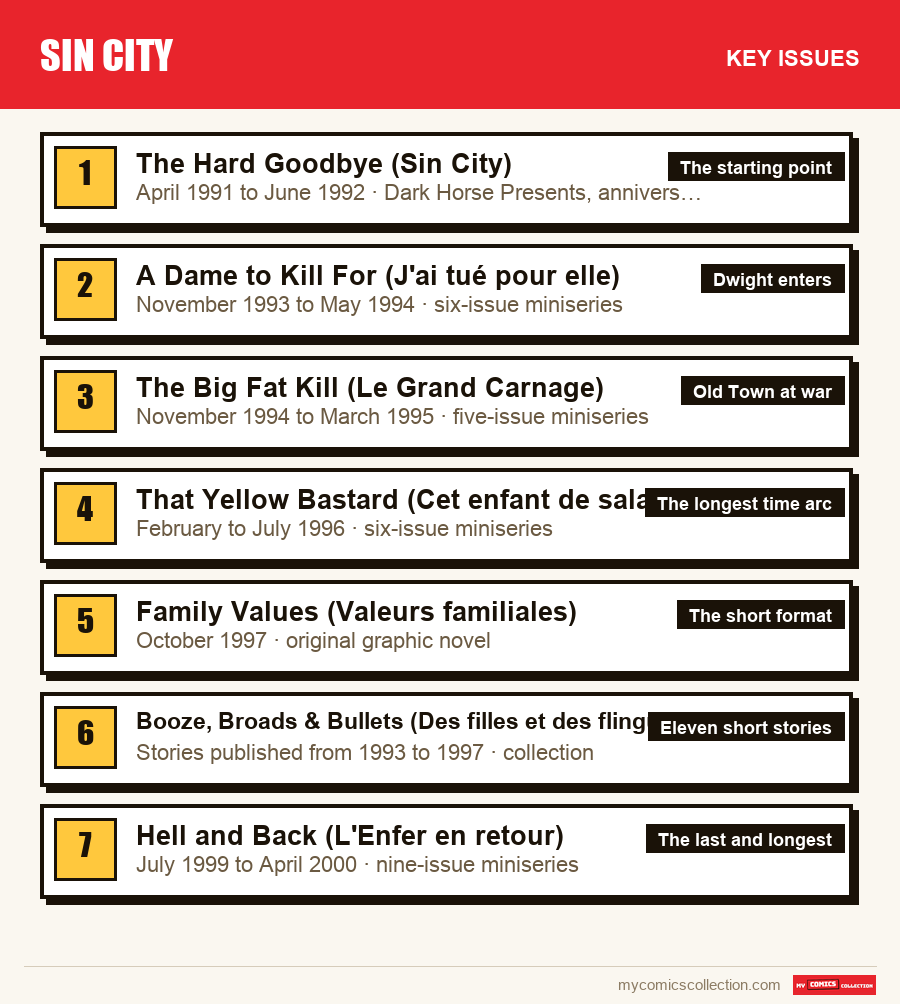
Sin City by Frank Miller has seven volumes, best read in release order: The Hard Goodbye (1991-1992, in French Sin City), A Dame to Kill For (1993-1994, J'ai tué pour elle), The Big Fat Kill (1994-1995, Le Grand Carnage), That Yellow Bastard (1996, Cet enfant de salaud), Family Values (1997, Valeurs familiales), Booze, Broads & Bullets (a collection of eleven short stories, Des filles et des flingues) and Hell and Back (1999-2000, L'Enfer en retour). Everything was published in the United States by Dark Horse between April 1991 and April 2000, and in France by Vertige Graphic then Rackham. Release order is the right one for a first read: it follows the evolution of Miller's art, and the internal chronology, deliberately fragmented, is better reconstructed once everything is read.
Sin City is not a series in the usual sense of the term. There is no single hero, no continuous numbering, no big story advancing from one volume to the next. There is a city, Basin City, and characters who cross it, meet, sometimes die in one volume before reappearing in another whose action is set earlier. Frank Miller called these stories "yarns," tales you tell each other.
This mosaic structure is the main reason the question of order comes up so often. Should you follow publication, internal chronology, or the characters? This article answers, volume by volume, sticking to the drawn work. The film adaptations are covered elsewhere on this site.
Where Sin City comes from
In the early 1990s, Frank Miller is already one of the most famous creators of American comics. He transformed Daredevil in the early 1980s, then signed The Dark Knight Returns in 1986. Both works already contained film noir elements. With Sin City, he makes it the very subject, in a work whose rights he owns and which he writes and draws alone.
The first episode appears in an anniversary special issue of the magazine Dark Horse Presents, in April 1991, then the story continues in issues 51 to 62 of this anthology, until June 1992, in thirteen parts. It is an important detail for collectors: the first Sin City is not an issue #1, but a serial in a collective magazine.
Pure black and white is the series' signature, with a few rare touches of color reserved for specific elements: a red dress, blue eyes, and above all the yellow character who gives the fourth volume its title. Miller pushes contrast to abstraction there: silhouettes cut out of the rain, sound effects drawn by light or by the negative space between panels.
The seven volumes, in release order
The Hard Goodbye (Sin City)
Marv, a colossus with a scarred face, wakes up next to a murdered woman and sets off on a revenge that leads him to the city's powerful. It is the most graphically experimental story, and the longest of the first period. It sets up the city, the corrupt police, the Roark family and the Old Town district.
A Dame to Kill For (J'ai tué pour elle)
Dwight McCarthy, a photographer trying to stay sober, falls back under the sway of a former mistress, Ava. It is the first story published as a standalone miniseries, and the first to play with chronology: it takes place before the first volume, and Marv makes an appearance in it.
The Big Fat Kill (Le Grand Carnage)
Dwight, back, follows a violent man to Old Town, the district held by the prostitutes, where a murder threatens to break the truce between them and the police. Miho, the silent killer, takes her full place there. It is the most action-oriented volume.
That Yellow Bastard (Cet enfant de salaud)
John Hartigan, an honest cop on the eve of retirement, saves a little girl, Nancy Callahan, from a killer protected by his family. The story spans several years and introduces yellow as a sole color, attached to the character who gives the volume its title.
Family Values (Valeurs familiales)
Dwight and Miho investigate a shooting and trace it back to a mob family. It is the only volume published directly as an album, with no prepublication, and one of the briefest, around 120 pages.
Booze, Broads & Bullets (Des filles et des flingues)
This volume gathers the short stories scattered across special issues and anthologies: "Just Another Saturday Night" with Marv, "The Babe Wore Red," "Silent Night," "Blue Eyes," "Rats," "Wrong Turn," "Wrong Track," "Daddy's Little Girl" and a few three- or four-page stories.
Hell and Back (L'Enfer en retour)
Wallace, a painter and former soldier, saves a young woman trying to drown, before she is kidnapped. With nearly 300 pages, it is the series' longest volume, and the only one whose hero appears nowhere else.
Release order or chronological order?
Basin City's internal chronology is not linear, and Miller never presented it as a puzzle to solve. Some stories overlap: Marv crosses Dwight in A Dame to Kill For, That Yellow Bastard begins well before the first volume and ends after, several short stories take place on the margins of the big stories. Reconstructing a strict order would require cutting some volumes into pieces.
That is why release order remains the best advice for a first read. Three reasons for this. First, Miller writes each volume assuming the reader knows the previous ones: characters' returns are surprise effects that work only in that order. Next, the art evolves clearly between 1991 and 2000, toward more abstraction; reading in order lets you follow that evolution. Finally, the short stories of the sixth volume take on their meaning after the big stories, because they come back to already established characters.
For a reread, on the other hand, an order by character can be stimulating. Here is the one we recommend.
Marv's path
The Hard Goodbye, then "Just Another Saturday Night" in the short-story collection, and his appearances in A Dame to Kill For.
Dwight's path
A Dame to Kill For, The Big Fat Kill, then Family Values, which form a de facto trilogy.
Hartigan and Nancy
That Yellow Bastard, read in one go, since the story alone covers several years.
The rest of the city
The other short stories, then Hell and Back, which works as an independent epilogue.
The editions, from single issues to omnibuses
In the United States, the work exists in several forms. The original issues first: the Dark Horse Presents issues for the first story, then the miniseries, and a series of one-shot issues for the short stories (The Babe Wore Red and Other Stories, Silent Night, Lost, Lonely & Lethal, Sex & Violence, Just Another Saturday Night). Then come the seven softcover collections, reissued with harmonized covers in the mid-2000s.
For readers who want everything in little space, two bound boxed sets came out in December 2005 and June 2006, each with four volumes, then a single-volume omnibus in June 2014, which adds an art book. Finally, in 2016, a giant edition of the first story was produced from the original pages scanned at full size, followed in 2021 by a deluxe edition of the same story.
In France, the series was published by Vertige Graphic, then by Rackham. The first six volumes came out between 1994 and 1999, and L'Enfer en retour in 2001. The French titles are those indicated in the quick answer. If you mix volumes from two publishers, check the volume numbering, which follows the American release order.
What to read after Sin City
If it is the noir that you liked, our ranking of the best noir and crime comics offers an overview of the genre in American comics. If it is Miller, go back to his Daredevil: our selection of Daredevil key issues indicates where his period begins. You will see the shadows born there, the New York rooftops in the rain and the broken heroes who will become those of Basin City.
Miller also announced in 2022 a story set in the city's past, Sin City 1858, a western, published by his own publishing house. It is not part of the seven classic volumes, and we do not include it in the reading order: it is a prequel to read afterward, if the universe has hooked you.
Finally, for those who discovered the city through cinema, our comparisons between the 2005 film and the comics, and between the 2014 film and the album, detail what the adaptations kept and changed.