
Wonder Woman is one of the three founding figures of DC Comics, along with Batman and Superman. Since its first appearance in All Star Comics #8 (December 1941), Diana Prince has spanned more than 80 years of editorial history. The runs of George Perez, Greg Rucka and Brian Azzarello constitute the pillars of a serious Wonder Woman collection, while the keys from the Golden Age remain among the rarest on the market.
Wonder Woman occupies a unique place in the history of American comics. Created by William Moulton Marston and the artist Harry G. Peter, she was the first superhero to get her own solo series in 1942, a feat no other heroine matched for decades. Beyond its narrative value, the Wonder Woman collection is also a fascinating area for the collector: Golden Age examples are extremely rare, modern runs offer accessible entry points, and the cultural dimension of the character gives each key issue a particular resonance.
Collecting Wonder Woman means navigating between several very distinct eras: the feminist Golden Age of Marston (1941-1947), the years of decline when Diana lost her powers (Mod era, 1968-1972), the spectacular rebirth signed by George Perez in 1987, and the modern reinterpretations of Rucka and Azzarello. Each era has its codes, its rarities and its traps. This guide gives you the keys to building a coherent Wonder Woman collection, from choosing priority runs to managing your budget.
The Golden Age origins: birth of an icon (1941-1950)
Wonder Woman appears for the first time in All Star Comics #8 (December 1941), an issue published by All-American Publications (future DC Comics). This key issue, where Diana of Themyscira is introduced in an eight-page secondary story, is one of the most sought-after comics of the Golden Age. A CGC 9.4 copy sold for $1.62 million in 2022. Even in mediocre condition (CGC 1.0-2.0), count on between $15,000 and $40,000.
After this introduction, Diana gets the cover of Sensation Comics #1 (January 1942), which became its regular series. The first number is a major key issue: a CGC 9.2 copy reached $399,000 at auction. The series Wonder Woman volume 1 begins in summer 1942 with Wonder Woman #1, a fundamental key issue that exceeded $400,000 in high CGC rating.
The creator William Moulton Marston, trained psychologist and inventor of the lie detector, sees Diana as a symbol of feminine strength and justice. The first issues, illustrated by Harry G. Peter, are recognizable by their unique, almost naive graphic style, which has no equivalent in the rest of DC's production of the time. Marston wrote the character until his death in 1947: this period (Wonder Woman #1-28 approximately) constitutes the historical heart of any Wonder Woman collection.
The big Wonder Woman runs to know
William Moulton Marston & Harry G. Peter (1941-1947)
The founding period. Marston infuses Diana with a unique philosophy blended with feminism, Greek mythology and psychology. Classic enemies appear: Cheetah (Wonder Woman #6, 1943), Ares , Doctor Psycho (Wonder Woman #5, 1943) et Giganta. These Golden Age issues are rare and expensive, but they define the character's DNA for the decades to come.
Robert Kanigher, the Silver Age (1958-1968)
Robert Kanigher takes the title back to the 1950s and directs Diana towards more conventional adventures, often tinged with romance. It is under his pen that Wonder Woman officially joins the Justice League in The Brave and the Bold #28 (1960). The issues from this period are less sought after than the Golden Age but remain Silver Age classics with often spectacular signed covers. Ross Andru and Mike Esposito.
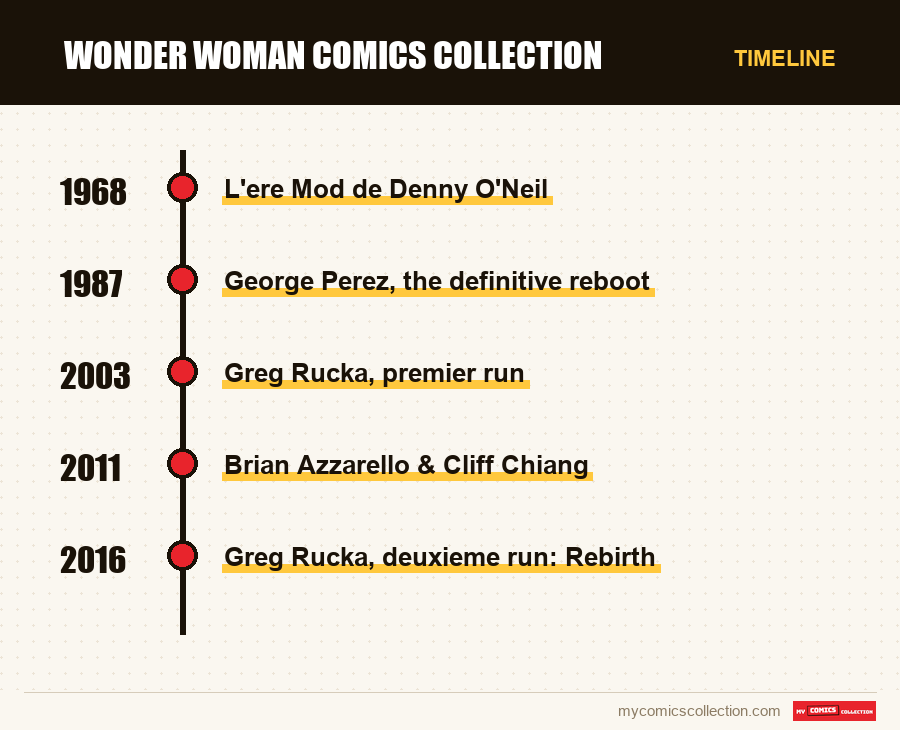
L'ere Mod de Denny O'Neil (Wonder Woman #178-204, 1968-1972)
A controversial turning point. Denny O'Neil and Mike Sekowsky rid Diana of her powers, her costume and her connection to the Amazons to make her a plainclothes adventurer mastering kung fu, inspired by The Avengers (the British TV series). Wonder Woman #178 (October 1968), the first issue of this era, is a fascinating key issue. Gloria Steinem publicly denounced this dehumanization of the character, leading to the restoration of her powers in 1972.
George Perez, the definitive reboot (Wonder Woman vol. 2, #1-62, 1987-1992)
Le run George Perez is considered the best incarnation of Wonder Woman in comics. After Crisis on Infinite Earths, Perez raises the title to zero with a Wonder Woman vol. 2 #1 (February 1987) which plunges Diana back into Greek mythology with exceptional narrative depth and graphic care. Perez rewrote the character's origin, expanded on Themyscira and the Amazons, and created memorable villains like Silver Swan and Circe. This 62-issue run is the most important of the modern era for any Wonder Woman collector. Wonder Woman vol. 2 #1 is the most accessible and recommended modern key issue as an entry point.
Greg Rucka, premier run (Wonder Woman vol. 2, #195-226, 2003-2005)
Greg Rucka signs a first high-class run which explores the political and diplomatic implications of Diana's role as ambassador. The climax is Wonder Woman #219 (September 2005), where Diana kills Maxwell Lord to save Superman: a scene which shocked the readership and whose consequences are reverberated in Infinite Crisis. This number is a very sought after modern key issue.
Brian Azzarello & Cliff Chiang (Wonder Woman New 52, #0-35, 2011-2014)
Le run Azzarello/Chiang is a radical reinvention that transforms the series into an ambitious mythological saga. Diana discovers that she is the biological daughter of Zeus, and the entire Olympian pantheon becomes the driving force behind the narrative. The graphic style of Cliff Chiang, elegant and expressive, gives the title a unique visual identity. Wonder Woman New 52 #1 is an accessible modern key issue (between 30 and 80 euros in good ungraded condition). This run is often cited as one of the best New 52 titles of all series.
Greg Rucka, deuxieme run: Rebirth (Wonder Woman vol. 5, #1-25, 2016-2017)
Rucka returns with a bold narrative structure: the even numbers ("Year One", drawn by Nicola Scott) tell the origins of Diana, while the odd numbers ("The Lies", drawn by Liam Sharp) explore the present. The run methodically deconstructs the New 52 to restore the classic essence of the character. Wonder Woman Rebirth #1 and Wonder Woman vol. 5 #1 are the keys resulting from the input of this run.
The essential Wonder Woman key issues
Here are the issues every Wonder Woman collector should know, from the Golden Age to the most recent publications:
- All Star Comics #8 (1941): First appearance of Wonder Woman. Key from the Golden Age among the most valuable in the world. CGC 1.0-2.0 copies: $15,000-40,000. High rating: over a million dollars.
- Sensation Comics #1 (1942) : First cover of Wonder Woman, first issue of its regular series. Key fundamental issue of the Golden Age.
- Wonder Woman #1 vol. 1 (1942): First solo series. A CGC 9.2 example exceeded $400,000 at auction.
- Wonder Woman #5 (1943) : Premiere apparition de Doctor Psycho. Key issue Golden Age.
- Wonder Woman #6 (1943): First appearance of Cheetah (Priscilla Rich). Iconic villain of the franchise.
- Wonder Woman #98 (1958): New origin story, start of the Silver Age era for the character.
- The Brave and the Bold #28 (1960): First appearance of the Justice League, of which Wonder Woman is a founding member.
- Wonder Woman #178 (1968): Start of the Mod era. Diana loses her powers. Key issue controversial but historically significant.
- Wonder Woman vol. 2 #1 (1987): Reboot by George Perez. Key modern issue the most important of the franchise. Accessible between 30 and 100 euros in good condition.
- Wonder Woman vol. 2 #63 (1992): Artemis becomes Wonder Woman temporarily. Key from the post-Perez run.
- Wonder Woman vol. 2 #219 (2005) : Diana tue Maxwell Lord. Key issue Rucka tres recherche.
- Wonder Woman New 52 #1 (2011) : Start of the Azzarello/Chiang run. Modern accessible key issue (30-80 euros).
- Wonder Woman Rebirth #1 (2016) : Retour de Greg Rucka. Key issue moderne d'entree.
Where to start with a reasonable budget: The most accessible key issues are Wonder Woman vol. 2 #1 (Perez, 1987), Wonder Woman New 52 #1 (Azzarello/Chiang, 2011), and Wonder Woman Rebirth #1 (Rucka, 2016). These issues can be found between 15 and 100 euros in good ungraded condition and are excellent entry points into the Wonder Woman collection. To find out more about key numbers, consult our dedicated guide on Wonder Woman key numbers.
The Cultural Significance of Wonder Woman to the Collector
Wonder Woman is not a comic book character like any other. Created explicitly to be a female role model in the midst of World War II, she has become a cultural symbol that goes far beyond the medium. In 1972, Gloria Steinem placed her on the cover of the first issue of Ms. Magazine, consecrating Diana as a feminist icon. This cultural dimension has a direct impact on the value of key issues: copies linked to strong cultural moments (the first issue, the controversial Mod era, the 2017 film) benefit from a market premium.
Le film Wonder Woman by Patty Jenkins (2017) caused a significant rise in ratings. Copies of All Star Comics #8 and Wonder Woman #1 vol. 1 saw their prices increase by 30 to 50% in the two years following the film's release. This cinematographic phenomenon is a factor that every collector must integrate into their purchasing strategy. To delve deeper into this fascinating story, check out our article on histoire de Wonder Woman en comics.
Conservation and grading of Wonder Woman comics
Wonder Woman comics from the Golden Age require special conservation precautions. Paper from the 1940s, of poor quality, is extremely fragile and sensitive to acidity, humidity and light. Here are the essential rules:
- Bags et boards acid-free: essential for any copy, even modern. Change them every 3 to 5 years to avoid acid migration.
- Stockage vertical in shortboxes or longboxes, away from direct light, in an approximately stable approximatelyment (18-22 degrees, humidity 40-50%).
- Grading CGC: for valuable key issues (Wonder Woman vol. 2 #1, All Star Comics #8, Sensation Comics #1), CGC grading is recommended. A graded copy in CGC 9.8 is often worth 3 to 5 times an ungraded copy of equivalent quality.
- Pressing: Before submitting for grading, consider professional dry cleaning to eliminate minor cosmetic defects (light creases, storage marks). This step can save you a half point or a full point in your CGC grade.
Budget: building a Wonder Woman collection at each level
Unlike Batman or Spider-Man, Wonder Woman offers relatively accessible entry points for modern key issues, while the Golden Age remains territory reserved for experienced collectors.
Budget debutant (moins de 200 euros)
Focus on modern key issues: Wonder Woman New 52 #1 (30-80 euros), Wonder Woman Rebirth #1 (15-40 euros), and complete with numbers from the Perez or Azzarello run in reading condition. A complete Azzarello/Chiang (#0-35) run in single issues costs around 100-150 euros if you are patient.
Budget intermediaire (500-2 000 euros)
Add Wonder Woman vol. 2 #1 (Perez) in CGC 9.6-9.8 (150-400 euros), Wonder Woman #219 (Rucka, death of Maxwell Lord) in high note, and start to build a complete Perez run (#1-62). Also aim for Wonder Woman #178 (Mod era, 200-500 euros depending on condition).
Advance budget (5,000 euros and more)
Golden Age copies become available: Wonder Woman #1 vol. 1 in average condition (CGC 1.0-3.0) is between 5,000 and 20,000 euros. All Star Comics #8 in very low condition (CGC 0.5-1.5) starts around 10,000-15,000 euros. At this level, each purchase must be verified, authenticated and ideally graded by CGC before transaction.
Organize your Wonder Woman collection methodically
Define a target run or era
Choose a specific objective: the Perez run (62 numbers), the Azzarello/Chiang run (36 numbers), or a collection of multi-era key issues. A target objective avoids dispersion and allows you to measure your progress.
Import the series into My Comics Collection
Avec My Comics Collection, import Wonder Woman (all volumes) in seconds. Each issue is referenced with its authors, date and cover. You immediately see your numeros manquants.
Prioritize key issues
In your target run, identify the key issues and purchase them as a priority. They are the ones that increase in value and form the backbone of your collection. THE tracking number by number allows you to note the condition, value and origin of each copy.
Complete current numbers
Once the key issues are secure, complete your run with the regular numbers. Buy in bulk when possible: incomplete runs are often sold at a reduced price on specialized marketplaces.
Suivre la valorisation
Use the tools of gestion de collection to monitor the rating of your key items. Media events (movies, TV series, DC announcements) can cause prices to vary significantly.
FAQ, Managing your Wonder Woman collection
Manage your Wonder Woman collection efficiently
With My Comics Collection, import your Wonder Woman series in just a few minutes and instantly identify your missing issues.
Free trial 7 days, No obligation