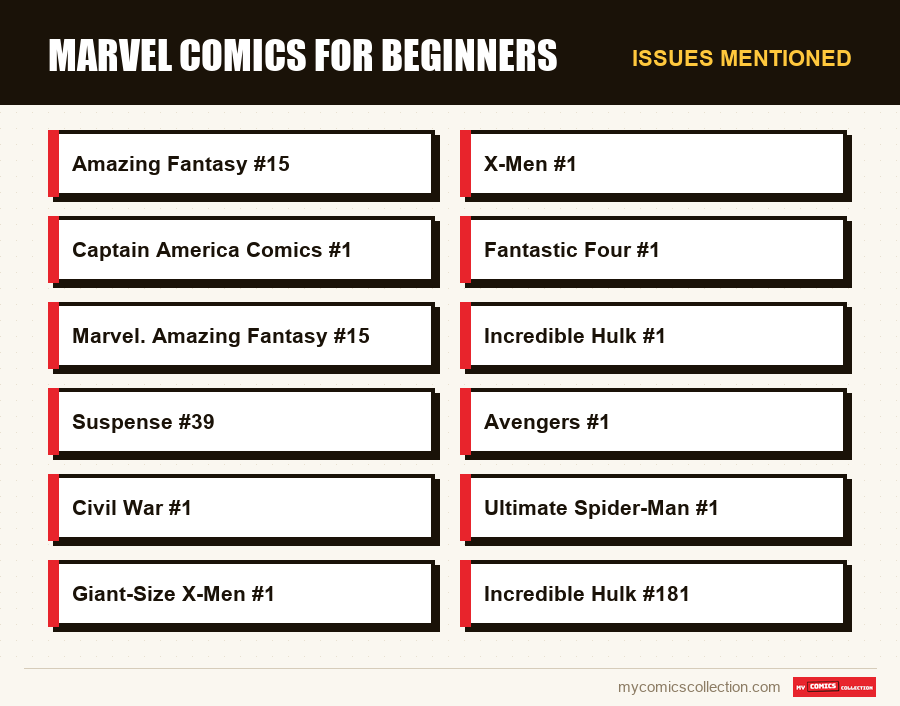
To start a collection of Marvel comics, it is not necessary to chase the #1 issues of the Silver Age (Amazing Fantasy #15, The most reasonable route is to first read these founding stories in reprint (Marvel Masterworks, Epic Collection, Marvel Unlimited), then identify a handful of titles or arcs that really speak to you, then buy in original press from the years 1990-2010, more accessible, before considering a Silver Age in modest grade if the budget follows.
Getting started with Marvel comics is often dizzying. On the one hand, there are more than sixty years of continuity, hundreds of titles, reboots, parallel universes and a vocabulary of connoisseurs (Golden Age, Silver Age, variant, CGC, pedigree) which can be discouraging. On the other hand, there is the very legitimate desire to one day own a copy of Amazing Fantasy #15 or X-Men #1, these issues which literally launched the comic book industry as we know it.
This guide does not seek to sell you a dream with impossible figures. It is based on verifiable facts: publication dates, names of creators, known print runs, CGC census data and documented sales results. The objective is to give you a realistic roadmap, whether you start with twenty euros per month or with a confirmed collector's budget.
We will first return to the editorial milestones that structure the Marvel universe, then to the concrete strategies for reading and purchasing intelligently, before dealing with the impact of cinema adaptations and the essential frequently asked questions.
Understand Marvel's publishing history before investing
Before Marvel, there was Timely Comics, the house founded by Martin Goodman which already published Captain America Comics #1 in 1941. But the modern DNA of Marvel, the one that interests the majority of new collectors, was really born at the turn of the 1960s, when Stan Lee, then editor-in-chief, joined forces with cartoonists like Jack Kirby and Steve Ditko to reinvent the American superhero. The bet: fallible characters, with money, relationship or identity problems, rather than flawless demigods.
Fantastic Four #1 opened the ball in 1961: date of sale on August 8, 1961 for an official publication in November, written by Stan Lee and drawn by Jack Kirby, ten cents per issue for thirty-two pages. This issue now occupies third place in Overstreet's ranking of the hundred most sought-after Silver Age comics, and more than fifteen hundred copies have already received a CGC grade in universal grade, a volume which gives an idea of the demand for this specific title.
The following year, in 1962, two issues permanently changed the trajectory of Marvel. Amazing Fantasy #15, often presented as the last issue of an anthology magazine about to be canceled, introduced Spider-Man under the pen of Stan Lee and the pencil of Steve Ditko: Stan Lee had also discarded Ditko's original cover in favor of a drawing by Jack Kirby, then inked by Ditko himself. The CGC census now lists around three thousand graded copies for this issue, a figure which remains low given the global demand for the very first Spider-Man. The same year also released Incredible Hulk #1, from a smaller print run than the other Marvel titles of the time: the CGC census only has 883 unrestored copies listed, including less than thirty in very high grade between 9.0 and 9.8. This issue occupies second place in the Overstreet 2019 ranking of one hundred Silver Age comics, just behind Amazing Fantasy #15. A copy of the Northland Pedigree, grade CGC 9.2, sold for $375,000 in 2016; in much more modest grades, an FN 6.0 went from around $8,000 in 2009 to around $24,000 today, and a GD 2.0 went from around $1,200 to around $9,000 over the same period, an illustration of the ongoing tension between rarity of the original print and growing demand.
1963 was the pivotal year when the shared universe took shape. Tales of Suspense #39, cover date March 1963, introduces Iron Man: the plot is credited to Stan Lee for the screenplay, his brother Larry Lieber for the script, Don Heck for the art, and Jack Kirby for the design of the original armor. A few months later, in September 1963, two issues were released almost at the same time: The Avengers #1, written by Stan Lee and drawn by Jack Kirby, brought together Iron Man, Ant-Man, the Hulk, Thor and the Wasp for the first time; and X-Men #1, also by Lee and Kirby (inking by Paul Reinman), introduces Professor X, Cyclops, Iceman, Angel, Beast, Marvel Girl and their recurring adversary Magneto. Of the latter title, a CGC 9.4 copy ranks in the top 0.5% of all graded copies, with only six copies rated higher, and a CGC 9.0 copy sold for $185,000 at a recent sale.
The turning point of the Bronze Age and the birth of the modern X-Men
After a commercial slowdown for the X-Men at the end of the 1960s, Marvel took a gamble in 1975: relaunching the title with a completely renewed team. Giant-Size This story, entitled "Second Genesis", is the direct starting point for what will become Uncanny X-Men under the pen of Chris Claremont, the longest and most influential run in the character's history. For a beginner, understanding this shift is essential: the X-Men mythology popularized today by films, series and video games is based almost entirely on this 1975 relaunch, not on the original 1963 team.
Where to start specifically depending on your budget
The question most newcomers ask themselves is not "what is the most expensive comic to own" but "where should I start reading, and buying, without breaking the bank". Three strategies coexist and are not mutually exclusive.
The first is to read before buying the original press. The great founding stories cited above are all available in reprint: the Marvel Masterworks reproduce the first issues in colors restored with critical equipment, the Epic Collection favors a more economical format bringing together several years of publication, and a digital subscription allows you to read thousands of issues without tying up your budget on paper. This approach has a double advantage: it avoids blindly buying an issue whose story we ultimately discover we don't like, and it leaves the budget available for real favorites.
The second strategy consists of targeting facsimile reprints or anniversary reissues for the very first issues. Marvel regularly publishes facsimile editions of titles like Civil War #1, reproducing the original cover and content at a near-new price. It is not a collector's item in the strict sense, but it allows you to physically possess a founding story without aiming for a vintage example.
The third strategy, the most financially engaging, consists of purchasing more recent and therefore less rare issues in the original press. The modern era of Marvel is full of stories that have become classics, the first printings of which remain accessible: Ultimate Spider-Man #1, published in 2000 by Brian Michael Bendis and Mark Bagley, reimagines the origin of Peter Parker over seven issues and has sold approximately twenty million copies worldwide in all editions, making it a relatively easy title to find in the original press at a reasonable budget. Civil War, the seven-issue mini-series by Mark Millar and Steve McNiven published in 2006, pitting Iron Man and Captain America against each other around a superhero census law, belongs to the same category: a cult story, widely available, whose first issue does not require a seasoned collector's budget.
To organize your reading without getting lost between runs, crossovers and renumberings, keeping track of your collection and your reading orders greatly facilitates progress; This is exactly what our comic collection management application, designed to catalog what we have, what we have read and what we target next.
Collecting this series?
Track what you own, what you are missing and what your collection is worth. 7 day trial.
Start my trial →The impact of adaptations on the rating
The launch of the film Iron Man in 2008, directed by Jon Favreau with Robert Downey Jr in the role of Tony Stark, released on May 2, 2008 in the United States, marks the beginning of the Marvel Cinematic Universe produced by Marvel Studios. This commercial success, more than $585 million in worldwide revenue, has permanently changed the general public's relationship with comics: readers from the cinema began looking for the origin stories of each character, in particular Tales of Suspense #39, the first appearance of Iron Man, and the arcs which directly inspired the storylines of films, such as Civil War.
This mechanism is reproduced with each new release: the announcement of a film or series devoted to a character who has until then been secondary mechanically triggers an increased search for his first appearances, which can cause his rating to evolve in the medium term. This is a phenomenon documented since the 2000s across the entire comic book market: demand follows media exposure, not just the intrinsic quality of the original story. For a beginner, the practical lesson is simple: a character who is very popular in cinema today is not necessarily the most affordable to collect, because his fan base has expanded well beyond historical comic book readers. Conversely, characters less exposed to the screen often remain more economical entry points to discover the Silver Age or the Bronze Age without competing with a market swollen by cinema news.
Before any purchase of an old issue motivated by a recent release, it is therefore useful to check the real rating rather than relying on an intuition linked to the release of the film. A comic that we think "must be worth a lot" because of a recent film may very well have a stable rating if the character concerned only appears in a supporting role, or on the contrary have risen sharply if the craze is confirmed by actual sales.
The essential vocabulary to avoid making mistakes
Before you get started, a few terms keep popping up in sales descriptions and collector discussions; mastering them avoids many misunderstandings when making a first purchase.
The CGC grade and what it really means
CGC, for Certified Guaranty Company, is the most recognized expert body on the market for the authentication and grading of American comics. The rating scale goes from 0.5 (Poor, a very degraded copy) to 10.0 (Gem Mint, a condition that is almost impossible to achieve on an old comic). In current practice, most collector's copies are between 6.0 (Fine) and 9.8 (Near Mint/Mint), and each half-point difference can significantly vary the rating on a sought-after title, as shown by the differences observed on Incredible Hulk #1 between a GD 2.0 and an FN 6.0. A copy that has not been graded is called "raw": this does not mean that it is of lower quality, simply that it has not been evaluated and enclosed in a sealed shell (a "slab") by a third party service.
Newsstand, direct edition, restored: details that matter
Until the 1990s, Marvel distributed its comics through two distinct circuits: the "newsstand" circuit, sold on newsstands with the right to return unsold items, and the "direct edition" circuit, reserved for specialized stores with no right of return. On certain numbers, the distribution between the two circuits was very unequal, which makes one of the two draws rarer than the other for the same number and the same year. Another essential distinction: a so-called "restored" comic has undergone an intervention (chemical cleaning, spine reinforcement, replacement of pages) which modifies its value compared to a strictly "unrestored" copy, that is to say in its original state. The CGC censuses always distinguish the two categories, as we saw with the 883 unrestored copies of Incredible Hulk #1.
What do we really call a “key issue”?
A key issue, or key number, designates a comic that marks a lasting editorial event: a first appearance of a character, the death or return of a major hero, an iconic costume change, or the debut of a team. Amazing Fantasy #15, X-Men #1 or Giant-Size X-Men #1 are key issues in the strict sense, because they introduce characters still active in the Marvel universe more than sixty years later. Conversely, an issue which simply continues a plot without a founding event, even if it is well written, remains a classic run issue, generally much more approachable. Understanding this distinction helps you prioritize your purchases: it is better to have a key issue in modest grade than an anecdotal number in impeccable grade.
Buying guide
Whether you are aiming for patient reading in reprints or a first purchase in the original press, a few principles avoid the disappointments common among new collectors of Marvel comics.
- Start by reading the story in reprint (Masterworks, Epic Collection or digital subscription) before purchasing a period issue: this avoids investing in a story which, once read, does not suit your tastes.
- Always distinguish between the first appearance of a character and the first appearance of a team or a costume: Wolverine appears for the first time in Incredible Hulk #181 in 1974, not in Giant-Size X-Men #1 which marks his entry into the X-Men team the following year; confusing the two completely distorts the planned budget.
- Favor runs and mini-series from the 1990s to 2010 for a first purchase in the original press: the print runs are significantly larger than the Silver Age, which makes the copy less rare and therefore less expensive, while remaining a "real" period comic.
- Systematically check the existence of a copy in the CGC census before considering an issue as rare: a low number of copies listed, like the 883 copies of Incredible Hulk #1, indicates a real rarity, while an abundant census indicates a title that is easier to find, therefore more suited to a beginner's budget.
- Never set a purchasing budget on the basis of a "memory" price or a figure read only once: the odds change, sometimes significantly, depending on current cinema news or recent sales observed on the market.
- Keep track of what you own and what you're targeting next: a collection that grows without tracking quickly becomes difficult to manage, especially when multiple sagas overlap.