
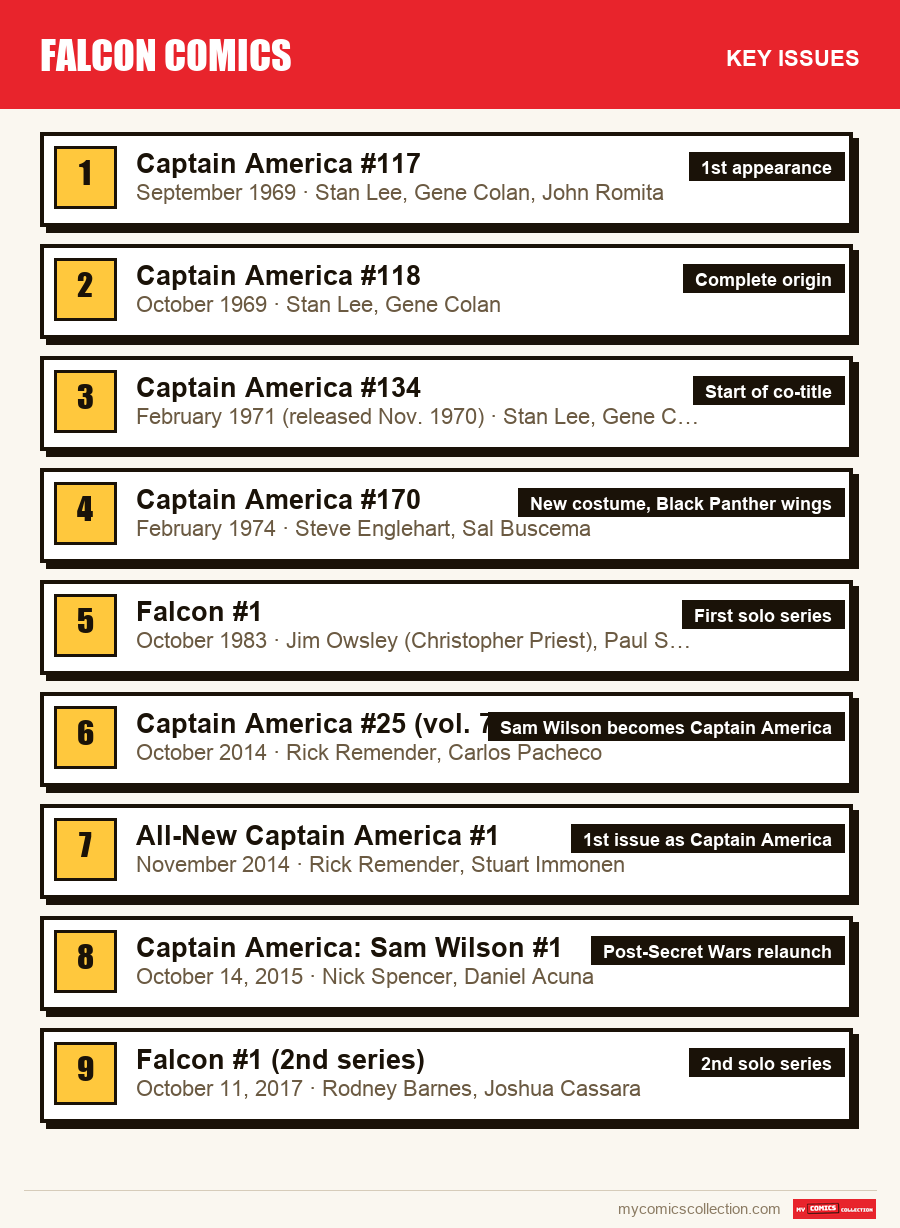
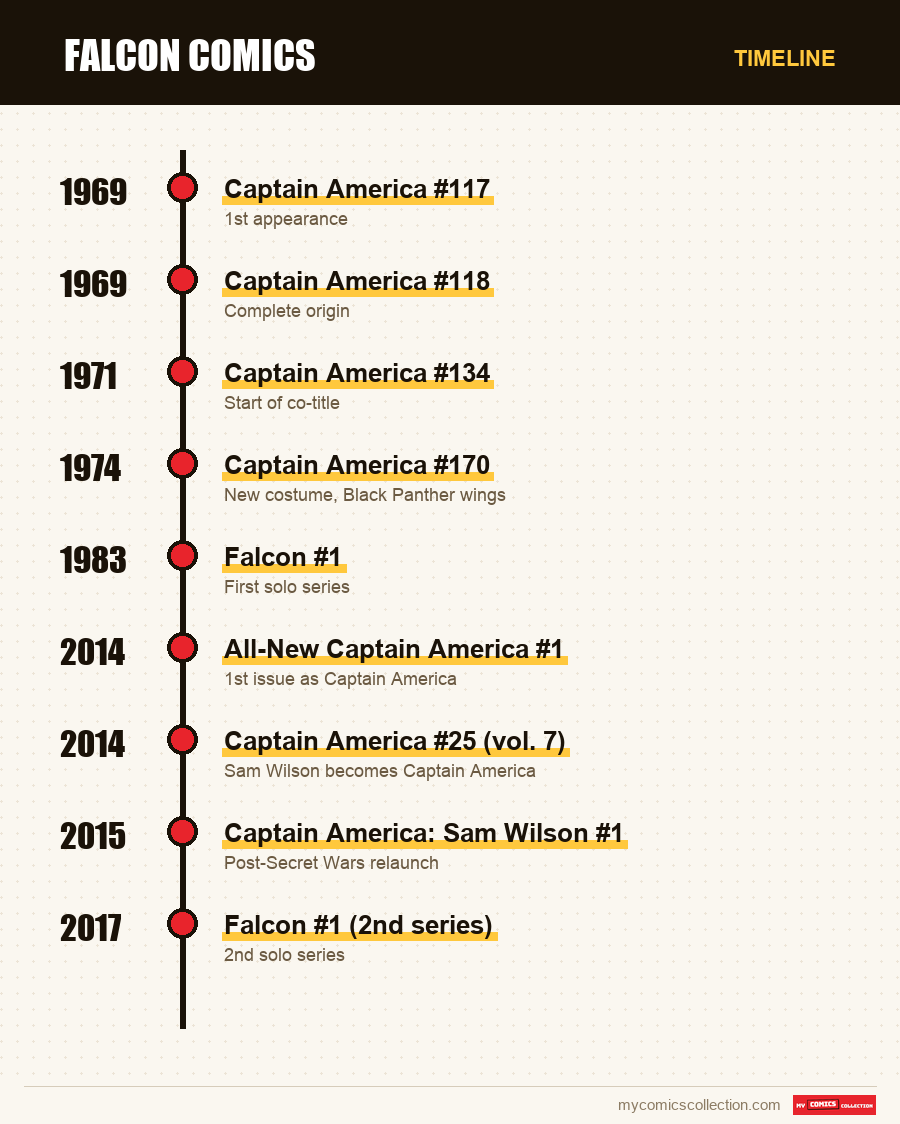
Falcon's truly key numbers are Captain America #117 (September 1969, first appearance of Sam Wilson by Stan Lee and Gene Colan), Captain America #118 (complete origin and reveal of the name), Captain America #134 (beginning of co-title "Captain America and the Falcon"), Captain America #170 (new wings offered by Black Panther), the Falcon #1 from 1983 (first solo series), and the modern trio Captain America #25 vol. 7 , All-New Captain America #1 and Captain America: Sam Wilson #1 which cover his time at the shield in 2014-2015. #117 largely dominates the price, with a record sale of $78,000 for a CGC 9.8 example.
Falcon occupies a special place in the history of Marvel: the publisher's first African-American superhero to wear an official costume, historic partner of Captain America for more than a decade of co-title, then heir to the shield itself in 2014. This long and winding trajectory makes the work of identifying key numbers more complex than for a character with a linear history: certain milestones are played out on the cover (the change of title in 1971), others on the costume (the wings of 1974), still others on the internal story (the transfer of the shield in 2014). A collector who simply searches for "first appearance Falcon" misses at least six other structuring numbers for the price.
This article focuses exclusively on the collection aspect: which numbers to own, why they matter, what they are really worth on the current market (when verified data exists) and how to prioritize your purchases according to your budget. For the complete story of Falcon's editorial career (biography of the character, major narrative arcs, evolution of the costume year by year) our article story of Falcon in comics covers this ground in detail; the two contents complement each other without overlapping.
Finally, as with any Silver Age, the difference in dimension between two neighboring CGC grades can multiply the price by five or ten: it is better to understand this mechanism before bidding. We come back to this in the buying guide, with a reference to our comparison dedicated to the grades.
One last point deserves to be made before going into the details of the issues: Falcon remains, compared to other first Silver Age appearances of characters who have become cinema headliners (Winter Soldier, War Machine, Vision), a case where the gap between "cultural interest" and "recognition of the classic comics market" has long been maintained. For decades, #117 traded at modest levels for a first issue of a character so enduringly present in the parent title of Captain America. It is only with the accumulation of cinematographic appearances, then the promotion of the character to the rank of Captain America on screen in 2021, that the rating has caught up with its real editorial importance: a catch-up phenomenon which deserves to be kept in mind when situating the more recent numbers on this list.
Falcon in Marvel editorial history: why these numbers matter
Sam Wilson arrives in Captain America #117 (cover dated September 1969, released at the end of August of the same year), at a time when Stan Lee was seeking to diversify the cast of Marvel heroes after the racial riots of the late 1960s. Gene Colan drew this first story, with finishing touches from John Romita and input from Jack Kirby to the visual design of the character. Falcon is presented as a Harlem social worker turned vigilante, accompanied by his trained hawk Redwing: a man-animal duo that has no direct equivalent elsewhere at Marvel at that time.
The next number, Captain America #118, completes this introduction: the civilian name of Sam Wilson is officially revealed, Redwing gains presence, and Red Skull appears as the duo's recurring antagonist. This is a tipping point often underestimated by collectors who focus solely on #117: #118 is where the character's identity stabilizes for good.
The real change of status arrived in 1971 with Captain America #134, the first issue whose cover officially bears the words "Captain America and the Falcon". This co-title will remain in effect until issue #222 in 1978, almost nine years during which Falcon appears at the same level as Captain America on the cover: an extremely rare treatment for a hero partner at Marvel during this period. Then in 1974, Captain America #170 marks a major visual break: Black Panther, during Falcon's stay in Wakanda, completely rebuilt his equipment and offered him the glider wing harness which would become his graphic signature for the following fifty years, even directly inspiring the design of the EXO-7 costume worn by Anthony Mackie in the cinema.
The mid-1970s also brought a significant narrative twist, less known to the general public but frequently discussed by comic collectors of the Englehart run: screenwriter Steve Englehart revealed that Falcon had once been a small-time delinquent nicknamed "Snap Wilson", whose past had been manipulated by the Cosmic Cube and the Red Skull. This rewrite, controversial upon its release, long stuck to the critical reception of the character before being toned down by subsequent reactions. She also explains why the mini-series Falcon #1-4 from 1983 explores a different and equally debated narrative path: the screenwriter then suggests that Falcon could be a mutant, endowed with a telepathic link with Redwing capable of alerting Professor Xavier himself: a hypothesis that Marvel will formally abandon in the Avengers Annual 2001. These two episodes shed light on why Falcon #1 from 1983 is also of interest to collectors specializing in the history of editorial treatment African-American characters at Marvel, beyond its sole value as a first solo series.
Falcon then joined the Avengers themselves, a status he did not have despite years of partnership with Captain America: his candidacy is mentioned in Avengers #181 (March 1979, David Michelinie and John Byrne), before its effective membership took place from issue #183 (May 1979), where the team had to reduce its workforce under pressure from a government agent. He remained an active member until issue #194 (April 1980). This passage, although rarely cited as a "collectible" key number in the strict sense, usefully completes the understanding of Falcon's institutional place in the Marvel universe before his accession, more than three decades later, to the rank of Captain America.
Captain America #117
First appearance of Sam Wilson / Falcon and Redwing. He is the founding number of the entire character, and one of the first African-American superheroes in Marvel history to wear an identified costume. Original cover price: $0.15. Demand has increased significantly since the arrival of Anthony Mackie in the cinema in 2014, then with his promotion to the rank of Captain America on screen.
Captain America #118
Second appearance of Falcon, but above all the number where his civilian name, Sam Wilson, is revealed for the first time to the reader, alongside a new confrontation with Red Skull. Often purchased as a complement to #117 by collectors who want the complete origin story rather than just the iconic cover.
Captain America #134
First issue whose cover officially displays "Captain America and the Falcon". Falcon becomes a full partner of the hero, an editorial status which will last until issue #222 in 1978 - almost nine years of co-starring, a rare case in the history of superhero comics. Numero sought after by collectors who build a complete run of the co-title rather than a single iconic copy.
Captain America #170
During a stay in Wakanda, Black Panther completely rebuilt Falcon's equipment and gave him the glider wing harness that would become his visual signature for fifty years, and the direct basis for the EXO-7 costume worn by Anthony Mackie in the MCU. This is the reference number for any collector looking for the "first iconic costume" rather than the first raw appearance.
Falcon #1
Four-issue miniseries, the first time that Falcon alone bears the title of a Marvel publication. Also historically notable is the professional writing debut of Christopher Priest (credited Jim Owsley), then an assistant editor, who would become one of the most influential black screenwriters in the industry. Classic Bronze/Copper Age print, cover price $0.60, 36 pages.
Captain America #25 (vol. 7)
Steve Rogers, deprived of the effects of the super-soldier serum and aging prematurely, chooses Sam Wilson to succeed him and gives him the shield during an Avengers meeting. This is the number of the narrative decision itself, the one that collectors seek first to mark the first time that Falcon is referred to as the new Captain America.
All-New Captain America #1
First issue of the new series where Sam Wilson actually wears the costume and title of Captain America over the course of a complete story, rather than the simple announcement of #25. Multiplies the variant covers (including an Alex Ross variant in 1:25 ratio, highly sought after by variant collectors), which creates a significant difference in odds between standard cover and variants printed at low ratio.
Captain America: Sam Wilson #1
After the Secret Wars crossover event, the series leaves with this issue 1, which installs Sam Wilson as Captain America full-time for the entire Spencer run, one of the most politically commented on of the period (immigration, surveillance, populism). Cover price $3.99.
Falcon #1 (2nd series)
Sam Wilson becomes Falcon again full-time and finds a series in his name, located in Chicago, with a tone anchored in urban social tensions. Series limited to 8 issues, modest print run according to the distributors of the time: it is today more difficult to complete in individual issues than the parallel Captain America titles from the same publisher.
Collecting this series?
Track what you own, what you are missing and what your collection is worth. 7 day trial.
Start my trial →The impact of adaptations on the rating
Falcon is one of the rare secondary characters in the Captain America universe to have benefited from a cinematic trajectory as long as it is continuous. Anthony Mackie plays Sam Wilson for the first time in Captain America: The Winter Soldier (2014), then continues Avengers: Age of Ultron , Captain America: Civil War , Avengers: Infinity War and Avengers: Endgame- an almost uninterrupted presence in the MCU for a decade which has maintained a large fan base well beyond the readership of comics.
The clearest commercial turning point comes with the Disney+ series The Falcon and the Winter Soldier (2021), in which Sam Wilson finally agrees to become the new on-screen Captain America: a direct echo of #25 vol. 7 of 2014. This adaptation has mechanically revived interest in the original issues of Falcon, in particular #117, whose highest auction sales are concentrated in the 2021-2022 period. The movie Captain America: Brave New World, released on February 14, 2025 with Anthony Mackie in the title role alongside Harrison Ford, extended this dynamic: the film crossed the $200 million mark in domestic revenue and accumulated more than $414 million worldwide, ranking it among the biggest Marvel successes of the year of its release.
Concretely, for a collector, this continuous cinematographic exhibition has two practical consequences. Firstly, the original issues (#117, #118, #134, #170) benefit from a structural base of demand which no longer depends solely on the market of Silver/Bronze Age purists: the general public discovering Falcon at the cinema naturally seeks "the first appearance" as a first collectible reflex. Then, the issues of the 2014-2015 transition (#25 vol. 7, All-New Captain America #1, Sam Wilson #1) directly benefit from each new release linked to the character-Captain America on screen, since they literally recount the event adapted to the cinema and in series. It is a correlation mechanism that we find for few Marvel secondary characters, most of the superheroes' partners having never experienced this continuity of adaptation.
Buying guide
- Prioritize #117 before any other number if the budget is limited to a single purchase: it is the only number on this list whose value in very high grade far exceeds the others ($78,000 for the CGC 9.8 record), and it is the one which historically anchors the character.
- Don't neglect #118 if you are aiming for a complete understanding of the origin: the civil name of Sam Wilson does not appear in #117, only in the following issue. A duo #117 + #118 tells the entire origin.
- Systematically check the grade difference before bidding: on a Silver Age like #117, the difference between a CGC 9.4 (around $2,880) and a CGC 9.8 ($78,000) can exceed a factor of 25. Our comparison CGC grade 9 versus 9.8 details precisely what separates these levels and why the price difference is so disproportionate to the visual difference.
- For #170, favor white pages.: this is a 1974 issue on standard newsprint paper, and the yellowing of the paper strongly impacts the grading note from the Fine grade.
- On modern issues (#25 vol. 7, All-New Captain America #1, Sam Wilson #1), the difference in value is primarily based on low ratio variant covers (1:10, 1:25, 1:50) rather than on the grade itself: these issues are too recent and too widely printed in standard coverage to justify a significant grade premium.
- Falcon #1 from 1983 and Falcon #1 from 2017 are two different series with the same title: always check the year and publisher before purchasing, as general search engines frequently confuse them.
- Consult the CGC census rather than relying on a single sales comparable: for issues where few recent sales exist (#134, #170, Falcon 1983), the number of copies noted in each grade provides more information on the real rarity than a single isolated transaction.
- Group your searches by run rather than by isolated number: A collector aiming for the co-title "Captain America and the Falcon" (1971-1978) benefits from planning the purchase of several consecutive issues, the prices of intermediate issues generally being more stable and less subject to speculative peaks than the very first issues.
To methodically organize these purchases, a tracking sheet by number (target grade, maximum budget, observed price range) avoids impulsive decisions during an auction. You can centralize this list and its rating tracking in the collection management application, and complete your reading with the sheet Falcon character to view his entire bibliography in one place.