Evaluating a comic consists of methodically examining its structure (spine, corners, staples), its surface (shininess, stains, folds) and the condition of its interior pages before placing it on the standard scale of 0.5 (Poor) to 10.0 (Gem Mint) used by professional grading organizations such as CGC, CBCS or PGX. A trained eye and good light are enough for reliable self-diagnosis; Third-party certification is only useful for high-value issues or those intended for resale.
Opening a box of comics inherited from an attic or found at the bottom of a moving box always triggers the same question: what is it really worth? Before even talking about price, we need to know how to answer a simpler and more useful question: in what condition is this comic exactly? The rating of an issue is never reduced to its title or its year of publication. Two strictly identical copies, released from the same press on the same day, can show a considerable difference in value simply because one has been read, folded, stacked under other magazines, while the other has slept flat in a protective sleeve.
Grading, that is to say the methodical evaluation of the physical condition of a comic, is a discipline in its own right, formalized for decades by reference guides and, since the beginning of the 2000s, by independent certification bodies. Understanding this reading grid is not reserved for professionals: any collector who sorts his boxes, prepares a sale or simply wants to know what he owns has an interest in mastering the basics of valuation. It is also the best protection against unpleasant surprises, whether it involves paying too much for a copy overpriced by a seller or selling off a misidentified treasure.
This guide details the concrete evaluation criteria, the history and operation of rating scales, the role of third-party grading companies, and provides a practical method for judging the condition of your collection yourself before, possibly, taking the step of professional certification.
Where does the comic rating scale come from?
For decades, evaluating a comic was a matter of subjective judgment: each dealer, each collector had their own mental grid, often inspired by the Overstreet guide which has published a descriptive scale in words since 1970 (Mint, Near Mint, Very Fine, Fine, Good, Poor...). This qualitative scale was then coupled with a numerical scale inspired by the coin notation model developed by the American numismatist William Sheldon in the 1940s: a system taken up and adapted to the world of comics to offer a finer granularity than just literal mentions.
The decisive turning point came in 2000, with the creation of Certified Guaranty Company (CGC) by Steve Borock. For the first time, an independent organization offers to rate a comic according to objective and reproducible criteria, to seal the copy in an inert plastic shell (the famous "slab") and to assign it a certification number that can be consulted publicly. The idea is a game changer: a buyer can now trust a note without having to physically examine the book, which streamlines remote transactions and stabilizes market prices. CGC published its first comics at the beginning of 2000 and quickly became the dominant reference in the sector.
Other companies follow. PGX (Professional Grading eXperts), founded in 2002, positions itself as a faster and more affordable alternative. Then, in 2015, Steve Borock, who was the very first official CGC grader, left the company he co-founded to launch CBCS (Comic Book Certification Service), acquired in 2018 by the Beckett Media group, already well established in sports card certification. These three players, with their specificities (deadlines, prices, requirements), today structure most of the global third-party certification market, but all rely on the same basic logic: a continuous scale from 0.5 to 10.0, modeled on the Overstreet/Sheldon standard.
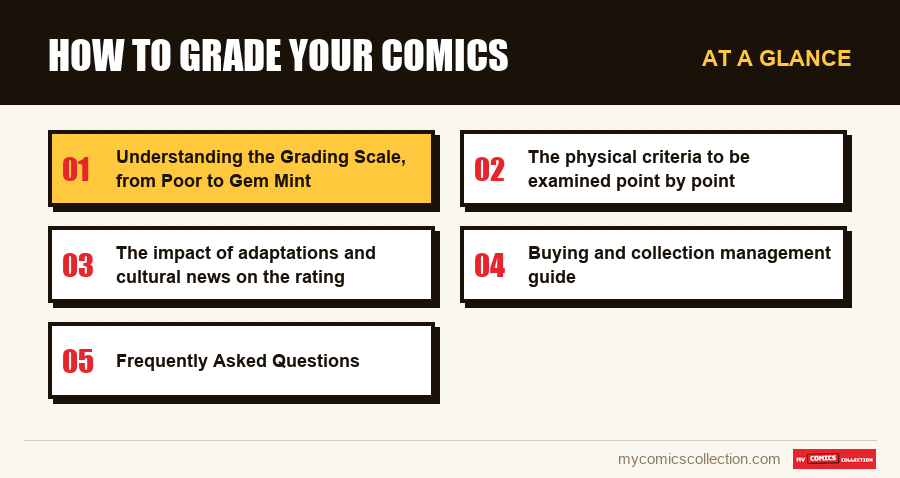
Understanding the Grading Scale, from Poor to Gem Mint
The scale goes from 0.5 (Poor) to 10.0 (Gem Mint), with around twenty intermediate levels. Each half point, or even each tenth of a point at the top of the spectrum, corresponds to a precise description of the faults tolerated. Understanding this grid avoids two frequent errors: overestimating a damaged copy because it "seems correct" at first glance, or on the contrary underestimating a very good copy due to lack of references.
At the bottom of the scale, a comic rated 0.5 (Poor) presents an accumulation of major defects: missing pages, broken spines, significant stains, sometimes mold or deep tears. At this level, the copy retains reading or collection value, but rarely investment value. Between 1.0 and 3.0 (Fair a Very Good), the comic is complete but visibly read and manipulated: marked folds, rounded corners, rusty or slightly loose staples. This is the most common condition for comics from the 1960s-1980s that have actually circulated in the hands of readers rather than being kept as collectibles upon purchase.
The 4.0 to 6.0 range (Good a Fine) brings together copies with moderate but localized defects: a few reading creases, slight discoloration of the spine, blunted corners without being broken. This is often the range in which comics sold "as is" by individuals, without professional grading, fall. From 7.0 (Very Fine), the defects become minor and isolated; we enter the zone where the difference between two notes is played out on details that only careful examination, if possible with a magnifying glass and under low lighting, can be identified.
The top of the scale concentrates most of the added value of professional grading. The 9.8 (Near Mint/Mint) grade is generally considered the "near perfect" grade sought by investors: at most a tiny stress mark on the back or a slight original printing defect. The grade 9.9 (Mint) is significantly rarer and indicates a copy almost indistinguishable from perfection, with a truly minimal manufacturing defect. As for 10.0 (Gem Mint), it is reserved for a tiny fraction of copies submitted for certification: books without any trace of handling or manufacturing defect, generally from never-opened printing boxes. Over an entire print, obtaining this grade is statistically exceptional, which explains why the difference in value between a 9.8 and a 9.9 or a 10.0 can be disproportionate to the difference in actually visible defects.
The physical criteria to be examined point by point
Beyond the final score, understanding the individual criteria allows you to diagnose a copy yourself before even considering sending it for certification. Professional graders, like experienced collectors, systematically examine the same areas.
The cover and its shine
The first impression comes from the cover: does it retain its original gloss, or has it become matte and dull over time? Superficial scratches, moisture stains, discoloration due to prolonged exposure to light (often visible at the edge, where the comic protruded from an exhibition tray) are all defects that cause the grade to drop. A cover that has retained its bright colors and original luster is the first signal of a well-preserved copy.
The back and stress marks
The back (spine) is the most fragile area of a comic spindle, and therefore the most scrutinized. Spine stress marks are thin horizontal lines, usually near the staples, caused by repeated bending of the book while reading. When they break the printing color (they then appear white on a colored back), they penalize the note more than simple folds without color break. A perfectly flat back, without the slightest undulation, is a determining criterion for any score above 9.0.
Corners and edges
Blunt, bent or outright broken corners indicate frequent handling or unprotected storage. A slightly rounded corner but without a clear crease is less penalized than a visibly horned corner. The edges of the cover must be examined to detect micro-tears invisible from a distance but identifiable by touch or under raking light.
Staples
On stapled comics (the vast majority of American periodicals), the condition of the staples matters enormously: rust, discoloration of the paper around the staple, staples torn in the paper or slightly out of their housing are classic defects which mechanically lower the grade, even when the rest of the book seems impeccable.
The quality of the interior pages
A criterion often underestimated by beginners: the color of the interior pages. The newsprint used in the majority of American comics naturally yellows over time due to oxidation. Graders distinguish several levels, from white to brown, including cream and light yellow. White or close to white pages are a real added value, particularly for old comics where this level of conservation is rare. Conversely, brittle pages, which crack when touched, constitute a major structural defect independent of the visual appearance of the cover.
Catering: a separate factor
Restoration deserves specific mention because it is not evaluated in the same way as natural defects. Techniques such as color touch (adding color to hide a faded area), adding missing paper, chemically bleaching pages, replacing staples or "married pages" (replacing pages with pages from another copy) are all considered restoration by certification bodies. Conversely, simple pressing which flattens the folds without chemical alteration or addition of material is generally not classified as restoration. A restored comic retains its value, but always lower than an unrestored copy of the same appearance: transparency on this point is essential, both for purchase and for resale.
Collecting this series?
Track what you own, what you are missing and what your collection is worth. 7 day trial.
Start my trial →Home grading or professional certification?
The entire collection is not intended to pass through a certification body. Sending in professional grading has a cost, a delay (which can extend from a few weeks to several months depending on the service chosen), and only makes economic sense for issues whose potential value greatly exceeds these costs. For the vast majority of a current collection, a rigorous self-evaluation is more than enough to get a fair idea of the general condition.
Third-party certification (CGC, CBCS, PGX) becomes relevant in specific cases: a particularly sought-after key number, a copy suspected of being in a very high level of conservation, an auction or a buyer requiring an independent guarantee, or even a dedicated comic book that we wish to authenticate via a signature witness program (Signature Series at CGC, Verified Signature at CBCS). In all other cases, the cost and time of certification are generally not justified in view of the gain in confidence provided.
When a comic is certified, it is sealed in a rigid shell accompanied by a label whose color indicates the type of certification. The blue label (Universal) indicates a standard copy with no restoration or particular defect to report beyond the note itself; This is the category most sought after by buyers. The yellow label (Signature Series) certifies that a signature has been affixed in the presence of a witness authorized by the certification body, a guarantee which generally results in a premium value estimated between 30% and 60% compared to an equivalent non-dedicated copy. The green label (Qualified) indicates a specific defect, often a restoration not declared at the time of grading or a particular anomaly, which must be specified on the label itself. The purple label (Restored) indicates a proven restoration, with a mention of the degree (slight, moderate or significant). For a buyer, the hierarchy of value generally goes from the blue label to the purple label, with an equal rating: a Universal Blue is always traded above a Restored Purple, although displaying the same numerical rating.
The impact of adaptations and cultural news on the rating
The physical state is only half of the value equation; the other half is due to demand, itself very sensitive to cultural news. The release of a film, a series or the announcement of a casting systematically has the effect of drawing attention to the key numbers associated with a character or a specific narrative arc: first appearance, origin, death or return of a character. This dynamic is not specific to a particular publisher: it is observed recurrently with each major announcement of a cinematographic or television project affecting the Marvel, DC universe or independent licenses adapted in recent years.
For the collector, this mechanism has a direct practical consequence on the evaluation: the grading note remains an objective and stable criterion over time, but the resulting market value fluctuates with current events. A copy rated 9.4 today will still be worth 9.4 in ten years, its rating does not change, but the price associated with this rating can fluctuate significantly upwards or downwards depending on the popularity of the character or series at the time of resale. This is an additional reason to clearly dissociate, in one's personal evaluation, the condition diagnosis (which comes from the physical examination of the comic) and the estimate of market value (which depends on the market at the time T and must be based on recent comparable sales rather than on old references).
Buying and collection management guide
Whether you're looking to buy a used comic, evaluate your own collection or prepare for a sale, a few simple reflexes can help you avoid the most common mistakes.
- Always examine under neutral, grazing light.: indirect daylight or a neutral spectrum LED lamp reveals creases, scratches and variations in shine much better than yellow ambient lighting.
- Handle the comic by the edges, never by the surface of the cover, and avoid folding it by opening it flat so as not to create new stress marks on the back.
- Always compare the advertised rating and the photos provided during a distance purchase: a seller who does not display a clear photo of the back or corners generally hides a defect.
- Systematically check the certification number on the website of the organization concerned (CGC, CBCS or PGX) before purchasing an already slabbed copy, in order to confirm that the note and title correspond to the copy offered.
- Do not confuse restoration invisible to the naked eye and absence of restoration: only an examination under ultraviolet light or the expertise of a professional grader can detect certain very careful color retouching.
- Keep your non-certified copies in reinforced pockets (backing board) and in an upright position, away from direct light and humidity, to avoid any additional degradation before possible future certification.
- Don't overestimate a copy that is "clean" to the eye: a comic that appears to be in good condition when quickly flipped through may hide spine folds or yellowing of the pages that only become apparent upon detailed examination.
- For numbers with high potential value, have your self-assessment confirmed before selling as is: a deviation of just half a point on the scale can represent a significant difference in value at the high end of the spectrum.
This methodical rigor applies just as well to a single key issue as to an entire collection accumulated over the years. For those who manage several hundred, or even several thousand, copies, keeping a structured inventory (with title, number, estimated condition and physical location) quickly becomes essential so as not to indefinitely reevaluate the same books each time they are sorted. An application dedicated to collection tracking makes it possible to centralize this information, to easily return to it during a future purchase/sale arbitration, and to avoid losing track of a remarkable example buried in a longbox among hundreds of others.