To find the missing issues of a comic collection, you must first establish a precise list of shortages (number, variant, targeted condition) based on an online collaborative database, then cross several search channels (conventions, second-hand bins, auctions, CGC/CBCS grading census to gauge the real rarity) by prioritizing issues with a low certified population and high demand. A number-by-issue tracking tool with automatic want list generation, like the My Comics Collection application, transforms this hunt into a method rather than a chance one.
There comes a point in every serious collector's life where the question stops being "what do I want to buy?" » to become “what am I missing, exactly?” ". It is the shift between accumulation and collection in the literal sense: the constitution of a complete run, without gaps, without approximation. And that's when most collectors discover that finding a missing number is not easy. A number may not be found because it is rare, but also simply because no one on the market knows that a buyer is looking for it.
The good news is that this hunt has become considerably more structured since the days when collectors exchanged photocopied lists by mail. Bibliographic databases, grading censuses and digital tracking tools have replaced uncertainty with verifiable data: how many copies of an issue have been graded, in what states, how often they go on sale. This guide details a complete method, from the inventory of your own collection to the reflexes to adopt at the time of purchase, to transform a scattered search into a constructed approach.
We will see why certain numbers are particularly resistant to research, how to read scarcity signals rather than relying on instinct, and which channels to combine to maximize the chances of coming across the copy that finally closes a run.
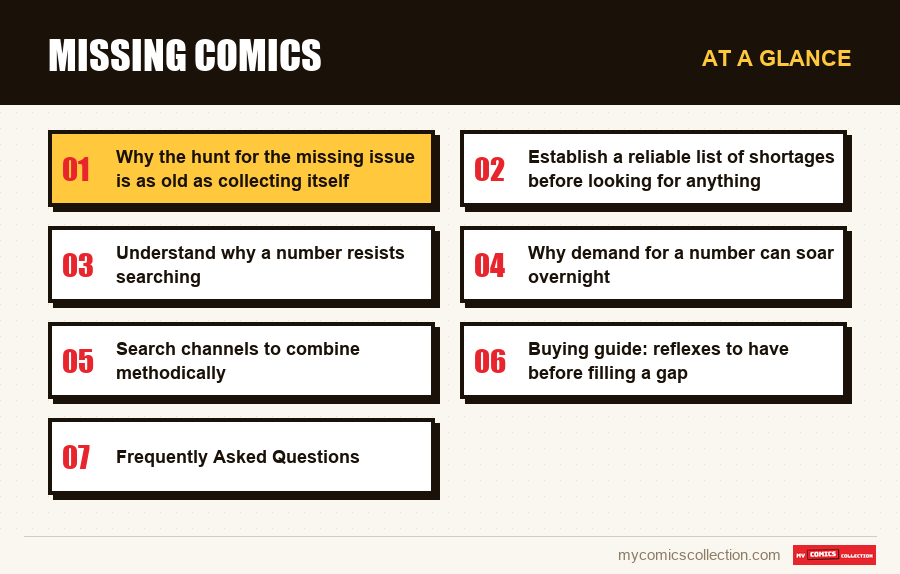
Why the hunt for the missing issue is as old as collecting itself
The reflex to complete a series does not date from the internet. It dates back at least to 1970, the year Robert M. Overstreet published the first edition of his Comic Book Price Guide: a confidential edition of 1,000 copies (completed by a second edition of 800 shortly after), 218 pages of listings sold for 5 dollars. The guide was already based in part on the notes accumulated by Jerry Bails, who was preparing a similar work. The objective of these first editions was not only to set indicative values: it was to give collectors a common reference to know what existed, in what order, and therefore what they were missing. In 1976, the guide had already achieved national distribution in the United States, proof that this need for structured reference reached a wide audience, well beyond just Golden Age specialists.
This census logic then moved to digital with an online collaborative database, which has cataloged series, creative credits and story times since the end of the 1990s. Its database now lists several million entries: more than 2.1 million indexed numbers, nearly 230,000 series and more than 1.3 million covers referenced according to the most recent records. It is one of the most reliable tools for checking the exact order of a numbering, spotting double numbers, renumberings of a series or one-shots which are discreetly inserted into a run and which one easily forgets to add to one's list of misses.
The third pillar of this structure, more recent, arrived with professional grading. Launched in 2000, Certified Guaranty Company (CGC) introduced a standardized ten-point rating scale, constructed from surveys of collectors, dealers and retailers, to reduce the amount of subjectivity in assessing condition. By 2007, CGC had already graded more than a million comics; the company now boasts more than 20 million certified objects in total, all categories combined. Each graded copy is recorded in a public census, which can be consulted number by number: this has become, without this being its primary objective, one of the best indicators of real rarity available to a collector who seeks to know if the issue he is tracking is simply not widely available, or truly rare.
Establish a reliable list of shortages before looking for anything
The first mistake, very common, consists of going in search of a number "by feeling", relying on one's memory of what is already on the shelf. A collection of several dozen or hundreds of issues does not hold its head reliably, especially when it includes variant covers, reprints, annual issues or crossovers that carry separate numbering. The rigorous approach therefore begins with an exhaustive inventory, number by number, compared with the official numbering of the series as it appears in a reference base such as the catalog.
This inventory must distinguish several levels of "missing": the issue completely absent from the collection, the variant cover not possessed while the standard issue already is, and the issue present but in such a degraded condition that a collector seeking aesthetic coherence of the run wishes to replace it. These three cases call for different search strategies: the first has priority in completion value, the second requires particular vigilance on variant identifiers (often a simple letter suffix that changes everything), the third is more a question of opportunity than of urgency.
This is precisely the type of work that a collection tracking app automates. My Comics Collection, for example, allows number-by-number tracking of its collection with automatic generation of the list of shortages, dedicated management of CGC grade copies and their variants, as well as a barcode scanner which accelerates the initial entry of a large batch. The benefit of a missing list generated automatically rather than kept by hand is twofold: it eliminates forgetfulness linked to memory, and it is instantly updated as soon as a new number joins the collection, which avoids actively searching for a number already acquired the previous week: a mishap more common than one might think on long runs.
Once this inventory has been established, it is useful to prioritize the list of shortages into two or three priority levels rather than treating it as a homogeneous block. A first level brings together numbers with a low census population and high demand, those which justify actively monitoring each sale. A second level brings together current numbers, present in abundance on the market, the acquisition of which can await a good price opportunity without particular urgency. This hierarchy avoids the classic pitfall of the collector who exhausts his budget on issues that are easy to find later, to the detriment of those whose availability window is structurally narrower. It also makes it possible to better scale the time devoted to each search channel: priority numbers deserve a dedicated alert and a regular presence at conventions, while current numbers can be left to more passive monitoring.
Understand why a number resists searching
Not all missing numbers are equal in search difficulty, and the reason is rarely due to chance. Three objective factors explain most of the differences: the original circulation, the physical survival rate of the issue until today, and current demand which weighs on the available supply.
The original print run varies greatly depending on the era and publisher, and it is not always accurately documented by the publishers themselves. Amazing Fantasy #15 (1962), Spider-Man's first appearance, illustrates this gray area well: comics historians generally estimate between 300,000 and 400,000 copies printed, with no official figure confirmed by Marvel. What is measurable today, however, is how many examples have survived in sufficient condition to be subject to gradation: the CGC census counted around 4,140 in total at the end of November 2025, with only four universal examples rated 9.6 and no examples beyond this rating. A print run of several hundred thousand units can therefore result, six decades later, in a handful of copies in the very high grades: the difference between the initial print run and the surviving population is often more telling than the print run itself in gauging the true rarity of a sought-after number.
The gradation census, precisely, is the most reliable tool to objectify this residual rarity without relying on impressions. It does not say how many ungraded copies are still circulating in attics and garage sale bins, but it gives a reliable snapshot of the proportion of copies which have been judged worthy of certification, grade by grade. A number with a very low census population in the middle grades (not just in the very high grades) generally signals a real search difficulty, regardless of its marketability. This is a useful reflex before embarking on an active search: consulting the census of the targeted number allows you to adjust your expectations of time and state before even starting to search.
Collecting this series?
Track what you own, what you are missing and what your collection is worth. 7 day trial.
Start my trial →Why demand for a number can soar overnight
Objective rarity is not enough to explain why certain numbers suddenly become difficult to find even though they were common the previous year. The demand factor, linked to editorial or cultural news, plays an equally determining role, and it is often the quickest to disrupt a market.
The most documented historical example remains the storyline "The Death of Superman" in 1992, whose mainstream publicity triggered an unprecedented wave of speculation in the industry. Casual readers, convinced that each new issue would become an investment, flocked to comic shops; the two main direct market distributors at the time relaxed their order conditions, which caused the number of points of sale to jump to around 10,000 stores at the height of the bubble. This euphoria turned around suddenly: by June 1994, the market contracted by around 10% per month, and half of the stores opened at the peak of the bubble had closed by 1996, the year Marvel even filed for bankruptcy. The direct consequence for a collector today: the issues published during this period of overproduction (1991-1993) are paradoxically abundant in circulation, while the earlier issues, printed at much more modest volumes and having never benefited from this mass speculation, remain proportionally more difficult to locate in good condition.
Conversely, a successful film or series adaptation can push a previously easy-to-find issue into a much more competitive category, not because the physical offering has decreased, but because the number of active buyers for this specific issue suddenly increases. This is a well-documented phenomenon for the first appearances of characters brought to the screen: the same quantity of available copies must suddenly satisfy a multiplied demand, which mechanically lengthens the search time for a copy in the desired condition and budget, even if the issue is objectively no rarer than before. Keeping an eye on the latest adaptations linked to the series that we collect allows us to anticipate these peaks and, if necessary, to complete a run before the search window narrows.
Search channels to combine methodically
No single channel is enough to complete a run efficiently; it is the combination of several sources, queried regularly, which maximizes the chances of coming across the right copy at the right time.
Conventions and specialized fairs remain a separate channel: they bring together in a limited place and time a density of sellers and private collections much higher than what is found online over the same period, with the advantage of being able to physically inspect the condition of a copy before purchase: a crucial point on old issues where online photos sometimes hide spine or binding defects. Second-hand bins, whether kept by individuals or professionals, work differently: they reward regular visits rather than one-off research, because their contents change according to the collections purchased.
Online auction platforms, led by eBay, today constitute the most systematically searchable channel for a specific issue: the ability to create a search alert on an exact title and number transforms an active hunt into passive monitoring, particularly useful for slow-moving issues that only appear on sale a few times a year. It is also the richest source of data to objectify a real rating before bidding, rather than relying on an isolated displayed price.
Digital tools that structure research
Three types of digital tools deserve to be systematically combined. First, an online collaborative database to check the exact numbering order of a series, including its renumberings, its annual issues and its listed variants: a step too often neglected which avoids looking for a number which does not exist or, conversely, forgetting one which does indeed exist under parallel numbering.
Then, the CGC and CBCS gradation censuses, available for free online, to gauge the population actually certified by a number and calibrate your expectations of time before setting out to look for it. Finally, a collection tracking tool with automatic generation of a list of missing items avoids duplicate searches and centralizes information on what is really missing, variant by variant. It is the combination of these three sources (bibliographic, statistical and personal) which transforms an approximate research into a methodical approach.
Buying guide: reflexes to have before filling a gap
- Check the exact numbering before purchasing: cross-reference the proposed number with a reference base to ensure that it is neither a late reprint not reported, nor a variant different from that sought.
- Consult the census of gradation of the number targeted before setting a budget, to know if its scarcity is concentrated on the high grades only or on the entire scale: this directly conditions the realism of a state objective.
- Prioritize your list of shortages by real scarcity and not by desire: an issue with a low census population and high demand deserves to be treated as a priority, because the window of opportunity can close faster than expected, particularly in the event of editorial news or adaptation.
- Systematically ask if an ungraded copy has restorations not declared, in particular on old issues with a high rating, where restoration invisible to the untrained eye remains a real risk.
- Create named search alerts (title, number, variant) on auction platforms rather than multiplying occasional manual searches, so as not to miss any sale on slow-moving issues.
- Compare the proposed item to a rating estimate based on actual sales rather than on an isolated displayed price, so as not to pay a number above its current market range.
- Keep your shortage list continuously updated, including after each acquisition, to avoid actively searching for a number already in the collection: a frequent pitfall on long runs followed by hand.
On this last point, a reliable estimate before purchase remains the best safeguard against an overvalued acquisition: our estimator based on current eBay listings allows you to check in a few seconds where a proposed item is located in relation to the low, middle and high range of the current market, before committing to a number that has been missing for a long time.