The total value of a comic collection is calculated by adding the individual rating of each issue, evaluated according to its condition (CGC/CBCS grade or "raw" estimate), its rarity (original print run and census population) and recent comparable sales. There is no universal "average price": a box of comics from the 1990s can be worth a few dozen euros when a handful of key issues from the Silver Age is enough to exceed several thousand euros. Cataloguing, mentally grading each piece and comparing to actual sales remains the only reliable method.
Asking “how much is my collection worth” is like asking a question as broad as “how much is my library worth”. The answer depends entirely on what's on the shelves. A collection of two thousand modern comics purchased on newsstands in the 2000s and a stack of thirty issues of the Silver Age can show a difference in value of one to a thousand, while the second is physically much smaller. It is this disparity which makes the estimation of an entire collection more complex than that of a single object: it is necessary to multiply the work of identification, notation of condition and search for comparables by the number of numbers possessed, then add it all up without double counting or underestimating the rare pieces buried in the mass.
This guide details the concrete method for arriving at a credible figure: how to organize inventory, how to read professional rating grids, which tools actually consult buyers and sellers in the market, how the market has evolved in recent years, and how to financially protect what you own once the value has been established. The objective is not to give a magic price but a reproducible method, the one used by professional evaluators before signing an expertise.
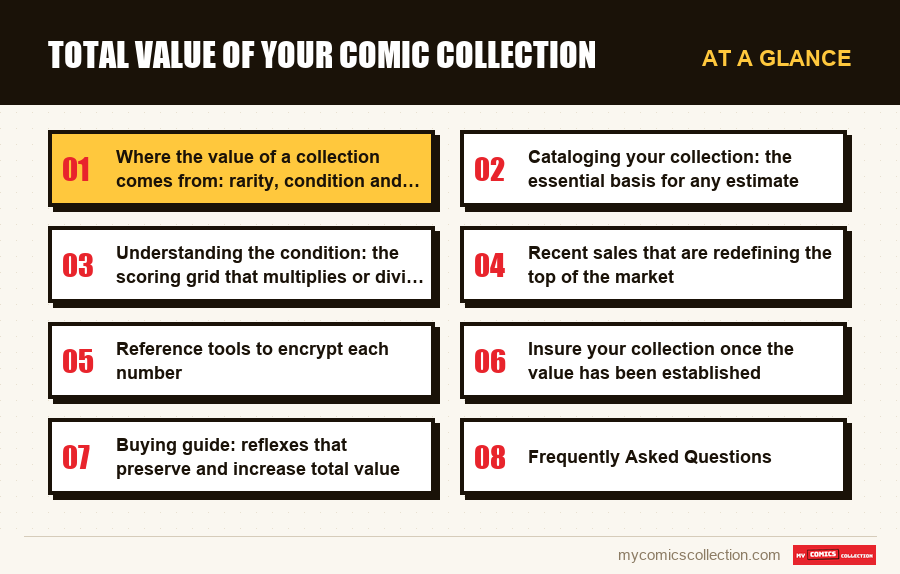
Where the value of a collection comes from: rarity, condition and editorial demand
The very notion of "collection value" is a construction of the secondary market, appearing gradually from the 1970s when the first printed price guides began to set numerical benchmarks for second-hand comics. Before that, a comic was a disposable consumer product: printed on cheap newsprint, sold on newsstands, then often thrown away or recycled once read. This initial fragility explains a central paradox of collecting today: the older a title is, the fewer surviving copies in good condition exist, and the more rarity weighs heavily in the calculation of the total value.
Three independent factors determine the price of each piece in a collection, and therefore its total sum. The first is the original circulation: an issue printed in several hundred thousand copies in the 1990s, a period of speculative overproduction in the American industry, remains structurally less rare than an issue of the Golden Age printed in a more modest circulation and largely destroyed by time. The second factor is editorial demand, that is to say the narrative importance of the issue: first appearance of a character, origin, death or start of a major arc generate a constant demand regardless of the situation. The third factor, often the most determining on the scale of an entire collection, is the physical state of conservation, which will be detailed later.
For a collection taken as a whole, these three factors combine number by number: the total value is never an average, but a sum or a few key pieces can represent 80% or more of the overall value, the rest of the collection weighing only marginally despite a much greater physical volume. This is why the first step in a serious estimate is not to encrypt each comic one by one from the start, but to first identify the numbers likely to be "keys" before processing the rest in batches.
Cataloging your collection: the essential basis for any estimate
No reliable estimate is possible without a structured inventory. This may seem obvious, but it's the step that the majority of collectors skip, contenting themselves with a general impression ("I have a lot of comics from the 90s") which does not allow any serious calculation. A useful inventory contains, for each issue: the exact title and publisher, the issue number and the variant cover if applicable, the year and month of publication, the estimated state or official grade if the comic is encapsulated, and any notable particularity (signature, limited edition, printing error).
Two approaches coexist to construct this inventory. The first, manual, consists of using a spreadsheet: it offers total control but requires constant rigor and makes updating the dimensions tedious as soon as the collection exceeds a few hundred issues. The second consists of relying on a collection management application which automates the recognition of numbers and centralizes the history, which quickly becomes more practical as soon as the collection exceeds a few hundred pieces. Our collection tracking application allows you to scan and catalog each issue with its characteristics, without repeated manual re-entry.
Once the inventory has been established, the next step consists of sorting: separating the issues likely to have a significant individual value (first appearances, original issues, short editions, signed or noted copies) from the rest of the collection, which will generally be treated in batches or in "long boxes" with a much more modest number value. This prior sorting avoids wasting a disproportionate amount of time searching for sales comparables for numbers whose unit value does not justify the individual research effort.
Understanding the condition: the scoring grid that multiplies or divides the rating
The physical condition of a comic is, along with editorial rarity, the factor that most influences its value, and it is also the one that collectors most often underestimate when they evaluate their own collection without hindsight. The reference scale used by the entire market goes from 0.5 (practically destroyed copy) to 10.0 (gem condition, almost untraceable), with key levels at 9.8 (near mint/mint), 9.4 (near mint), 9.0 (very fine/near mint), 8.0 (very fine), 6.0 (fine) and 2.0 (good). The difference in value between the levels is not linear: for the same key number, going from a grade 9.8 to a grade 2.0 can divide the rating by a factor of 50 to 100, a well-documented phenomenon on the most sought-after numbers on the market.
Two third-party organizations dominate the professional rating and encapsulation of comics in the United States: CGC (Certified Guaranty Company) and CBCS (Comic Book Certification Service), joined by more recent players like PGX. Having a comic graded by one of these organizations has a double benefit for the estimation of a collection: it objectively freezes the condition in a sealed shell and enters the grade in a searchable public register, the "population report" or census. This register indicates, for each number and each grade, how many copies have been officially graded by the organization to date. A low number at the top of the scale-for example, only a few dozen known copies in 9.8 for a given issue-signals a high-grade rarity that warrants a significant premium, even if the issue's original print run was large.
However, we must keep in mind a methodological limitation of the census: it only lists the copies submitted for grading, not the total number of surviving copies in the world, a portion of which remains ungraded ("raw") in private individuals. The census therefore measures a graduated rarity and not an absolute rarity. For an ungraded collection, the estimate of the condition necessarily remains approximate and must be deliberately cautious: a collector who evaluates his own comics tends to overestimate their condition through attachment, which artificially inflates the total calculated if we then apply reference ratings corresponding to a condition higher than reality.
Recent sales that are redefining the top of the market
The estimation of a collection is never done in a vacuum: it is part of a market whose references evolve, sometimes suddenly, according to the exceptional sales which make the news in the sector. In November 2025, a copy of Superman #1 (1939) changed hands for $9.12 million, becoming to that date the most expensive comic ever sold at auction and shattering by more than 50% the previous record of $6 million, itself set in 2024 by a copy of Action Comics #1. A few months later, in February 2026, a private transaction concerned two other emblematic pieces of the Golden Age: a Batman #1 rated CGC 9.4, described as the highest grade known for this founding number of the first appearances of the Joker and Catwoman, sold for 6 million dollars, almost triple the previous record for this title, and a Superman #1 of the "Mile High" pedigree rated CGC 8.5, sold for $7 million.
These record figures concern exceptional pieces, beyond the reach of almost all private collections, but they have a real effect on the entire market: they raise the psychological benchmark of what founding numbers of the Golden Age at very high grades can be worth, and they attract media attention which stimulates demand on the grade levels just below. At the same time, the market as a whole has gone through a significant correction since the speculative peak of 2021-2022: according to price tracking indices, the Silver Age index has fallen by around 23% since its peak in 2022, a decline that especially affects the middle and low end of the market, where modern speculation had inflated prices the most. Conversely, the key numbers recognized in high grades, the real “trophy books”, have retained or even increased their value over the same period, driven by a structural scarcity that the economic situation cannot absorb.
For the total value of an ordinary collection, the practical lesson of this contrast is twofold. On the one hand, key numbers in good condition remain the most resilient part of a collection in the face of market cycles, which justifies identifying them and treating them separately in the inventory. On the other hand, the mass of modern or mid-range numbers accumulated during the 2020-2022 period has likely lost value since their acquisition, and a realistic estimate must incorporate this correction rather than relying on odds dating from this period of intense speculation.
Collecting this series?
Track what you own, what you are missing and what your collection is worth. 7 day trial.
Start my trial →Reference tools to encrypt each number
Once the inventory has been established and the state estimated, all that remains is to assign a rating to each number, then to add it up. Two families of tools coexist on the market and meet complementary needs. The first is the annual printed price guide, the oldest and most recognized in the industry, now in its 55th edition (2025-2026): it offers value ranges by grade, established from reports from dealers and collectors around the world, and remains particularly useful for evaluating ungraded ("raw") comics, where real sales databases lack comparables.
The second family brings together online databases which aggregate the sales actually concluded, graduated or not, and calculate trend indices by title or by period. These tools have the advantage of reactivity: unlike the printed guide, updated once a year, a base of actual sales reflects in almost real time an increase or decrease in demand for a given issue, which makes it valuable for monitoring the evolution of the value of a collection over the months rather than relying on a fixed figure.
For an entire collection, the most reliable method consists of crossing the two sources: the printed guide to establish a coherent base range on all the ungraded numbers, and the actual sales comparables to precisely refine the rating of the few key pieces identified during the initial sorting. This is exactly the principle that our estimator applies, which relies on current eBay listings to return a low, median and high range rather than a single, misleading number.
Insure your collection once the value has been established
Establishing the total value of a collection is only of practical interest if this value is then protected. This is a point that many collectors discover too late, often after a loss: most standard home insurance contracts have a very low cap on coverage for collectibles, and frequently exclude certain risks such as water damage or target theft, precisely the most frequent losses for a comic collection stored at home.
Two options exist to fill this limit. The first is the rider ("rider" or "scheduled personal property endorsement" in Anglo-Saxon terminology), which is added to the existing housing contract to specifically cover the valuable objects listed individually, generally with an agreed value established in support of an expertise or a documented inventory. The second is the policy dedicated to collectibles, distinct from home insurance, more suitable when the total value of the collection becomes significant and the piece by piece detail justifies a stand-alone contract rather than a simple endorsement.
In both cases, documentation is the sine qua non condition for correct compensation in the event of a loss: a dated inventory with photos, an estimate of the total value updated regularly, and if possible a professional expertise for the most significant parts. This is also why a digital inventory kept up to date, such as that provided by a collection tracking application, is not only a comfort tool for the collector: it is the supporting document which will allow, if necessary, to assert the real value of the collection to an insurer rather than ending up with a lump sum compensation much lower than the actual value.
Buying guide: reflexes that preserve and increase total value
Whether the objective is to complete an existing collection or to constitute a new collection, a few concrete principles make it possible to optimize the total value in the long term rather than eroding it through impulsive choices.
- Favor quality over quantity on key acquisitions. A single key number in very good condition generally weighs more in total value than around ten current numbers purchased at the same budget, and is more easily resold if necessary.
- Systematically verify authenticity before any significant purchase. Undeclared restorations, replaced pages or reattached covers directly affect the potential grade and therefore the value; a careful examination of the back, the staples and the edge avoids unpleasant surprises.
- Keep unread copies in suitable folders and rigid boards. Exposure to light, humidity and repeated handling physically degrades the condition, which mechanically lowers the potential grade and therefore the rating in the long term.
- Grade the parts whose estimated value justifies the cost of the service. Professional encapsulation freezes the condition, facilitates resale and places the comic in the population report, an argument of confidence for any future buyer.
- Document each acquisition from purchase. Date, price, source and condition noted at the time of purchase form a valuable history for monitoring the performance of the collection and for any subsequent insurance process.
- Reassess regularly rather than just once. The market moves, sometimes strongly over short periods like the correction observed since 2022; a collection valued three or four years ago deserves an update before any decision to sell or insure.
- Treat key numbers and the rest of the collection separately. Searching for a precise sales comparable for each issue of a collection of several thousand pieces is neither realistic nor useful; concentrate the individual estimation effort on the parts which really weigh in the total.
These principles obviously do not guarantee any future added value, the comics market remains subject to the same cycles of demand and speculation as any collector's market, but they limit avoidable losses linked to poor conservation, absent documentation or an approximate estimate which underestimates or overestimates reality.