After a few months of active collecting, the question inevitably comes up: how do you keep track of everything you have? A notebook, a spreadsheet, photos on your phone?
Creating your online comic library: everything you need to know
After a few months of active collecting, the question inevitably comes up: how do you keep track of everything you have? A notebook, a spreadsheet, photos on your phone? These solutions work up to a point, then they break down. The online comic library has become in 2026 the natural answer to this problem. Here's everything you need to know to create one that actually works.
What is an online comic library?
An online comic library is a digital catalog of your physical collection, accessible from any connected device. It's not a digital version of your comics (you don't read the comics online: you manage the inventory of your paper comics), it's a management tool.
The difference with a simple paper list or an Excel file is fundamental. A real online library offers:
- Access from your phone, anywhere and anytime
- Complete metadata for each issue (cover, publication date, writers, artists)
- An estimated market value for each title
- The ability to share all or part of your catalog with others
- Advanced search and filtering features
- A permanent backup of your inventory
For anyone collecting seriously, the online library isn't a luxury: it's the backbone of the collection.
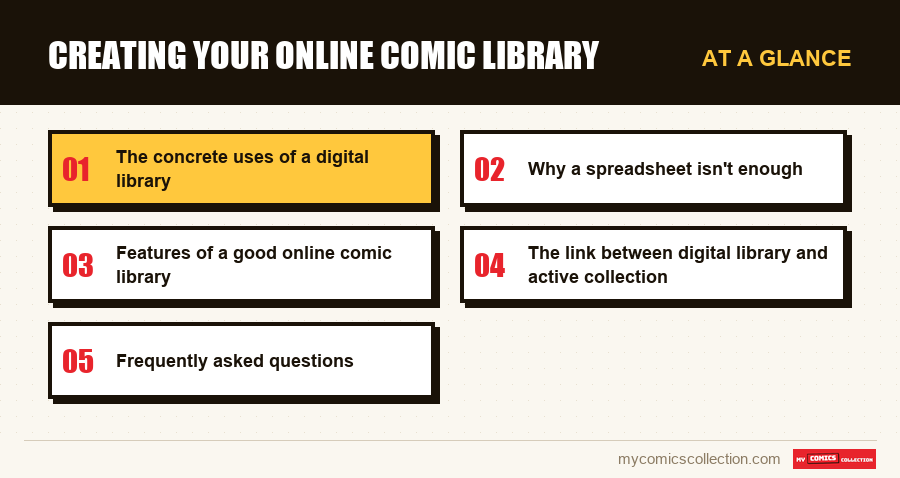
The concrete uses of a digital library
You only truly realize the value of an online library in real situations. Here are the use cases that make the difference day to day.
At a flea market or shop. You come across a lot of 50 Amazing Spider-Man. You have 30 seconds to decide which issues you're missing. Without a digital library, it's a lucky guess. With your catalog on your phone, you check in 10 seconds the issues you already have, and spot exactly the gaps to fill. This is maybe the most valuable use of the entire library.
To avoid duplicates. Duplicates are every collector's plague. With a well-maintained digital library, it's a nearly eliminated problem. Each new acquisition is added to the catalog, and the app alerts you if the number is already there.
To know your collection's value. A good online library estimates market values and gives you your collection's estimated value on demand. Useful for insurance, for a potential sale or simply to know where you stand.
To share with loved ones or the community. Sharing your collection with other collectors or simply showing your library to friends is much easier with an online catalog. Some apps let you make your collection public, which can lead to trades or sales between collectors.
As a security backup. A fire, flood, or burglary: in these situations, the online library becomes the only record of what you owned. For insurance, a complete digital inventory with photos is infinitely more usable than an approximate memory.
Why a spreadsheet isn't enough
The spreadsheet remains many collectors' natural reflex. It's free, flexible, and you master the tool. But in practice, Excel or Google Sheets quickly show their limits for a comic collection.
Not accessible without a desktop connection. A shared Google Sheets works on phone, sure, but the quick-lookup experience at a flea market is far less fluid than a dedicated app with search bar and optimized filters.
No automatic metadata. In a spreadsheet, you enter everything manually: title, number, author, condition. In a dedicated online library, a barcode scan often suffices to fill all this information automatically. The productivity difference is considerable when you catalog 200 comics at once.
No daily-updated valuation. Calculating your collection's value in a spreadsheet means manually updating prices that change. A dedicated app syncs these values automatically with market data.
No integrated wishlist management. The connection between "what I have" and "what I want" is native in a specialized online library, not in a two-tab spreadsheet that drifts out of sync over time.
Features of a good online comic library
Not all solutions are equal. Here's what distinguishes a truly useful tool from a basic catalog.
Multi-criteria search. Being able to search by series title, issue, writer, artist, publisher, publication year, and ideally combine these criteria. "All Daredevil by Frank Miller" or "all my comics in Near Mint" should be a trivial search.
Condition and category filters. Condition is central to a collection. A good library lets you filter by grade (Near Mint, Very Fine, Fine, etc.) and quickly identify comics worth upgrading.
Data export. Your data must remain yours. CSV or PDF export is a basic feature that signals a tool's seriousness. Useful for insurance, for potential transfer to another solution, or simply for archiving.
Connected wishlist management. The wishlist must be connected to the inventory: if you find a wishlist comic, it should pass into your collection in one click. Some apps even let you get alerts when a wishlist comic becomes available at partner sellers.
Duplicate management. A library that automatically flags a comic you're adding as already in your collection: that's a feature worth its weight in gold once you hit 300-400 comics.
Collecting this series?
Track what you own, what you are missing and what your collection is worth. 7 day trial.
Start my trial →The link between digital library and active collection
An online library isn't a static tool you consult occasionally. For active collectors, it becomes the central dashboard of their activity.
The connection between library and lending management is often underestimated. Who borrowed what from you, since when? With a loan note in your catalog, no more comics lost at friends' houses.
The connection with valuation is just as important. Tracking your collection's value evolution over time, identifying comics that have appreciated most, spotting undervalued pieces you could acquire: all of this becomes possible when your library is connected to market data.
Finally, the digital library is a planning tool. How many issues are you missing to complete a given run? What's the estimated cost to fill those gaps? These questions get an immediate answer in a well-maintained library, and remain without precise answer if you work from memory.
Where to start to create your online comic library?
The hardest part is the initial catalog. If you already have 500 comics and you're starting from zero, the idea of entering everything can seem discouraging. A few practical tips:
Start with the most valuable or most recent comics. Those first, because they have the most to gain from rigorous tracking.
Use barcode scanning to speed up entry. Most comics published since the 90s have a barcode that enables automatic identification. For older comics, manual entry is often needed, but it's fast once the title and series are identified.
Set a goal of 20 to 30 comics per session. Cataloging an entire longbox in one evening is perfectly doable. In a few weeks, your library will be complete.
An online comic library is an upfront time investment that pays back very quickly: at the first flea market where you avoid a duplicate, or the first time you calculate in 30 seconds that your collection is worth several thousand dollars.
Frequently asked questions
The best collection management apps offer an offline mode that lets you consult your catalog even without network. That's essential for flea markets in poorly covered zones. Data syncs automatically as soon as connection is restored. Check this feature before choosing your tool: it's a discriminating criterion for active collectors who frequent shows and conventions.
With an app using barcode scanning, count about 1 to 2 minutes per comic for recent issues (scan + verification + condition entry). For a longbox of 300 comics, that's 5 to 10 hours of work total. Comics without barcodes (pre-90s) require longer manual entry. The trick: catalog in several 30-45 minute sessions rather than one long session: it's less tedious and less prone to entry errors.
Yes, it's one of modern apps' most appreciated features. You can generally choose to make your collection public (visible to everyone), semi-public (visible to people with a link) or private. Sharing facilitates trades between collectors: someone looking for an issue you have as a duplicate can contact you directly. Some apps also let you share a public wishlist, very useful for gifts or for finding sellers who have exactly what you're looking for.
Values shown in collection management apps are generally based on aggregated market data (eBay sales, online shop prices) and constitute a good indication of current value. They don't replace professional expertise for high-value pieces, but for the vast majority of a collection, they're precise enough to have an idea of total value, identify the most valuable pieces and decide whether a comic is worth sending to a professional grader.