Making your comic collection visible online involves documenting each issue (title, number, publisher, condition, possible CGC/CBCS certificate, double-sided photos) in a digital tool, then choosing a level of sharing (private, public or partial) according to your objectives: proof in the event of a disaster, monitoring of the rating, exchange with the community or simple desire to show off your library. This approach is part of a tradition of collaborative cataloging that dates back to the paper indexes of the 1970s and is structured with online collaborative databases (from 1994) and the CGC certification system (2000).
For a long time, "cataloging your collection" meant keeping a binder, an Excel sheet or, for the most organized, an Access database filled out by hand after each trip to the flea market or comic shop. This list remained on a hard drive, invisible to the rest of the world, useful only on the day when one was trying to find out if one already had a given number before buying a duplicate copy. The switch to tools accessible from a browser or a mobile application has changed the very nature of the exercise: the collection is no longer just a personal inventory, it becomes a searchable, shareable object and sometimes even an element of proof.
This development responds to very concrete needs. A collector who correctly documents his pieces can assert their existence and value to an insurer in the event of water damage or burglary. Anyone who follows the rating of their key numbers as films or series are announced can more accurately decide when to sell. And anyone who opens part of their collection to the community rediscovers the original spirit of comics fandom, built since the 1970s on the exchange of information between enthusiasts dispersed geographically.
This guide details how to structure a comic collection so that it's readable, usable, and, if you choose, viewable online: without ever sacrificing the security of your personal data or the privacy of your home.
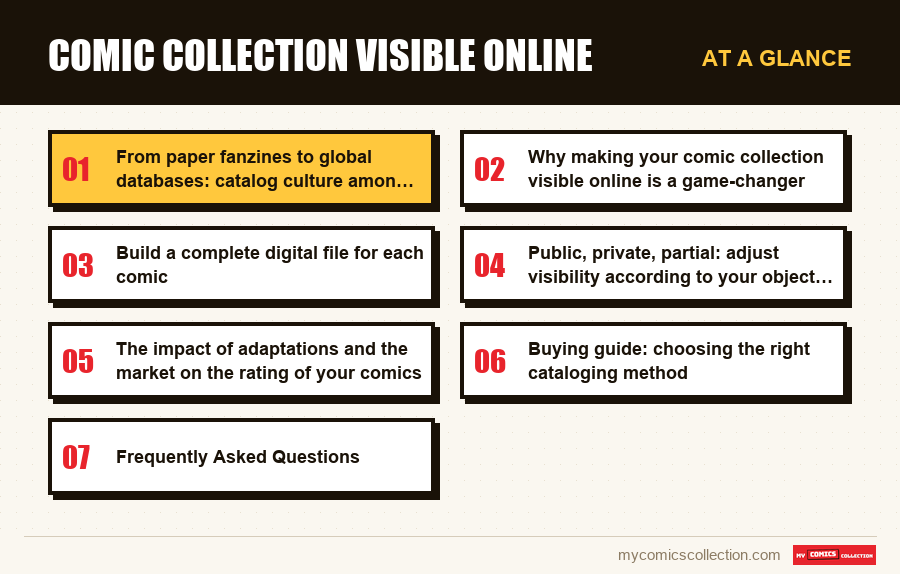
From paper fanzines to global databases: catalog culture among collectors
The desire to precisely document one's collection does not date from the internet. It dates back to the APA-I (Amateur Press Alliance for Indexing), a network of amateurs formed in 1978 to exchange, in the form of paper indexes, information on the content of comic books: who had drawn which story, in which issue, with which scriptwriter. These documents circulated by mail among enthusiasts who often had no other way of knowing what an issue contained before purchasing it.
It was from this soil that an online collaborative comics database was born, in March 1994. Three members of the APA-I, Tim Stroup, Bob Klein and Jonathan E. Ingersoll, began communicating by e-mail to build an electronic version of these indexes, with one objective stated from the start: to list all the comic books ever published. The project grew slowly, with information first circulating on diskette and by post, before the web allowed the centralization and collaborative consultation that we know today. This database remains, more than thirty years after its creation, a reference for creator credits, story details and reprint information: proof that a collectively built catalog can become a sustainable infrastructure for an entire community.
The second milestone in this catalog culture arrived in 2000, with the creation of CGC (Certified Guaranty Company), which introduced a standardized grading system on a scale of 0.5 to 10, associated with sealed encapsulation and above all with a public census: also called population report. This census indicates, for each number and each note, the exact number of copies certified to date. An example rated “pop 1 in 9.8” means that only one example in the world has received that precise rating, a rarity that can drive up the bidding dramatically. The CGC census has a blind spot that must be kept in mind: it only measures the copies submitted for certification, not the raw copies which lie dormant in binders or collections that have never been declared.
These two stories tell the same thing in two different forms: information about comics only has value, for its owner and for the community, if it comes out of the drawer. This is exactly the principle behind modern digital cataloging: transforming a pile of numbers into information that is usable, searchable, and if you wish, visible to others.
Why making your comic collection visible online is a game-changer
Documenting your collection for yourself has always made sense: quickly finding out if you already own a particular issue before an impulsive purchase at the comic shop, or simply having an overview of what you have accumulated over the years. But making it visible, even partially, opens up uses that the private filing cabinet did not allow.
Connect to a community of enthusiasts
Comics culture was built on the exchange of information between geographically isolated collectors: this is literally the story of the APA-I then the catalog. A collection visible online brings this logic up to date: it allows other enthusiasts to spot an issue they have been looking for for years, to compare a variant or an edition, or simply to discuss the condition of a particular copy. For collectors specializing in a title, an author or a specific period, a public collection becomes a resource consulted by other enthusiasts in the same segment.
Protect yourself in the event of disaster or theft
This is the argument most often neglected, and yet the most concrete. When it comes to insurance for collectibles, the burden of proof rests on the owner: in the event of an accident, theft or water damage, it is up to you to provide proof of the value and existence of the lost or damaged item. A properly documented inventory must include, for each piece, its precise designation, its provenance with date and place of acquisition, its estimated value and photographs from several angles. Insurers also recommend keeping this documentation in a separate location from the collection itself: which a catalog hosted online naturally accomplishes, since it survives even if your home is damaged. For items whose individual value exceeds €1,500 to €2,000, a formal expertise remains recommended to establish a value approved by the insurer.
Follow the evolution of the rating of its key numbers
A cataloged collection with acquisition dates and purchase prices becomes a performance monitoring tool. You can spot which issues have increased in value, which are stagnant, and make an informed decision about when to sell or strengthen a series. This is particularly useful for key issues (first appearance, origin, death or return of a character) whose rating is most sensitive to announcements of adaptations, a phenomenon detailed later in this guide.
Build a complete digital file for each comic
The quality of a collection visible online depends entirely on the rigor of the file associated with each issue. A poorly informed collection provides none of the guarantees mentioned above: neither usable proof for an insurer, nor useful information for another collector. Here are the fields that make the difference between a decorative inventory and a truly usable catalog.
Basic identification. Exact title of the series, number, publisher, cover date and actual publication date if different. This information seems obvious but becomes crucial as soon as a title has undergone several relaunches numbered at 1, as is the case for many Marvel or DC series.
Variant and print. Standard or variant cover, printing ratio if known (1:25, 1:50...), possible signature with certificate of authenticity. Two copies of the same issue can have radically different prices depending on the cover.
Condition and gradation. For a rough copy, an honest estimate of condition (Near Mint, Very Fine, Fine, etc.) with mention of visible defects: folds, discoloration, split spine. For a certified copy, the name of the grading service (CGC or CBCS), the grade assigned and the certification number, verifiable on the website of the organization concerned.
Provenance and acquisition history. Date and place of purchase, price paid, seller if relevant for traceability. This is the most useful information in the event of an insurance dispute and the most often neglected, because it requires discipline at the time of purchase rather than catching up after the fact.
Visual documentation. Systematically photograph the front and back of each issue, under natural, diffuse lighting which avoids reflections on the protective plastic. For items of significant value, add a close-up of sensitive areas (spine, corners, staples) which will allow, in the event of a future dispute, to prove the condition at the time of cataloging. A dated photo serves as an informal timestamp of the condition of the piece.
A collection management application dedicated to comics, like the one offered by mycomicscollection.com, structures these fields to avoid forgetting and allows text and photos to be centralized in the same place, without depending on a spreadsheet which grows over the years to the point of becoming illegible. The objective is not the quantity of data entered but their consistency: better twenty well-documented numbers than two thousand approximate entries.
Collecting this series?
Track what you own, what you are missing and what your collection is worth. 7 day trial.
Start my trial →Public, private, partial: adjust visibility according to your objectives
Making your collection “visible online” does not necessarily mean exposing it in full to the public. Three levels of visibility meet different needs, and it is entirely possible to combine them according to the numbers or sections of the collection.
Strictly private catalog. Useful for the sole function of proof and personal tracking. Your data remains accessible only to you, but still benefits from the main advantage of digital compared to paper filing: it survives a domestic disaster since it is hosted elsewhere than at your home.
Restricted sharing. You open access to a chosen circle: family for the transmission of assets, expert for an evaluation, notary in the context of an inheritance. This intermediate level serves insurance documentation needs well without publicly exposing the composition and value of your collection.
Public showcase. You make all or part of your collection searchable by anyone. This is the level that recreates the community spirit inherited from the catalog: other collectors can discover your pieces, discuss a specific number with you, or simply be inspired by your approach to cataloging.
A point of vigilance deserves to be underlined: a public collection simultaneously revealing the residence address, the size of the collection and its value constitutes a signal that can be exploited by malicious people. Good practice consists of strictly separating this information: never geolocation or address associated with the public catalog, and particular caution on the cumulative display of high total values. A public catalog may well exist without ever revealing where the collection is physically located or how much it is worth in total.
The impact of adaptations and the market on the rating of your comics
An up-to-date catalog takes on its full meaning when it allows you to monitor in real time the effect of an external event on the value of your collection. The comic book market has experienced two types of well-documented shocks in recent years which illustrate the benefit of keeping an eye on key issues.
The first is structural: the 2020-2021 period marked an upheaval in the back-issue market. After a particularly difficult 2020 for comic shop sales: 63.2 million copies sold, the worst figure of the decade: the market rebounded violently in 2021, with sales up nearly 49% in volume and a record turnover exceeding $2.07 billion, up more than 62% year-on-year. In the specific segment of old issues, the index following Copper Age comics (late 1980s) increased by 168% between March 2020 and July 2021, while the Bronze Age index (1970s) increased by 137% over 27 months. Issues long neglected by collectors have suddenly become sought after again, driven by the nostalgia of a generation of buyers suddenly having cash and free time.
The second shock is punctual and directly linked to the screen adaptations. The announcement of a film or series regularly sets in motion the rating of key numbers associated with the character concerned, with a peak in demand generally observed two to four weeks before the release. The extent of these movements varies greatly depending on the case: certain first appearance issues saw their rating increase by several hundred percentage points in a few weeks when a series or film featuring them was announced, before stabilizing once the product was released. The correlation measured between a media announcement and an auction peak is, on average across all affected numbers, in a range of +14% to +28% over six months: a much more modest gap than the extreme cases in the media, which reminds us that we must be wary of isolated spectacular figures and look at the underlying trend.
These two examples illustrate why a living catalog, updated regularly, has more value than a fixed inventory created once and for all. A collector who follows his collection over time can observe these movements on his own numbers, compare with actual sales observed on the market, and decide with full knowledge of the facts whether it is relevant to sell at a peak or to keep for the long term. The eBay estimator available on mycomicscollection.com allows you to check in a few seconds where the low, median and high price range for a given issue is located, based on current eBay listings.
Buying guide: choosing the right cataloging method
Before embarking on the complete documentation of a collection, a few structuring choices should be made from the start to avoid having to start again six months later.
- Choose a tool that centralizes text and photos. A single spreadsheet requires managing images separately in a folder, which quickly breaks the link between the form and its illustration as soon as the files are renamed or moved.
- Enter the purchase price upon acquisition, never retrospectively. This is the most difficult information to reconstruct later and the most useful for monitoring the actual performance of the collection and documenting possible added value in the event of resale.
- Systematically photograph at the time of entry into the collection. The condition of a comic evolves over time, even when kept in a cover and cardboard sheet; a photo taken on the day of purchase serves as a reference in the event of a future dispute regarding the condition.
- Note the certification number for any graded specimen. Both CGC and CBCS offer online verification of the slab number, a simple reflex which protects both the buyer and the seller in the event of future resale.
- Clearly separate sensitive information from shareable content. Address, total value of the collection and geolocation elements must never appear on the publicly visible part, even if the details of the numbers are.
- Update the catalog after each movement, not once a year. An inventory taken every twelve months accumulates oversights; the immediate input reflex, upon purchase or sale, keeps the catalog continuously reliable.
- Cross-reference your estimate with recent actual sales. A value fixed at the time of purchase loses its relevance over time; regularly checking the current price range avoids unpleasant surprises in the event of a loss or sale.