A beautiful comic collection deserves to be presented with care. Collectors who have spent years hunting rare editions, maintaining their comics in perfect condition, organizing their longboxes methodically: these people know their collection tells a story.
Creating a digital showcase for your comic collection: practical guide
A beautiful comic collection deserves to be presented with care. Collectors who have spent years hunting rare editions, maintaining their comics in perfect condition, organizing their longboxes methodically: these people know their collection tells a story. The story of their tastes, their discoveries, their patience.
The digital showcase is the natural extension of this approach. Like a vinyl collector who photographs their record wall, or an art enthusiast who documents their personal gallery, creating an online presence for your comic collection means giving it an existence beyond the bag-and-board drawer and the storage boxes.
This guide explains concretely what a good digital showcase must contain, which platforms complement it, how to effectively photograph your comics, and why a sharing link from a dedicated application is often much more efficient than doing everything manually.
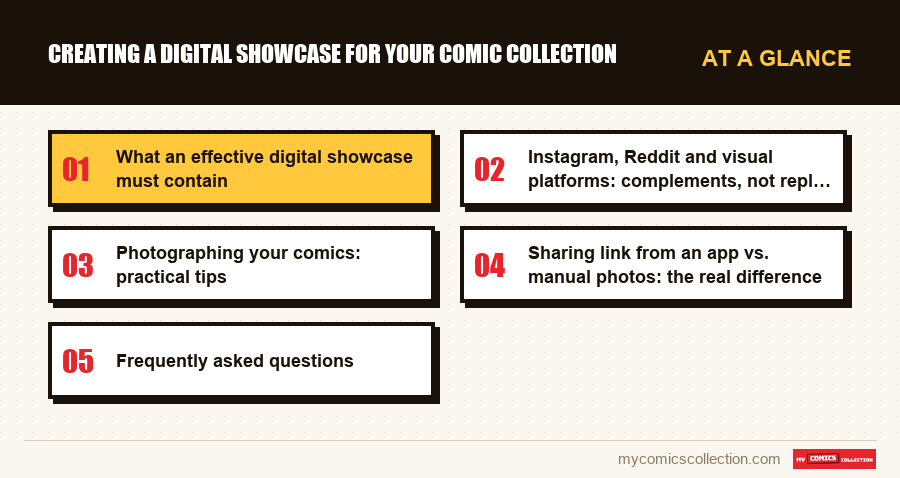
What an effective digital showcase must contain
Not all digital showcases are equal. Some collectors post a few photos on Instagram and stop there. Others maintain a complete, documented catalog. The difference between the two is long-term usefulness.
A truly useful digital showcase must display:
- Covers: the central visual element. A cover immediately identifies a comic, its era, its style. Without visuals, a list of titles and numbers remains abstract.
- Condition: Near Mint, Very Fine, Fine, Good: condition is crucial information for any collector interested in a trade or purchase. Not indicating it forces contacts to ask the question every time.
- CGC or CBCS grades, if applicable: a graded comic is a different piece from an ungraded comic. The grade (9.8, 9.6...) and label (Universal, Signature Series) deserve to be visible.
- Estimated value, if you wish to display it: useful for sellers, for insurance documentation, for collectors wanting to evaluate potential trades. Optional if you'd rather keep this information private.
- Acquisition date: an often-overlooked detail, but useful for tracing a comic's origin, for insurance declarations, or simply for your collection's personal narrative.
These elements form a serious showcase's foundation. They can be complemented by personal notes (why this issue matters to you, the story of its acquisition, its importance in the editorial continuity) but the factual foundation is essential.
Instagram, Reddit and visual platforms: complements, not replacements
Instagram and Reddit (notably r/comicbookcollecting) are active spaces for sharing your comics passion. Thousands of collectors post their recent acquisitions, their long-sought "grails," their most beautiful pieces. These are lively, engaged and often kind communities.
But these platforms have their limits as a structured showcase:
The algorithm degrades visibility over time. An Instagram post has a lifespan of a few hours. Three years later, no one will find your Near Mint Amazing Spider-Man #300 in your feed. On Reddit, older posts are no longer easily accessible either.
There's no catalog structure. Posting photo by photo doesn't constitute an inventory. A visitor to your Instagram profile can't browse your collection, filter by series or search for a specific issue. It's an image gallery, not a catalog.
Metadata is absent. Condition, value, acquisition date, CGC grade: this information can't be properly associated with each image on a generalist social platform.
Instagram and Reddit are therefore excellent complements for sharing remarkable pieces, connecting with the community or announcing a sale. But they don't replace a structured catalog.
Collecting this series?
Track what you own, what you are missing and what your collection is worth. 7 day trial.
Start my trial →Photographing your comics: practical tips
Photo quality makes the difference between an amateur showcase and one that makes you want to stop and look. No need for professional equipment: a recent smartphone is enough, with a few simple precautions.
Background
Choose a neutral background: white, light gray or matte black depending on the mood you're aiming for. Avoid cluttered backgrounds (messy table, carpet, visible tiles). The background should highlight the cover, not compete with it. A white cardboard sheet or a solid-color fabric works perfectly.
Lighting
Diffused natural light near a window (but not in direct sun) is ideal. It reproduces colors faithfully without creating reflections on plastic sleeves or glossy covers. If you shoot in the evening, two soft artificial light sources placed at an angle on each side avoid harsh shadows.
Resolution and framing
Frame tight on the comic, leaving a small background margin at the edges. Avoid angles: a frontal photo, perpendicular to the cover, shows details best. Shoot in high resolution: a too-compressed image makes small text and artistic details unreadable: details that make a cover's value.
Consistency
If you're building a real showcase, maintain a consistent style. Same backgrounds, same lighting, same framing from one comic to another. A homogeneous showcase is much more pleasant to browse than a collection of photos taken in different contexts.
Sharing link from an app vs. manual photos: the real difference
When you catalog your collection in My Comics Collection, covers are automatically integrated from the database. You don't have to individually photograph each issue to have a readable showcase. The app automatically associates the right cover image with each catalog entry.
This is a considerable time saving for large collections. If you have 500 comics, individually photographing each cover would take several hours. With an app, the visual catalog is built at the same time as the inventory.
And when you share your collection via a link, your contact accesses a clean, navigable interface with covers, information and filters: not a chronological photo album on Instagram.
Personal photos retain their usefulness for documenting a comic's precise condition (a light crease, a slight stress mark on the cover) or for highlighting a remarkable piece on social networks. But for the daily catalog showcase, a dedicated application is incomparably more effective.
Frequently asked questions
No. An app like My Comics Collection uses a cover database covering hundreds of thousands of issues. When you add a comic to your catalog, the cover is automatically associated. You only need to manually photograph very rare comics or cover variants that aren't in the database.
My Comics Collection offers an integrated barcode scanner that automatically identifies comics from their ISBN or UPC code. For older comics without barcodes, manual search by title and number works well. The visual catalog is built automatically in parallel with the inventory.
Yes, especially if you plan to sell or trade comics someday. Condition is information every potential buyer or trader will systematically ask about. Indicating it directly in your catalog avoids many back-and-forths and makes your showcase much more professional.
Absolutely. My Comics Collection lets you maintain a complete catalog for your personal use and generate selective sharing links only when you want. Your collection is never public by default: you choose who gets access and when.