Sharing your comic collection with loved ones seems simple on the surface. But as soon as you dig into details, you realize that "sharing" can mean very different things depending on context. Sharing with family to avoid duplicate gifts is one need.
Sharing your comic collection with loved ones: the good options
Sharing your comic collection with loved ones seems simple on the surface. But as soon as you dig into details, you realize that "sharing" can mean very different things depending on context. Sharing with family to avoid duplicate gifts is one need. Sharing with collector friends to find trades is another. And managing comic loans to friends, hoping to get them back, is yet another challenge entirely.
This guide treats these three use cases separately, with the practical problems each raises and the concrete solutions an app like My Comics Collection brings.
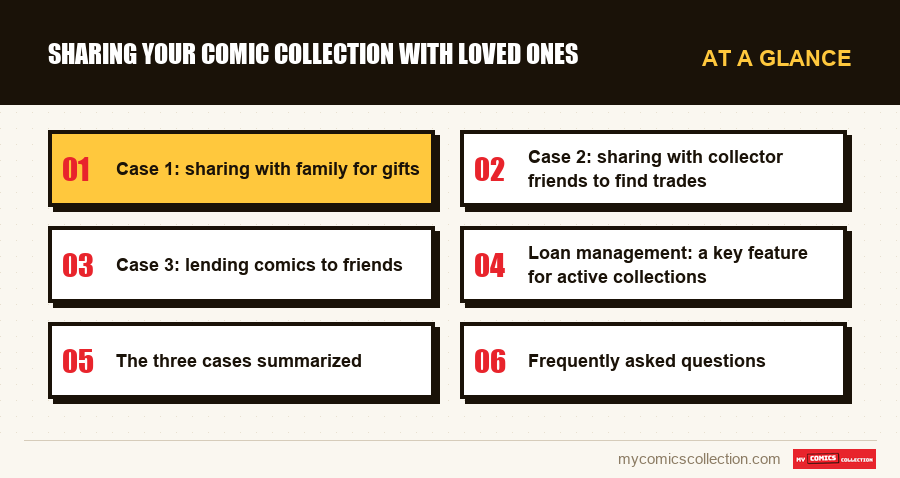
Case 1: sharing with family for gifts
This is probably the most universal situation. Every year, at Christmas or for a birthday, well-meaning loved ones offer a comic you already have. Sometimes several times. The problem is structural: your family doesn't know what you have, and you don't want to read them a list of 400 issues over the phone.
What's truly useful in this case
To solve this problem, your loved ones need access to two pieces of information: what you already have (so they don't buy duplicates) and what you're looking for (so they can make you happy). Ideally, this information should be easily consultable from a smartphone, without creating an account anywhere.
The practical problem
Sending a list by message or email doesn't work long-term. The list quickly becomes outdated, hard to consult, and your loved ones don't know whether an issue you mentioned six months ago is still on your wishlist.
The solution
My Comics Collection generates a sharing link to your complete catalog, including your wishlist if you want. You send this link once to your family, and they can consult it anytime directly from their browser. The link is always up to date: when you add a comic or check off an item from your wishlist, your loved ones see the current version without you having to resend anything.
And because your personal data is separate from the sharing link, your family sees your comic library, not your account information.
Case 2: sharing with collector friends to find trades
Two collectors can make mutually beneficial trades: one has doubles the other is looking for, and vice versa. But to identify these opportunities, you need reciprocal visibility on collections, and ideally on each other's want lists.
What's truly useful in this case
A consultable, filterable catalog by series or character, with condition indicated. A collector friend looking for specific Uncanny X-Men issues should be able to quickly verify whether you have those numbers and in what condition. Without this structured information, the potential trade remains vague and hard to materialize.
The practical problem
Sending individual photos, message series or Excel exports for each trade discussion is cumbersome. Especially when discussions concern multiple series simultaneously, or when you're trading with several collectors in parallel.
The solution
Sharing your My Comics Collection link with your collector friends gives them access to your complete catalog instantly. They can freely navigate, search series they're interested in, identify your doubles. On your side, you ask for theirs: if they use the same app, the link exchange takes thirty seconds.
The efficiency of this system particularly shows before comics conventions. Sharing your lists in advance with other group attendees lets you identify potential trades before even arriving on site.
Case 3: lending comics to friends
Comic lending is probably the most-neglected use case in collection management thinking, yet one of the most frequent. Almost every active collector has, at some point, lent a comic to a friend. And many have lived the same frustrating experience: the comic never came back.
What's truly useful in this case
Tracking ongoing loans. Knowing precisely which comic is with whom, since when, and whether you've asked for it back recently. It's not a question of distrust toward your friends: it's simply reality: without tracking, loans get lost in memory. Your friend forgot they have it, you forgot you lent it to them, and the comic stays on their shelf for years.
The practical problem
The problem is that comic loans are rarely formalized. You pass a comic hand to hand, you say "give it back when you're done," and you move on. No trace, no reminder, no visibility on ongoing loans.
For collections worth hundreds or thousands of dollars, this lack of tracking can translate into real losses. An Amazing Spider-Man in good condition, lent three years ago and never asked back, is a piece that left your collection without you deciding it.
The solution
My Comics Collection integrates a loan tracking feature. When you lend a comic to someone, you indicate it in the app: which issue, to whom, since when. The comic stays in your catalog but is marked as "loaned." You see at a glance which comics have left your home and where they are.
This feature seems trivial, but it concretely changes loan dynamics. With visible tracking, you naturally think to ask for your comics during your next interactions with the friend in question. Without tracking, the question simply doesn't come up: until you search for the comic and realize it's no longer there.
Collecting this series?
Track what you own, what you are missing and what your collection is worth. 7 day trial.
Start my trial →Loan management: a key feature for active collections
Collectors who regularly lend comics (to family members, friends, sometimes to several people at once) particularly benefit from a structured tracking system. Beyond the simple "who has what" list, a few additional elements make management even more efficient:
- Loan date: a comic lent two weeks ago and one lent two years ago don't call for the same reaction. The loan date changes how you read the situation.
- Associated notes: "expected back end of month," "they also asked for volume 2": these specifics, noted at loan time, prevent misunderstandings.
- Global visibility: seeing all ongoing loans on a single view lets you manage multiple simultaneous loans without confusion.
An active collection is alive. Comics come in, go out, come back. A good management tool accompanies this dynamic instead of fighting it.
The three cases summarized
Family and gifts: a sharing link to your catalog and wishlist, always up to date, consultable without creating an account.
Collector friends and trades: a link to your complete catalog with condition grades, to quickly identify trade opportunities.
Loans: structured tracking in the app, with dates and names, so you never lose a comic in the wild again.
These three use cases don't have the same needs, but they share one thing in common: they require a digitized, well-organized collection to work properly. It's the prerequisite for everything else.
Frequently asked questions
In My Comics Collection, you can mark issues as "wanted" in your catalog. These entries appear in your wishlist, visible to people with access to your sharing link. Your loved ones can see exactly which comics you're looking for, with covers so they don't pick the wrong issue or edition.
Yes. When you record a loan in My Comics Collection, the comic stays in your catalog and in your statistics: it still belongs to you, it's just temporarily with someone else. It's marked as "loaned" with the person's name and loan date, which lets you find it easily and not re-catalog it by mistake.
No. My Comics Collection's sharing link opens directly in the browser, with no installation or account required. Your family or friends click the link and immediately access your catalog. It's an essential condition for sharing to actually be used in daily life.
My Comics Collection lets you share your complete catalog or create filtered views. If you want to share only your Spider-Man collection with a friend passionate about that character, you can filter your catalog and share that selection. Useful for very targeted exchanges without exposing your whole collection.