A comic collection often evolves organically: you start by buying raw issues, then over time, you start grading your most valuable pieces. You end up with a mixed collection: ungraded comics in their Mylar sleeves, and CGC slabs piled on a shelf.
Managing and tracking graded comics in your collection: tools and methods
A comic collection often evolves organically: you start by buying raw issues, then over time, you start grading your most valuable pieces. You end up with a mixed collection: ungraded comics in their Mylar sleeves, and CGC slabs piled on a shelf. Managing these two universes in parallel requires specific organization, and many collectors quickly realize that usual tools don't suffice.
This article explores the specifics of a mixed collection, what to record for each slab, and how a dedicated app can effectively centralize all that.
The mixed collection: two different logics under one roof
An ungraded comic and a CGC slab aren't managed the same way. For a raw comic, the essential information is simple: title, number, estimated condition, purchase price. For a slab, the game changes radically.
A CGC slab represents an entity in itself. It's no longer just the comic it contains but a certified object whose value depends on a combination of factors: the grade assigned by the graders, the unique certification number (called CGC number or certification number), the date the comic was submitted, the grading type (standard, Signature Series, Qualified, Restored...) and of course the state of the case itself.
Neglecting any of these elements means ending up with an incomplete inventory, and potentially a bad estimate of your collection's real value.
What to record for each CGC slab
Here's the minimum information to log for each slab in your collection:
- CGC certification number: this 10-digit number is your slab's unique identifier. It lets you verify authenticity on the CGC site and retrieve the comic's history.
- The assigned grade: from 0.5 to 10.0 with decimals. A CGC 9.8 and a CGC 9.6 aren't managed the same way in terms of value at all.
- The grade or label: Universal (blue), Signature Series (yellow), Qualified (green), Restored (purple). Each label has a direct impact on value.
- The grading or submission date: useful for calculating holding time and tracking value variations over time.
- Total cost basis: raw comic purchase price + CGC submission fees + shipping and insurance fees. Many collectors forget to include these costs, which skews their profitability calculation.
- Current market value: distinct from cost basis, it should be updated regularly by consulting recent sales on eBay, Heritage Auctions or GoCollect.
Why a slab's value evolves differently from a raw comic
A slab's valuation dynamic is fundamentally different from an ungraded comic. Two phenomena add up: the grade premium and the slab premium.
The grade premium is the value supplement linked to the certified grade. An Amazing Spider-Man #300 in CGC 9.8 can be worth two to three times more than an ungraded copy in very good condition, even if the buyer themselves estimates the latter at 9.0 or 9.2. Certification provides objective guarantee that the market rewards.
The slab premium comes from the fact that a comic encapsulated in its CGC case attracts a specific buyer audience: often investors or collectors who want an "untouchable" piece. This additional liquidity has value in itself.
Result: two identical comics in title and apparent condition can show considerable value gaps depending on whether they're raw or graded, and on their precise grade. Your tracking tool must absolutely distinguish these two categories.
How to physically organize your slabs
CGC slabs have a standard size of about 7 × 10 × 0.6 inches and weigh between 14 and 18 ounces each. They don't fit in a classic longbox, and stacking them flat high eventually creates significant pressure on the bottom cases.
Ideal slab storage relies on a few principles:
- Horizontal storage, not vertical: unlike raw comics stored upright, slabs should ideally be placed flat to avoid any tipping risk and reduce pressure on the case corners.
- Avoid excessive stacking: beyond 10 to 15 slabs stacked, weight starts marking the bottom cases. Shelves with separate compartments are preferable.
- Specific slab boxes: several manufacturers offer thick cardboard boxes dimensioned for CGC slabs, with integrated foam padding, much more suitable than DIY solutions.
- Protect the corners: the polycarbonate case corners are the most vulnerable zones. A slab with a broken or cracked corner may require a "repress" (re-encapsulation) at CGC: an expensive operation.
Collecting this series?
Track what you own, what you are missing and what your collection is worth. 7 day trial.
Start my trial →The importance of insurance for slabs
A CGC 9.8 slab of Amazing Spider-Man #300 is worth several thousand dollars today. Yet most collectors don't cover their slabs via specific insurance. Standard homeowner's insurance generally doesn't cover collection objects beyond a very low cap, and rarely at their real market value.
To properly insure your slabs, you need to:
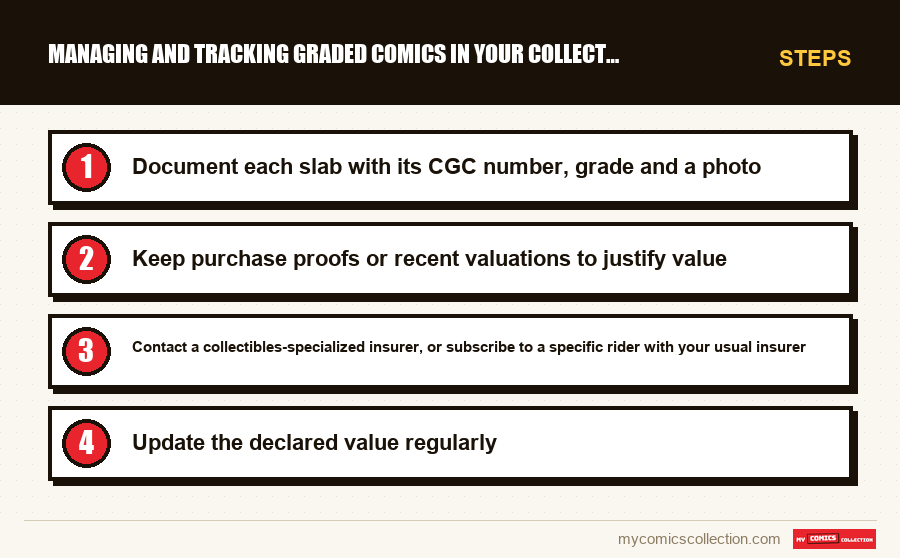
- Document each slab with its CGC number, grade and a photo.
- Keep purchase proofs or recent valuations to justify value.
- Contact a collectibles-specialized insurer, or subscribe to a specific rider with your usual insurer.
- Update the declared value regularly: CGC values fluctuate, sometimes significantly from one year to the next.
Without precise documentation, it's impossible to justify compensation in case of theft, fire or water damage. That's one of the main reasons a digital tracking tool is indispensable.
The app's role in centralizing all this
Managing a mixed collection with a spreadsheet is doable, up to a point. As soon as you have several dozen slabs, the complexity of data to maintain exceeds what a spreadsheet handles comfortably. Values have to be manually updated, duplicates slip in easily, and there's no automated way to calculate your collection's total insurable value.
My Comics Collection was designed to precisely address these needs. The app lets you record each slab with its CGC number, grade, label, cost basis and current value. It distinguishes graded comics from raw comics in the inventory, and lets you generate in one click a total value report, useful for your insurer or simply to know where you stand.
Daily-updated value tracking avoids having to manually consult recent sales for each slab. And secure backup ensures your inventory doesn't disappear if your computer breaks: a very real risk when managing valuable data.
Frequently asked questions
Yes, absolutely. Each slab is a unique entity with its own CGC certification number, grade and value. Grouping them or treating them like ordinary comics in your inventory will give you an inaccurate view of your collection, particularly for insurance and valuation.
A slab's cost basis includes: the raw comic purchase price (or already-graded slab), CGC submission fees according to the service level chosen, round-trip shipping and any insurance fees. For a comic bought raw and sent for grading, these ancillary fees can represent 20 to 40% of total cost.
Technically yes, but it's not recommended. Vertical storage creates a tipping risk and can exert lateral pressure on the case corners. Horizontal position, in reasonable piles of 10 to 15 units maximum, is preferable for preserving case integrity long-term.
In most cases, no: at least not at their real value. Standard homeowner's insurance caps collectible coverage and doesn't factor in graded comics' market value. It's strongly recommended to subscribe to a specific rider or dedicated collectibles policy, providing a documented inventory with CGC numbers and recent valuations.