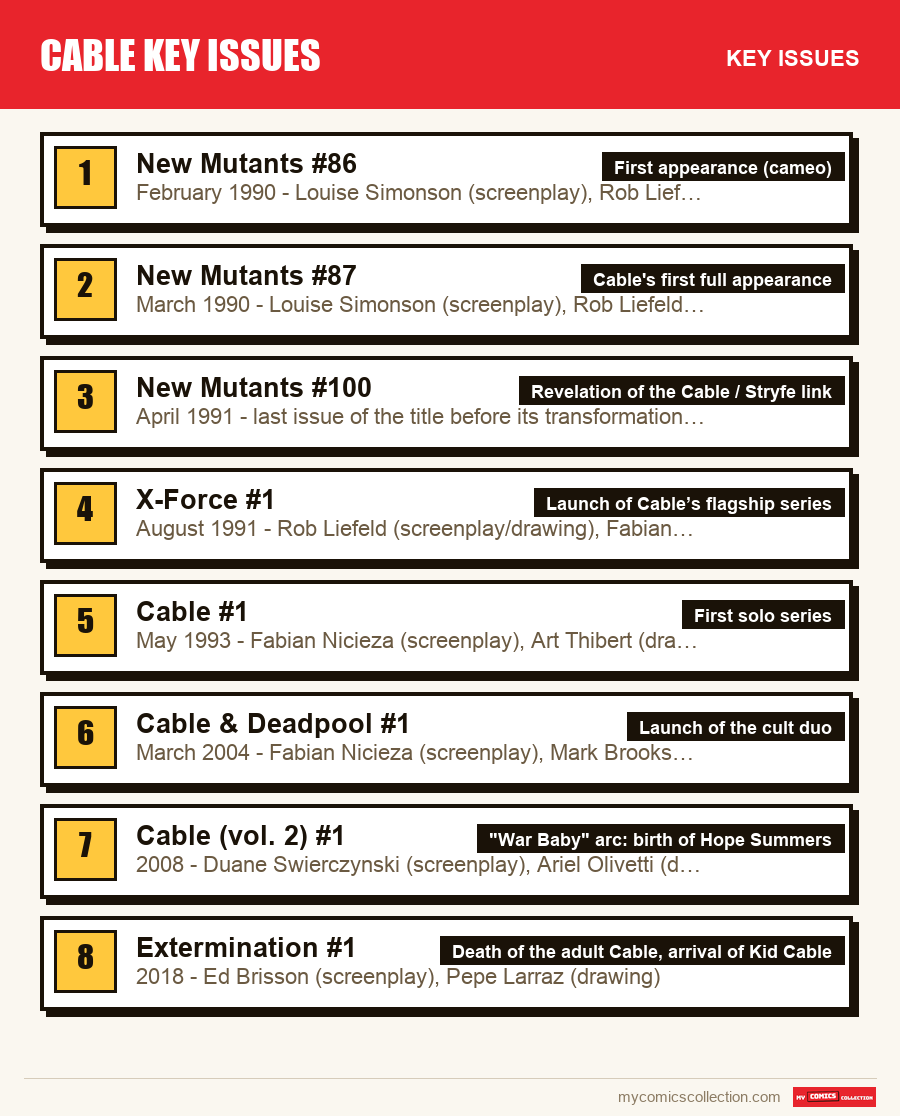
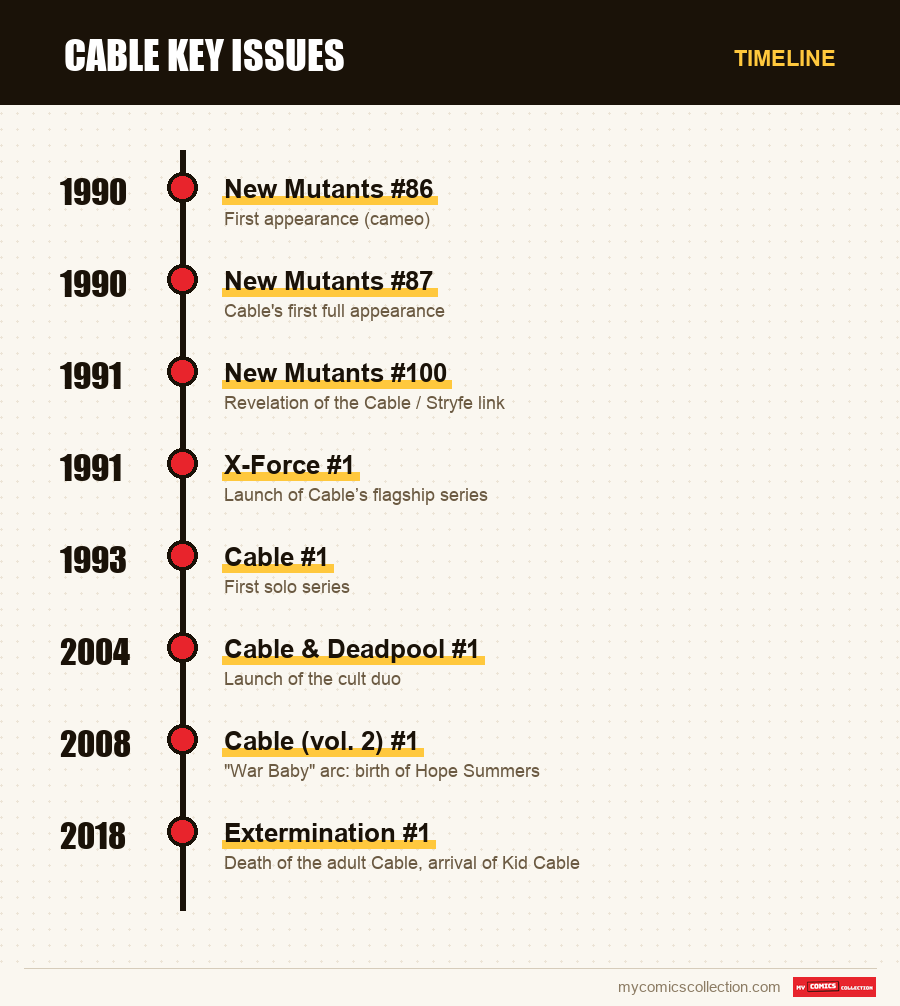
Cable's absolute key number is New Mutants #87 (March 1990), its first full appearance by Louise Simonson and Rob Liefeld, with a cover co-designed by Todd McFarlane. CGC 9.8 examples have already crossed the $1,000 mark at auction. Next come New Mutants #86 (the teaser in silhouette, February 1990), X-Force #1 (August 1991, colossal print run therefore modest value despite its popularity) and Cable #1 (May 1993, first solo series with embossed gold cover). The rest of the list -New Mutants #100 , Cable & Deadpool #1 , Cable vol. 2 #1 and Extermination #1- marks thirty-five years of editorial history of the soldier from the future.
Few characters born in the wake of the Image-avant-l'heure era have had such a unique trajectory as Cable. Conceived in the midst of the commercial explosion of comics at the end of the 1980s, Nathan Summers landed in a minor series from the X-Men stable, The New Mutants, and transformed it in the space of a few issues into a paramilitary vehicle which would give birth to X-Force. This radical editorial shift, carried by the duo Louise Simonson / Rob Liefeld, makes the 1990-1991 window the number one hunting ground for any collector interested in the character.
But Cable's popularity is not limited to these two or three founding numbers. Unlike characters whose editorial career runs out of steam after their launch, Cable has benefited from an unusual number of solo relaunches (1993, 2008, 2017, 2020), from the status of a pivotal character in several temporal sagas (Messiah Complex, Second Coming, Extermination) and above all from a highly anticipated cinematographic adaptation with Josh Brolin in Deadpool 2 in 2018, which put a brutal spotlight back on its first paper appearances.
This article lists, number by issue, the keys that really structure the value and rarity of Cable comics, based on verified editorial facts (publication dates, creative teams, print runs, census elements when they are available) rather than on approximate estimates. For a complete narrative overview of his journey (technorganic origin, Askani sect, rivalry with Stryfe), the article Cable story in comics deals with the biographical angle; this one focuses exclusively on the collection and investment angle.
A character born in the creative turmoil of 1990
At the start of 1990, The New Mutants was no longer the teen drama title that Chris Claremont had imagined when it was launched in 1982. Louise Simonson had been the screenwriter for several years and was looking for a way to beef up a series whose sales were stagnating, while a young designer named Rob Liefeld gradually imposed an exaggerated anatomical style, oversized military gadgets and an aesthetic far removed from classicism. X-Men from the 1980s. Their collaboration leads to one of the most radical changes ever made to a monthly Marvel series still in progress: the arrival of a mercenary from the future, cybernetic on half his body, who will literally take control of the group and the editorial line.
This editorial context explains why the very first issues of Cable have a disproportionate value compared to their actual circulation. We are still, in 1990, in a period where Marvel print runs remain reasonable: nothing to do with the inflation that will follow in 1991-1992 with the launch of Image Comics and the widespread overproduction of speculative covers. New Mutants #87 was published before the market fell into the fever of variants and embossed covers with a deliberately massive circulation; it is a factor of relative rarity which clearly distinguishes it from X-Force #1, released barely eighteen months later at the height of speculation.
The rest of Cable's editorial career faithfully follows the great waves of the American comic book market: speculative explosion in 1991-1993 (X-Force, Cable solo), crash in the mid-1990s, more sedate relaunches in the years 2000-2010, then a new collector's boom from 2016 with the announcement of the casting of Deadpool 2. Understanding these cycles is essential to correctly interpret the relative rarity of each key number.
New Mutants #86
Technically, Cable appears for the very first time in this issue, but as a silhouette in a single panel, with no visible face and no spoken name. This deliberately vague teaser was a common marketing technique at Marvel at the time to fuel curiosity before a reveal the following month. It is this ambiguous status of "unidentifiable first appearance" which explains a significant difference in rating with number 87: purist collectors seek it for the completeness of a Cable collection, but general public demand focuses almost exclusively on the following appearance, where the character is finally named and drawn in full page.
New Mutants #87
The absolute reference number. Cable is presented in full light as the new military leader of the New Mutants, with his definitive design: cybernetic arm, biomechanical eye, gadgets and commando attitude from a devastated future. The cover, co-signed by Rob Liefeld and Todd McFarlane (then on Spider-Man), makes it a dual object of interest for Copper Age collectors. It is one of the rare comics of this period to have seen copies graded CGC 9.8 cross the symbolic barrier of 1,000 dollars at auction, a level rarely reached by an issue of The New Mutants outside of special annuals. There is also a second printing (2nd printing) recognizable by its distinct banner on the cover and a modified golden logo on certain so-called "Gold" editions: a version that is much less sought after than the first direct printing edition.
New Mutants #100
A pivotal number with a double title: it is the last in the original series The New Mutants before the title becomes X-Force the following month, and it is also the one where the masked supervillain Stryfe removes his helmet to reveal a face identical to that of Cable. This scene establishes one of the great mysteries of the character's mythology (the exact link between Nathan Summers and his double, a genetic clone created by the Askani sect) which will not be fully explained until several years later. The issue enjoys stable demand from readers who follow the full story arc rather than just the first appearance, without rivaling #87 in terms of rating.
X-Force #1
The issue which definitively established Cable as team leader and central character of the X-Men line in the early 1990s. This astronomical print run has a mechanical and lasting effect on its value: even thirty-five years later, copies in excellent condition remain abundant on the secondary market, and the value remains modest compared to the cultural importance of the issue for Cable. This is a textbook case to illustrate that editorial popularity and market scarcity are two totally independent notions.
Cable #1
First issue of the very first regularly monthly series devoted exclusively to Cable, published at the price of $3.50 with an entirely embossed and hot-gilded cover (gold foil embossed wraparound cover), a printing technique then very fashionable and used to artificially boost sales in periods of intense speculation. Il existe une variante avec logo blanc plutot que dorée, moins courante. This period of 1993 corresponds to the absolute peak of the speculative bubble of American comics: the print runs are deliberately massive, which makes copies generally abundant today, including very high grades. The real collection issue for this issue is therefore not so much the raw rarity as the state of conservation of the gilded cover, particularly prone to cracking and peeling of the foil over time: a frequent defect which heavily penalizes the CGC rating of poorly stored copies.
Cable & Deadpool #1
This series co-written by Fabian Nicieza: already author of Cable #1 in 1993 - establishes for the first time in a lasting manner the comic duo that the general public will discover much later in the cinema. It is in this series that the "cynical mentor/talkative mercenary" dynamic crystallizes which will directly inspire the tone of the Cable-Deadpool relationship adapted in Deadpool 2. The demand for this issue has experienced a notable resurgence from 2016-2018, driven by fans discovering the paper universe after having seen the duo in the cinema, even if the title remains financially accessible much more reasonably than the keys of 1990-1991.
Cable (vol. 2) #1
This relaunch follows directly from the Messiah Complex event, in which Hope Summers, the first mutant since M-Day, was born. Cable takes the child under his protection and plunges into the future to protect her, giving birth to an unusual series for X-Men: a true time travel fiction, centered on the relationship between an aging soldier and a child destined for a messianic role. This issue marks an important tonal turning point for the character, who goes from simple paramilitary leader to an almost fatherly figure, an arc which will strongly influence the character's writing in the following years.
Extermination #1
Published the same year as the release of Deadpool 2 in the cinema, this mini-event turns the mythology of the character upside down: the adult Cable that readers have been following since 1990 is assassinated by an attacker who turns out to be... a younger version of himself, brought back from the past and convinced that his elder brother has failed in his mission. This "Kid Cable" will take center stage for several years, before the old Cable is finally resurrected via Krakoa's resurrection protocols in the series Cable (2020) #11. A key number for readers who follow the recent continuity of the character rather than its founding period.
Collecting this series?
Track what you own, what you are missing and what your collection is worth. 7 day trial.
Start my trial →The impact of Deadpool 2 on the rating of Cable comics
No adaptation has had as measurable an effect on Cable's collector demand as Deadpool 2, released in theaters on May 18, 2018. The film, written by Rhett Reese, Paul Wernick and Ryan Reynolds, entrusts the role of the cybernetic soldier to Josh Brolin: who simultaneously played Thanos in Avengers: Infinity War the same year, a double bill which considerably amplified the character's visibility among the general public. The film ultimately grossed $785.9 million at the worldwide box office on a budget of $110 million, becoming the highest-grossing feature film in the X-Men franchise at the time of its release and the highest-grossing R-rated film ever made up to that point.
On a collector's level, the announcement of the casting of Brolin in 2017 produced a classic and well-documented effect on the American comics market: a spontaneous surge of interest in the very first issues of the character concerned, here mainly New Mutants #87 and, to a lesser extent, Cable #1 (1993) and Cable & Deadpool #1. This phenomenon is not specific to Cable: we systematically observe it as soon as a second-rate character becomes a cinematic headliner (Iron Fist, Moon Knight, Blade have experienced comparable dynamics), but it is amplified here by the fact that Deadpool 2 also introduced the concept of X-Force to the cinema, bringing attention back to X-Force #1 despite its pharaonic circulation which structurally limits its popularity.
However, it is necessary to qualify the extent of this phenomenon for Cable specifically: unlike characters whose very first appearance in print is as rare as it is unknown before their adaptation, New Mutants #87 was already an issue identified and sought after by collectors of the Copper Age well before 2018, in particular thanks to the notoriety of Rob Liefeld and the cult status of the X-Force period within the Marvel fandom of 1990s. The Deadpool 2 effect therefore consolidated a pre-existing demand more than it created a craze ex nihilo, which makes Cable's rating structurally more stable over time than that of characters purely "revealed" by the cinema.
To situate this dynamic in a broader framework of collection and evaluation, it is useful to understand how differences in grading concretely affect the value of the same issue: our guide CGC grade 9 vs 9.8 details the difference in dimensions between these two hinge notes, a particularly marked difference on fragile covers like that of Cable #1 (1993) and its waffle foil.
Buying guide: what to check before buying a Cable comic
- Distinguish first print and second print on New Mutants #87: the second printing exists with a banner or a modified logo on the cover; its rating is significantly lower than the original direct edition print, always check the printing mention on the back or on the inside page.
- Carefully inspect the condition of the foil on Cable #1 (1993): gaufree gilding cracks and flakes easily, especially on the cover folds and on the spine; an otherwise impeccable example can lose several grade points due to the single damaged foil.
- Check if the copy of New Mutants #86 comes from the first printing: this cameo number only has real value in its original 1990 version, subsequent reprints do not have the same interest for purists of the "strict first appearance".
- Don't overpay for X-Force #1 just because it "launches" Cable as a headliner: with more than five million copies in print, even the high CGC ratings remain reasonably budgetary; Always compare several recent sales before committing.
- Beware of unofficial alternative covers: on recent series like Extermination or Cable (2020), multiple variant covers exist (ratio 1:25, 1:50) which have no link with the first appearance of a character and are only graphic collector's items.
- Favor CGC authentication for numbers prior to 1995: beyond 30 years, the origin and integrity of a raw (ungraded) copy are more difficult to guarantee without a documented provenance.
- Systematically compare actual prices rather than displayed prices: sales announcements do not always reflect the real market price, only concluded sales give a reliable image of the current value.
To go further in the construction of a coherent Cable collection, beyond just the key numbers mentioned here, the sheet Cable centralizes all of the character's appearances listed on the site, while the collection management application allows you to precisely track which issues you already have, their estimated condition and the remaining gaps in your collection.