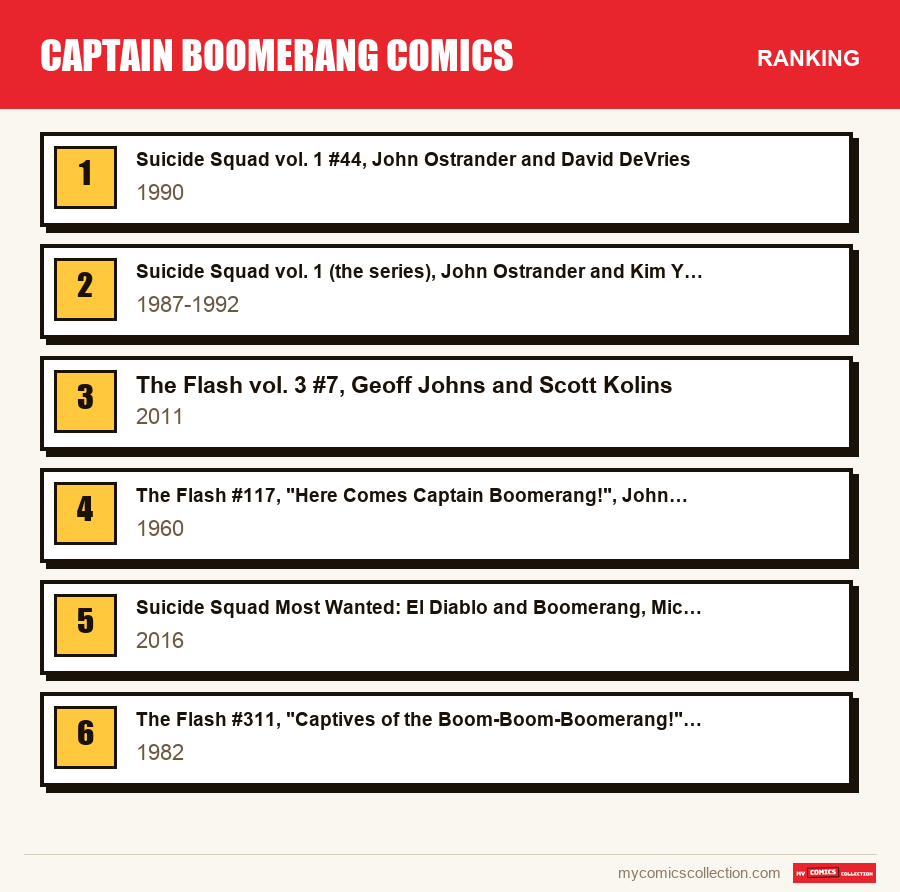
To read the best Captain Boomerang comics, George "Digger" Harkness, start with Suicide Squad vol. 1 #44 (1990), where John Ostrander and David DeVries take him home to Australia for a funeral that reveals his family. Follow it with The Flash vol. 3 #7 (2011), a portrait published after his return from the dead, and save the 1960 source, The Flash #117 by John Broome and Carmine Infantino, for last.
Captain Boomerang doesn't have the stature of Captain Cold or Reverse-Flash in the Flash rogues gallery. He is a cheat, a likable coward, an Australian who throws exploding boomerangs and gets by on cunning rather than strength. That weakness is exactly what makes him interesting: the writers who took him seriously found a man with no loyalty, but not without a past. Six reads follow, whether he carries them alone or shares them with a team whose role is spelled out: for each one, what it changes for Digger, the reader it suits, and where it belongs in your stack.
As always in this guide, we only state verified facts (creators, issue numbers, dates); the analysis is our own, with no reproduction of protected art or dialogue.
His first appearance
Digger Harkness is born in The Flash #117, dated 1960, with "Here Comes Captain Boomerang!" John Broome wrote the story, Carmine Infantino drew it, and Julius Schwartz edited the whole series. The issue pits the criminal against Barry Allen, with Iris West in a supporting role, and it also introduces a toy maker, Wally W. Wiggins, who makes his first appearance in this same book.
The issue collects two Flash stories: the second, "The Madcap Inventors of Central City!", is a separate episode with no connection to Boomerang. So the hero of this guide is found in the first story, and only there. That detail matters for the collector hunting for the right story in the right issue.
A reading tip: the 1960 story reads as a Silver Age document. Its real weight shows only after the 1990 and 2011 stories described below, which give this stage name a man and a history. The artists who defined Barry Allen's Central City are covered in our feature on the major Flash artists.
1: Suicide Squad vol. 1 #44, John Ostrander and David DeVries (1990)
This is the best entry point, because this issue does what the 1960 book never did: it gives Boomerang a family. John Ostrander writes it with David DeVries, and Luke McDonnell handles the art. Harkness returns to Australia with Deadshot for his mother's funeral; there he meets his father and his brother, and learns that "Uncle Walt," meaning W. W. Wiggins, the 1960 toy maker, launched him on his Captain Boomerang career and has a real tie to the Harkness family.
What it adds to the character is considerable: the boomerang thrower becomes a man with a childhood, grudges and an accent. Ostrander builds him as a cowardly braggart, entertaining in spite of himself, and this issue, which belongs to the period of the The Phoenix Gambit arc, gives him a very recognizable voice.
It is for anyone who wants to understand the character in a single issue. How to read it? First. No prior knowledge of the series is needed, but his traveling companion, Deadshot, deserves a separate read if you enjoy the duo.
2: Suicide Squad vol. 1 (the series), John Ostrander and Kim Yale (1987-1992)
Here Boomerang doesn't headline alone: he is one of the pillars of a team of convicts employed by Amanda Waller. The series runs 66 issues, from #1 (May 1987) to #66 (June 1992), written by John Ostrander, with Kim Yale as his usual co-writer, and drawn by Luke McDonnell among others. The character is there from the first arc, where his cowardice and treachery become a recurring engine.
His role is specific: the cynical, laughing voice of the team, the cheat his teammates distrust. The series pulled this second-tier criminal out of obscurity, like Deadshot, and made him one of the most memorable supporting players of the decade. The The Janus Directive (1989) and The Phoenix Gambit (1990) arcs test him without making him the center of the story.
Who is this series for? The reader who wants to see Boomerang live inside an ensemble and not only in a face-off with the Flash. Open #44 first; only then go back to the start of the run, with the Suicide Squad reading guide as your compass. The team's organizer gets her own guide on Amanda Waller.
3: The Flash vol. 3 #7, Geoff Johns and Scott Kolins (2011)
This issue is a "Rogue profile" devoted to Digger Harkness, published in the wake of Blackest Night and tied to the Brightest Day event. Geoff Johns writes, Scott Kolins draws, and Francis Manapul did the cover. Brought back to life at the end of Blackest Night along with eleven other characters, Boomerang breaks into Iron Heights to confront Zoom; most of the story runs through flashbacks of his life.
The issue offers a retrospective look: the present-day action amounts to one escape, and the rest of the book revisits Harkness's life. The appeal lies in the contrast between a man who moves forward on bravado and a past he drags behind him. The guide to Zoom places his opponent in his other stories.
This single issue suits readers who already know Harkness and want a condensed portrait, or who follow the Rogues in the early 2010s. How to read it? After Suicide Squad #44, because the story plays on your memory of what you already learned about Harkness.
4: The Flash #117, "Here Comes Captain Boomerang!", John Broome and Carmine Infantino (1960)
This first story is all Broome and Infantino need to set up the rivalry with Barry Allen. Harkness still speaks with an American accent here, which he keeps for several years before taking on the Australian accent in the late 1980s. The toy maker Wiggins and his employees round out the cast.
For the collection, this issue is the source; for reading, it asks for some indulgence. It shows a still loosely defined crook in a series run by Julius Schwartz, and that contrast is what makes the work of Ostrander and Johns instructive.
This story is for Silver Age fans and for those who collect by first appearance. Read it alone, in a few minutes, after the modern reads. To place the era, the analysis of the Silver Age Flash and the Flash reading guide give you the thread.
Do you collect this series?
Track what you own, what you are missing and what your collection is worth. 7-day trial.
Start my trial →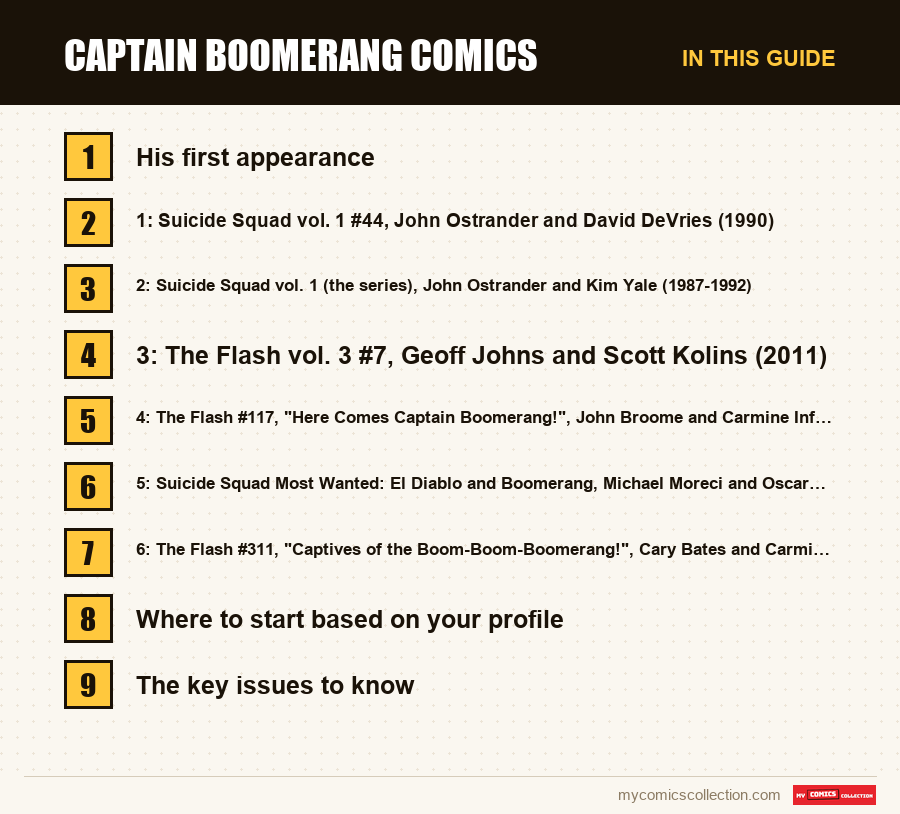
5: Suicide Squad Most Wanted: El Diablo and Boomerang, Michael Moreci and Oscar Bazaldua (2016)
This six-issue miniseries pairs El Diablo, handled by Jai Nitz and Cliff Richards, with a second story devoted to Boomerang in issues #1 and #2. Michael Moreci writes "What Goes Around, Comes Around," and Oscar Bazaldua draws it.
The setup is effective: the Suicide Squad goes after a Latin American dictator, the mission goes wrong, and the team flees by helicopter, leaving Boomerang behind. Alone against the army, he has to survive until rescue arrives, with the help of a young girl; his opponent, El Jaguar, has metahumans at his disposal and wants him dead. The dictator dies in the second episode.
It is a light, brisk read that puts the hero in isolation, with no team to cover him, and that is exactly what his best stories bring out. It is for the reader who knows the 2010s team and wants a complete adventure in two issues.
6: The Flash #311, "Captives of the Boom-Boom-Boomerang!", Cary Bates and Carmine Infantino (1982)
This 1982 issue is a curious document: Cary Bates writes, Carmine Infantino draws. Colonel Computron traps the Flash and Boomerang on a giant boomerang that hurls them into the past. The villain ends up protecting the unconscious hero from pirates, then revives him with a tiny electric boomerang.
The appeal is an amusing reversal: a recurring enemy becomes, for one episode, Barry Allen's forced sidekick. It doesn't change his fate, but it shows the flexibility of a character the writers of the day happily used as a comedy partner.
It is for the Bronze Age reader and for the curious who want to see Boomerang from a funnier angle. Read it last, as entertainment, once you have the other reads in mind.
Where to start based on your profile
If you want to understand the character in a single issue, open Suicide Squad vol. 1 #44; if you want the most recent synthesis, move on to The Flash vol. 3 #7. These two issues complement each other: one gives him a family, the other sums up his path after his resurrection.
If you follow the Flash in chronological order, start from the Flash reading guide, treat The Flash #117 as the 1960 marker, then continue with issue #311 from 1982. To meet the leader of the gang that takes him in, read Captain Cold.
If you like teams of crooks recruited by force, go back to the 66 issues of Suicide Squad vol. 1, then move on to the 2016 miniseries. If you collect, favor the issues that matter in the character's history: the 1960 first appearance, the 1990 issue that reveals his family, and the book where he dies, described below.
The key issues to know
Here are the issues that mark out Captain Boomerang's history. No figures here: you judge a copy by comparing completed sales of an issue in the same grade, never from a single listing.
- The Flash #117 (1960): first appearance of Digger Harkness, by John Broome and Carmine Infantino.
- The Flash #155 (1965): "The Gauntlet of Super-Villains!", where Boomerang is among the enemies gathered by John Broome and Carmine Infantino.
- The Flash #311 (1982): "Captives of the Boom-Boom-Boomerang!", by Cary Bates and Carmine Infantino.
- Suicide Squad vol. 1 #1 (1987): start of Ostrander's series, where Boomerang is present from its first issues.
- Suicide Squad vol. 1 #44 (1990): the return to Australia, by John Ostrander and David DeVries.
- Identity Crisis #5 (2004): Digger Harkness dies here facing Jack Drake, the father of Tim Drake; the miniseries is by Brad Meltzer and Rags Morales. He is not the hero of it, but this issue marks his death.
- Blackest Night #8 (2010): the last issue of the event, at the end of which Digger comes back to life.
- The Flash vol. 3 #7 (2011): the Rogue profile by Geoff Johns and Scott Kolins.
On a 1960 or 1965 Flash, look first at the corners, the spine and the paper: condition makes the difference, because the book is old. Ostrander's Suicide Squad and the 2010s issues are more common and separate on sharpness. His son Owen Mercer takes over the Captain Boomerang name after Digger's death, and his path crosses Identity Crisis and then Blackest Night: for the latter, see the key issues of Blackest Night. The Geoff Johns page lists his other work, and the blog extends the topic.
Frequently asked questions
Digger Harkness debuts in The Flash #117, dated 1960, in the story "Here Comes Captain Boomerang!" John Broome writes, Carmine Infantino draws. The same issue contains another story that has nothing to do with Boomerang: the hero of this guide appears only in the first one.
Start with Suicide Squad vol. 1 #44 (1990), by John Ostrander and David DeVries, which shows his return to Australia and his family. Follow with The Flash vol. 3 #7 (2011), by Geoff Johns and Scott Kolins, then go back to the 1960 first appearance to measure how far he has come.
Owen Mercer is Digger Harkness's son. He appears in Identity Crisis (2004) and takes his father's name after his death. He dies in Blackest Night: The Flash #3 (2010), then returns as a Black Lantern.
In Identity Crisis #5 (2004), a seven-issue miniseries by Brad Meltzer and Rags Morales, where he is killed facing Jack Drake, the father of Tim Drake. He comes back later: Blackest Night (2009-2010) brings him back as a Black Lantern, then alive at the end of the event.
Yes. In the Ostrander and Yale series (1987-1992), he belongs to the band of convicts run by Amanda Waller, from the first arc. He plays an ensemble role rather than a lead one, except for issue #44, which puts him front and center.
Do you own a Silver Age Flash or a Suicide Squad issue by Ostrander? A free estimate shows you where it stands.
Estimate my comic