The defining Silver Age Flash key is Showcase #4 (October 1956), the first appearance of Barry Allen by Robert Kanigher, John Broome, and Carmine Infantino: a CGC 9.6 copy realised $900,000 at Heritage Auctions on January 11, 2024: the all-time record for a Silver Age DC comic. Within the first The Flash series (1959-1985), the essential keys are #105 (first issue, 1st Mirror Master), #110 (1st Kid Flash and 1st Weather Wizard, CGC 9.6 at $49,200), and #123 ( Flash of Two Worlds, the issue that invented the DC multiverse).
Before Barry Allen there was Jay Garrick: the Golden Age Flash, created by Gardner Fox and Harry Lampert in Flash Comics #1 (January 1940). The series folded in 1949. When editor Julius Schwartz commissioned a new Flash in 1956, he made a radical choice: start from scratch with an entirely new character. Barry Allen is no longer a chemistry student but a police forensic scientist in Central City, struck by lightning that douses him with laboratory chemicals. That pseudo-scientific plausibility and the deliberate clean break from the past define the Silver Age approach.
This guide sticks to the verifiable: sale records documented by Heritage Auctions, GoCollect, and CGC News, and data from our eBay estimator (eBay.fr + eBay.com, June 2026). The Silver Age keys of the Flash series (#105, #110, #123, #139) return zero or one active eBay listing; medians are therefore not citable. Auction records are the authoritative benchmark for these scarce issues.
First Flash series key issue ranking (real values, June 2026)
For scarce Silver Age issues, auction records are the authoritative reference. Our eBay estimator returns no reliable active listings for keys #105, #110, #123, and #139: that near-zero signal is itself informative: these books are virtually absent from the everyday market and trade primarily through specialist auction houses.
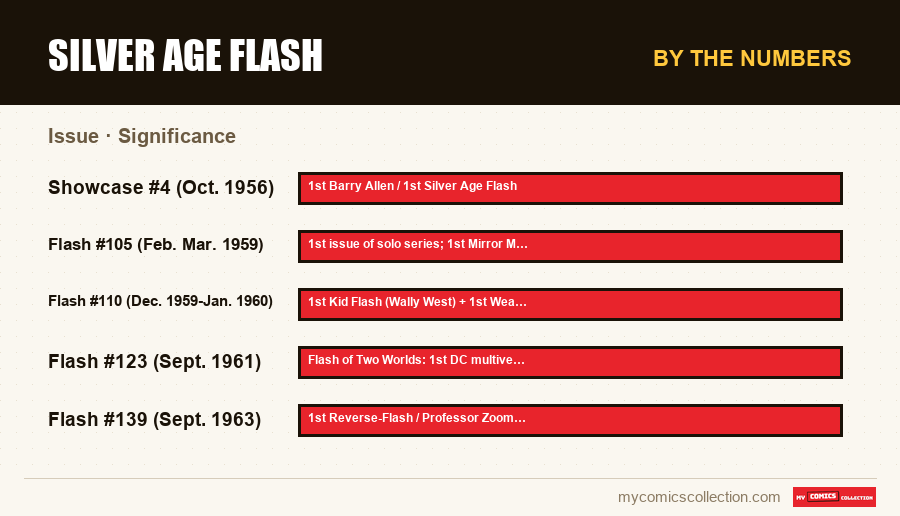
| Issue | Significance | eBay data (all grades) | Documented record |
|---|---|---|---|
| Showcase #4 (Oct. 1956) | 1st Barry Allen / 1st Silver Age Flash | Different series: not available | $900,000 (CGC 9.6, Heritage Jan. 2024) |
| Flash #105 (Feb. Mar. 1959) | 1st issue of solo series; 1st Mirror Master | 1 listing: signal too thin | ~$38,838 (CGC 9.4, Heritage 2011) |
| Flash #110 (Dec. 1959-Jan. 1960) | 1st Kid Flash (Wally West) + 1st Weather Wizard | 0 listings: absent from everyday market | $49,200 (CGC 9.6, Heritage June 2024) |
| Flash #123 (Sept. 1961) | Flash of Two Worlds: 1st DC multiverse / Earth-Two | 0 listings: absent from everyday market | ~$18,000 (CGC 9.4, 2020) · $13,600 (CGC 9.2, 2022) |
| Flash #139 (Sept. 1963) | 1st Reverse-Flash / Professor Zoom (Eobard Thawne) | 0 listings: absent from everyday market | ~$8,300 (CGC 9.6, Heritage 2006) |
Record sources: Heritage Auctions, CGC News, GoCollect, sellmycomicbooks.com.
Showcase #4: the comic that triggered the Silver Age
Published in October 1956 (cover-dated September-October), Showcase #4 is the founding document of the Silver Age of American comics. DC was using Showcase as a testing ground: a try-out title that let editors gauge reader interest in new characters without committing to a full series. The response to the Flash exceeded all expectations: he returned in Showcase #8, #13, and #14 before earning his own solo title in 1959.
The creative team brought together two writers: Robert Kanigher on the first story (Mystery of the Human Thunderbolt!) and John Broome on the second (The Man Who Broke the Time Barrier!): with Carmine Infantino on pencils and Joe Kubert on inks, all under the editorial direction of Julius Schwartz. Infantino's dynamic, clean-lined style broke sharply with the more cartoonish art of the 1940s. Barry Allen's origin, a police scientist struck by a freak lightning bolt in his own lab, replaced the Golden Age's student-in-a-chemical-experiment trope. This grounding in plausibility and modernity is the hallmark of the Silver Age aesthetic.
At auction, that foundational status translates unambiguously into price. A CGC 9.6 copy, the sole example at that grade in the CGC census at the time of sale, realised $900,000 at Heritage Auctions on January 11, 2024, setting the all-time record for a Silver Age DC comic. That same copy had sold at Heritage for $179,250 in 2009, illustrating the dramatic appreciation of top-grade Silver Age grails over fifteen years. The Overstreet Price Guide values a NM- 9.2 copy at $182,000; mid-grade CGC slabs in the 6.0-6.5 range have traded in a documented window of roughly $55,000-$85,000.
Flash #105: the first issue of the solo series (1959)
Buoyed by the success of Showcase, Julius Schwartz launched The Flash as a dedicated solo title in February-March 1959. The numbering picked up where Flash Comics had left off in 1949, at issue #105: a deliberate editorial statement of continuity. That first issue is a double key: it is simultaneously the birth of the Silver Age ongoing series and the first appearance of Mirror Master (Sam Scudder), one of Barry Allen's most enduring rogues.
Our eBay estimator returns only a single active listing for this issue: too thin to produce a reliable median. High-grade auction results confirm a very limited market: a CGC 9.4 copy realised approximately $38,838 at Heritage Auctions in 2011. At mid-grade, a CGC 6.0 has traded around $3,300 in recent sales. The Overstreet Price Guide ranks this issue among the top 15 Silver Age comics.
Flash #110 and #123: Kid Flash, the multiverse, and the next tier of keys
The Flash #110 (December 1959-January 1960) is a double grail in its own right. It contains the first appearance of Kid Flash (Wally West, Iris West's nephew, who accidentally replicates Barry Allen's lab accident) and the first appearance of Weather Wizard. Wally West would go on to become the Flash himself in the 1980s, giving this issue a compounded significance. Our eBay estimator returns no active listings at all. At the high end, a CGC 9.6 copy realised $49,200 at Heritage Auctions in June 2024: the documented record for this issue.
The Flash #123 (September 1961), titled Flash of Two Worlds!, is another cornerstone. Written by Gardner Fox and drawn by Carmine Infantino, it stages the meeting between Barry Allen and Jay Garrick, the Golden Age Flash, on a parallel Earth designated Earth-Two. The story invented the concept of the DC multiverse, a narrative framework that would shape the publisher's universe for decades. Documented high-grade sales reach approximately $18,000 for a CGC 9.4 (2020) and $13,600 for a CGC 9.2 (2022). No active eBay listings exist: these books are reserved for specialist auction venues.
Rounding out the core Silver Age run, Flash #139 (September 1963) introduces Reverse-Flash / Professor Zoom (Eobard Thawne), Barry Allen's mirror-image nemesis from the 25th century. The documented CGC 9.6 record stands at approximately $8,300. Together, #105, #110, #123, and #139 form the essential shortlist for any serious collector of the first Flash series.
Own a Flash comic? Get a free valuation with our tool based on real eBay sales to find its low, median, and high value.
Frequently asked questions
Showcase #4 (October 1956), the first appearance of Barry Allen, by Robert Kanigher, John Broome and Carmine Infantino. It holds a historic auction record for a Silver Age DC comic.
#105 (first issue, first appearance of Mirror Master), #110 (first appearances of Kid Flash and Weather Wizard), #123 (Flash of Two Worlds, the DC multiverse concept) and #139 (first appearance of Reverse-Flash, Eobard Thawne).
Jay Garrick is the Golden Age Flash, created by Gardner Fox and Harry Lampert in Flash Comics #1 (January 1940), and his series ended in 1949. In 1956, editor Julius Schwartz started from scratch with Barry Allen, a Central City police forensic scientist struck by lightning in his laboratory.
Flash of Two Worlds is the first meeting between Jay Garrick and Barry Allen and the first appearance of the DC multiverse. It is one of the founding issues of the publisher's continuity.
Because the keys #105, #110, #123 and #139 are almost absent from the current market: they trade mostly in specialist auction rooms. With no active listings, documented records remain the most reliable indicator.