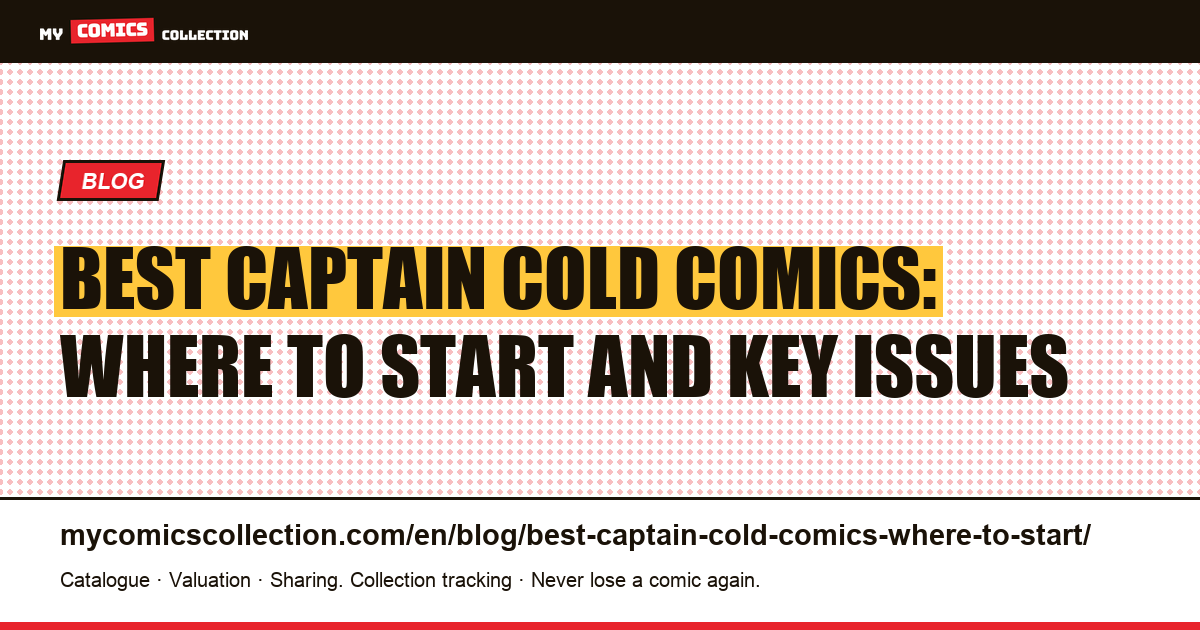
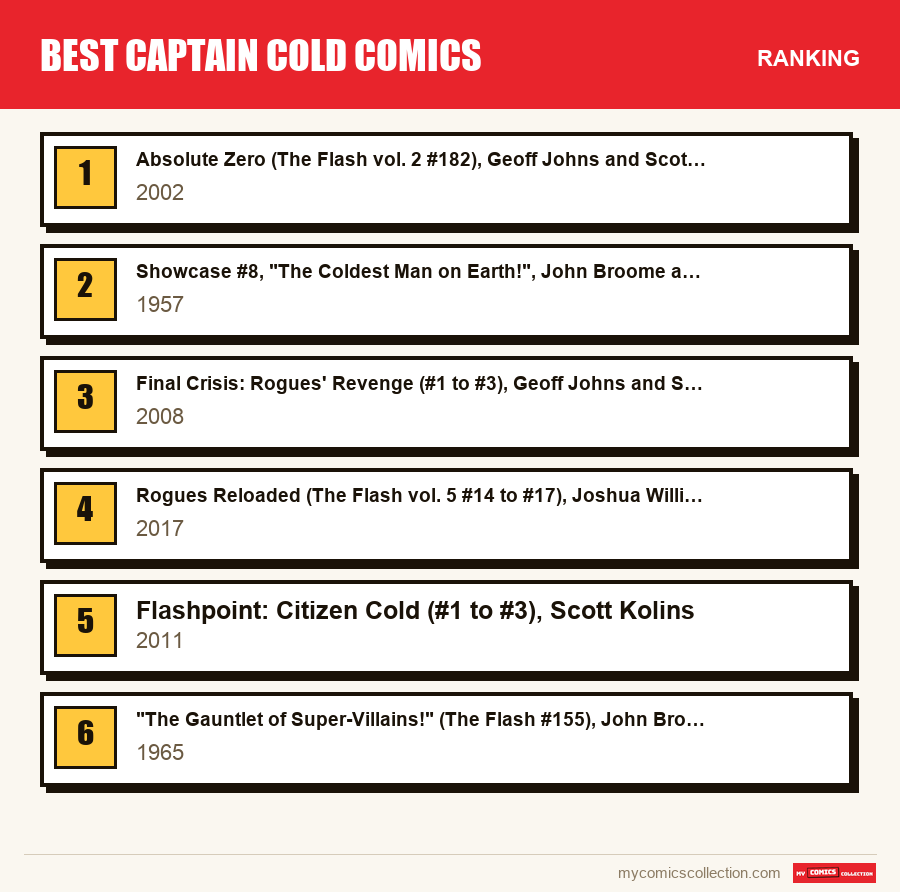
To find the best Captain Cold comics, Leonard Snart, start with The Flash (vol. 2) #182, "Absolute Zero" (2002), by Geoff Johns and Scott Kolins, the issue that gives him an inner life. Then go back to his first appearance, Showcase #8 (1957) by John Broome and Carmine Infantino, and read Final Crisis: Rogues' Revenge (2008) and Joshua Williamson's Rogues Reloaded arc (2017), where he regains his place as leader of the gang.
Captain Cold holds a place apart among Flash's enemies. He has no evil double, no cosmic power, no plan for conquest: he has a cold gun, a thief's code of honor, and a crew, the Rogues, which he runs with quiet authority. The best stories about him are the ones that take this thief seriously, with a sister, a father, a sense of loyalty. This guide ranks six of them, with what each one brings him, who it is for, and in what order to approach them.
As always in this guide, only verified facts (creators, issue numbers, dates) are stated; the analysis is our own, with no reproduction of protected art or dialogue.
His first appearance
Leonard "Len" Snart debuts in Showcase #8, cover-dated 1957. He appears in the second story of the issue, "The Coldest Man on Earth!", with text by Broome, pencils by Infantino, and inks by Frank Giacoia. The first story in the same issue, "The Secret of the Empty Box!", is a different tale, written by Robert Kanigher. For a curious reader, that makes for a double surprise: the issue contains two Flash stories, and it is the second one that carries the enemy we care about.
This detail matters for collecting as much as for reading. Snart is not yet the charismatic leader of his future accomplices: he is an isolated criminal, equipped with an inventive weapon and an evocative name. The rest of his path plays out elsewhere, and this first story is best appreciated as a document of how the Broome and Infantino team built memorable enemies around a simple idea.
1: Absolute Zero (The Flash vol. 2 #182), Geoff Johns and Scott Kolins (2002)
This is the best entry point, and the reason lies in its design: a single issue that reads on its own. Geoff Johns writes it, Scott Kolins draws it, and Dan Panosian inks it. Captain Cold is no foil here: he is the central character, driven by the need to avenge his sister, killed by a man named Chillblaine. He disregards the truce the Rogues had agreed to, acts alone, and carries out his revenge.
What the issue gives the character is decisive. After it, Snart is no longer just a well-oiled adversary: he has a family, a debt, and a conscience that slips away from him. The story ends on a victory that rings hollow, which lets the reader understand why Cold is often treated with a sympathy that other Flash enemies do not get.
Who is it for? Any reader who wants to understand the character in a single issue, even without having read Flash's adventures. How should you read it? Alone, first, then move on. The issue is also collected with Final Crisis: Rogues' Revenge in the 2009 volume, which makes it easier to find.
2: Showcase #8, "The Coldest Man on Earth!", John Broome and Carmine Infantino (1957)
The founding story reads in a few minutes and remains a model of the Silver Age: a strong idea, a weapon with a telling name, a clean face-off. The point of going back to it after reading the 2002 issue is to measure how far the character has come. The 1957 Snart is an inventive criminal with no backstory on display, whereas Johns's Snart is a brother, a son, a leader.
Infantino's art deserves attention too: his airy page layouts and slender figures defined the look of Flash in this period, and the collaboration with Broome fed the whole gallery of his adversaries. The profile of the creators of The Flash traces their contribution, and the page devoted to Carmine Infantino gathers his other work.
This story is for readers who want the source and for those who collect first appearances. It reads on its own. To place the issue in the series of the time, see the analysis of The Flash in the Silver Age.
3: Final Crisis: Rogues' Revenge (#1 to #3), Geoff Johns and Scott Kolins (2008)
Johns and Kolins, who had teamed up on the ongoing series from 2001 to 2003, reunite for this three-issue miniseries tied to Final Crisis. The starting point is direct: Captain Cold and the Rogues, accomplices in the murder of Bart Allen, try to lie low, until the urge for old-fashioned revenge brings them back to the forefront. Libra goes after Cold's father, a man the character despises.
This is where Cold acquires the depth of a leader. The Rogues are a gang of professionals who defend their own rules, and the story gives them the role of protagonists. Zoom and Inertia play the antagonists; for the former, the guide devoted to Zoom gives the context of his other stories.
This story is for the reader who already knows issue #182 and wants to see Snart at the center of a larger plot. It reads in an evening, and the 2009 collected edition groups it with issues #182 and #197 of the ongoing series.
4: Rogues Reloaded (The Flash vol. 5 #14 to #17), Joshua Williamson and Carmine Di Giandomenico (2017)
The Rogues Reloaded arc, published under the Rebirth banner, is the clearest recent story for a reader who wants to see Cold at work as a gang leader. Joshua Williamson writes it and Carmine Di Giandomenico draws the early parts; in issue #17, which concludes the arc, the art is shared with Davide Gianfelice and Neil Googe.
In this final chapter, Captain Cold is the main antagonist and the mastermind of the heist carried out by the Rogues, presented as the oldest of the gang, the one who always gets away. The final confrontation with Flash rests on that reputation. The arc has the advantage of a short format: four issues, a heist plot, an expected face-off.
It is for the reader who follows Flash in the Rebirth era or who wants a contemporary adventure, more nervous than the stories of the 2000s. Read it after issue #182, because it plays on the image of an already established Snart.
Do you collect this series?
Track what you own, what you are missing and what your collection is worth. 7-day trial.
Start my trial →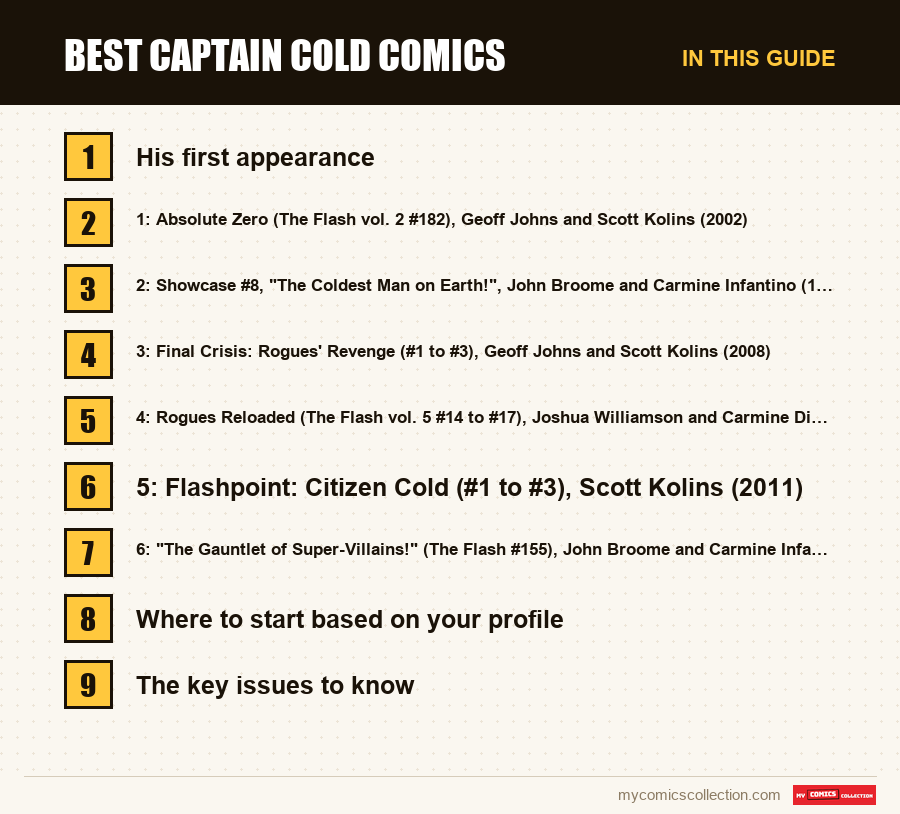
5: Flashpoint: Citizen Cold (#1 to #3), Scott Kolins (2011)
In the alternate reality of Flashpoint, Leonard Snart is a hero: Citizen Cold, a vigilante whose turf is Central City. Scott Kolins handles both the script and the art of this three-issue miniseries. The story pits him against reimagined Rogues, among them Trickster, Mirror Master, and Weather Wizard, and has him hiding a secret he fears will be exposed.
The appeal is a reversal: the same man, placed on the right side of the law, reveals what makes him singular. This is not a story to read to understand the usual Cold, but rather a counterpoint, useful to someone who already knows his major stories. For the event it stems from, see the Flashpoint key issues.
This story suits the reader who likes variations on a character and has already read issue #182. It is not recommended as a first contact, because its effect assumes you know the reference Snart.
6: "The Gauntlet of Super-Villains!" (The Flash #155), John Broome and Carmine Infantino (1965)
This 1965 issue brings together, in a single story, part of Flash's rogues gallery: Captain Cold, Mirror Master, Captain Boomerang, Pied Piper, Heat Wave, and Top, joined by Gorilla Grodd. John Broome writes, Carmine Infantino draws, and Joe Giella inks the interior; Murphy Anderson inked the cover.
It is a document of how the Silver Age series put its villains to work as a group. Cold is not alone at the center, but he is part of the assembled cast, which shows how the team that will become the Rogues was conceived at the time. The issue is read mostly for its historical value and for the pleasure of an old-school adventure.
It is for Silver Age fans and for collectors who follow Flash's enemies through landmark issues. Read it after Showcase #8 and after the modern reading, never first.
Where to start based on your profile
To get to know Snart in a single issue, open The Flash #182. If you then want a plot that mixes Cold with the other Rogues, follow with Final Crisis: Rogues' Revenge, three issues that form a whole.
If you follow Flash in order, start from the Flash reading guide, then place Showcase #8 and The Flash #155 as Silver Age landmarks, and Rogues Reloaded as the landmark of the Rebirth era. The history of The Flash puts these landmarks back into the overall timeline.
If you collect, favor the issues that matter in the character's history: the 1957 first appearance, the 1965 issue that gathers the gallery, and the 2002 story that gives him an inner life. Recent stories are easy to find in collected editions.
The key issues to know
Here are the single issues that mark Captain Cold's history. No value is given here: to appraise a copy, compare several recent sales of comparable single issues rather than relying on one listing.
- Showcase #8 (1957): first appearance of Leonard Snart in "The Coldest Man on Earth!", by John Broome and Carmine Infantino.
- The Flash #155 (1965): "The Gauntlet of Super-Villains!", part of Flash's gallery brought together.
- The Flash vol. 2 #182 (2002): "Absolute Zero," by Geoff Johns and Scott Kolins.
- Final Crisis: Rogues' Revenge #1 to #3 (2008): by Geoff Johns and Scott Kolins.
- Flashpoint: Citizen Cold #1 to #3 (2011): by Scott Kolins.
- The Flash vol. 5 #14 to #17 (2017): Rogues Reloaded, by Joshua Williamson.
For each single issue, examine the corners, the spine, and the whiteness of the paper. A 1957 or 1965 issue is judged on its grade and its scarcity, while single issues from the 2000s and 2010s are plentiful and are told apart by sharpness and by comparing several listings. For the context of covers from the era, also explore the blog.
Frequently asked questions
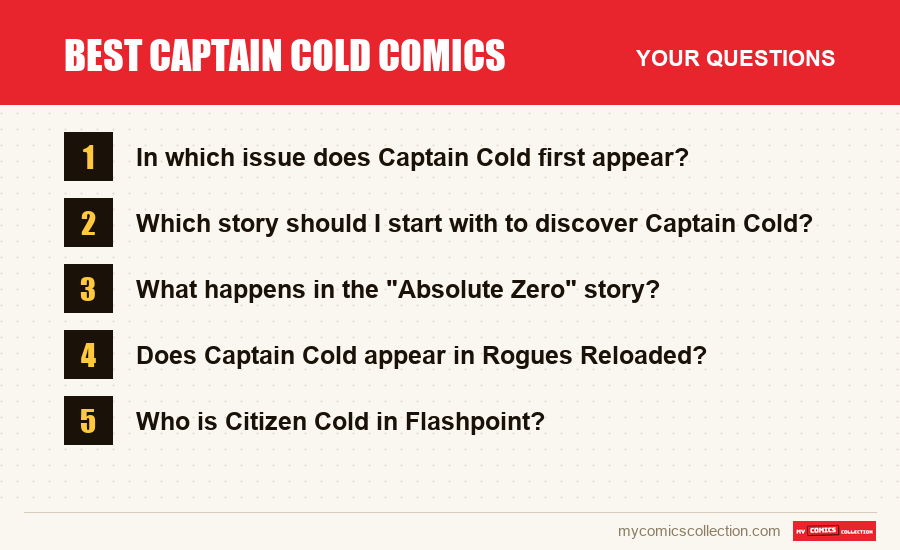
Leonard Snart debuts in Showcase #8, cover-dated 1957, in the story "The Coldest Man on Earth!" The text is by John Broome and the art by Carmine Infantino. The same issue contains another Flash story, "The Secret of the Empty Box!", written by Robert Kanigher.
Start with The Flash vol. 2 #182, "Absolute Zero" (2002), by Geoff Johns and Scott Kolins. It is a standalone issue that puts Snart at the center and reads without preparation. Follow with Final Crisis: Rogues' Revenge (2008), three issues by the same duo, then go back to Showcase #8.
In The Flash vol. 2 #182, Captain Cold sets out to avenge his sister against Chillblaine, in defiance of the truce the Rogues had agreed to. The issue, written by Geoff Johns and drawn by Scott Kolins, ends on a victory that leaves a taste of emptiness, and that is what gives it depth.
Yes, and he is the main antagonist. The arc runs through issues #14 to #17 of The Flash vol. 5 (2017), written by Joshua Williamson, with Carmine Di Giandomenico on art, joined by Davide Gianfelice and Neil Googe in the last issue. Cold organizes the Rogues' heist.
Citizen Cold is the version of Leonard Snart in the alternate reality of Flashpoint, where he is a vigilante in Central City. The miniseries Flashpoint: Citizen Cold (2011), written and drawn by Scott Kolins, runs three issues and pits him against reimagined Rogues.
Do you own a Silver Age Flash or an issue featuring the Rogues? A free estimate tells you where it stands.
Estimate my comic