The Flash owes its existence to two distinct waves of creators separated by sixteen years. In 1940, Gardner Fox and Harry Lampert invented Jay Garrick in Flash Comics #1. In 1956, Robert Kanigher , John Broome and Carmine Infantino relaunched the character as Barry Allen in Showcase #4: the founding act of the Silver Age of comics. Later, Mark Waid and Geoff Johns turned Wally West into one of DC's most fully realised human heroes. A CGC 9.6 copy of Showcase #4 sold for $900,000 at Heritage Auctions in January 2024.
Few superheroes have crossed so many editorial eras while maintaining such strong internal consistency. The Flash is the only major DC character to have embodied a complete change of age, from the Golden Age of the 1940s to the Silver Age renaissance of the 1950s, through a chain of creators who each left a lasting mark. No single author built the Scarlet Speedster's legend alone; what connects them is a tradition of creative handoffs, each generation building on the one before it.
This guide sticks to the verifiable: documented editorial facts and auction records reported by Heritage Auctions and specialist press. The key Silver Age Flash issues (including Showcase #4, Flash Comics #1, Flash #110, #123, #139) are absent or near-absent from our eBay estimator, listing volume is zero or below 15, and do not support a reliable median price. Documented auction records are the authoritative benchmark here.
Gardner Fox and Harry Lampert: inventing Jay Garrick (1940)
The first Flash was born in Flash Comics #1, published in January 1940 (released November 1939). Writer Gardner Fox: one of the most prolific comics authors in history, with more than 4,000 stories to his name: imagined Jay Garrick, a college student who inhales hard water vapours and gains supernatural speed. Artist Harry Lampert, trained in animation at Max Fleischer's studio (Betty Boop, Popeye), gave the character his distinctive Art Deco look, including the winged helmet borrowed from Hermes. Lampert drew only two stories before moving on to other projects; Fox remained durably associated with DC's mythology, co-creating Hawkman in that very same first issue and, later, the Justice Society of America. Flash Comics #1 ranks among the most sought-after Golden Age comics in the world: the rare documented auction results for high-grade copies reach into the hundreds of thousands of dollars, and pedigree copies have crossed seven figures.
Robert Kanigher, John Broome and Carmine Infantino: the Silver Age renaissance (1956)
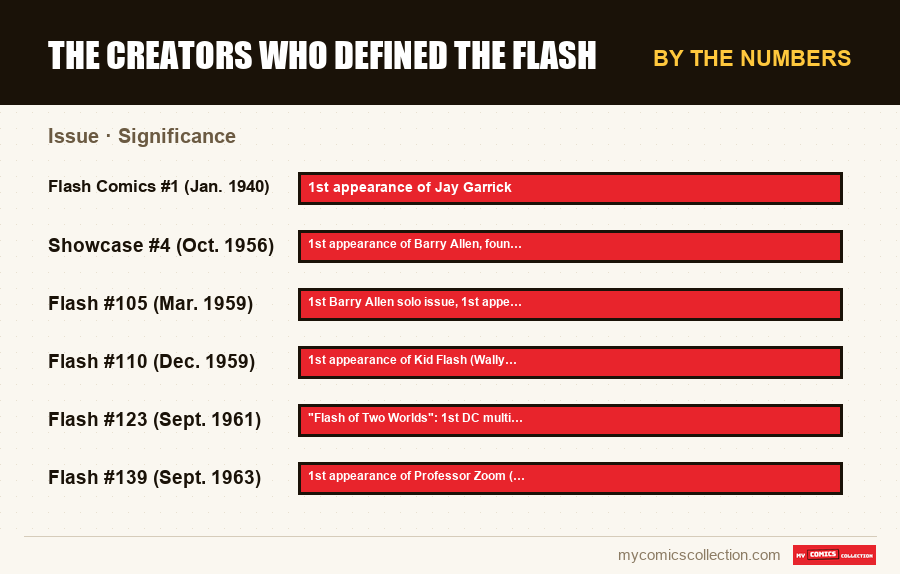
In 1956, editor Julius Schwartz gave artist Carmine Infantino and writer Robert Kanigher the task of reviving The Flash in a modern, science-fiction register suited to the post-war era. Showcase #4 (October 1956) introduced Barry Allen, a police forensic chemist struck by lightning in his laboratory: a radical reinterpretation of the archetype, inked by Joe Kubert. Kanigher scripted the origin story; John Broome, who co-wrote the second story in that issue, became the primary writer of the ongoing series from The Flash #105 (1959): Barry Allen's first solo issue, picking up the numbering where Flash Comics had left off. Broome and Infantino together produced the most consequential issues of the Silver Age: Flash #110 (December 1959, introducing Kid Flash / Wally West and the Weather Wizard), Flash #139 (September 1963, origin and first appearance of the Reverse-Flash / Professor Zoom, Eobard Thawne). Infantino also pencilled the landmark Flash #123 (September 1961), written by Gardner Fox: "Flash of Two Worlds," the story that introduced the DC multiverse and Earth-Two. Infantino's spare, modernist visual language, his use of motion lines and stroboscopic blurs to depict speed, defined the graphic identity of DC's Silver Age. He later served as DC's editorial director from 1967 and publisher from 1971 to 1976, was inducted into the Will Eisner Comic Book Hall of Fame in 2000, and died in 2013 at the age of 87.
| Issue | Creators | Significance | Market data |
|---|---|---|---|
| Flash Comics #1 (Jan. 1940) | Fox / Lampert | 1st appearance of Jay Garrick | Series not in tool: auction records (high-grade pedigree copies in hundreds of thousands of dollars) |
| Showcase #4 (Oct. 1956) | Kanigher / Infantino / Kubert | 1st appearance of Barry Allen, founding act of the Silver Age | Series not in tool: record: $900,000 (CGC 9.6, Heritage Jan. 2024) |
| Flash #105 (Mar. 1959) | Broome / Infantino | 1st Barry Allen solo issue, 1st appearance of Mirror Master | 1 eBay listing: signal too thin |
| Flash #110 (Dec. 1959) | Broome / Infantino | 1st appearance of Kid Flash (Wally West) + Weather Wizard | 0 eBay listings: web data only |
| Flash #123 (Sept. 1961) | Fox / Infantino | "Flash of Two Worlds": 1st DC multiverse | 0 eBay listings: documented record: ~$83,000 (Heritage 2004) |
| Flash #139 (Sept. 1963) | Broome / Infantino | 1st appearance of Professor Zoom (Reverse-Flash) | 0 eBay listings: web data only |
Record sources: Heritage Auctions, Bleeding Cool, ComicsPriceGuide.
Mark Waid: the Speed Force and Wally West's legitimacy (1992-2000)
After Barry Allen's death in Crisis on Infinite Earths #8 (1985) and the launch of Flash vol.2 in 1987 with Wally West as the new Flash, it was Mark Waid who elevated the series to its modern peak. Taking over The Flash vol.2 in 1992, Waid opened with "Born to Run", a Year One story tracing Wally's days as Kid Flash, before delivering two defining arcs: "The Return of Barry Allen" (issues #73-79, 1993), in which Wally must accept his mentor's legacy in the face of an impostor, and "Terminal Velocity" (issues #95-100, 1994-1995), which introduced the concept of the Speed Force: the universal kinetic energy field that powers all DC speedsters. Waid made Wally West a character in his own right, no longer a carbon copy of Barry Allen, but a hero fully inhabiting his own identity.
Geoff Johns: emotional grounding and the mythology of the Rogues (2000-2005 and 2009)
Geoff Johns wrote The Flash vol.2 from issue #164 (September 2000) through issue #225 (October 2005). His approach differed from Waid's: where Waid celebrated speed as liberation, Johns explored the psychology of the Rogues Gallery (Captain Cold, Mirror Master, Weather Wizard) giving them human depth and internal logic. His arc "Blitz" (issues #197-200, 2003) redefined the modern Zoom (Hunter Zolomon), while "Ignition" (issues #201-206) played with Wally's secret identity and memory. Johns returned to The Flash for Flash: Rebirth (2009, six issues, art by Ethan Van Sciver), the miniseries that brought Barry Allen back after twenty-four years and reset the narrative framework of the Speed Force for the decades ahead. Issue #1 sold out at Diamond Comic Distributors on its first day of release: a measure of the pent-up demand for Barry Allen's return. Johns left the title after Flashpoint (2011), the event that restructured the DC universe and launched the New 52.
A legacy passed from one generation to the next
What sets The Flash apart from most superhero franchises is the thematic continuity of its creative legacy. Fox established the myth of divine speed; Kanigher, Broome and Infantino translated it into rigorous science fiction; Waid turned it into a story of generational succession; Johns made it a human tragedy. The CW television series The Flash (2014-2023, starring Grant Gustin as Barry Allen) and the film The Flash (2023, directed by Andy Muschietti, starring Ezra Miller) both drew on this catalogue of foundational stories to build their plots. Each creator defined an era without erasing the one before, and that is precisely why Flash comics endure across decades.
Own a Flash comic? Get a free valuation with our tool based on real eBay sales to find its low, median, and high value.
Frequently asked questions
Writer Gardner Fox and artist Harry Lampert created him in Flash Comics #1, dated January 1940. Lampert drew only the first two stories, while Fox remained closely tied to DC mythology.
Showcase #4 (October 1956), which introduces Barry Allen, a police chemist struck by lightning. This issue by Kanigher and Infantino is regarded as the founding act of the Silver Age of comics.
From 1992 he lifted The Flash vol.2 with "The Return of Barry Allen" (#73-79) and then "Terminal Velocity" (#95-100), which introduced the Speed Force. He also made Wally West a legitimate hero in his own right.
He wrote the series from #164 (2000) to #225 (2005) and gave the Rogues real human depth. His "Blitz" arc redefined Zoom, and he wrote Flash: Rebirth in 2009.
Online listings for these issues are absent or too scarce to give a reliable median. The guide therefore sticks to documented auction records rather than inventing a figure.