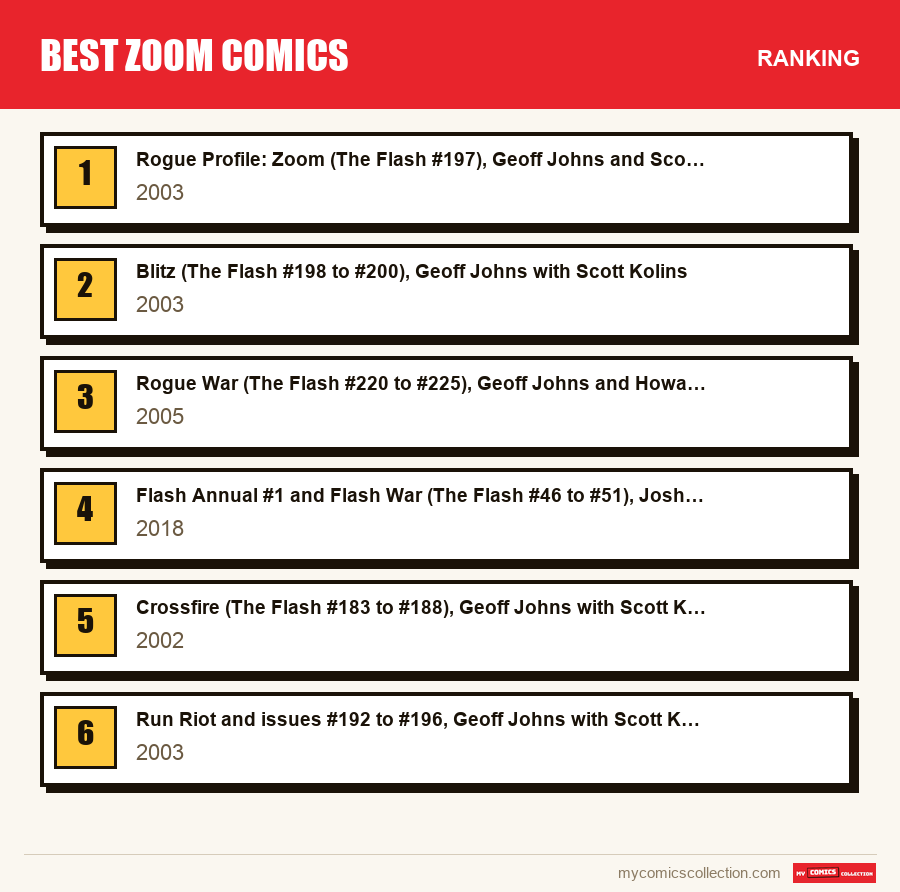
To find the best Zoom comics and know where to start with Hunter Zolomon, begin with The Flash (vol. 2) #197, "Rogue Profile: Zoom" (June 2003), then move on to the Blitz arc (#198 to #200) by Geoff Johns and Scott Kolins. Continue with Rogue War (#220 to #225, 2005), which closes his duel with Wally West, and finish with Flash War (2018) for the modern version of the character.
Zoom is Wally West's most unsettling enemy because he does not present himself as an enemy. Hunter Zolomon is a friend, a specialist in criminal behavior, who claims to make the Flash better by inflicting on him what he believes forges heroes: loss. Every story that features him asks the same question, that of where help stops and cruelty begins. This guide ranks the stories to read in order of their interest for a reader discovering the character.
As always in this guide, we only state verified information (creators, issue numbers, dates); the analysis is ours, with no reproduction of protected artwork or dialogue.
His first appearance
Hunter Zolomon is born in The Flash: Secret Files & Origins #3, dated 2001, from the pen of Geoff Johns and with art by Scott Kolins. At this stage he is not yet Zoom: he is a character from Wally West's circle, set in the monthly series that Johns has been writing since issue #164 (September 2000). He then appears in several episodes of The Flash (vol. 2) starting with #181 (February 2002), always as an ally.
The shift happens with The Flash (vol. 2) #197, "Rogue Profile: Zoom" (June 2003): the episode tells Zolomon's past, and it is under the name Zoom that the character acts from the following issues. So remember two dates, 2001 for the man and 2003 for the villain. This distinction matters for reading as well as for collecting: the 2001 issue is a special rather than an issue of the regular series, which puts it in a separate search category.
Zoom is not Eobard Thawne's Reverse-Flash
First, a confusion to clear up. The name "Professor Zoom" belongs first to the original Reverse-Flash, Eobard Thawne, the Barry Allen enemy born in The Flash #139 (1963). Hunter Zolomon is a different man, created almost forty years later, who takes up that nickname and shortens it. His motivations, his story and his relationship to Wally West have nothing in common with Thawne's. If you are looking for the Reverse-Flash of the Barry Allen lineage, the guide devoted to Thawne is the one you need; here, we are only talking about Zolomon.
1: Rogue Profile: Zoom (The Flash #197), Geoff Johns and Scott Kolins (2003)
This standalone episode is the ideal entry point. Johns lays out Zolomon's path: a criminologist and psychologist who went through the FBI, became a profiler in Keystone City, whose career collapses after a clash with the Clown, and who is then left paraplegic by an attack from Gorilla Grodd. Scott Kolins draws it.
This story explains the character's logic without requiring you to know twenty years of continuity. Zolomon begs Wally to use the cosmic treadmill to rewrite his past; Wally refuses, fearing what such a gesture would do to the flow of time. Zolomon goes ahead anyway, seizes the machine, and comes out healed and endowed with a speed nobody really controls. For the reader, the episode has a great merit: it makes the character understandable before making him frightening.
Who is it for? Any reader curious about why Zoom matters in the history of the Flash, even without having read the other issues. How do you read it? First, then go back to the episodes where Zolomon still appears under his real name. It is collected in several editions of the period, including the Blitz volume.
2: Blitz (The Flash #198 to #200), Geoff Johns with Scott Kolins (2003)
This is the arc where Zoom comes down on Wally. The title Blitz covers, in the monthly run, issues #198 to #200 (July to September 2003), while the collection of the same name gathers issues #192 to #200, which includes the chapters that set up the confrontation. Geoff Johns writes, Scott Kolins dominates the art, with other artists across the volume, including Phil Winslade.
The dramatic engine is simple: Wally worries about his wife, Linda Park, who is pregnant, and Zoom gets in his way, claiming to help him improve. The tone is that of a psychological thriller more than a superhero fight. The interest lies in the tension: every move by Zoom presents itself as a favor to Wally, which makes the threat harder to name.
This story is for the reader who wants the heart of the conflict. It requires having read issue #197, which provides the psychological key, but nothing more. After issue #200 (September 2003), the series also restores Wally's secret identity.
3: Rogue War (The Flash #220 to #225), Geoff Johns and Howard Porter (2005)
Two years later, Johns closes the duel. In Rogue War, Zoom seeks to unite the Rogues, Keystone City's gang of criminals, and he faces Wally again. Howard Porter is the main artist, with John Livesay on inks for several issues. The story runs from issue #220 (May 2005) to issue #225 (October 2005), the last of Johns's regular run before the end of his tenure.
What makes the arc valuable is that it concludes a face-off rather than stretching it out. Zoom delivers what is presented as his last personal attack on Wally, before disappearing into the flow of time. The reader finds the culmination of a relationship begun three years earlier and the inverted reflection of the logic of Blitz.
This final chapter is worth it for anyone who followed #197 to #200 and wants to see how Johns wraps up the confrontation. The Rogue War collection, published in 2006, does not contain only these six issues: it also gathers other episodes from the period, with artists other than Porter, which explains why it does not read as a uniform block.
Do you collect this series?
Track what you own, what you are missing and what your collection is worth. 7-day trial.
Start my trial →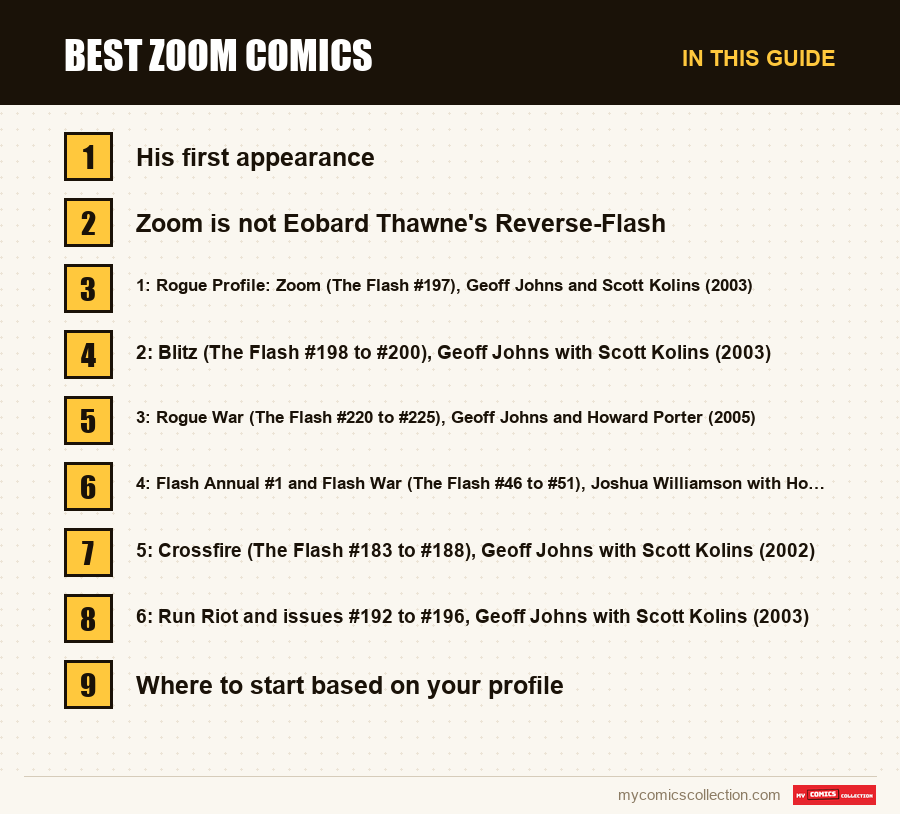
4: Flash Annual #1 and Flash War (The Flash #46 to #51), Joshua Williamson with Howard Porter and Scott Kolins (2018)
Thirteen years after his disappearance, Zolomon returns in the Rebirth era. The Flash Annual #1 (2018), written by Joshua Williamson, reveals on its last page that the mysterious judge manipulating events is Hunter Zolomon. The Flash War arc, which runs through issues #46 to #51 of the regular series, develops the idea: Zolomon wants to provoke a war between Wally West and Barry Allen to make them, he says, better. He takes on the role of the Flash for a time. Howard Porter draws the whole thing, with Scott Kolins on additional art in the collection.
The 2018 version extends the logic of 2003: a manipulator who justifies himself by the good of his victims. It adds a direct link with Eobard Thawne's Reverse-Flash, tied to Zolomon in this story, which makes it the read to choose for the modern-era reader rather than for the reader of the 2000s.
This story is for someone who already knows Wally West and Barry Allen, and who wants to measure what the character has become. Read it after Rogue War; starting with it would be possible, but you would lose the emotional weight of the relationship between Wally and Zolomon.
5: Crossfire (The Flash #183 to #188), Geoff Johns with Scott Kolins (2002)
This arc belongs to the period when Zolomon is still an ally of Wally. It is useful to reread because it shows what Blitz destroys: a friendship and a professional collaboration. Zolomon then works with Wally in the unit that tracks Keystone City's metahumans, and the reader sees him as a confidant. The story runs from the prologue (issue #183, April 2002) to the conclusion in issue #188 (September 2002).
It is not a Zoom story in the strict sense, but a portrait of Hunter Zolomon before the fall. Its interest is retrospective: once Blitz has been read, these issues take on another weight. The Crossfire collection exists in volume form, best read after the essential episodes.
6: Run Riot and issues #192 to #196, Geoff Johns with Scott Kolins (2003)
The episodes that separate Crossfire from Rogue Profile make up the rise in tension. Run Riot occupies issues #192 and #193 (January and February 2003); then come "Dead or Alive" (#194), "Off-Balance" (#195) and "Helpless" (#196). Zolomon is present alongside Wally, and it is in this sequence that the event that will make him an enemy is prepared.
This sequence is for the reader who wants to understand how a friend becomes an adversary, but it is not essential for a first read. The collections of the period, notably the omnibus devoted to issues #177 to #200 of the series, make it easy to follow in one go.
Where to start based on your profile
If you are discovering the character and want a short story, read issue #197 alone, then the Blitz arc. That is four issues and enough to grasp the essentials of the character.
If you read the Flash in order, start at The Flash #164 (September 2000), the start of Geoff Johns's run, and let Zolomon appear naturally from #181. The omnibus The Flash by Geoff Johns covering issues #177 to #200 gathers that whole path, including DC First: Flash/Superman #1. You will find the context of these years in our history of Wally West.
If you collect, favor the issues that matter in the character's history over secondary appearances. For an overview of the series, consult the Flash reading guide.
The key issues to know
Here are the issues that mark the life of Hunter Zolomon. To place one of them, compare several recent sales of comparable copies rather than stopping at a single listing.
- The Flash: Secret Files & Origins #3 (2001): debut of Hunter Zolomon, created by Geoff Johns and Scott Kolins.
- The Flash (vol. 2) #197 (June 2003): "Rogue Profile: Zoom," the episode that lays out his history.
- The Flash (vol. 2) #198 to #200 (July to September 2003): the Blitz arc.
- The Flash (vol. 2) #220 to #225 (May to October 2005): the Rogue War arc.
- Final Crisis: Rogues' Revenge #1 to #3 (September to November 2008), by Geoff Johns and Scott Kolins: Zoom is not the protagonist there, he returns in the third issue, after a story centered on the Rogues.
- The Flash Annual #1 (2018): the reveal of Zolomon as the judge.
- The Flash #46 to #51 (2018): Flash War.
For each issue, look at the condition of the book, the absence of foxing on the edges and the sharpness of the corners. A 2003 issue is recent and plentiful: it is judged on condition and on comparing several listings, whereas the 2001 special requires more patience to track down. For the general logic of first appearances, see also the historical overview of the Flash.
Frequently asked questions
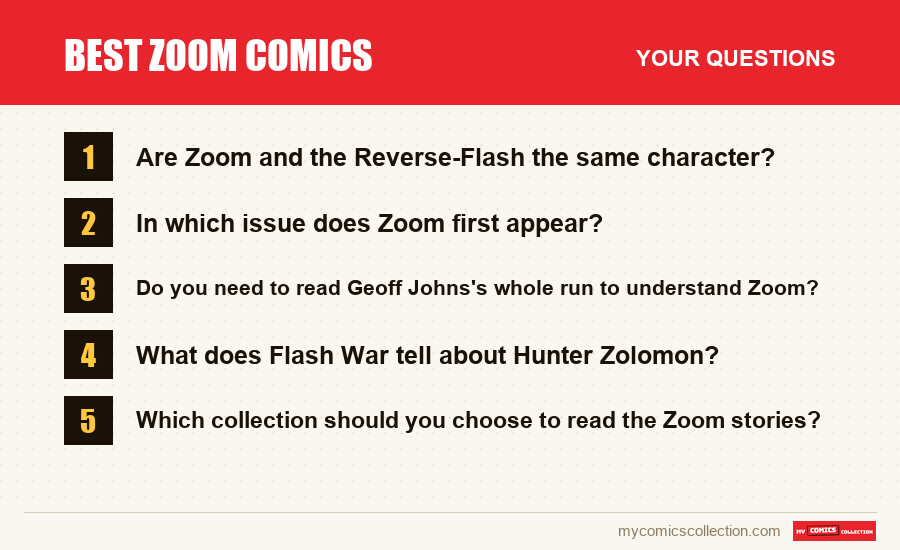
No. The original Reverse-Flash is Eobard Thawne, Barry Allen's enemy who appeared in The Flash #139 in 1963, and his nickname is Professor Zoom. Zoom, in the sense of this guide, is Hunter Zolomon, created by Geoff Johns and Scott Kolins in 2001, and he is Wally West's enemy.
Hunter Zolomon debuts in The Flash: Secret Files & Origins #3, dated 2001. He acts under the name Zoom starting with The Flash (vol. 2) #197, "Rogue Profile: Zoom" (June 2003), the episode that tells his past, and in the issues that follow.
No. Issue #197 explains his path, and the Blitz arc (#198 to #200) is enough to grasp his conflict with Wally West. The earlier issues and Rogue War enrich the reading without being necessary to begin.
Joshua Williamson picks up the character after The Flash Annual #1 (2018), in which he is revealed as the judge manipulating Wally West and Barry Allen. In Flash War (#46 to #51), he tries to set them against each other and takes on the role of the Flash for a time.
The Blitz volume gathers issues #192 to #200 of The Flash, and the Rogue War collection (2006) covers the conclusion. The omnibus covering issues #177 to #200 of Geoff Johns's period brings together most of the character's build-up.
Do you own an issue from Geoff Johns's period on the Flash? A free estimate tells you where it stands.
Estimate my comic