
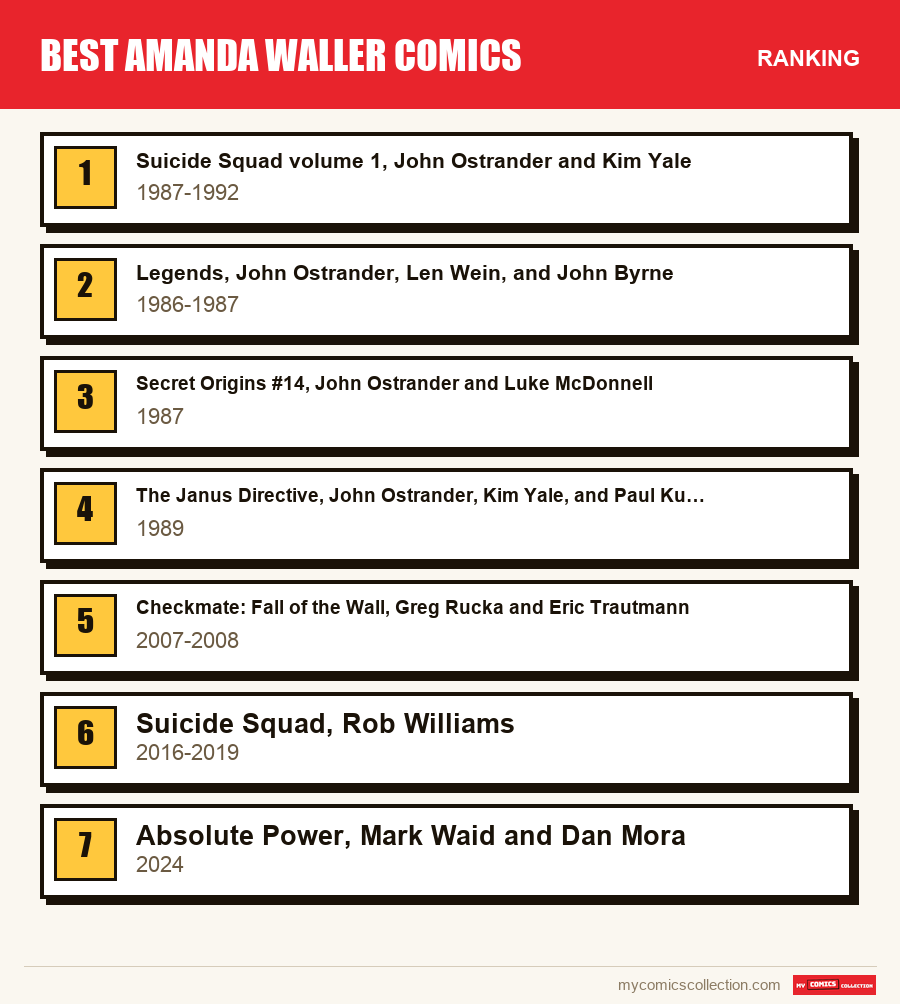
To find the best Amanda Waller comics, open John Ostrander and Kim Yale's Suicide Squad series (1987-1992), where the character takes her definitive form, after her first appearance in Legends #1 (November 1986). Add Checkmate for her spy side, Rob Williams's Suicide Squad (2016-2019) for the recent version, then Absolute Power (2024), where she becomes the heroes' adversary.
Amanda Waller holds a singular place at DC: no powers, no costume, and yet a political weight few heroes match on the page. Director of a program that trades reduced sentences for missions with no return, nicknamed "the Wall," she reads as a political figure more than as a villain or a heroine. This guide ranks seven reads to follow her trajectory, from the 1980s to the 2024 event.
As always in this guide, only verified facts (creators, issue numbers, dates) are stated; the analysis is our own, with no reproduction of protected art or dialogue.
Her first appearance
Amanda Waller debuts in Legends #1, cover-dated November 1986, a six-issue miniseries created by John Ostrander, Len Wein, and John Byrne. She does not yet hold the central role we know her for: she arrives in a plot where the heroes of the DC universe have fallen out of favor with the public, and it is in this void that she reactivates Task Force X, the program that assembles criminals for off-the-books operations.
Keep in mind that this issue holds the character's birth, but it is not what makes her interesting to read. Her psychology, her way of negotiating with her superiors, and her toughness are built the following year, in the ongoing series launched in May 1987. If you want the original single issue, aim for Legends #1; if you want the character, start from the series.
1: Suicide Squad volume 1, John Ostrander and Kim Yale (1987-1992)
Sixty-six issues appear between May 1987 and June 1992. John Ostrander writes them, soon supported by Kim Yale, while Luke McDonnell draws the first twenty-four before other artists take over. Waller is at once director, strategist, and target: the team members hate her, her superiors try to control her, and she always finds a lever to keep the upper hand. Belle Reve serves as prison and base, and the charges implanted in the convicts' necks give the whole book its constant tension.
Why has Waller lasted forty years? The answer is here. A collected edition of several issues gives these plots more room to breathe than a single issue. The team relaunches that followed can be compared with each other in our ranking of the team's runs. A concrete starting point: read the first issues for the setup, then the The Janus Directive crossover (entry 4) to gauge how far the writing pushes the power struggles between agencies. If you can only open one volume, it is this one.
2: Legends, John Ostrander, Len Wein, and John Byrne (1986-1987)
Back to the source, with a caveat: Waller is not the heroine of this miniseries, which is a DC universe event serving as a launch pad for several series. Her role in it is to bring the Suicide Squad into action, and her first field of operation is the threat of Brimstone, whom the team is sent to destroy. John Byrne handles the art, Len Wein the dialogue, John Ostrander the overall plan.
Who is it for? Readers who like to know what comes before a series, and collectors aiming for the character's original issue. Read it after a first contact with the 1987 series, not before: the event feels mechanical if you do not know what it sets up. The third issue, the one where the team really takes the stage, is the one that interests a Waller reader most.
3: Secret Origins #14, John Ostrander and Luke McDonnell (1987)
A single issue, cover-dated May 1987, titled "The Secret Origin of the Suicide Squad." John Ostrander writes it, Luke McDonnell draws it, with Dave Hunt on inks. It is the single issue that tells both the birth of the team and Waller's past, that is, what the ongoing series only sketches. To understand the character's toughness, it is the piece of the file not to skip.
It is for those who want a portrait rather than a mission. It is a short read, and it slips in nicely between two collected volumes of the series. For a collector, it naturally sits between Legends and the first issue of the series, give or take the cover date: May 1987 for both.
4: The Janus Directive, John Ostrander, Kim Yale, and Paul Kupperberg (1989)
This 1989 crossover pits Checkmate against the Suicide Squad, along with other neighboring series, in a war between agencies manipulated by Kobra. Waller is one of the stakes: Checkmate loses a large part of its agents and its headquarters, and Sarge Steel replaces Waller at the head of the organization. The Suicide Squad chapters are written by John Ostrander; those of Checkmate go to Paul Kupperberg, and several artists share the whole.
Who should you recommend it to? Readers who like agency plots and lasting consequences. Plan to read the chapters in publication order, even if that means going through a collected edition, because the episodes answer each other from one series to the next. The crossover reads better with the few preceding issues in mind, otherwise the alliances stay confusing.
Do you collect this series?
Track what you own, what you are missing and what your collection is worth. 7-day trial.
Start my trial →
5: Checkmate: Fall of the Wall, Greg Rucka and Eric Trautmann (2007-2008)
The 2006-2008 Checkmate series runs thirty-one issues. Waller sits there as White Queen, a senior post entrusted to her on the express condition that she have no direct control over operations, which does not stop her from running her own missions in secret. The Fall of the Wall arc, written by Greg Rucka and Eric Trautmann with Joe Bennett among others on art, tells of the other leaders' counterattack: they gather evidence of her clandestine operations, and she resorts to blackmail to protect her affairs, before having to resign.
This read is for those who prefer political thrillers to action. It shows Waller on the espionage chessboard, far from Belle Reve. To read it, start at the beginning of the series, because the arc rests on balances of power set up from the first issues; jumping straight to this trade paperback robs the fall of its effect.
6: Suicide Squad, Rob Williams (2016-2019)
After the 2016 relaunch of the DC universe, Waller regains her original look in Rob Williams's series, which spans three years and calls on several artists. The standout episode: she is shot in issue #11, her death seems confirmed in #12, and #15 reveals she faked her disappearance. Further on in the series, an issue is titled "The Trial of Amanda Waller," a sign that putting her character on trial has become a stake in its own right.
This run suits those who discover the character through the movies and want a recent way in. It requires reading the sequence from #11 to #15 without interruption: the single issues follow one another, and a collected edition spares you the gaps. It plays more on plot twists than on the political depth of the 1987 series, which makes it a complement rather than a starting point.
7: Absolute Power, Mark Waid and Dan Mora (2024)
A four-issue event, from July to October 2024, written by Mark Waid and drawn by Dan Mora. Waller is the antagonist: she takes control of the Hall of Justice, founds the Bureau of Sovereignty, and launches a campaign against metahumans, aided by Task Force VII, an army of Amazos. The heroes organize into a Resistance, and she is finally defeated and sentenced to life in prison at Belle Reve.
It is for readers who want to see her as the universe's main threat, not as the head of a team of convicts. Read it last: the impact of her fall rests on what you already know of her, her sense of the state, and her distrust of superhumans.
Where to start based on your profile
- You come from the movies: begin with Rob Williams's Suicide Squad series, then go back to the 1987 series. Our comparison of the 2021 film spells out what the screen borrows.
- You are looking for Waller's roots: read Legends, then Secret Origins #14, then the first episodes of 1987.
- You like espionage thrillers: take The Janus Directive then Checkmate.
- You follow recent events: Absolute Power reads on its own, but benefits from a prior taste of Rob Williams's series.
- You want to be guided step by step: the editorial path of the Suicide Squad puts each read in its context.
If you hesitate between publication order and reading order, keep one simple rule for Waller: editorial chronology and narrative interest contradict each other. Read in date order, her trajectory starts in 1986, passes through the 1987 series, the espionage of Checkmate in 2006, the 2016 reboot, then the fall of 2024. Read by interest, it starts at 1987 and goes back. Both paths are defensible, but the second is kinder to the patience of a reader discovering a character whose age is counted in decades.
The key issues to know
For a character whose identity rests on a program, the markers are counted in team milestones. The detail for the whole team appears in the Suicide Squad milestones; keep here the ones that touch Waller closely.
- Legends #1 (November 1986): her first appearance, created by John Ostrander, Len Wein, and John Byrne.
- Secret Origins #14 (May 1987): the story of the team and of Waller, by John Ostrander and Luke McDonnell.
- Suicide Squad #1 (May 1987): start of the series where Waller runs Task Force X.
- Suicide Squad #11 and #15 (2016 series): Waller's fall and return.
- Absolute Power #1 (July 2024): the start of her role as the heroes' adversary.
The method for gauging a milestone is the same as for other characters: a first-appearance issue weighs more than a return issue, and an origin issue weighs more than a recent event issue. Always check the exact identity of the issue (series, volume, cover month), because several series carry the same title. Then compare several completed sales for the same grade, because a single listing tells you nothing about the real level of prices.
Frequently asked questions
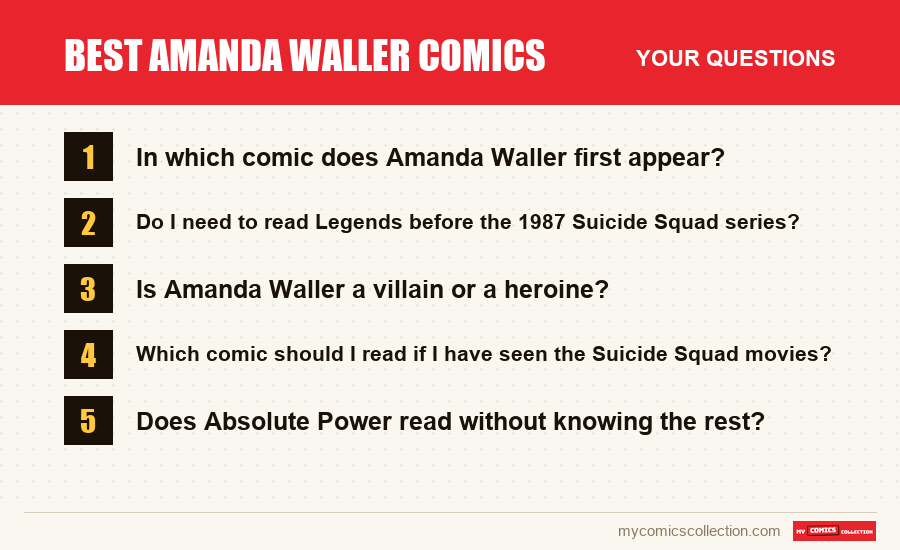
In Legends #1, cover-dated November 1986, a six-issue miniseries created by John Ostrander, Len Wein, and John Byrne. She is not yet the central figure of the Suicide Squad there, a role she takes on in the series launched in May 1987.
It is not required. Legends explains how Task Force X is relaunched, but the 1987 series stands on its own. Many readers prefer to read it first, then go back to Legends for its context, because the event feels more mechanical without that.
Both, depending on the era. In the 1987 series, she directs criminals for the government without being a criminal herself. In Absolute Power (2024), she is the antagonist the heroes must defeat. The character thrives on this ambiguity, and each writer shifts it.
Start with Rob Williams's Suicide Squad (2016-2019), close to the spirit of the films, then move on to the Ostrander and Yale series (1987-1992) for the foundation. Our pages on the 2016 and 2021 films show what the screen borrows and what it transforms.
Yes, the 2024 event, written by Mark Waid and drawn by Dan Mora, reads on its own in four issues. Knowing Waller's path strengthens the effect, but the story recalls the essentials: her program, her role as director, and her attitude toward metahumans.
Do you have a copy of the 1987 Suicide Squad series or of Legends? Have it appraised before you resell it.
Estimate my comic