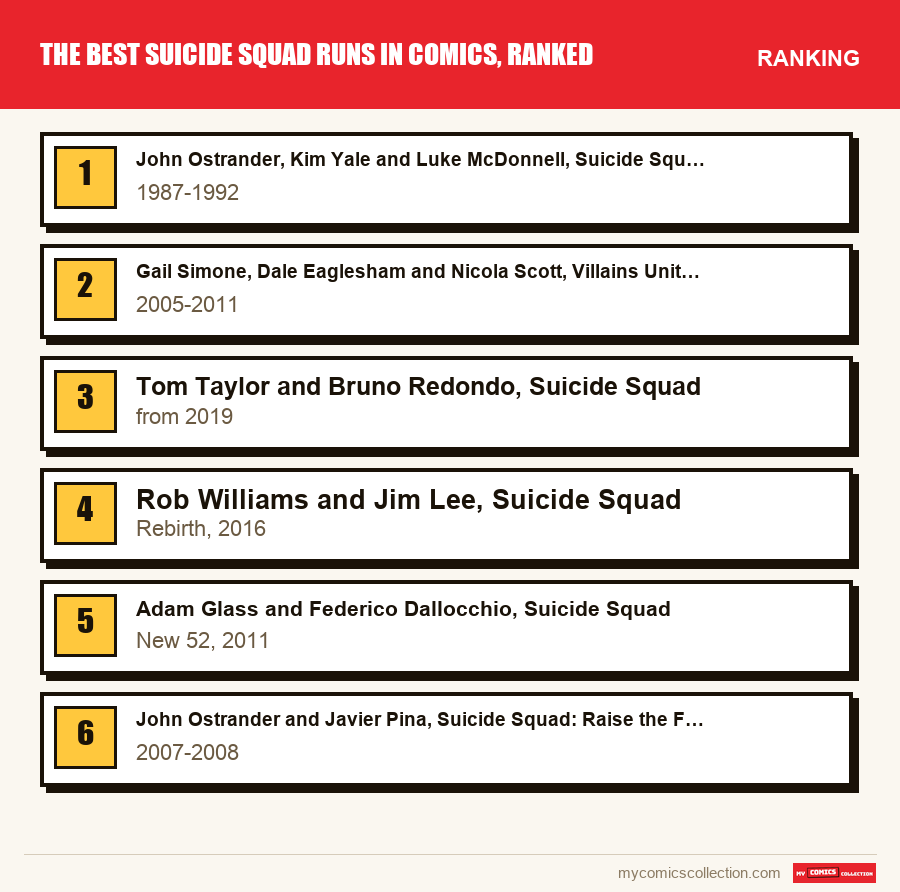
The best Suicide Squad run remains the one by John Ostrander, Kim Yale and Luke McDonnell (1987-1992, sixty-six issues), ahead of Gail Simone's cycle, from Villains United to Secret Six, and the series by Tom Taylor and Bruno Redondo. Six sets are ranked, from the founding run to the recent relaunches. Each entry gives its starting point, its audience and the choice between original issues and collected editions.
Ranking the runs of a team whose roster changes with every mission raises a problem that a ranking devoted to a single hero does not have: here the common thread is not a character, it is an idea. Convicts trade a reduced sentence for operations nobody wants to sign off on, and Amanda Waller holds the leash. Depending on the writer, that idea becomes political tragedy, dark comedy or an action movie on paper.
As always in this guide, only verified information (creators, issue numbers, dates) is stated as fact; the analysis is our own, with no reproduction of protected art or dialogue.
How we ranked these runs
A team series is judged on three points that plain commercial success does not reflect. First, the place given to Waller and the system of coercion, because without the blackmail of the implanted bomb the Suicide Squad is just a gang of villains on a mission. Second, the ability to kill off characters without it turning into a gimmick. Third, access for someone who discovers the team through the movies and has not read the 1980s. A founding run can therefore come ahead of a more brilliant but more closed one.
A word on the backstory. The first Suicide Squad appears in the late 1950s in The Brave and the Bold, with Robert Kanigher and Ross Andru: adventurers with no sentence and no blackmail. The modern concept is born with the Legends maxi-series (1986), which serves as a prologue to the 1987 launch. We start from that launch.
Top 1: John Ostrander, Kim Yale and Luke McDonnell, Suicide Squad (1987-1992)
The series opens with issue 1, dated May 1987, and ends with issue 66, in 1992. John Ostrander writes the whole run; Kim Yale quickly joins the writing, and Luke McDonnell handles the art in the early going. The story sets up Belle Reve, the Louisiana prison that serves as a recruiting pool, then operations carried out against foreign regimes, occult organizations and sometimes rival American agencies.
Why this run dominates: nobody is protected. Deadshot, Captain Boomerang, Bronze Tiger, Rick Flag, the Enchantress or Nightshade can fall on any page, and the consequences carry on for years of publication. Waller gains the depth of a figure of power that adaptations still borrow. The high point of this political vein is the crossover The Janus Directive, which spills over into several DC espionage titles. In this series, Barbara Gordon also takes on the identity of Oracle, which ties the Squad to the whole of DC's history.
This path suits the reader who accepts a long crossing, with artists who take turns from one cycle to the next. For collecting: original issues are the enthusiast's option, collected editions the reader's, since they respect the publication order and spare you from chasing isolated issues. In both cases, spot the crossovers that spill over into other titles.
Top 2: Gail Simone, Dale Eaglesham and Nicola Scott, Villains United then Secret Six (2005-2011)
This is not a Suicide Squad series in the strict sense, and we own that: Gail Simone takes up the team's moral DNA, villains who do good without believing in it, but with no Waller and no bomb. Villains United (six issues, 2005, drawn by Dale Eaglesham) sets up a group of mercenaries who refuse to line up behind a secret society of supervillains. Secret Six picks up from 2008, with Nicola Scott on art at launch, and runs for three years.
This run counts because it proves that the criminal-team premise works through the writing of bonds more than through coercion. Deadshot and Catman are its most endearing figures, and the black humor is kept up to the end. No prior knowledge is required beyond a taste for moral ambiguity.
It suits the reader who loved the spirit of the Squad but wants a character story more than an espionage one. On the collecting side, these releases are nothing rare: the Villains United and Secret Six collected editions are enough, and only fans of themed shelves will go looking for the single issues.
Top 3: Tom Taylor and Bruno Redondo, Suicide Squad (from 2019)
Tom Taylor writes, Bruno Redondo draws, and the series brings a fresh look at Waller's machine: young idealistic recruits collide with a cynical apparatus that has no use for their convictions. This clash gives the launch a tension that the earlier relaunches had lost, and Redondo's line makes the violence readable without indulging in it.
It is the smoothest entry point for a reader coming from James Gunn's films: the tone is direct, and nothing requires knowing the 1980s. The downside is that the whole remains shorter and less dense than the founding run.
For collecting, this is a recent release: the market value is not settled. What will move it comes down to identifiable factors: how long the series runs, the place of these issues in future adaptations, and successive print runs. We offer no ratio and no print-run figure. The collected edition is the reasonable choice; keep the single issues of the first number if you like series debuts.
Top 4: Rob Williams and Jim Lee, Suicide Squad (Rebirth, 2016)
The Rebirth revival hands the series to Rob Williams, with Jim Lee on art for the opening arc. Waller returns to the center of the game, Harley Quinn stays in the cast and the series aims to capture the audience drawn in by the film released the same year. The opening gathers a large team from the first pages and stays readable for anyone who has read nothing before.
Its appeal is being an entry point with no baggage, with a spectacular layout. Its limit is the distance between this work and the political finesse of 1987: what you read here is orderly action, rarely anguish. The run suits anyone who wants a modern, quick read, or who collects Jim Lee's work.
For collecting, the conclusion is the same as for any 2010s release: follow alternate covers only if you are sure they exist, compare completed sales at the same condition and prefer the collected edition for reading.
Do you collect this series?
Track what you own, what you're missing and what your collection is worth. 7-day trial.
Start my trial →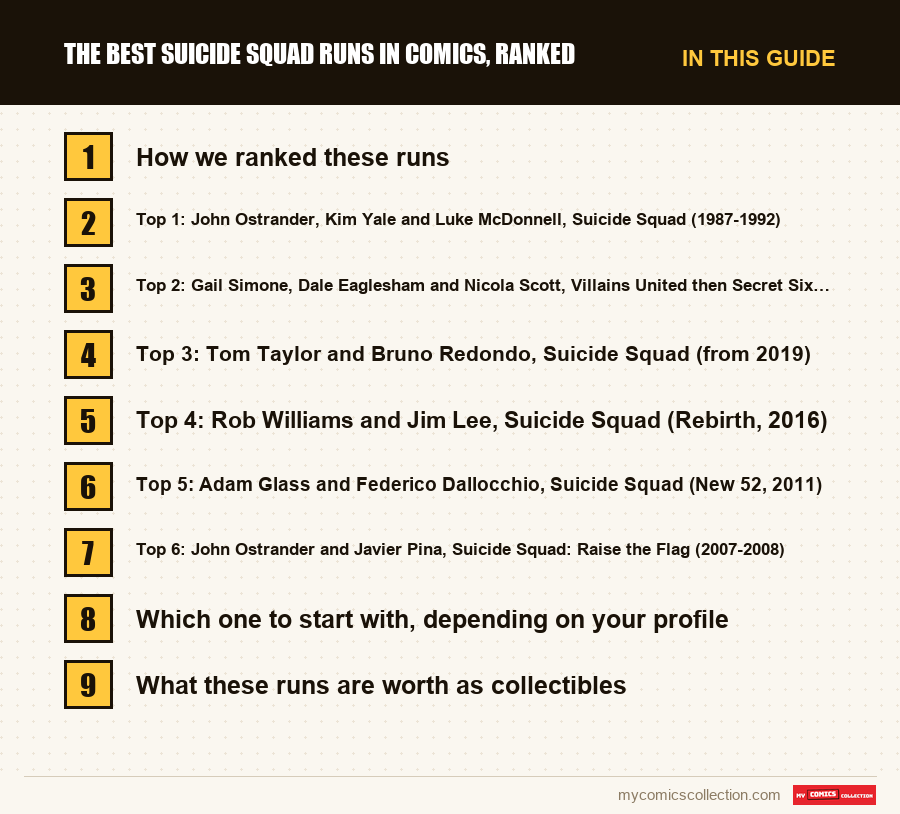
Top 5: Adam Glass and Federico Dallocchio, Suicide Squad (New 52, 2011)
The New 52 relaunches the series in 2011 with Adam Glass on script and Federico Dallocchio on the first art. This is where Harley Quinn joins the team for good, with a new costume, and where Deadshot, King Shark and El Diablo make up a more explosive and more "pop" group. Matt Kindt takes over part of the cycle.
The series is uneven, and that is why we rank it here: it has historical importance, since it prepares the movie craze, but its writing is looser than that of its elders. It interests the reader who wants to understand how the Squad became a brand, and the Harley Quinn collector who wants to follow her change of look.
In single issues, these numbers are easy to find; in collected form, the New 52 is cut into volumes that do not always follow the arcs. Check the list of issues covered before buying, and match it against your inventory to avoid duplicates.
Top 6: John Ostrander and Javier Pina, Suicide Squad: Raise the Flag (2007-2008)
Ostrander returns to his creation with this miniseries and Javier Pina on art. The context has changed: a generation has grown up, and the miniseries' very title points to Rick Flag, the soldier of the first group. The appeal is seeing the founding writer take up the subject again with twenty years of hindsight.
The miniseries is less foundational than elegiac. It is aimed at those who have already read the 1987 run, who will find an echo in it, and less at newcomers: the stakes assume you know the characters. It is also the shortest of the selection, which makes it an easy complement to shelve in a library.
For collecting, it is a supplementary title: a miniseries that completes the Ostrander shelf without being its pillar. If your budget is tight, it comes after the founding issues.
Which one to start with, depending on your profile
If you come from the movies and want to read without effort, open Tom Taylor's series: it reads on its own and assumes no earlier reading. If you prefer characters to missions, start with Gail Simone's Villains United and Secret Six, then come back to the team.
If you are after the team as it was invented, tackle the Ostrander, Yale and McDonnell run, preferably in successive collected editions. And if you are short on time, read Legends for the setting, then the first issues of 1987: they are enough to grasp the mechanics before deciding whether to continue. Our reading guide details the complete order for those who want to go further.
The seasoned collector will start from the milestones: Suicide Squad #1 of 1987, Legends for Waller, The Brave and the Bold #25 for the original team. The detail of these issues is in the article devoted to key issues.
What these runs are worth as collectibles
The Suicide Squad is a textbook case: a popular team, numerous series, and a market value concentrated on a few issues rather than on the runs. The 66 issues of 1987-1992 were printed in quantity in the Copper Age; what gives them value is condition and the demand of readers loyal to the run. The first issue and the structuring crossovers stand out, and the rest can be completed at reasonable cost.
For recent releases, method matters more than the number: the market value is not settled, and you cannot deduce it from a single price. Pull completed sales for the same issue, at the same condition, over several weeks, then compare them to the median of open listings. A widening gap points to demand; a stable gap, a quiet market.
Finally, the effect of adaptations is real but irregular. The debuts of a secondary character like Peacemaker reacted to the release of James Gunn's film in 2021, while more central issues did not move. To pin down the condition of a copy, reread our grading method, and track your inventory issue by issue to spot the gaps in a run.
Frequently asked questions
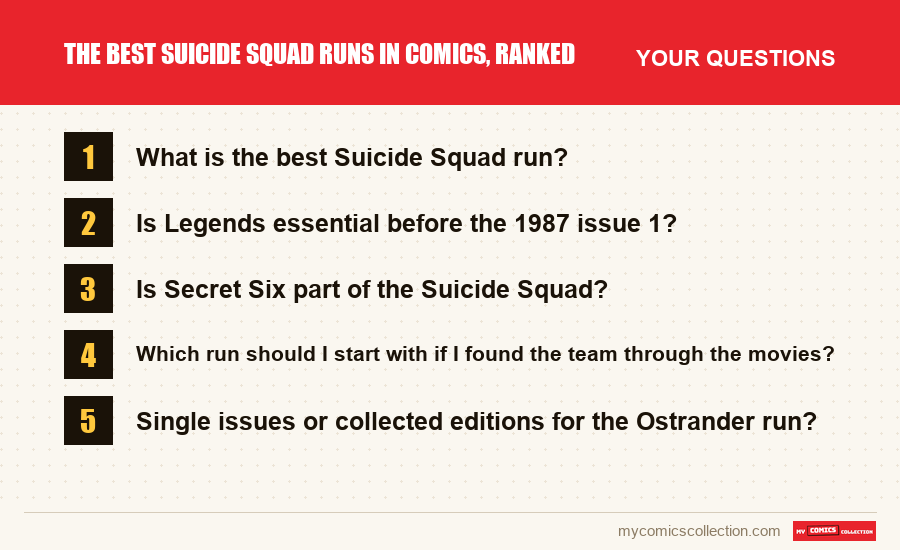
The run by John Ostrander, Kim Yale and Luke McDonnell (1987-1992) comes first: it invents the modern formula, establishes Waller and dares to kill off its characters. For a lighter and more recent read, the series by Tom Taylor and Bruno Redondo is the best compromise.
It is not mandatory. Legends (1986) introduces Waller and serves as a prologue, but the first issue of the regular series recaps what you need to know about Task Force X. Read it if you want the event's context; otherwise start directly with the 1987 issue 1.
Not in the editorial sense: Gail Simone's series follows free mercenaries, with no Waller and no implanted bomb. It shares the team's spirit, criminals facing moral choices, and Deadshot appears in it. Read it as a cousin, to slip in after the Ostrander run.
Take the series by Tom Taylor and Bruno Redondo, launched in late 2019: it reads on its own, with a direct tone and easy-to-identify recruits. If you then feel like going back to the source, follow up with the first collected edition of the Ostrander run.
For reading, collected editions: they follow the publication order and can be bought in one go. To own the original issues, aim first for the 1987 issue 1, then fill in gradually. Before buying any collected edition, check the range of issues it covers.
Do you own Suicide Squad #1 of 1987 or an issue of the Janus Directive crossover? Estimate it by comparing completed sales to its condition.
Estimate my comic