
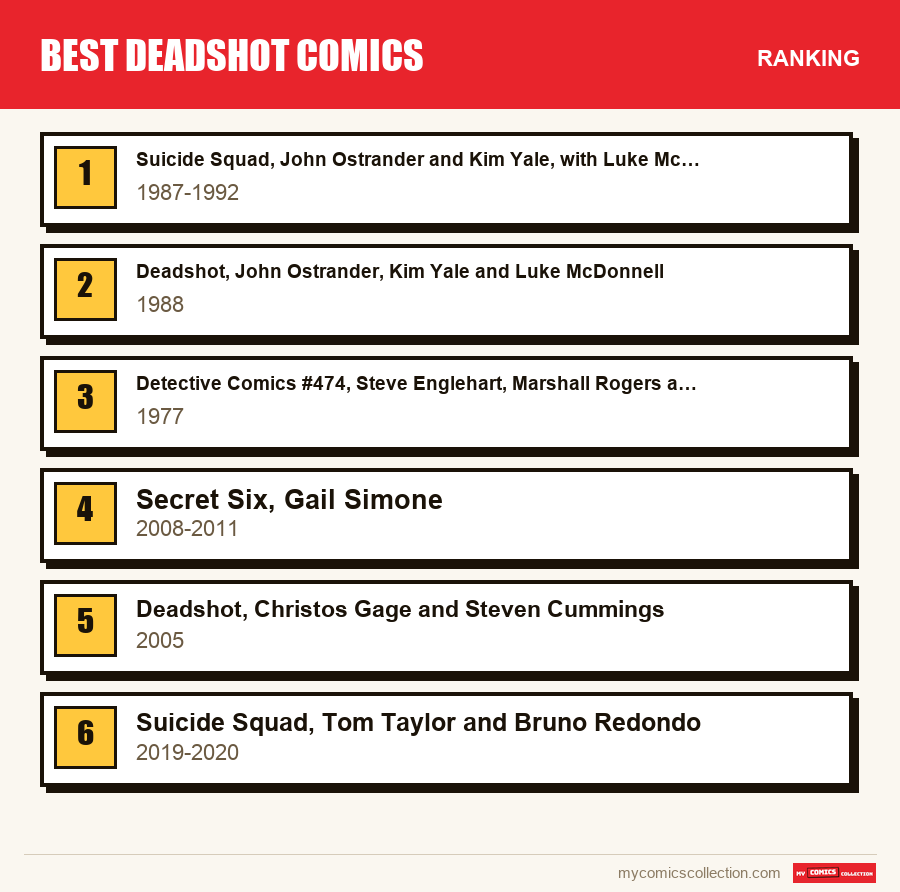
The best Deadshot comics to start with are the Deadshot miniseries (1988) and the Suicide Squad series (1987-1992), both written by John Ostrander and Kim Yale with Luke McDonnell, where Floyd Lawton becomes a character in his own right. Add Detective Comics #474 (1977) for his current costume, Gail Simone's Secret Six (2008-2011) and Christos Gage's miniseries (2005). His first appearance is Batman #59 (1950).
Floyd Lawton is a hired killer billed as an infallible shot, and his best writers prefer to approach him from the opposite angle: a man who no longer aims at anything but his own end. This guide ranks six reads that show that reversal, from the 1970s Batman villain to the Suicide Squad veteran of the 2020s.
As always in this guide, we only state what is verified (creators, issue numbers, dates); the analysis is our own, with no reproduction of protected art or dialogue.
His first appearance
Deadshot debuts in Batman #59, cover-dated June-July 1950, in the story titled "The Man Who Replaced Batman." David Vern Reed wrote it and Lew Sayre Schwartz drew it, with Charles Paris on inks, from a concept credited to Bob Kane. Floyd Lawton appears there as a masked, armed vigilante while actually covering for his own criminal activities. The character was conceived as a one-issue opponent.
That detail shapes how you should read him: the 1950 Deadshot has almost nothing in common with the one readers follow today. The dark, tormented killer took shape in the 1970s and 1980s. For the collector, Batman #59 is the original issue to know; for the reader, it remains a curiosity that says nothing about the modern character.
1: Suicide Squad, John Ostrander and Kim Yale, with Luke McDonnell (1987-1992)
This is where Deadshot gains his depth. The title runs from May 1987 to June 1992, sixty-six issues in all: Ostrander on script, Yale at his side, McDonnell on the early pencils. Deadshot is a regular member of the team of convicts run by Amanda Waller. Two moments put him at the center: issues #21 and #22, the character's real breaking point, with the second pitting him against Rick Flag, and issue #51 (March 1991), after the loss of his costume, when he learns that another criminal is using it to make a name as an assassin and sets out to hunt him down.
This series is for the reader who wants to understand the character in context, that of a team where nobody is safe. Favor the trade paperbacks over loose single issues. If you want to measure Deadshot against the other recruits, you will find plenty to compare in the squad's best runs. Start with the first issues, then jump to #21-22: you will have the setup before Deadshot's breaking point.
Issue #51 deserves a stop of its own: it asks what makes Deadshot, the costume or the man, and the series answers that Floyd Lawton stays Deadshot no matter who wears the outfit. For a reader going through the whole series, it is a breather between two big missions, and a good test of whether the writing suits you.
2: Deadshot, John Ostrander, Kim Yale and Luke McDonnell (1988)
The four-issue miniseries, released in 1988, carries the titles "Die But Once," "Suffer the Child," "Victims" and "Astride a Grave." The same creators as the Suicide Squad take Floyd Lawton out of the team and place him back in his own story: a return to his family of origin and the search for his kidnapped son, in a revenge thriller that establishes the character's torment.
It contains one of the threads later picked up by other writers: Floyd Lawton's death wish, which gives meaning to his skill as a marksman. In other words, the miniseries is not just a kidnapping investigation, it fixes the psychology on which the following stories rest.
This is the read to recommend to anyone who does not feel like diving into sixty-six issues. It nearly stands on its own, and it explains moves Deadshot makes that you later see in the team books. Look for it in a collection that gathers it with Detective Comics #474: the Deadshot: Beginnings volume brings these two milestones together.
3: Detective Comics #474, Steve Englehart, Marshall Rogers and Terry Austin (1977)
The issue, cover-dated December 1977, is titled "The Deadshot Ricochet." Steve Englehart wrote it, Marshall Rogers drew it and Terry Austin inked it. After nearly thirty years away, Deadshot returns to the pages of Batman with a redesigned costume: red, silver and gold, a full mask, a target emblem on the chest and guns mounted on the wrists. That is the silhouette we still recognize.
Who is it for? Batman fans and collectors who want the issue that remade the character. It reads on its own, with no preparation. The same creators follow up with Detective Comics #475, which has nothing to do with Deadshot but sits right after it in their run.
Between this 1977 redesign and his arrival in the Suicide Squad, Deadshot remains first and foremost a Batman adversary. Two of his appearances from that period, Detective Comics #518 (September 1982) and Batman #369 (March 1984), are in the Deadshot: Beginnings collection (2013), which makes it a handy volume for covering the pre-1987 years. It is not the most thrilling of the bunch, but it is the most useful for understanding where Ostrander starts from.
4: Secret Six, Gail Simone (2008-2011)
The series launched in September 2008 and runs thirty-six issues, with Gail Simone on script and, on art, Nicola Scott for the opening run and then J. Calafiore. It gathers Catman, Scandal and Rag Doll around Deadshot, joined by Bane and by Jeannette, a character created for the series. Deadshot is on the team from the first issue, and the series keeps putting him alongside criminals who are nothing like him.
It is for those who enjoy the team-book spirit of the Suicide Squad without Waller's political constraints. Start with the first issue, because the series builds its relationships from the opening chapters.
Do you collect this series?
Track what you own, what you are missing and what your collection is worth. 7-day trial.
Start my trial →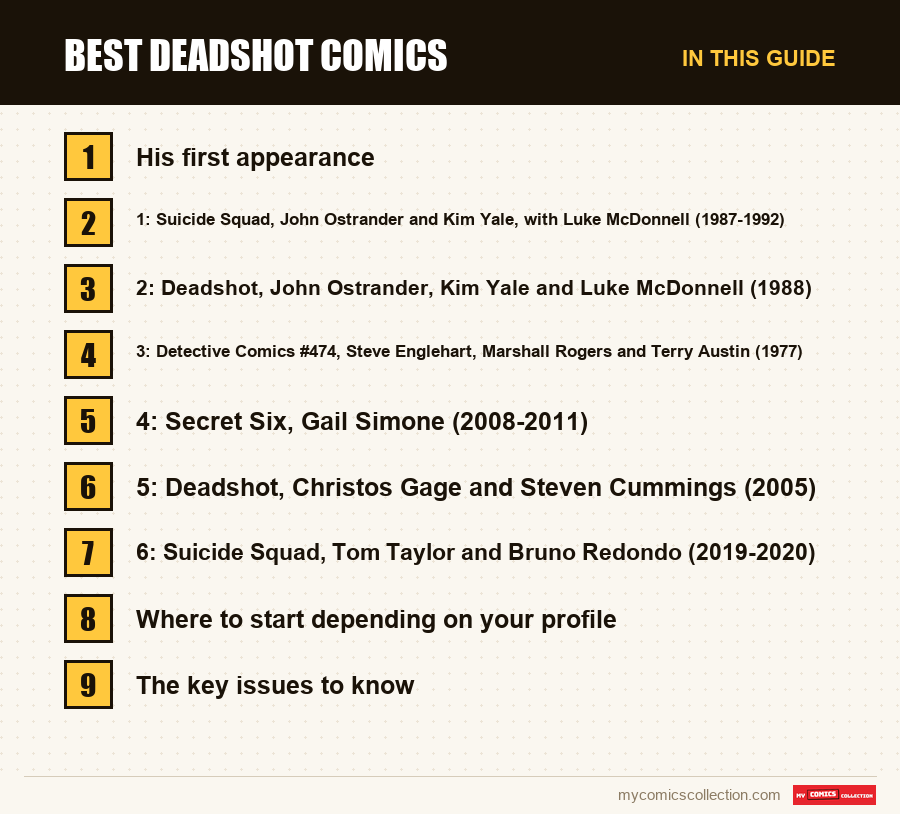
5: Deadshot, Christos Gage and Steven Cummings (2005)
Five issues, from February to June 2005. Christos Gage writes, Steven Cummings draws. The miniseries introduces Floyd Lawton's daughter, Zoe, and places her father in a Star City neighborhood he wants to make safe for her and her mother. In the second issue, the police call on Green Arrow to get rid of him, and the final issue gathers a large share of the DC Universe's villains.
This read is for those who want to see Deadshot as a father, in a more human register than the 1987 series. It is collected as Deadshot: Bulletproof, along with an issue of Batman: Legends of the Dark Knight. It is sometimes overshadowed by Secret Six, but it deserves a read of its own.
6: Suicide Squad, Tom Taylor and Bruno Redondo (2019-2020)
Eleven issues, the last of which came out in November 2020, written by Tom Taylor and drawn by Bruno Redondo, with Daniel Sampere on art. Deadshot and Harley Quinn play the veterans opposite new recruits who were the very targets they had been assigned. One scene also puts Harley face to face with Deadshot's daughter. The whole run is collected in Bad Blood (April 2021).
It is the easiest entry point for a recent reader. Read it as a trade paperback, in one sitting: eleven issues are enough to cover the plot, and the series asks for no prior knowledge. Choosing the trade also saves you from chasing single issues scattered over a year of publication, and it lets you reread the clash between the new recruits and the old hands in one go. For the rest of the universe, find Harley Quinn on her character page.
Where to start depending on your profile
- You come from the 2016 movie: open Tom Taylor's Suicide Squad, then work back to the 1987 series. The page on David Ayer's film sets the screen against the page.
- You want the character in depth: read the 1988 miniseries, then issues #21-22 of the 1987 series.
- You like Batman: start with Detective Comics #474 (1977), which puts him back in the Dark Knight's universe.
- You prefer team books: pick up Secret Six.
- You want a roadmap: the Suicide Squad publication path puts it all in order.
To organize your reading, one order holds up well: the 1988 miniseries, the Suicide Squad series up to issues #21-22, then Detective Comics #474 as a side trip, the 2005 miniseries, Secret Six and finally Tom Taylor's Suicide Squad. This path follows the character's growing intimacy: first his torment, then his fatherhood, then his role as a veteran. It also avoids repetition, because each step offers an angle no other one gives.
The key issues to know
Deadshot has milestones scattered across several decades. The landmarks below complement the Suicide Squad key issues.
- Batman #59 (June-July 1950): his first appearance, by David Vern Reed and Lew Sayre Schwartz.
- Detective Comics #474 (December 1977): Deadshot's return in a new costume, by Englehart, Rogers and Austin.
- Suicide Squad #1 (May 1987): the start of the series that enlists him in the team.
- Deadshot #1 (1988): the start of his four-issue miniseries, with Ostrander, Yale and McDonnell.
- Deadshot #1 (February 2005): the arrival of his daughter Zoe in Christos Gage's miniseries.
For a character with several editorial ages, the method is to tell apart the birth issue, the redesign issue and the anchor issue. The first is sought after for its age, the second is the most useful to know for understanding the character, and the third is the one that will actually get you reading what follows. Then check the condition on full photos, cover and spine included, before you decide.
Frequently asked questions
In Batman #59, cover-dated June-July 1950, in the story "The Man Who Replaced Batman," written by David Vern Reed and drawn by Lew Sayre Schwartz. He is a one-off adversary there, far from the modern version that emerged in the 1970s and 1980s.
The 1988 Deadshot miniseries by John Ostrander, Kim Yale and Luke McDonnell, in four issues. It reads on its own and establishes the character. If you would rather have a recent story, Tom Taylor and Bruno Redondo's Suicide Squad (eleven issues) requires less prior knowledge.
It debuts in Detective Comics #474 (1977), with Steve Englehart on script, Marshall Rogers on art and Terry Austin on inks. The red, silver and gold costume, with its full mask and wrist guns, comes from this issue, and you see it again in the stories that follow the character.
Yes, named Zoe, introduced in the 2005 Deadshot miniseries written by Christos Gage and drawn by Steven Cummings. Tom Taylor's Suicide Squad also features her in an exchange with Harley Quinn.
It is not essential. Gail Simone's Secret Six (2008-2011) is a team book in which Deadshot is on board from the launch, alongside Catman, Scandal, Rag Doll, Bane and Jeannette. It appeals mostly to readers who enjoyed the Suicide Squad atmosphere.
Own a copy of Detective Comics #474 or of the 1987 Suicide Squad series? Get it appraised before you sell it.
Estimate my comic