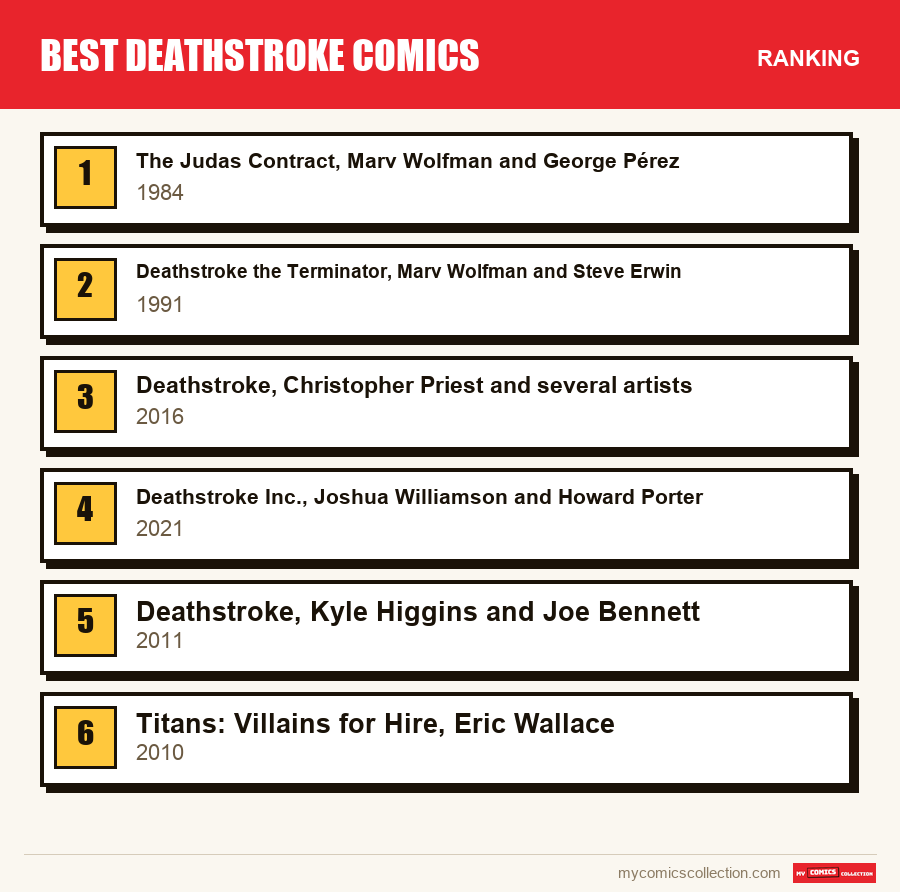
The best Deathstroke comics start with The Judas Contract (1984), the Marv Wolfman and George Pérez saga that makes Slade Wilson the arch-enemy of the Titans. Continue with Deathstroke the Terminator (1991), his own series written by Wolfman, then with Christopher Priest's Deathstroke (2016), the most complete modern run. His first appearance, and the key issue to chase, is the end of the second issue of The New Teen Titans, in December 1980.
Deathstroke is a rare case: an antagonist who became popular enough to carry his own series, without ever ceasing to be defined by his relationship to the young heroes he hunts. Elite mercenary, feared strategist, disastrous father, Slade Wilson can be read from three very different angles, and this guide ranks them so you know which volume to open depending on your mood.
As always in this guide, only verified information (creators, issue numbers, dates) is stated as fact; the analysis is our own, with no reproduction of protected panels or dialogue.
His first appearance
Slade Wilson makes his entrance in the last third of the second issue of The New Teen Titans, cover-dated December 1980. Marv Wolfman writes the story, George Pérez draws it: the duo had just assembled a renewed team in the previous issue, and they immediately give it an opponent worthy of it. The mercenary only appears at the end of the issue. He takes over a contract put out on the team after the failure of his son Grant Wilson, the Ravager, who appears in the same issue.
So remember that there is only one single issue to hunt down for both Wilsons, and that Deathstroke is not in #1. Our dedicated guide to this #2 details the two-step launch and the pitfalls in listing descriptions.
1: The Judas Contract, Marv Wolfman and George Pérez (1984)
This is the entry not to miss. Terra, a young recruit on the team, betrays her friends under Slade's influence: the story fills issues 42 to 44 of Tales of the Teen Titans and Annual #3, in 1984. Wolfman provides the script, Pérez the art and covers, with Dick Giordano and Mike DeCarlo on inks.
What this read gives Slade Wilson: a demonstration of his method. He does not strike head-on; he prepares, he infiltrates, he picks his target from among human weak points. The story also establishes the rivalry that will define the character for more than forty years, and #44 sees Dick Grayson leave the Robin identity to become Nightwing, a turning point you will find again in our Nightwing reading guide.
It is for any reader, including those with no prior knowledge of the run: the stakes are clear on their own, even if the characters gain depth once you have read the previous three years. The most practical option is a trade paperback, since several editions collect everything in order. Read the Annual after #44, in story order, and not wherever it happens to sit on your shelf.
2: Deathstroke the Terminator, Marv Wolfman and Steve Erwin (1991)
Eleven years after his creation, Slade Wilson gets his own title. Issue #1 is dated August 1991: Wolfman, his creator, writes it, Steve Erwin draws it, Will Blyberg inks, and the cover is by Mike Zeck. Erwin draws the first nine issues, then returns on several others over the course of the series.
The series has a precise goal: to make a villain a protagonist without turning him into a hero. The reader follows the contracts, the logistics, the family conflicts, and stays in the skin of a professional who apologizes for nothing. It is also the read that most directly extends Wolfman's Slade, with his codes of honor and his complicated private life.
Who should you recommend it to? Fans of 1990s series, who accept a serial pace and period artwork. The single issues are easy to find; an omnibus has been published for those who would rather avoid the back-issue bins. Start with the first issues, which form a coherent block, and stop when your interest dips: the series is not meant to be read in one sitting.
3: Deathstroke, Christopher Priest and several artists (2016)
The Rebirth series is the best contemporary way in. After a Deathstroke: Rebirth one-shot from October 2016, the ongoing series runs fifty issues, all written by Christopher Priest. The art changes by arc: Carlo Pagulayan and Joe Bennett carry the first volumes, joined by Cary Nord, Denys Cowan, and Diogenes Neves, among others.
Priest is interested in Slade's family more than in his feats. The Professional (#1 to 8) opens the run, Twilight (#12 to 16 and 18) digs into the relationship with his children, and The Lazarus Contract (#19 and 20) is the central chapter of a crossover with the two Titans series, along with Teen Titans #8 and a dedicated special. Issues #30 to 35 pit him against Batman, in an arc collected as Batman vs. Deathstroke.
This run is for readers who like fragmented storytelling, with plenty of flashbacks. Read it in order, by volume, rather than through scattered single issues; the first trade paperbacks easily cover the opening eight issues.
A reading tip for The Lazarus Contract: the crossover is spread across four publications, and the trade paperback Titans: The Lazarus Contract gathers Titans #11, Teen Titans #8, Deathstroke #19 and 20, and the special. If you are following Priest's run, read it where it falls, after Twilight, then go back to Defiance (#21 to 24) to pick up the thread of the supporting characters.
4: Deathstroke Inc., Joshua Williamson and Howard Porter (2021)
After years of wandering, the Deathstroke Inc. series puts Slade Wilson back at center stage with a new angle. Issue #1 is dated November 2021 and is written by Joshua Williamson and drawn by Howard Porter. Slade changes course there after heavy losses, joins a secret organization called T.R.U.S.T., tasked with neutralizing the DC universe's major criminals, and finds himself partnered with Black Canary.
The series gives the character a reversal: the killer works for a cause, at least officially. It is for those who want a contemporary action story tied into the whole DC universe, with many guest stars. To read it, start from #1 and follow the issues in order; the 2021 issues are among the easiest to find in new condition.
A word on the order of the entries: we put the foundational work first, because everything that follows responds to it. The ongoing series of 1991, 2011, and 2016 read like three takes on the same character by different creators, and there is no need to read them back to back. Pick the one whose era speaks to you, and save the others for later.
Do you collect this series?
Track what you own, what you are missing and what your collection is worth. 7-day trial.
Start my trial →
5: Deathstroke, Kyle Higgins and Joe Bennett (2011)
The 2011 relaunch is a portrait of a more brutal Slade. Kyle Higgins writes the first issues, Joe Bennett draws them, with Art Thibert on inks. Rob Liefeld then takes over and both writes and draws #9, which opens the Lobo hunt arc.
This stop will interest those who want to compare versions of the character: the origin is rewritten there, and the series does not have the reputation of the first two entries. It suits curious readers, less so those looking for the definitive read. Limit yourself to the eight opening issues, which form a homogeneous whole under Higgins's pen.
6: Titans: Villains for Hire, Eric Wallace (2010)
A curiosity that earns its place: here Slade Wilson leads his own team of mercenaries, within the 2008 Titans series. The Titans: Villains for Hire Special #1, dated May 2010, is written by Eric Wallace and drawn by Fabrizio Fiorentino; it introduces a team hired to eliminate the Atom, and the story then continues in Titans #24. The 2011 trade paperback collects the special and issues #24 to 27.
This story shows Slade operating like a business owner: he recruits, hands out missions, and picks the targets, including Lex Luthor's convoy for the first mission. Who is it for? It suits those who know Slade and like seeing a criminal run the action. Read the special first, then the trade paperback.
Where to start based on your profile
Your entry point depends on what you are looking for, not on chronological order.
- You love the big classics: The Judas Contract, in trade paperback, then The New Teen Titans #2 if you want to see the first contact with the Titans.
- You want a modern solo series: Priest's Deathstroke, in arc order, starting with The Professional.
- You come from the animated adaptations: the 1984 saga remains the best point of comparison, since it presents the character against the heroes those adaptations feature.
- You like stories where the villains drive the action: Deathstroke the Terminator, then Villains for Hire.
- You want to follow current continuity: Deathstroke Inc., whose #1 serves as the entry point.
If you want to branch out afterward, the ranking of the best Teen Titans runs puts the 1984 saga in context, and the guide to the best Bane comics offers another large-scale adversary from the same publisher, so you can compare approaches.
One last habit before you dive in: file these reads by character and not by publisher. Deathstroke crosses paths with the Titans, the heroes of Gotham, and the whole DC universe, and you quickly lose the thread if you sort only by series title. One card per character, with the issue number of his first appearance and that of his best arc, is enough to find each single issue in seconds in a growing collection.
The key issues to know
To build a small coherent set, keep the following landmarks in mind, ranked by role rather than by rarity.
- The New Teen Titans #2 (December 1980): first appearance of Deathstroke and of Grant Wilson, the Ravager. This is the foundational issue of the collection.
- Tales of the Teen Titans #44 (1984): the outcome of Terra's betrayal, and the birth of the Nightwing identity for Dick Grayson.
- Tales of the Teen Titans Annual #3 (1984): epilogue to the saga.
- Deathstroke the Terminator #1 (August 1991): start of his first ongoing series.
- Deathstroke #1 of the 2016 series: opening of Priest's run, along with the Rebirth issue.
- Deathstroke Inc. #1 (November 2021): start of Williamson's series.
As for method, always compare completed sales for the same grade, check the printing note on the back of the issue, and do not confuse a character's first appearance with the first time he becomes central: here, the gap is four years between the 1980 #2 and the 1984 saga. A well-preserved issue from that era is worth most for the strength of its spine and the sharpness of its corners.
Frequently asked questions
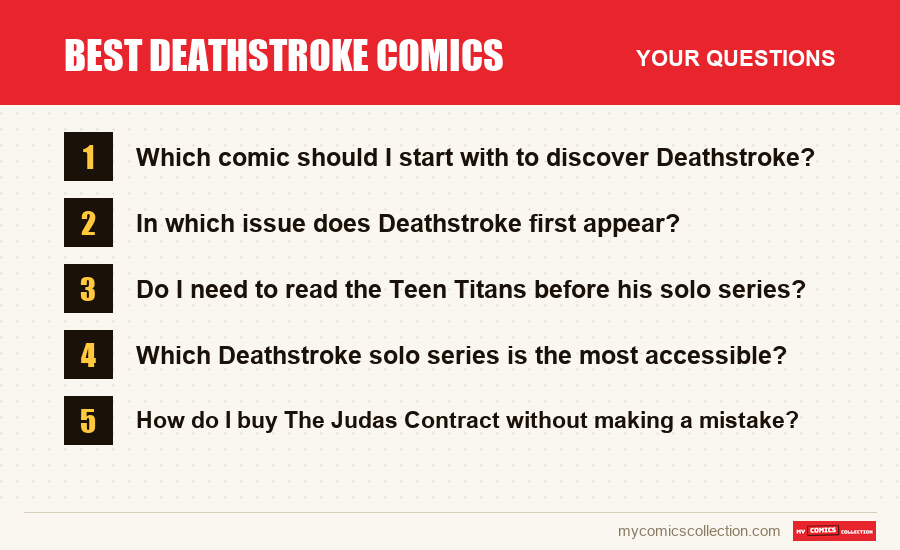
Open The Judas Contract first, a work by Marv Wolfman and George Pérez whose chapters fill three issues of Tales of the Teen Titans and an Annual, in 1984. This saga reads on its own and shows Slade Wilson at his best. Then move on to Christopher Priest's Deathstroke for a modern version.
In the second issue of The New Teen Titans, cover-dated December 1980, scripted by Marv Wolfman and illustrated by George Pérez. He is not in #1. His son Grant Wilson, the Ravager, appears in the same issue, so you do not have two issues to hunt down.
No, it is not required. Deathstroke the Terminator and the 2016 series can be read without preparation, since each run covers the basics of the character. However, knowing The Judas Contract gives more depth to his relationship with his children and with the Titans.
The series by Christopher Priest launched in 2016 is the most complete: fifty issues written by the same author, with a continuous storyline. Deathstroke Inc., by Joshua Williamson, offers an alternative more focused on action and on the rest of the DC universe.
The simplest route is a trade paperback, which collects the three issues of Tales of the Teen Titans and the Annual in the right order. For single issues, check the numbering, the condition of the spine, and the date on the back of the Annual.
Did you find a Titans single issue in a box, such as The New Teen Titans #2? Have its condition and value appraised in a few minutes.
Appraise my comic