An antagonist who became popular enough to get his own series, and whose series is now asking for $6.99 an issue. As of August 29, 2026, it counts 169 gross ads, from $1.00, with only 3 certified announcements. However, the character has since appeared on screen. The 1990s series captured none of this: the notoriety of a character does not carry over to the series that bear his name.
This is a clear case of dissociation between the value of a character and that of the books that exploit him.
This article explains what the series offers, what the survey shows, why the postponement did not take place, and how to approach this character through the work of its co-author.
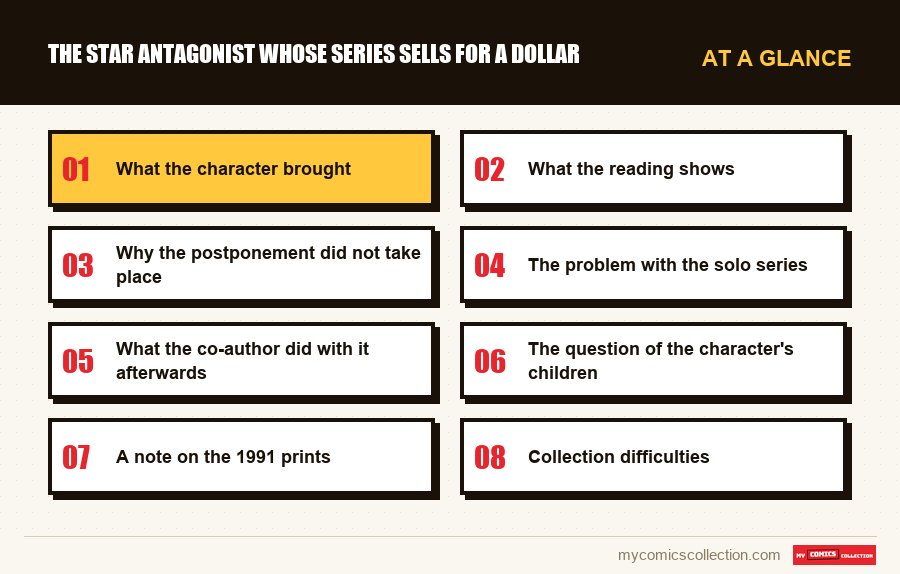
What the character brought
We must first say why this antagonist stood out from the others, because it is not a question of power.
He is competent rather than powerful. Without spectacular ability, he wins by preparation, knowledge of his opponents and exploitation of their weaknesses. It’s a rare register in a genre that proceeds by escalation.
He has a job. He works for money, accepts contracts, and his opposition to the heroes is professional rather than personal: which makes his appearances unpredictable.
He has a family. His relationship with his children is an important part of what concerns him, and the story devotes time to it.
It is not redeemable. The story does not seek to excuse or convert him, a position held with unusual consistency.
These four traits make it an opponent that can be brought back without devaluing him, which is the main problem with the recurring antagonists. He loses without being ridiculed, because he works and a contract can fail.
What the reading shows
The 1990s solo series
169 ads raw, of $1.00 to $89.99 requested, median $6.99. Certified: 3 ads only, median $94.95.
An abundant supply and an almost non-existent collector's market.
First appearance number
It is in another series, where the certified side counts 53 ads à $327.22 of median.
All the value linked to the character is concentrated there.
The gap between the two
A considerable factor between the issue which introduces it and the entire series which is devoted to it, and a certified slope of 53 advertisements against 3.
Lowest entries
From issues of the solo series to $1.00 and $1.99 requested, in conditions described as correct.
These figures come from a statement dated August 29, 2026 on fixed price announcements, with a separate count of raw and certified. They express what sellers hope to achieve.
Why the postponement did not take place
There are three reasons why the popularity of the character did not carry over to his series.
The market buys points of origin. What is valued is the issue where the character first appears, not the hundreds of pages that develop him afterwards. This is a constant observed among all the authors of this campaign.
The series dates from the period of large print runs. Launched in the early 1990s, it was printed massively, and the supply remains overabundant thirty years later.
A solo antagonist series is difficult to sustain. The character works by contrast with heroes; alone, it is necessary to invent an opposition to it, and the exercise rarely succeeds.
These three causes combine. A series can be correct and only be worth its paper price, which is not a judgment but a consequence of the conditions of its publication.
I can't say anything about the adaptations. The character has been on screen, and it would be easy to conclude something about prices.
My data is a dated snapshot: it says what sellers display on a given day. To establish an effect, you would need two shots spaced apart and, better yet, actual sales. I have neither. The only statement I can make is this: as of August 29, 2026, this series is asking $6.99 on median. What it was worth in 2015 is unknown to me.
The problem with the solo series
It is worth being precise, because it is structural and it explains the uneven quality of the whole.
An antagonist derives his interest from what he threatens. Removed from this context, we must provide him with adversaries, and two solutions present themselves, both problematic.
Oppose him to figures worse than him, which gradually turns him into a hero and removes what made him interesting.
Oppose comparable professionals, which produces technical confrontations without moral issues and which are tiring over time.
The series takes both paths at different times, with predictable results. This is not a weakness of writing but a contradiction of the format: and it explains why so few antagonist series last.
What the co-author did with it afterwards
A bibliography point sheds light on the character's trajectory and it is rarely noted.
His co-author wrote the solo series himself, which was not a given: a popular character is often entrusted to others as soon as he leaves his original series, the initial author remaining on the title which made him known.
Reusing an antagonist that you have created for another context requires agreeing to change its nature. What worked through spaced appearances must now last twenty pages per month, and the character can no longer remain so opaque.
It's visible when reading: the solo series explains more, shows more private life, and gives access to reasoning that the group series left us guessing. We gain in knowledge what we lose in worry.
This movement is general and it is worth knowing: developing an antagonist makes him less threatening, because the threat feeds on what we don't know. There is no solution to this problem, only trade-offs.
The question of the character's children
One aspect deserves to be developed, because it constitutes the best of the material and is found in both series.
The character has children, and they become autonomous figures who oppose him, follow him or flee him depending on the period. This family dimension is treated with unusual continuity for an antagonist.
It provides a stake that does not depend on any external adversary: it's exactly what a solo series needs, and it's what saves the title's best arcs.
It also produces the only register where the character is at fault: competent everywhere else, he systematically fails with his people, and the story grants him no mitigating circumstances.
For a hesitant reader, this is the thread to follow. The arcs devoted to this dimension are clearly superior to the professional confrontations which occupy the rest, and they are easily identified in the summary of the collections.
Collecting this series?
Track what you own, what you are missing and what your collection is worth. 7 day trial.
Start my trial →A note on the 1991 prints
The launch date of the solo series explains part of its current market and is worth situating.
The early 1990s corresponded to the peak of a bubble where buyers took the first issues in several copies as an investment. Publishers printed accordingly, and the stocks created then still circulate.
A series launched at this time therefore carries a lasting handicap: its supply will not become scarce, its copies are in good condition because they have not been read, and nothing will correct this imbalance.
This is the same mechanism observed elsewhere in this campaign on other titles of the period, and it produces the same result everywhere: one-dollar issues thirty years later.
For a reader, it is a godsend without compensation: these copies are abundant, in good condition, and cost less than a coffee. Just don't buy them expecting something else.
Collection difficulties
Plusieurs séries successives
The character has had several titles at different times, each renumbered from one.
Multiple screenwriters
Not all of these series are written by his co-author. The character's name does not guarantee the same hand.
Une offre pléthorique
One hundred and sixty-nine ads for a single series: sorting takes more time than searching.
A name that has changed
The title of the series changed during publication, which fragments the research.
How to approach this character
Three recommendations, in an order that prioritizes quality over completeness.
By the group series, first. This is where he works best, because the contrast with the heroes gives him his place. His appearances are spaced out and each one counts.
By an arc of the solo series, then. A block of consecutive numbers is enough to judge, and at $1.00 each the test costs nothing. There's no point aiming for the full series before knowing if the registry is right for you.
By later series, only if you are interested in the character on its own. They are written by others and have other intentions.
This progression has one merit: she puts the best first, which is the opposite of what a collection organized by character does.
What this case teaches
The lesson goes beyond this character and is worth stating, because it recurs throughout this issue.
We spontaneously assume that a popular character values everything that bears his name. The readings show the opposite: the value concentrates on one point of origin and does not spread.
This is because of what the collectible market actually measures: a combination of material scarcity and convention about what matters. A series printed in hundreds of thousands of copies is by no means rare, whatever its subject.
For a reader, the consequence is entirely favorable. Following a character through their series almost always costs less than acquiring the single issue that introduces them, and gives infinitely more to read.
It's a trade-off to be made explicitly rather than endured: we collect an object, or we read a character, and the two projects do not have the same price or the same content.
What to record
On a character crossing several series from several writers, the sheet must distinguish what the name confuses.
The screenwriter of each series, noted at the same rank as the title. This character was written by his co-author and then by others, with different intentions, and a collection organized by character mixes these works without pointing it out. This is the only way to know if you are following an author or a figure.
The distinction matters more here than elsewhere, because the register of the character (professional, non-redeemable) is not held by everyone in the same way.
The exact title of the series at the time of publication, this having changed during publication: a file based on a single title makes part of what we already have invisible.
These two mentions respond to what a figure exploited over decades poses: distinguishing the books which bring it into existence from those which use it.
Frequently asked questions
Three cumulative causes: the market buys points of origin and not developments, the series dates from the period of large print runs and its supply remains overabundant, and a solo antagonist series is structurally difficult to maintain. A series may be decent and only worth its paper price.
Impossible to establish here. Measuring an effect requires comparing two moments, and I only have one snapshot, which moreover relates to requests and not to sales. All this data allows is to note a level on one date: $6.99 median on August 29, 2026, with no history to relate it to.
He is competent rather than powerful, he works for money-so his opposition is professional and unpredictable-he has a family that matters in the story, and he is never redeemable. These traits allow him to come back without devaluing him, which is the main problem with recurring antagonists.
By the group series where he appears, because it is the contrast with the heroes that gives him his place. An arc of the solo series then, to judge: at $1.00 per issue the trial costs nothing. Later series, written by others, only if you are interested in the character itself.
Only three ads, which is consistent with a median of $6.99: certification makes no economic sense at this level. All the value linked to the character is concentrated on the number which introduces it, in another series, where the certified side has 53 announcements.
Who wrote this number?
A collection organized by character mixes authors with opposing intentions without ever pointing it out.