
Wolverine (Logan, James Howlett) was born from a last-page cameo in Incredible Hulk #180 (October 1974), before his first full appearance in Hulk #181 (November 1974), created by Len Wein , designed by John Romita Sr. , and drawn by Herb Trimpe. He joined the mainstream X-Men in Giant-Size X-Men #1 (May 1975) and then X-Men #94 (August 1975). His first solo series was Wolverine: Limited Series #1-4 (1982) by Chris Claremont and Frank Miller, followed by an ongoing Wolverine Vol.1 from 1988 to 2003 (189 issues). All told, the character has 12 solo volumes through Saladin Ahmed's current run (Vol.7, 2024+), plus dozens of mini-series and spin-offs (X-23, Daken, Old Man Logan, Death of Wolverine, Hunt for Wolverine).
Along with Spider-Man and the Punisher, Wolverine is one of the most collected Marvel characters in the world. But where Peter Parker embodies teenage innocence and Frank Castle is a rigid militaristic figure, Logan condenses the rawest, most animal, and most tragic side of the Marvel universe. A near-immortal regenerating mutant with bone claws coated in adamantium, haunted by a fragmented memory and a past as a soldier, spy, and samurai, Wolverine has crossed every era of modern comics while pushing the line between anti-hero and beast. No other Marvel character has been so mainstream while never losing his cult aura.
This guide is going to give you everything you need to understand the birth of Wolverine , follow the complete chronology of Wolverine series in order , and identify the key issues and major arcs to prioritize. We'll cover the character's 50+ years, from his cameo in Incredible Hulk #180 (1974) all the way to Saladin Ahmed's current run in 2026, distinguishing the main volumes, parallel ongoings (X-23, Daken, Old Man Logan, All-New Wolverine), and cult maxi-series (Origin, Weapon X, Death of Wolverine, Return of Wolverine, Hunt for Wolverine).
The Birth of Wolverine: Marvel in 1974
To understand how Wolverine was born, you have to go back to the summer of 1974. Marvel was looking for a new antagonist who could stand toe-to-toe with the Hulk in a Canadian-set story. Roy Thomas, then editor-in-chief, asked Len Wein, an Anglo-American writer rising fast after his runs on Swamp Thing and The Phantom Stranger, to create a fierce Canadian character. The idea of a mutant with claws came together quickly, but the definitive design is the joint work of John Romita Sr., who drew the original yellow-and-blue costume (with the spiked mask inspired by the wolverine animal and the black whiskers), and Herb Trimpe, who staged him in the pages of Incredible Hulk.
Wolverine's appearance was deliberately gradual: Marvel tested the character with a last-page cameo before fully committing to him. This soft-launch strategy was rare at the time: most new heroes debuted on the cover. But it would become a signature: Wolverine is a character who reveals himself little by little, in fragments, like his own memory. Originally, his identity behind the mask wasn't defined, his claws were presented as part of the costume, and his immortality hadn't yet emerged. It would take the Claremont runs (1975-1991), then Larry Hama, Barry Windsor-Smith, and Jeph Loeb for the full mythology to unfold.
Incredible Hulk #180 and #181 (October-November 1974)
Wolverine's cameo appears on the last page of Incredible Hulk #180 (cover-dated October 1974, on newsstands as early as July 1974), where he leaps into the foreground, teasing the fight with the Hulk in the next issue. He's credited simply as "Weapon X" with no proper name. That single panel turns the issue into one of the most chased comics of the 1970s. A CGC 9.8 copy sold for over $60,000 in 2022.
The first full appearance arrives in Incredible Hulk #181 (cover-dated November 1974), where Wolverine fights both the Hulk and the Wendigo in the Canadian forests. The issue is by Len Wein on script, Herb Trimpe on pencils, and Jack Abel on inks. Hulk #181 is now considered one of the five most valuable modern comics in the world, alongside Giant-Size X-Men #1 , Amazing Spider-Man #129 (1st Punisher), Hulk #1 , and Amazing Fantasy #15. A CGC 9.8 copy crossed the $250,000 mark in 2022.
Joining the X-Men: Giant-Size X-Men #1 (May 1975)
The character's success prompted Marvel to slot him into a team that had been losing steam since 1970: X-Men . Giant-Size X-Men #1 (cover-dated May 1975) by Len Wein and Dave Cockrum relaunches the team with a new international lineup (Wolverine for Canada, Storm for Africa, Colossus for the USSR, Nightcrawler for Germany, Thunderbird for the Apache nation, Banshee for Ireland, Sunfire for Japan). Wolverine is introduced as a hot-headed Canadian agent in his yellow uniform.
Three months later, X-Men #94 (August 1975) marks the start of the relaunched ongoing under the pen of Chris Claremont. The Claremont run would last 16 years (until 1991) and turn Wolverine into a central Marvel figure. Claremont gradually deepens the character: his relationship with Jean Grey, his samurai code of honor in the 1982 mini-series, his Weapon X past, his immortality, his fragmented memory. It's under Claremont that Wolverine becomes the cult mutant we know today.
The historical irony: Len Wein created Wolverine in 1974 and brought him into the X-Men in 1975, but it's Chris Claremont who turned him into a cultural icon between 1975 and 1991. For 17 years, Wolverine was Marvel's most popular character without ever having his own regular series, until Wolverine: Limited Series (1982) and then Wolverine Vol.1 (1988). A record wait: almost no other Marvel character lasted 13 years on a team before getting an ongoing.
The Main Wolverine Volumes in Chronological Order
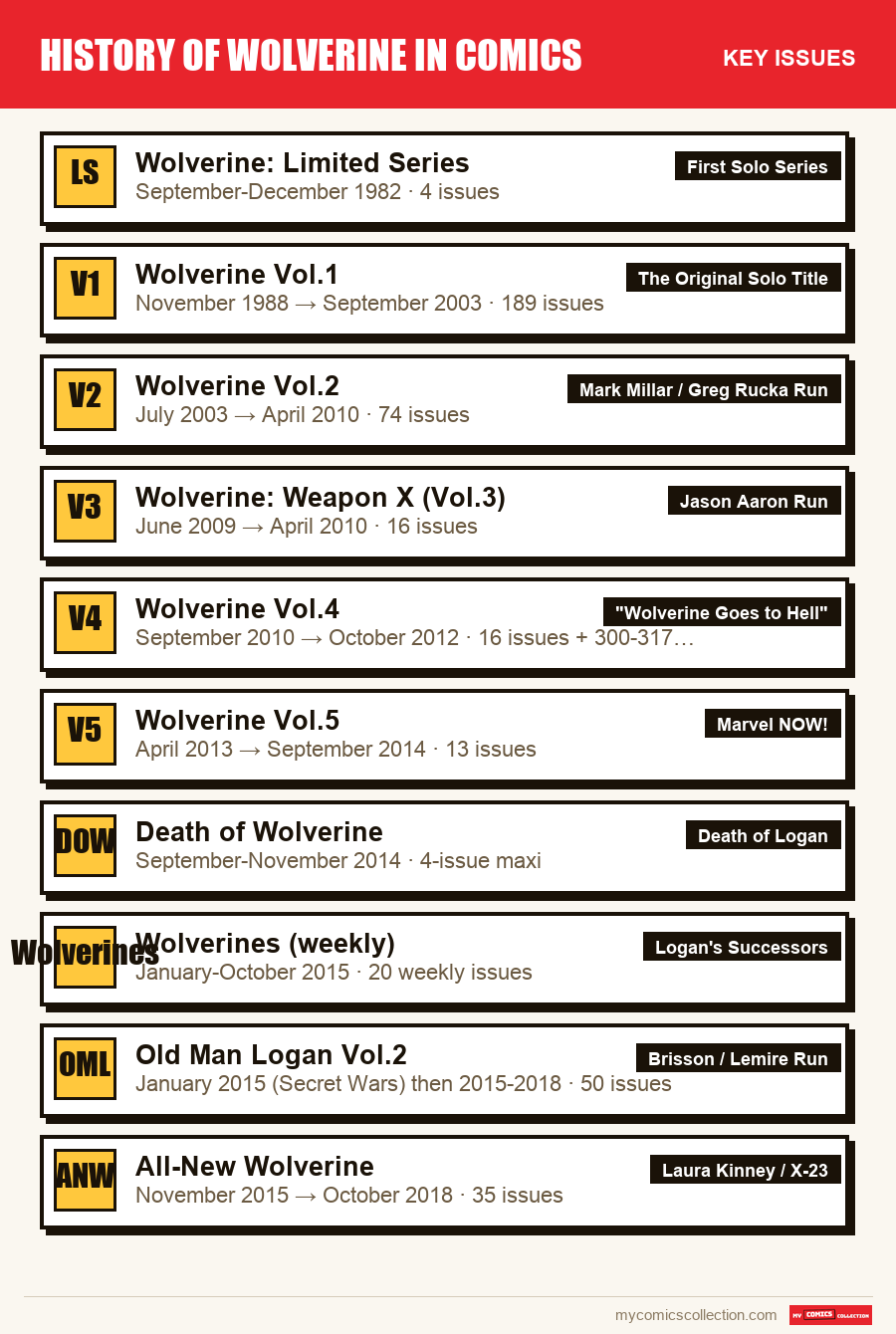
The Wolverine solo franchise has 12 main volumes since 1982, with remarkable continuity in legacy numbering. Here are the solo series in order of their first issue:
Wolverine: Limited Series
The very first Wolverine solo series, written by Chris Claremont with Frank Miller on art (and inks by Joe Rubinstein). 4 issues that lay down Logan's samurai code of honor, introduce Mariko Yashida (the love of his life) and Yukio, and establish the Japan arc that would define the character for 40 years. The maxi-series directly inspired the film The Wolverine (2013) with Hugh Jackman. The original printing is highly sought after in CGC 9.8.
Wolverine Vol.1
A direct follow-up to the success of the limited series and the back-ups in Marvel Comics Presents, Marvel finally launches the Wolverine Vol.1 ongoing, with Chris Claremont on script and John Buscema on art. The series runs 189 issues without interruption for 15 years, spanning the Madripoor era (Patch), the Larry Hama era (#31-118, one of the longest runs in Marvel history) which reveals the origin of the adamantium, the arrival of Onslaught (#107-110), Wolverine losing the adamantium in X-Men #25 and sticking with his bone claws for 30 issues, then the return of the adamantium thanks to Apocalypse. Wolverine #10 ("Mr. X / Logan in his prime") reveals major fragments of his origin.
Wolverine Vol.2
A full reboot in 2003 with Greg Rucka on the launch (#1-19), then Mark Millar and John Romita Jr. on the major arc " Enemy of the State" (#20-31, 2004-2005) where Wolverine is brainwashed by the Hand. Followed by "Get Mystique" (#62-65, Jason Aaron). The series ends at #74 before transitioning to Wolverine: Weapon X (Vol.3).
Wolverine: Weapon X (Vol.3)
A brief transitional volume centered on the ghosts of the Weapon X program. Jason Aaron on script delivers short, explosive arcs: "Adamantium Men ", " Insane in the Brain ", " Tomorrow Dies Today". A setup volume for Aaron's epic run on Wolverine Vol.4.
Wolverine Vol.4
Launches with "Wolverine Goes to Hell" by Jason Aaron / Renato Guedes. Logan literally in hell, his body possessed by demons on Earth. Dark, gothic run, on the edge of the supernatural. Continues through #16, then Marvel renumbers as Wolverine #300-317 in 2011-2012 to celebrate the accumulated legacy numbering.
Wolverine Vol.5
A Marvel NOW! reboot by Paul Cornell (#1-13, 2013-2014), then continued in Wolverine Vol.6 (2014, 12 issues) again under Cornell. Logan loses his healing factor after being infected by a microverse virus. Direct setup for Death of Wolverine (2014). A short volume but important to understand the character's downfall.
Death of Wolverine
A maxi-series by Charles Soule and Steve McNiven that closes out the "classic" Wolverine era. Logan, without his healing factor, is hunted by all his enemies and ends up coated in liquid adamantium that suffocates him to death. The series sold over 200,000 copies on #1. Followed by a 4-year period without a canon Wolverine (2014-2018).
Wolverines (weekly)
A weekly series of 20 issues centered on Logan's heirs: X-23 , Daken , Sabretooth , Mystique , Lady Deathstrike. Rotating writers (Charles Soule, Ray Fawkes, Frank Tieri). Sets up the All-New Wolverine era.
Old Man Logan Vol.2
First a 5-issue series during Secret Wars 2015, then an ongoing starting October 2015 written by Jeff Lemire and then Ed Brisson. The Logan from Mark Millar's futuristic timeline (Old Man Logan 2008) is brought into the main Marvel present to replace the deceased Logan. A 50-issue run that bridges the gap until the real Wolverine returns. A direct reference for the film Logan (2017).
All-New Wolverine
A historic volume: Laura Kinney / X-23 officially takes up the Wolverine mantle. Script by Tom Taylor , art by David Lopez and then Adam Kubert. 35 critically acclaimed issues that establish Laura as Logan's legitimate heir. Laura is Logan's female clone via the Weapon X program. A major run for understanding the handoff of the character. Continued in X-23 Vol.4 (2018-2019).
Return of Wolverine
A maxi-series by Charles Soule and Steve McNiven (already the creators of Death of Wolverine, an intentional symmetry). Logan officially comes back to life after 4 years of canonical absence. Preceded by the mini Hunt for Wolverine (2018), which sets the stage. Closes out the "Old Man Logan / All-New Wolverine" era and paves the way for a Wolverine Vol.6.
Wolverine Vol.6 (Dawn of X)
A reboot within the Dawn of X / Reign of X / Krakoa era imagined by Jonathan Hickman. Benjamin Percy writes all 50 issues, with Adam Kubert , Viktor Bogdanovic , and Federico Vicentini on art. A thriller / espionage / horror volume: Wolverine becomes an X-Force agent, hunting anti-mutant bio-weapons, crossing paths with vampires and ghosts of the Weapon X program. A model run for narrative consistency, one of the best modern Wolverine runs.
Wolverine Vol.7
The current post-Krakoa volume, under Marvel's From the Ashes era. Saladin Ahmed on script, Martín Cóccolo on art. Logan is solo again, more brutal than ever, without the Krakoa community. Variant covers in high demand. The run is ongoing in 2026, essential reading for modern collectors.
All the Parallel Wolverine Series in Chronological Order
Alongside the main volumes, Marvel has published dozens of related series: anthologies, mini-series, spin-offs about the heirs (X-23, Daken), origin retellings. Here's the chronology of the key titles to understand the ecosystem:
- Marvel Comics Presents Vol.1 (1988-1995, 175 issues): a weekly (then bi-weekly) anthology that hosted Wolverine as the lead story for years (#1-10 "Save the Tiger", then recurring arcs). It's in this series that "Weapon X" by Barry Windsor-Smith ran in #72-84 (1991), the story that reveals the origin of the adamantium program. An essential anthology to understand the mythology.
- Wolverine: Origin (2001-2002, 6 issues): a maxi-series by Paul Jenkins and Andy Kubert that finally reveals Logan's true name: James Howlett, illegitimate son of a servant in late-19th-century Victorian Canada. The reference for the canon origin. Origin #1 (November 2001) remains one of the most collected modern comics.
- Origins: Wolverine (2006-2010, 50 issues): an ongoing by Daniel Way developing Logan's origins as he digs through his own memory. Introduction of Daken (Logan's biological son) in #10.
- Wolverine: First Class (2008-2010, 21 issues): an all-ages series telling Wolverine's early years with the X-Men.
- Astonishing Wolverine and Spider-Man (2009, 4 issues): a Jason Aaron / Adam Kubert mini.
- Weapon X (multiple volumes): Barry Windsor-Smith in Marvel Comics Presents #72-84, then an ongoing 2002-2004 (28 issues), then Vol.3 (2017-2018, 27 issues) with a new Sabretooth/Lady Deathstrike/Old Man Logan team.
- X-23: multiple solo volumes for Laura Kinney. Vol.1 mini-series (2005, 6 issues), Vol.2 (2010, 21 issues), Vol.3 (Innocence Lost, 2010, 6 issues), Vol.4 (2018-2019, 12 issues), NYX #3 (2004) marks her very first appearance.
- Daken: Dark Wolverine (2010-2012, 31 issues): an ongoing centered on Daken Akihiro, Logan's biological son born in Japan, a tortured anti-hero.
- Death of Wolverine: The Logan Legacy (2014, 7 issues): a post-Death of Wolverine mini.
- Hunt for Wolverine (2018, 1 one-shot + 4 four-issue mini-series): an event setting up Logan's return. Mini-series "Adamantium Agenda", "Mystery in Madripoor", "Weapon Lost", "Claws of a Killer".
- Old Man Logan Vol.1 (Wolverine #66-72 + Giant-Size Old Man Logan, 2008-2009): Mark Millar and Steve McNiven imagine a dystopian future where Logan has given up fighting. A major reference for the film Logan (2017).
- X-Force (multiple volumes): Wolverine is one of the pillars of the dark X-Force by Craig Kyle / Christopher Yost (2008-2010), then Rick Remender on Uncanny X-Force (2010-2013). Cult arcs: "Apocalypse Solution", "Dark Angel Saga".
- Astonishing X-Men (2004-2013): Wolverine on a team with Cyclops, Beast, and Emma Frost under Joss Whedon's pen (#1-24).
- Savage Avengers (2019-2022, 28 issues): Wolverine teamed up with Conan, Punisher, Elektra, and Doctor Voodoo.
Wolverine Key Issues in Chronological Order
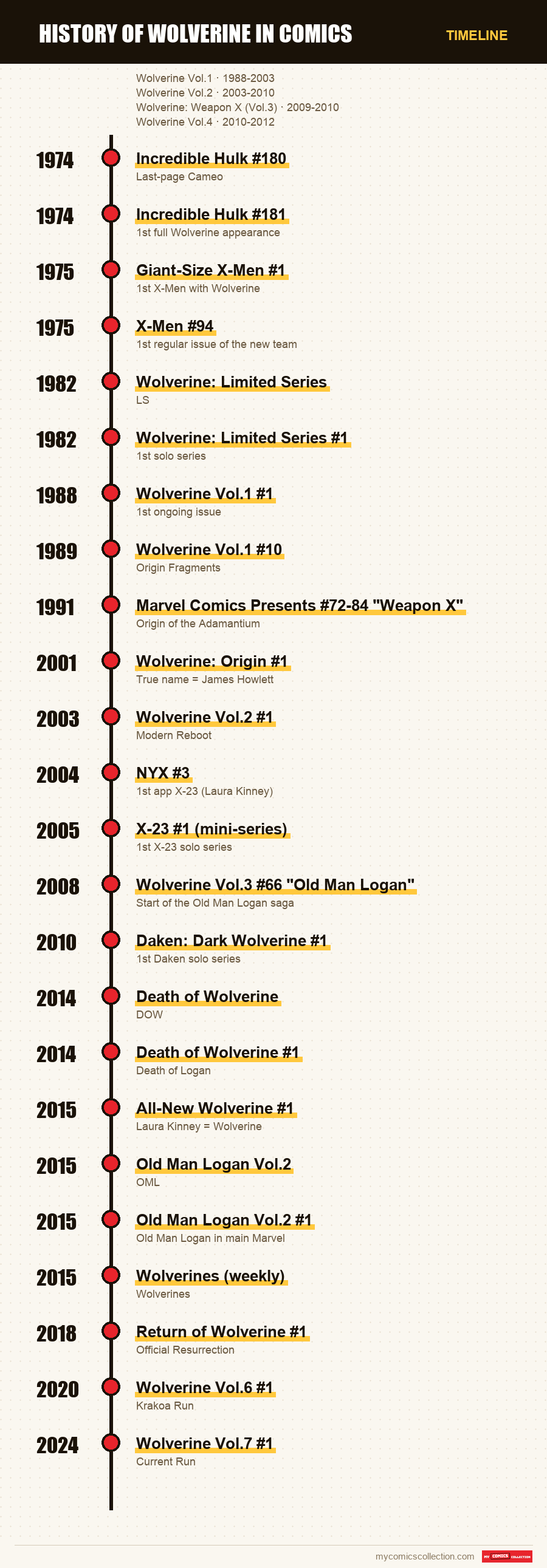
Here are the most important issues to know in chronological order:
Incredible Hulk #180
Wolverine's very first appearance, a cameo in a single panel on the last page. Sets up the upcoming fight with the Hulk. Credited as "Weapon X" with no name. CGC 9.8 estimated at over $60,000 in 2026. Has to be distinguished from Hulk #181.
Incredible Hulk #181
The foundational issue. Wolverine in his yellow-and-blue costume fights the Hulk and the Wendigo in the Canadian forests. The most valuable modern Marvel comic after Amazing Fantasy #15. CGC 9.8 sold for over $250,000 in 2022. Top 5 of the most expensive modern comics in the world across all characters.
Giant-Size X-Men #1
The X-Men relaunch with an international team. First Wolverine on the X-Men, first Storm, first Colossus, first Nightcrawler, first Thunderbird. Considered one of the most historically important comics of the 1970s. CGC 9.8 reaches $100,000+.
X-Men #94
The first regular issue after Giant-Size X-Men #1. Start of Chris Claremont's epic run that would last 16 years. The first issue where Wolverine, Storm, Colossus, and Nightcrawler operate as a regular team. A cornerstone of Bronze Age Marvel.
Wolverine: Limited Series #1
The first issue of the first Wolverine solo series. Introduces Mariko Yashida and the Japan arc that would define the character. Frank Miller at the peak of his craft (right before Daredevil and Dark Knight Returns). CGC 9.8 estimated between $800 and $1,500.
Wolverine Vol.1 #1
The first issue of the ongoing after a 13-year wait. Logan is in Madripoor under the identity of "Patch", a one-eyed mercenary. Introduction of the Madripoor mythology, which would remain a recurring setting. CGC 9.8 around $200-400.
Wolverine Vol.1 #10
The issue where Claremont starts revealing fragments of Logan's past via Mr. X and "Logan in his prime". One of the first big clues about the Weapon X program and the origin of the adamantium. A cornerstone for understanding the pre-Origin mythology.
Marvel Comics Presents #72-84 "Weapon X"
A 13-chapter saga by Barry Windsor-Smith revealing for the first time the Weapon X program: Logan kidnapped, experimented on, his skeleton infused with liquid adamantium. A cult graphic work, considered one of the high-water marks of American comics. MCP #72 is the most collected issue of the anthology series.
Wolverine Vol.2 #1
The first issue of the Vol.2 reboot. Greg Rucka delivers a darker, more investigative Wolverine, foreshadowing Mark Millar's Enemy of the State arc. A crime / thriller tone that stands apart from previous runs.
Wolverine: Origin #1
The first issue of the maxi-series that finally reveals Logan's origin: his name is James Howlett, born in late-19th-century Canada, son of the servant Thomas Logan, his bone claws emerging in adolescence after his father's murder. Issue sold over 250,000 copies.
NYX #3
First appearance of Laura Kinney / X-23, Logan's female clone created by Sarah Kinney via the Weapon X program. First introduced in the animated series X-Men: Evolution (2003), Laura debuts in comics in NYX #3. Became the title Wolverine in 2015. CGC 9.8 around $200-400 in 2026.
X-23 #1 (mini-series)
The first issue of the first X-23 solo mini-series ("Innocence Lost"). Develops Laura's origin, her childhood in the program, her bond with Sarah Kinney. A cornerstone of the X-23 canon.
Wolverine Vol.3 #66 "Old Man Logan"
The first chapter of the "Old Man Logan" saga by Mark Millar / Steve McNiven in Wolverine Vol.3 (#66-72 + Giant-Size). Logan in a dystopian future where the villains have won. A direct reference for the film Logan (2017). CGC 9.8 around $100-200.
Daken: Dark Wolverine #1
The first issue of the Daken Akihiro solo series, Logan's biological son born in Japan. A tortured anti-hero, often an antagonist of his father. First appearance in Wolverine: Origins #10 (2007).
Death of Wolverine #1
The first issue of the maxi-series that closes out the "original" Wolverine era. Logan, without his healing factor, hunts down his enemies before being coated in liquid adamantium. Sold over 200,000 copies on #1.
All-New Wolverine #1
The first issue where Laura Kinney officially takes up the Wolverine mantle. A historic turning point for the character and for female representation at Marvel. The Tom Taylor run was critically acclaimed.
Old Man Logan Vol.2 #1
The first issue of the Old Man Logan ongoing in main Marvel (post-Secret Wars). The Logan from the futuristic timeline settles in as the lead Wolverine until the real Logan returns in 2018.
Return of Wolverine #1
The first issue of the maxi that officially resurrects Logan after 4 years of canonical absence. Charles Soule / Steve McNiven (already the creators of Death of Wolverine) close the loop.
Wolverine Vol.6 #1
The first issue of the Benjamin Percy run within Jonathan Hickman's Krakoa era. Variant covers in high demand, a 50-issue run critically praised for its horror / thriller consistency.
Wolverine Vol.7 #1
Launch of the current post-Krakoa run, under the From the Ashes era. Saladin Ahmed delivers a solo Wolverine, more brutal, with no mutant community around him. Variant covers heavily collected in 2026.
Collecting this series?
Track what you own, what you are missing and what your collection is worth. 7 day trial.
Start my trial →The Major Wolverine Story Arcs in Order
Wolverine: Limited Series (1982)
Claremont / Miller mini-series. Samurai code, Mariko, Yukio, Tokyo.
Weapon X (1991)
Barry Windsor-Smith saga. Origin of the adamantium program.
Fatal Attractions (1993)
Magneto rips out Wolverine's adamantium. X-Men crossover.
Wolverine: Origin (2001-2002)
True name revealed = James Howlett. Victorian Canada.
Enemy of the State (2004-2005)
Mark Millar / John Romita Jr. Logan brainwashed by the Hand.
Get Mystique (2007)
Jason Aaron settles scores with Mystique. A signature run.
Old Man Logan (2008)
Mark Millar / Steve McNiven. Dystopian future. The source of the Logan film.
Wolverine: Berserker (2009-2010)
Jason Aaron retraces Logan's berserk side.
Wolverine Goes to Hell (2010-2011)
Jason Aaron / Renato Guedes. Logan literally in hell.
Schism (2011)
Wolverine vs Cyclops. The X-Men split, Logan founds Wolverine and the X-Men.
Madripoor stories (1988-ongoing)
A recurring setting: Logan as the mercenary "Patch", Asian organized crime.
Civil War: Wolverine (2007)
Marc Guggenheim. Logan hunts down Nitro after the Stamford disaster.
Death of Wolverine (2014)
Charles Soule / Steve McNiven. Logan killed by liquid adamantium.
Hunt for Wolverine (2018)
4 mini-series setting up Logan's return.
Return of Wolverine (2018-2019)
Charles Soule / Steve McNiven. Official resurrection.
Wolverine: X of Swords (2020)
Hickman's Krakoa crossover. Wolverine as champion of Otherworld.
Wolverine vs Vampires (2020-2021)
Benjamin Percy. Thriller / horror arc on the anti-vampire "Adamantium-Solar Flare".
How to Start a Wolverine Collection in 2026
Set a clear goal
"I want everything Wolverine" is a bad goal (12 solo volumes + 50+ mini-series + dozens of tie-ins). "I want Wolverine: Limited Series + the Claremont/Buscema run (Vol.1 #1-10)" or "the Larry Hama run (Vol.1 #31-118)" are excellent starting points.
Import the catalog into My Comics Collection
With My Comics Collection, import Wolverine Vol.1-7, Wolverine: Limited Series, Origin, X-23, Daken, Old Man Logan, and all the mini-series. Each volume is identified separately, with key issues flagged.
Prioritize the major key issues
Hulk #181, Giant-Size X-Men #1, Wolverine LS #1, MCP #72, Origin #1, and NYX #3 represent 80% of the historical value. See our dedicated Wolverine top 10 for a focus on key issues + current CGC values.
Organize by run rather than by volume
Wolverine is best collected by run (Claremont, Hama, Aaron, Percy) rather than strict volume. It makes the reading easier and gives the 189 issues of Vol.1 real meaning.
Track CGC + eBay valuations
Hulk #181 and Giant-Size X-Men #1 are blue-chip investments. Plenty of other key issues (Origin #1, NYX #3, Wolverine LS #1) move constantly. My Comics Collection updates the values based on current eBay listings.
Why Wolverine Is Still Collected in 2026
Along with Spider-Man and Batman, Wolverine is one of the three most active franchises in monthly sales across all publishers in 2026. Several reasons:
- Exceptional cinematic presence : Hugh Jackman played Wolverine in 9 Fox X-Men films (X-Men 2000, X2 2003, X-Men: The Last Stand 2006, X-Men Origins: Wolverine 2009, The Wolverine 2013, X-Men: Days of Future Past 2014, X-Men: Apocalypse 2016 cameo, Logan 2017, and his MCU return in Deadpool & Wolverine 2024). 17 years in the role, an absolute record for a superhero played by a single actor.
- The film Logan (2017) sent the Old Man Logan collection and the 1982 limited series to all-time highs.
- Deadpool & Wolverine (2024) blew up the box office with $1.3 billion, putting the character back in the cultural conversation and pushing the values of Hulk #181 and Giant-Size X-Men #1 up by 30 to 40% in 6 months.
- MCU Phase 6: Wolverine's return in the Disney/Marvel Studios stable signals appearances in Avengers: Doomsday (2026) and beyond. A guaranteed collecting effect for years to come.
- Complex mythology: amnesia, immortality, the Weapon X program, Japanese son Daken, female clone Laura, future Old Man Logan… no other Marvel character offers as many narrative angles.
- Genre versatility: pulp samurai (Limited Series 1982), crime / espionage (Madripoor), horror (Wolverine Goes to Hell), dystopian western (Old Man Logan), anti-vampire thriller (Vol.6 Percy)… every era has its Wolverine.
Biography of James "Logan" Howlett (Wolverine)
Wolverine is a character of Marvel Comics created by Len Wein, John Romita Sr. and Herb Trimpe. His first appearance is in Incredible Hulk #180 (cameo), #181 (full appearance) , published in October/November 1974.
Identity sheet of James "Logan" Howlett
- Real name: James "Logan" Howlett (aka Patch, Weapon X)
- Date of birth: End of the 19th century (around 1882-1886, fictional): October 1974 (creation)
- Place of birth: Cold Lake, Alberta, Canada
- First appearance : Incredible Hulk #180 (cameo), #181 (full appearance)(October/November 1974)
- Creators: Len Wein (screenwriter), John Romita Sr. (design) and Herb Trimpe (drawing)
- Editor: Marvel Comics
- Memberships: X-Men, X-Force, Avengers, Alpha Flight, Weapon X (ex-forced member)
Character origins
James Howlett was born in Canada in the late 19th century. A mutant, he developed his bone claws and healing factor as a teenager after the death of his biological father. He lives for decades under various identities until being captured by the Weapon X program, which grafts adamantium onto his skeleton and erases his memory. Recruited by Professor X in Giant-Size X-Men #1 (1975), he became one of the most iconic members of the X-Men.
Powers and Abilities
- Accelerated Healing Factor (Instant Regeneration)
- Adamantium claws (3 per hand, retractable)
- Adamantium-enhanced skeleton (indestructible)
- Superhuman animal senses (smell, hearing, night vision)
- Near-immortal longevity (lived since 1880+)
- Immunity to diseases and toxins
- Mastery of martial arts (samurai, ninjutsu, military combat)
Costume and visual identity
Yellow and blue (classic) or brown and beige (Bronze Age) suit. Characteristic winged mask. Iconic adamantium claws sprouting between the knuckles.
Build Your Wolverine Collection With a Real Method
Import the 12 Wolverine volumes + Origin + X-23 + Daken + Old Man Logan in one click, identify your missing key issues, track CGC values. Free 7-day trial.
🚀 Start your free trial, 7 daysGo further
- Wolverine Reading Guide: Where to Start
- The Best Wolverine Runs: Ranking of Essential Series for Collectors
- Top 10 Wolverine Key Issues Every Collector Must Own
- Incredible Hulk #181 (1974): Wolverine's First Full Appearance: Analysis, CGC Census & Value
- Wolverine Comic Collection: Runs, Key Issues & Budget Guide
FAQ, History of Wolverine
Other Comic Character Histories to Discover
Our complete "Comics history" article series covers the 20 biggest Marvel and DC franchises. Each article follows the same format: birth, complete chronology of volumes, parallel series, key issues classified chronologically, major arcs, and collection method.
→ See all "History" blog articles