In short
Green Lantern #1 is dated July to August 1960 and starts Hal Jordan's own series after his three-issue tryout in Showcase. Julius Schwartz edited it, John Broome wrote it, and Gil Kane drew it. The issue introduces the Guardians of the Universe. The value of a copy rests on four things: grade, restoration status, page quality and eye appeal. This guide explains how to weigh each one without leaning on any single number.
Collectors ask about the value of Green Lantern #1 more often than about almost any other Silver Age DC first issue, and the answers they find are usually a single figure with no explanation. A figure is only as good as the copy behind it. This page takes the opposite approach: it describes what is inside the issue, what separates one copy from another, and how to read a listing so that you can place a specific book yourself.
The July to August 1960 date, the creators and the arrival of the Guardians were checked against the publication history of Hal Jordan and of the series. The advice on grading, restoration and the market is analysis, and no price appears on the page.

Not Hal Jordan's first appearance: where #1 sits
The first thing to fix in your mind is the order of events. The hero arrives in Showcase #22 (September to October 1959), where Julius Schwartz enlisted writer John Broome and artist Gil Kane to create him. That book is the character's first appearance and has its own dedicated guide. After a three-issue run in Showcase, the decision was made to follow up with a self-titled series, and Green Lantern #1, dated July to August 1960, is where that series begins.
Because of this, a seller who describes #1 as Hal Jordan's debut is mistaken, and a buyer who treats it as a substitute for Showcase #22 will be confused about both. Number one opens the ongoing series, so it earns its standing differently: a long-running title begins and the Guardians arrive.
The series that begins here is the second volume of Green Lantern. The first volume, from 1941, starred a different character, Alan Scott, and belongs to the Golden Age. Collectors sometimes meet both under the plain name "Green Lantern #1," which is why the year in the title of this page matters.
What is inside the issue: credits and stories
The essentials are short and firm. John Broome wrote the issue, Gil Kane drew it and Julius Schwartz edited it, the same trio that had launched the hero in Showcase. Inking credits for the stories and the cover vary between listings, so check them against a reliable reprint before you repeat them.
The issue's key content is the arrival of the Guardians of the Universe, who make their first appearance here. Their homeworld, Oa, sits at the center of the universe in the mythology, and almost every later Green Lantern era returns to it. For a buyer, this is the real substance of #1: Hal Jordan already existed, but the authority he answers to enters the comics in this book.
That distinction also explains why accounts of how Hal first met the Guardians vary from one era of the comics to the next. Later continuity revisits the early meetings, so a summary written for a modern reader may not match the 1960 pages word for word. If the story content matters to you, read the issue or a faithful reprint rather than a recap.
The name of the series on the cover is simply Green Lantern. A common mistake is to confuse it with the French-language editions from the early 1970s, which the Lug and Arédit publishers numbered separately; those are covered in our guides to the 1972 French issue and to look-alike reprints, and they are different books.
The team behind the book
John Broome is credited as the writer of the opening issues, with Gil Kane as the principal penciler and Julius Schwartz as editor. Schwartz, Broome, Gardner Fox and Kane remained the core team until 1970, with Fox arriving as a writer within the first twenty issues. Schwartz stayed with the title for most of its run, leaving with issue #103. His long editorial presence is part of why the early issues of the series feel so consistent, and why his name turns up on so many Silver Age DC reprints and relaunches.
The first issue also shows how a creative team uses a debut to set a house style. Broome's writing and Kane's art establish the premise quickly: a hero who now answers to a higher authority, the Guardians, in a series of his own. Those elements carry through the early issues, and they are the reason the book reads as a coherent beginning rather than as a one-off experiment.
The series later moved well beyond the premise of #1. The second volume ran to #224 and was cancelled in 1988, and its early numbering is the part of the run that collectors tend to organize in sets. The Silver Age portion is covered in our key issues overview, which places #1 among the other early landmarks, such as the issue in which Sinestro first appears.
Why the issue matters, and why it is not priced like a debut
A first issue gains standing from several features at once. It is the start of a long-running series. Inside, the Guardians of the Universe make their entrance, an idea that Green Lantern stories lean on for decades, along with their homeworld of Oa at the center of the universe. Its art comes from Gil Kane, the co-creator of the hero. And it sits in the early Silver Age DC revival, a period that collectors treat as a family: Showcase #4 for the Flash, Showcase #22 for Green Lantern, and the first issues of the revived titles that followed.
What it does not have is the debut of the lead character. That is the reason a copy of #1 and a copy of Showcase #22 are not interchangeable in the market, even when their condition is similar. A guide that only quotes a headline figure hides this distinction. When you evaluate a listing, ask what the seller is actually offering: the start of the series, the start of the Guardians, or the start of Hal Jordan. Only the first two are true of this book.
The four drivers of a copy's value
With no numbers to quote, the useful question is what moves a given copy up or down relative to another one. Four factors do most of the work.
Grade. Condition is the largest lever, and the relationship is not linear: small steps near the top of the scale tend to matter more than small steps in the middle. A book with a clean spine, sharp corners and bright cover color sits in a different bracket from a book with the same issue number and visible wear. Our grading scale explanation shows what each step on the scale describes.
Restoration. Put a restored 1960 copy beside an unrestored one at the same apparent grade and you are looking at two different products. Color touch, spine repairs, piece replacements and cleaning all show up under examination, and a graded label records them. The effect on value is discussed in the guide to restored-label copies. A buyer who wants the book as a display piece may accept restoration; a buyer who is assembling a long-term set often will not.
Page quality. A graded label names the paper quality, from white to brittle. Silver Age books were printed on newsprint, which tones and becomes fragile with time and storage. Two copies with the same numerical grade can differ in page quality, and the better pages usually hold their appeal better.
Eye appeal. Centering, color saturation, gloss and the absence of distracting marks affect how a book looks even at the same grade. For a cover as bold as this one, eye appeal is part of what the buyer is paying for.
Do you collect this series?
Track what you own, what you are missing and what your collection is worth. 7-day trial.
Start my trial →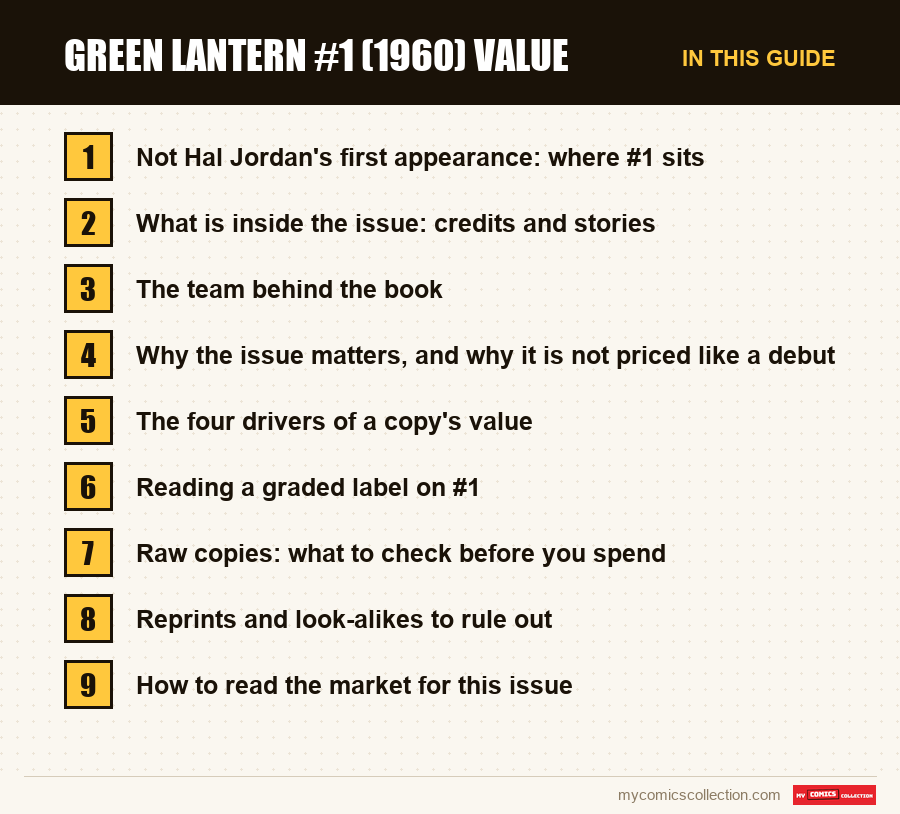
Reading a graded label on #1
Slab labels carry several fields, and for this book each deserves a deliberate look:
- Title and number. The label should read Green Lantern with issue 1 and a 1960 date. A 1941 date means the Golden Age volume; a later date means a different series.
- Cover date. The cover is dated July to August 1960. A label with another date is a red flag worth questioning.
- Page quality. Note the descriptor and compare it with the grade. A high grade with a lower page-quality note is a common pairing for books of this age.
- Notes box. Defects such as a tear, a stain or a staple replacement are recorded here, and they matter even if the numerical grade looks attractive.
- Label type. The label color tells you whether the book is recorded as restored. Our grading guide lists the label types and what each indicates.
Raw copies: what to check before you spend
A raw, ungraded copy puts the burden of assessment on you. Six checks catch most problems.
- Cover identity. Confirm that the cover is the 1960 design and that the issue number and date match.
- Spine. Look for splits, stress lines and color breaks, and hold the book at an angle to catch light reflections that show creases.
- Staples and centerfold. Check that the staples are original and the centerfold is secure. Rust and replaced staples both change the picture.
- Edges and corners. Chipping, rounding and tears at the corners and edges are common on a newsstand-era book.
- Interior. Look for tanning, brittleness and any writing or stamps. The story pages should be complete, with nothing cut out or missing.
- Signs of work. A fresh glossy patch, mismatched color or a suspiciously clean spine can point to restoration.
Reprints and look-alikes to rule out
Several later products reproduce the story or the cover, and they are not the 1960 comic.
- Collected editions. Green Lantern Archives Volume 1 collects Showcase #22 to #24 and Green Lantern volume two #1 to #5. Other collections include the Showcase Presents volumes, Green Lantern Chronicles and the Silver Age Omnibus. All are bound books, easy to tell from a stapled comic.
- Other first issues. Later series of Green Lantern restart at #1, as does the 1941 series. The year on the cover and in the indicia settles the question.
- French editions. The Lug and Arédit books carry the character into a different market with their own numbering and are a separate collecting area.
How to read the market for this issue
You do not need a quote to understand the shape of the market for #1. It is driven by a small number of buyers who want a high-condition original, a larger group who want a presentable copy, and a long tail of collectors who accept lower grades to own the book. The result is a wide spread between the best and the typical copy, and a copy's position in that spread is determined by the four factors above.
Media attention can change interest in the series. When a new film, series or relaunch brings Green Lantern back into view, attention moves across the character's key books, but it moves unevenly. A patient buyer can often choose a better moment than a buyer who reacts to a headline.
Building around the issue
A collection centered on #1 has a few natural neighbors. Showcase #22 to #24 are the three tryout issues that precede it. Green Lantern #7 introduces Sinestro, and our guide to the sleeper issues highlights books in the run that are easy to overlook. Beyond the Silver Age, the later debuts of John Stewart in #87 and Guy Gardner in #59 extend the story of the series.
For a first-time buyer, the most useful rule is to decide whether you want the book as a keystone or as a reading copy, and to set a condition floor before you start looking. A keystone buyer will wait for the right copy. A reading-copy buyer can choose a lower grade with a complete interior and enjoy the stories as they were published. Both are legitimate, and our collecting guide covers how to organize the rest of the run around either choice.
Frequently asked questions
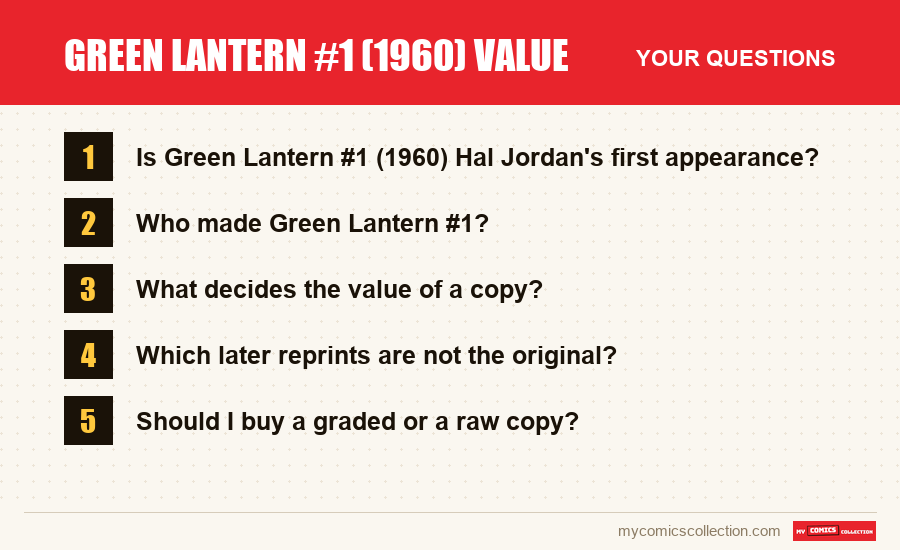
No. Hal Jordan debuts in Showcase #22, dated September to October 1959. Green Lantern #1, dated July to August 1960, begins his own series after the three-issue tryout in Showcase. It opens the series and brings in the Guardians, yet the hero was already on sale in Showcase a year earlier.
John Broome wrote it, Gil Kane drew it, and Julius Schwartz edited it. The Guardians of the Universe, created by Broome and Kane, make their first appearance in this issue. Broome, Kane and Schwartz are the same trio behind the Showcase debut.
Four things: the grade, whether the book is restored, the page quality, and the eye appeal of the cover. Provenance and third-party examination can reduce uncertainty. Equal grades do not guarantee equal standing: the paper note, the notes box and the look of the cover can all pull two copies apart.
The hardcover Green Lantern Archives Volume 1 gathers Showcase #22 to #24 with the first five issues of the series. The Showcase Presents books, Green Lantern Chronicles and the Silver Age Omnibus are other collections. All are bound volumes, so none replaces the stapled 1960 comic.
A graded copy gives you an independent record of grade, page quality and restoration, which is useful when you cannot inspect the book in person. A raw copy puts the assessment on you, and rewards careful checking. If you hesitate, run the copy through the free valuation tool before deciding.
Do you own a copy of Green Lantern #1 from 1960 and want to know where its condition places it? Describe it and get an estimate.
Estimate my comic