
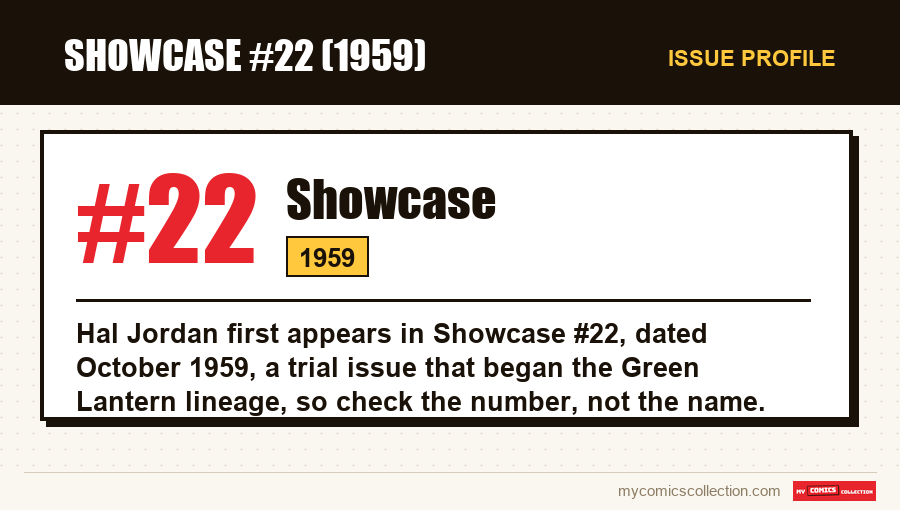
Hal Jordan first appears in Showcase #22, cover-dated October 1959, in a story written by John Broome and drawn by Gil Kane under the editorial direction of Julius Schwartz. A test pilot receives the ring of a dying cosmic policeman and becomes the Green Lantern of his sector. Collectors seek this issue because it opens the modern Green Lantern lineage, and through it the whole Silver Age of its publisher.
Showcase #22 poses a problem that few key issues pose with such insistence: you need to know what you are buying before you know what you are paying. The title of the magazine does not say Green Lantern, the name Green Lantern had already been used twenty years earlier by a hero who has nothing to do with Hal Jordan, and the first appearance everyone talks about is in fact the first third of a three-issue editorial experiment. A collector who buys by the character's name without looking at the magazine number is on the wrong floor.
As always in this guide, only verified information (creators, issue numbers, dates) is stated as fact. The analysis is ours, with no reproduction of panels or protected dialogue.
The issue: October 1959, Broome and Kane, a ring changes hands
The cover of Showcase #22 bears the cover date of October 1959. As with all American production of the period, this date is a newsstand removal date, not a release date: the actual sale precedes the cover date by several weeks. A seller who tells you "1959" is correct, but a seller who gives you a precise month of sale is offering information the cover does not contain.
The script is by John Broome, the art by Gil Kane, and the whole was put together by Julius Schwartz, the editor who had already orchestrated the return of the Flash three years earlier in the same magazine. Inking is attributed to Joe Giella by the usual sources; the studio's practice at the time does not always allow a firm answer, so the credit holds with reservations. The issue contains two Green Lantern stories rather than one, a detail that sales listings almost always leave out.
The content itself has remained the skeleton of the character for sixty years. Hal Jordan is a test pilot working for an aircraft manufacturer run by the Ferris family, and he happens to be there when a spaceship crashes. Its occupant, a policeman from an interstellar organization, hands him a ring before dying. Jordan inherits the ring, the lantern that recharges it, the oath that goes with it, and the two limits Broome imposes on him at once: the ring does not work against yellow, and it runs down after a day. Everything that came later, the Guardians, the Corps, the sector assignments, was built on top of this opening page.
The publishing context: Showcase was not a series, it was a test bench
Showcase is the anomaly to understand before buying. The magazine had no fixed hero: each issue, or each small group of issues, was used to put a proposal before the public and measure sales. If the test worked, the character got a title of its own; if it failed, it went back into the drawer. It is a commercial polling mechanism, not a collection in the sense a collector understands.
This arrangement explains why Showcase concentrates an unusual number of first appearances for a single title. The Barry Allen Flash had been relaunched there in issue 4, in 1956; the Challengers of the Unknown were born there; Adam Strange occupied three consecutive issues; the Atom passed through at the start of the 1960s, as did Aquaman in his relaunched version. One magazine therefore houses key issues of very different origins and values, and the word "Showcase" in a listing tells you nothing. In an inventory, this title is filed by number and never by character, and that is also how the catalog treats it.
Why this issue became a key
Showcase #22 combines three statuses that rarely overlap. It is the first appearance of a character still exploited today, it is the opening issue of a trial that succeeded, and it is a periodization marker: the relaunch of the Flash in 1956 had opened the Silver Age, and that of Green Lantern in 1959 showed that the method could be repeated. A buyer of historical keys is not only buying Hal Jordan; they are buying the demonstration that the Schwartz model worked.
Add the longevity of the material. The Guardians, the oath, the weakness to yellow, the assigned sector: these elements set down in 1959 are still the ones contemporary stories manipulate, including when they hand the ring to other bearers. Keys that endure are rarely the ones holding a good story; they are the ones holding a reusable blueprint, and this one is one.
Finally, preservation works against supply. Nobody bought a trial magazine in 1959 to keep it, since nobody yet knew the character would have a sequel. The survivors are often reading copies, and scarcity is concentrated at the top of the grading scale more than in the absolute number of copies.
What moves the price: condition, pagination, integrity
On a 1959 issue, the price gap between two grades is more violent than on any issue after 1980, because the population of copies at the top of the scale is tiny. An average copy and a very clean one do not trade in the same price range, and moving up a single grade can multiply the value rather than raise it by a few percent.
The control points specific to this period are well known. Staples rust and stain the central booklet. The paper yellows and becomes brittle at the edges. The spine rubs at the fold. And above all, inside pages go missing more often than one might think: the cut-out games and the advertisers' coupons of 1959 were cut out by the first readers, and a missing coupon drops an otherwise very presentable copy several grades.
Old restorations add to this: a reattached corner, a spine reinforced with tape, a retouched color. These interventions were made in the 1970s without any intent to deceive, but they show today and change the nature of the copy.
Telling one edition from another
The original 1959 printing carries a cover price in cents, no barcode, and an indicia at the foot of the first inside page that names the magazine and its number. The absence of a barcode is not a sign of authenticity in itself, since late reproductions may omit it, but its presence is enough to rule out the original printing.
The story has been reprinted several times, in original-series collections, bound volumes and black-and-white compilations. These reprints are legitimate and readable, but they carry their own title and their own numbering: there is no ambiguity once you hold the object. The ambiguity arises in listings where a photo of a panel replaces the photo of the cover.
Facsimiles, meaning reissues that reproduce the period cover and contents, call for more attention. When one exists for an issue, it can be told apart by the paper, by a contemporary cover price, by a barcode or by an edition statement on the back cover. On an issue of this importance, ask for a photo of the spine and of the foot of the first page before concluding, rather than relying on the cover alone.
Do you collect this series?
Track what you own, what you are missing and what your collection is worth. 7-day trial.
Start my trial →
Buying traps, starting with the name
The name Green Lantern had already been carried, from 1940, by Alan Scott, who debuted in All-American Comics #16. Nothing links the two characters at the start: Scott draws his power from a ring of magical origin, and his classic vulnerability is wood. The two lineages were connected later through parallel-world stories, but that connection came afterward and does not concern Showcase #22. The duplicate name produces two symmetrical errors: paying for a 1940s issue believing you are buying the beginning of Hal Jordan, or seeing a "first appearance of Green Lantern" listing on a 1940s lot and concluding that Showcase #22 is overpriced.
The next trap is not counterfeiting but a difference in issue number. The success of the trial produced Showcase #23 and #24, then a regular series whose first issue is dated summer 1960. These four objects circulate together, look alike in lists, and the cheapest of the four is often presented with the sales pitch of the most expensive. Read the number, not the description.
A second trap: the lot. Showcase #22 sometimes appears in "DC 1950s" bundles whose seller does not know the exact contents. That is good news for the attentive buyer, but the reverse also exists, with lots whose cover photo does not match the copy delivered. Demand a photo of the actual copy, not an illustrative image.
A third trap: pressure from the story. Each audiovisual adaptation of the character pushes listing prices up for a few weeks without any change in supply. Buying within those windows costs you. A regular check of completed sales, rather than asking prices, will tell you when the window closes. Our free estimate page is there for exactly that purpose: setting a benchmark before you negotiate.
Neighboring issues that matter too
Showcase #23 and #24 extend the trial. Considerably more affordable than #22 while belonging to the same sequence, they are the best entry point for anyone who wants the period without aiming for the flagship. Green Lantern #1, dated summer 1960, is the other key of the lineage: the issue where the trial becomes a series.
Earlier, Showcase #4 holds a comparable place for the Flash and trades in a higher bracket. It is worth knowing even just to calibrate your reading of the market: the two issues belong to the same magazine, the same editorial method and the same publisher, and the gaps in their prices tell you how the market ranks first appearances.
Later, the period when the series pairs Hal Jordan with Green Arrow produces other landmarks. These are keys tied to content and treatment rather than to a first appearance, and they cannot be compared directly with Showcase #22.
What grading changes on a 1959 issue
Having an issue of this age graded has a mechanical value: encapsulation fixes its condition, documents any restorations, and makes the copy comparable to others without handling. On 1959 paper, which continues to acidify, the preservation argument counts as much as the resale argument.
The calculation is not automatic, however. The cost of the process is fixed while the gain depends on the grade obtained, and on a reading copy the gain may be nil. The question to ask is one of threshold: is your copy clean enough for the grade to move a buyer, or fragile enough that protection alone justifies the expense? In between, a quality sleeve and vertical storage are enough.
How to track it in a collection
Showcase #22 is entered under the magazine title, with its number and year, and not under the character's name. That is the only way to keep it from being filed beside the Green Lantern series, where it has no place. If you also track the neighboring #23 and #24, the sequence becomes readable at a glance and you immediately see what is missing.
Three fields deserve filling in at entry, because they cannot be reconstructed later: the condition as you observed it, in your own words; the presence or absence of the inside coupons; and the nature of the copy, original printing or reprint. An inventory that does not distinguish these three things will make you believe you own a key when you own a compilation.
The Green Lantern hub brings together the publishing landmarks of the lineage and will keep you from confusing the two bearers of the name when you complete your file.
Conclusion: an issue to identify before coveting it
Showcase #22 is not a hard issue to understand; it is hard to name correctly. A trial magazine with no fixed hero, a character name already used twenty years earlier for someone else, and a first appearance spread over three issues before the real series: each of these three features produces its own buying error, and they combine.
Check the exact title, the number, the cover price in cents and the presence of the inside coupons: most of the risk is eliminated. Someone who relies on the words Green Lantern in a listing title will, one day, buy something else. For the rest, the blog guides explain the method for evaluating condition point by point.
You have a late-1950s Showcase in a lot and you do not know whether it is number 22 or one of its trial neighbors? Have it identified before you sell or insure it.
Estimate my comic
Frequently asked questions
It is the first appearance of Hal Jordan, the Green Lantern of the Silver Age. The name had already been carried from 1940 by Alan Scott, a distinct character who debuted in All-American Comics #16, with a ring of magical origin. The two first appearances both exist and do not replace one another.
Because Showcase was precisely there to gauge public interest before committing to a title. Green Lantern occupied three trial issues, 22, 23 and 24, before obtaining his own series, whose first issue is dated summer 1960. A successful trial is the condition for the series, not its automatic outcome.
Both are keys, but not for the same reason. #22 carries the first appearance and trades in a far higher bracket. Green Lantern #1 marks the move to the regular series and remains much more accessible. On a limited budget, Showcase issues 23 and 24 offer the trial sequence at a lower cost.
The original printing carries a cover price in cents and no barcode, and its indicia names the magazine and the issue at the foot of the first inside page. A barcode, a contemporary price or an edition statement on the back indicates a reissue. Ask for a photo of the back and of the foot of the page before drawing any conclusion.
Missing pages or inside coupons. The 1959 advertising coupons were often cut out by the first readers, and an incomplete page drops the copy by several grades even when the cover remains presentable. Check the pagination and the condition of the staples before discussing the gloss of the cover.