In short
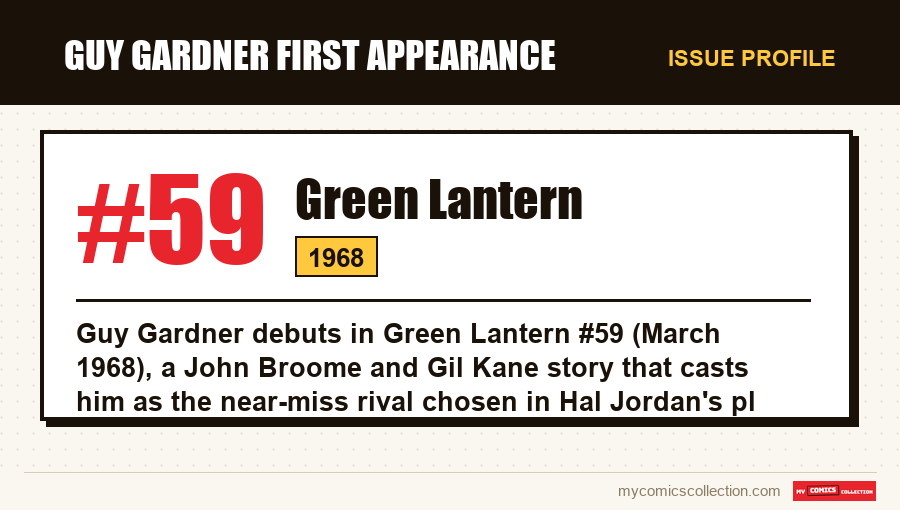
Guy Gardner makes his debut in Green Lantern #59, cover dated March 1968. Broome scripted the tale, titled "Earth's Other Green Lantern!", and Kane supplied the art, under editor Julius Schwartz. Guy appears as the other candidate whom Abin Sur's ring could have chosen, and the story imagines the Green Lantern career he would have had in Hal Jordan's place. He is not yet an established ring-bearer of the regular series.
Few debuts in the Silver Age look as modest on the page and as important on the shelf as Green Lantern #59. The cover announces a different kind of Green Lantern story, and the issue reads today as a thought experiment that DC's editors did not know would become the foundation of a major character. This guide treats the issue itself, not the character's whole career: what is inside the book, who made it, what it does and does not establish, and what to check before you pay for a copy.
Credits, the story title and the March 1968 date come from reference pages read for this guide; the advice on spines and slabs is our own reasoning. The sections on condition, restoration and buying order are analysis and method, not claims about market behavior.
The issue at a glance: cover date, format and credits
Green Lantern (volume 2) #59 carries a cover date of March 1968. Its story, "Earth's Other Green Lantern!", is the one that introduces Guy, and that title is the detail to look for in a listing, since sellers do not always mention the character by name in the description of an older book.
John Broome wrote the story and Gil Kane drew it, and the two are the credited creators of Guy Gardner. Julius Schwartz edited the book. Note that the issue sits between writers: Gardner Fox scripted several of the issues that follow, including #60, and Dennis O'Neil arrived with #63, so a listing that credits #59 to Fox has mixed up neighboring books.
Broome, Kane and Schwartz had been behind the series for years at this point in its life. Issue #59 comes from a creative team that knew the premise well, which is part of why it can afford to ask a question about the lead: what if somebody else had held the ring?
How Guy Gardner is introduced
The premise is the key to reading this issue correctly. Abin Sur, the dying alien Green Lantern, sends his power ring across the area around his crashed ship to find a worthy successor. The ring identifies two human candidates of comparable integrity. Hal Jordan is the one who is chosen, because he is nearer to the crash site. Guy Gardner, a teacher, is the other name on the ring's short list.
Issue #59 builds its story on that near miss. It follows what might have happened had the ring chosen Guy instead, with Guy in the role that Hal normally fills. The result is a story told in the register of an "imaginary" adventure: the reader sees what could have been, not what is.
This distinction is the single most important point for anyone describing the issue accurately. Guy appears in Green Lantern #59 as a candidate and as the protagonist of a simulated alternative. He is not an established member of the Green Lantern Corps in the regular continuity of the series when the issue goes on sale. A listing that says "Guy Gardner becomes a Green Lantern in this issue" overstates what the book establishes. A listing that says "Guy Gardner's debut as the ring's other choice" is much closer to the page.
Who created him, and in what editorial setting
Guy Gardner is a creation of John Broome and Gil Kane. Broome also scripted a sidekick debut at DC in late 1959, and Kane supplied the pencils that defined the 1960s look of this title. By 1968 they were working a title that had been running for years and that could use a way to put fresh stakes into a premise with a well-known origin.
The editorial setting explains why a story like this appears in a book of this kind. DC's editors in this period ran stories that explored alternate versions of established heroes, sometimes presenting them as "what if" tales and sometimes as dream sequences or tests. Issue #59 fits that mold: the alternate scenario allows the creators to show an unfamiliar Green Lantern without disturbing the ongoing continuity of the series. Guy was built to carry a single story, and nothing on the page promises a return.
Why the issue became a key issue
For years after 1968, Green Lantern #59 could be read as a curiosity, much like an imaginary tale from other DC books. Guy came back as Hal's backup at the end of the 1970s, and in the mid-1980s Steve Englehart, working with Joe Staton, revamped him into the abrasive figure readers know. That revamp changed the status of the issue: a one-off debut became the origin point of a character who joined the Justice League and the Green Lantern Corps and who remains part of the DC Universe.
The later milestones are what give the debut its weight. In Green Lantern #197, cover dated February 1986, Guy's personality is radically altered. He is part of the Justice League launched in 1987, the group that later became known as Justice League International, and Justice League #5, cover dated September 1987, holds his most famous scene. The 1992 miniseries Guy Gardner: Reborn restores his power, and his own ongoing series begins with a cover date of October 1992 before being retitled Guy Gardner: Warrior with issue #17. Green Lantern: Rebirth in 2005 returned his ring, and he went on to figure in the Sinestro Corps War in Green Lantern volume 4 #21 to #25 in 2007 and in the Blackest Night crossover in 2009, when he becomes a Red Lantern in Green Lantern Corps #43.
For a view of where the issue sits among other Silver Age Green Lantern books, see our overview of Silver Age Green Lantern key issues, and for the character who defines the series, read the guide to Hal Jordan's debut in Showcase #22.
Do you collect this series?
Track what you own, what you are missing and what your collection is worth. 7-day trial.
Start my trial →
Reprints, look-alikes and issues that get confused with it
The most common confusion has nothing to do with reprints. It comes from the number of issues in which Guy Gardner appears at key moments of his career, and from the way different volumes of Green Lantern share the same title. The 1968 debut is in Green Lantern volume 2. Later volumes of the series carry their own issue #59, and the cover date, not the number, is what identifies the book you want. Check for March 1968 before you assume you are looking at the right issue.
A second source of confusion is the backup-Green-Lantern storyline. Guy returns as a backup ring-bearer in the late 1970s, and the issues of that period are sometimes described as his origin. Green Lantern #116, cover dated May 1979, shows him trapped in the Phantom Zone after Hal's power battery explodes, and #122 and #123 from late 1979 continue his story, the second leaving him in a coma for years. Those books are part of his history, but they are not his debut. If a listing for one of them uses the words "first appearance," read the description closely.
A third confusion concerns the Batman punch. The scene in Justice League #5 from September 1987 is the single most quoted moment in Guy's career, and it is frequently misdescribed as his first appearance or as the issue that introduced him. It is a landmark of his personality, not of his existence. The debut is the 1968 book.
What to check before buying a copy
The issue is a mid-1960s-to-1970s style newsstand comic, and the checks that apply to any Silver Age DC book apply here. Start with the cover. Kane's cover art is bold and the colors are saturated, which means that wear shows as color breaks along the spine and corners. Look at the spine for stress lines that run through the color, because a small number of creases and a long run of stress marks are not equivalent even when both are called "light wear" in a listing.
Next, check for restoration. Silver Age books of this era are often cleaned, pressed, color touched or re-glued, and a book that looks unusually bright for its age deserves a closer look. A slab with a restoration label is a fine collectible for the right buyer, though it sits in its own bracket. Compare like with like when you look at sold copies, and read the grader's label as well as the number.
To judge a copy of #59, line up several completed sales that share its grade and restoration status instead of fixating on one headline result. The estimate link at the end of this guide is one place to start. Because values move with film and television news, with new Guy Gardner appearances and with the broader Silver Age market, any specific number written in an article would be out of date soon after it appeared, so this guide gives methods and not figures.
For a grading primer written for this series, see our Green Lantern grading guide, which explains what graders look for on books of this era and how label categories differ.
Key appearances that follow the debut
If you are building a Guy Gardner run and want to know what comes after #59, these are the issues the reference material identifies as the steps that matter. They are listed in publication order.
- Green Lantern #116 (May 1979): Guy is trapped in the Phantom Zone, an episode that begins a multi-issue arc in the late 1970s run. This is the main entry point to his backup-ring period.
- Green Lantern #197 (February 1986): The issue in which Guy's personality is radically altered, part of the shift that turned him from a mild-mannered substitute into the abrasive figure that later readers know.
- Justice League #5 (September 1987): Guy is a member of the team that later becomes Justice League International. The issue is remembered for a scene with Batman that has been cited ever since.
- Guy Gardner: Reborn #1 to #3 (1992): A three-part miniseries in which Guy works to regain his power, leading directly into his own ongoing series.
- Guy Gardner #1 (October 1992): The start of his ongoing series, later retitled Guy Gardner: Warrior from issue #17.
Beyond those, the 2005 miniseries Green Lantern: Rebirth restores his ring, and the Sinestro Corps War in 2007 and Blackest Night in 2009 move him through new phases. The books around that 2007 event are mapped in our Sinestro Corps War key issues list.
How to place the issue in a Green Lantern collection
There are two reasonable ways to think about the issue. If you collect Silver Age Green Lantern as a series, #59 is a book to watch for as part of the Broome and Kane run, and it deserves a place beside the key Hal Jordan debut books. If you collect by character, it is the root of a Guy Gardner collection, and the later appearances above fill in the rest of the structure.
If you want a broader view of the title before you commit, our guide to Green Lantern key issues maps the other books that sit around #59 in demand and in importance, and the Green Lantern character hub collects the rest of the series coverage.
Frequently asked questions
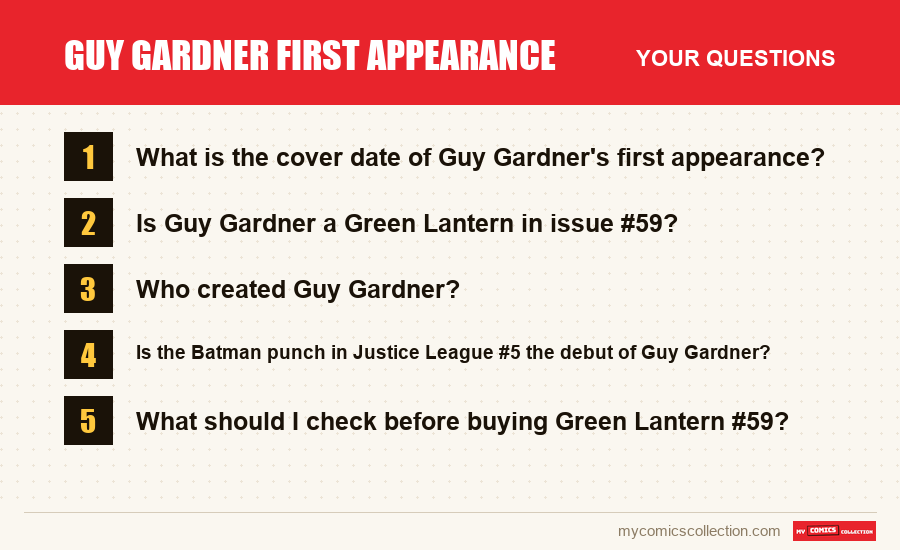
Guy Gardner debuts in Green Lantern (volume 2) #59, cover dated March 1968. The cover reads March 1968 and the lone feature inside is "Earth's Other Green Lantern!" by Broome and Kane. Check for the March 1968 date on the cover, because later volumes of the series also contain an issue #59.
Not in the regular continuity of the series. The issue presents him as the other candidate whom Abin Sur's ring could have selected, and the story imagines the career he would have had if the ring had picked him. Hal Jordan is the chosen ring-bearer, with Guy as the near miss who later became his backup in the character's history.
John Broome and Gil Kane created Guy Gardner. Broome wrote the story and Kane drew it, with Julius Schwartz editing the book. Guy returned as Hal's backup in 1979, and Steve Englehart revamped him in the 1980s into a lead personality, which is why the 1968 debut gained attention long after it first appeared.
No. The scene in Justice League #5, cover dated September 1987, is the most quoted moment of Guy's career, but he had already debuted in Green Lantern #59 in 1968. The 1987 issue shows him as a member of the group that later became Justice League International, not as a new character.
Confirm the March 1968 cover date, then examine the spine for stress lines, the corners for color breaks and the staples for originality. Ask the seller about cleaning, pressing and color touch, and read any slab label for a restoration note. Match comparables by grade and restoration.
Own a copy of Green Lantern #59 or another Silver Age Green Lantern book? Run a free estimate based on the issue and its condition.
Estimate my comic