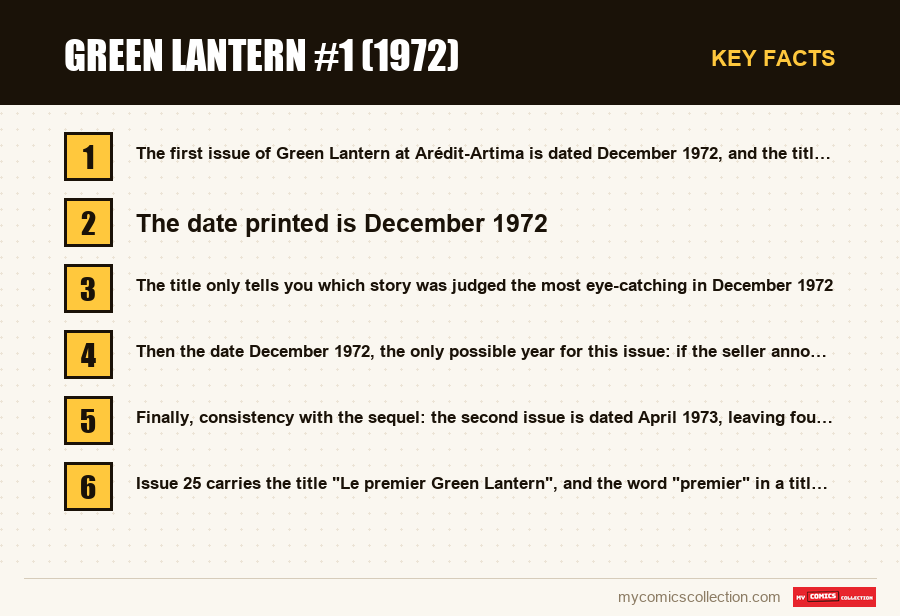
The first issue of Green Lantern at Arédit-Artima is dated December 1972, and the title recorded in the catalogue is "La menace géante", which does not name the hero. Across all thirty-five issues, only five titles mention Green Lantern or Hal Jordan, and none before the fourteenth. Buying this issue therefore means buying a contents list that has to be checked page by page, not a title.
You are looking for the first issue of a quarterly series that is half a century old, and the first thing you will see in a listing is a cover photograph with a title printed on it. On this series in particular, that title is the least reliable piece of information in the whole listing. This is the starting point of this guide: to understand why, measure it, and draw from it a buying method that does not rely on what is printed in large letters.
As always on this guide, only verified information (creators, issue numbers, dates) is stated as fact; the analysis is our own, with no reproduction of artwork or protected dialogue.
What the catalogue says about issue 1, and nothing more
Three pieces of data hold up without discussion. The date printed is December 1972. The recorded title is "La menace géante". And the creators listed for this issue are, on script, Gardner Fox, John Broome and Otto Binder; on art, Gil Kane, Murphy Anderson and Carmine Infantino.
This list of six names for a single title is itself a piece of information, and the most useful one in this guide. A single episode does not call on three writers and three artists. The issue therefore contained several stories, and the catalogue retained only one title. In other words, you have the list of the hands that worked on this issue, but not how the work was divided: it is impossible to say here which artist illustrated which episode, or how many episodes there are in total. On this point, the sources disagree.
Remember the combination of Fox and Broome on script with Kane on art: it is the signature that recurs most often on the first issues of the series, and it disappears completely from the twenty-sixth issue onward, where Denny O'Neil and Neal Adams take over. A seller who advertises Neal Adams in an issue 1 has the wrong issue.
The central fact: one title in seven names the hero
Here is the measure, taken across the thirty-five issues of the series. Only five titles name Green Lantern or his civilian identity: "Hal Jordan en prison", "Deux Green Lantern dans la famille", "Green Lantern un jour, Green Lantern toujours", "La fin de Green Lantern" and "Le premier Green Lantern". Five out of thirty-five, a little more than one in seven.
Their position matters as much as their number. All five cluster in the middle section of the series, between the fourteenth and the twenty-fifth issues. The first thirteen contain none, and neither do the last ten. Issue 1 therefore belongs to the part of the series where the hero's name never appears in the featured title.
What the other thirty titles say
They do not speak of superheroes, not even of a single genre. "Churchill à Omdurman" and "Médaille de bravoure" are war-story titles. "Victoire sur les Sioux" and "Le dernier cheval sur Terre" point to the western. "Rudolph spécial géant" is a Christmas title. "Les martiens existent", "Prisonniers de l'atome" and "Des constructeurs de mondes" belong to classic science fiction.
The most telling case is that of the last issues: "Faucon Noir", "Miss Hulk" and "Thor le fils d'Odin" name characters entirely foreign to the ring-bearer's universe. Put plainly, the title chosen for an issue of this series could name any story in its contents, including one with no connection to the hero of the magazine's title. The publisher promoted what looked saleable on the newsstand, not what defined the issue.
The practical consequence for anyone buying issue 1
It is blunt, and it is better to accept it straight away: what you buy is not what the title promises. "La menace géante" does not tell you how many episodes the issue contains, which of them feature the ring-bearer, or what share of the booklet is taken up by a story of another genre. The title only tells you which story was judged the most eye-catching in December 1972.
The method that follows is simple. The contents are checked on the copy, never on the listing. Ask the seller for a photograph of the inside page that lists the stories, or failing that a photograph of the first panel of each story, recognisable by its title at the top. If neither can be provided, you are buying an object whose contents remain unknown, and that is a factor to weigh before committing, not after delivery.
This caution has a pleasant corollary: when a listing claims that this issue contains such-and-such a first French publication, it claims more than it can know. We will not write that it is wrong; we write that it has no means of proving it from the title, and that it is up to you to ask for the pages.
Recognising a genuine first issue in a listing
Four checks, in this order, and each rests on an element that is visible in a photograph.
The issue number first, which must read clearly on the cover. Then the date December 1972, the only possible year for this issue: if the seller announces an issue 1 with another date, it is either a data-entry error or a different title from the same publisher. Next, the title "La menace géante", which must match. Finally, consistency with the sequel: the second issue is dated April 1973, leaving four months between the two publications. A lot sold as "the first issues" whose dates follow each other month by month does not come from this series.
Be especially wary of a single photograph taken from a distance, straight on. On a fifty-year-old booklet, the only photograph that really tells you anything is the one of the spine and corners, and a listing that does not offer it asks you to trust a scan of a cover that you can find everywhere else.
Do you collect this series?
Track what you own, what you are missing and what your collection is worth. 7-day trial.
Start my trial →
Possible confusions, and how to resolve them
The first is internal to the series. Issue 25 carries the title "Le premier Green Lantern", and the word "premier" in a title brings this issue up in the search results of any buyer who types "first issue". You may come across a perfectly honest listing, correctly numbered 25, and for a moment believe you have found the start of the series. Its date, December 1978, settles the question.
The second comes from reprints and collected editions. Publishers of the period happily bound several issues together in a hardcover or softcover, and the contents of issue 1 may well turn up in a volume that carries no visible issue number. That volume is not the first issue, even if it contains its pages.
The third concerns the name. The hero also appeared in other French publications of the same period, as lead or as supporting character, and a listing that says "Green Lantern numéro 1" without naming the publisher or the date leaves you to guess which series is meant. Require both.
What to look at on the object, before anything else
This is a December 1972 issue, sold on the newsstand, printed on paper that was not meant to last. The condition and completeness of the booklet will outweigh every other consideration, including the interest of the contents.
Open it flat and count. On these stapled booklets, the central pages are the first to come loose, and a booklet missing its central double leaf loses two pages without anything showing from the outside. Then check the staples themselves: rust that stains the paper around them cannot be cleaned off, and it signals damp storage that will also have weakened the spine. Look at the fold of the spine in raking light; whitening shows up there immediately. Finally, check the four corners and the edge of the pages, which tell the story of the issue's handling better than the cover does.
Two defects specific to the period deserve particular attention. Advertising pages and game pages, often present in these magazines, were the first to be cut out by young readers in 1972; a missing page at the back often goes unnoticed. And handwritten marks, an owner's name or a purchase date in ballpoint on the cover, are very common on the first issues of collections, precisely because those are the ones children marked so they could recognise them.
Why its relative rarity
It does not come from a confidential print run, of which we know nothing, but from a readership mechanism. The series appeared at roughly four issues a year, from December 1972 to May 1981. A quarterly publication builds its audience slowly: the buyers of the first issue were, by definition, those who found it on the newsstand before the series had any reputation, and they were necessarily fewer than those of issues published six or seven years later.
Add the classic effect of unsold copies. A first issue that fails to find its reader is sent back and disappears, whereas a mid-series issue is bought by collectors who keep it. The result, on the French second-hand market, is that fine copies from the start of a quarterly series of this period turn up less often than those from the end, and almost never in near-mint condition.
Finally, the rarity of an object and its price do not follow the same rule. What separates two copies of the same issue 1 is the condition of the booklet, the presence of every page, and the absence of inscriptions, in that order. A complete, clean copy is worth several times a worn copy, even though both carry the same date and the same title. That is why valuation is done on detailed photographs and not on a reference.
Tracking this issue in a collection
A method tip that follows directly from everything above: in your inventory, do not settle for recording "issue 1, La menace géante". Add a free-text field in which you note, copy in hand, the actual list of stories your issue contains. On this series, that field is the only information that appears nowhere else, and it will be worth its weight in gold the day you need to spot duplicates between your issues and your collected editions.
Also note the date December 1972 rather than the year alone, because the quarterly rhythm of the series makes the year ambiguous: three or four different issues share each year. A collection record that shows only "1972" will force you to pull the booklet out again to settle the matter.
Frequently asked questions
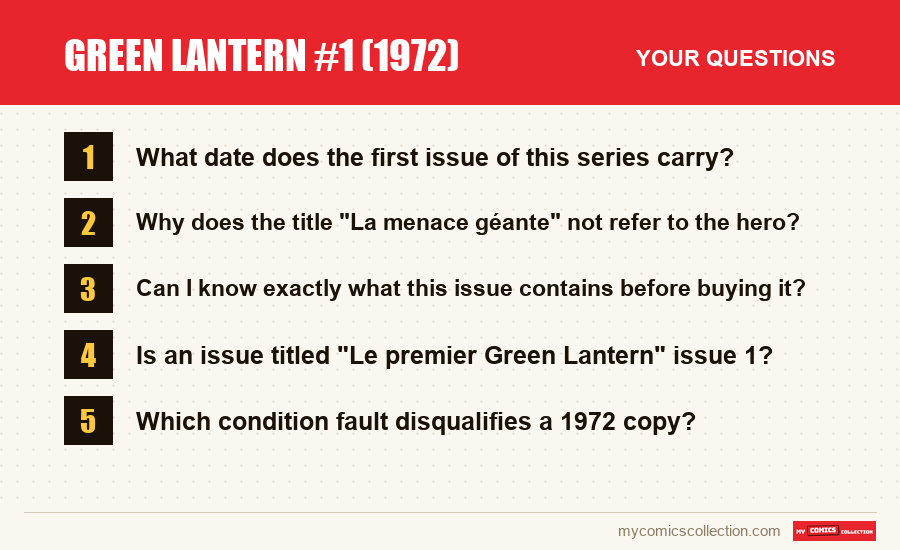
December 1972. It is the only possible date for this issue, and the quickest check when faced with a listing. The next issue is dated April 1973, four months later: if two issues presented as consecutive are dated a month apart, they do not belong to this collection.
Because on this series the title put forward designated the story judged most saleable, not the contents as a whole. The measure is clear: five titles out of thirty-five name Green Lantern or Hal Jordan, and none before the fourteenth issue. The rest refer to war, the western, Christmas or science fiction.
Not from the listing alone. The six creators recorded for this issue, three writers and three artists, indicate several episodes, but not which ones or how many. Ask for a photograph of the contents page or, failing that, of the first panel of each story, where the title appears at the top.
No. That title belongs to the twenty-fifth issue, dated December 1978. It is the most common confusion on this series, because the word "premier" in a title pulls this issue up in searches. The date settles it, and so does the issue number printed on the cover.
An incomplete booklet, above all else. On these stapled issues, the central double leaf comes loose first, and its absence is not visible with the cover closed. Next come staple rust, which stains the paper irreversibly, and whitening along the spine fold, visible in raking light.