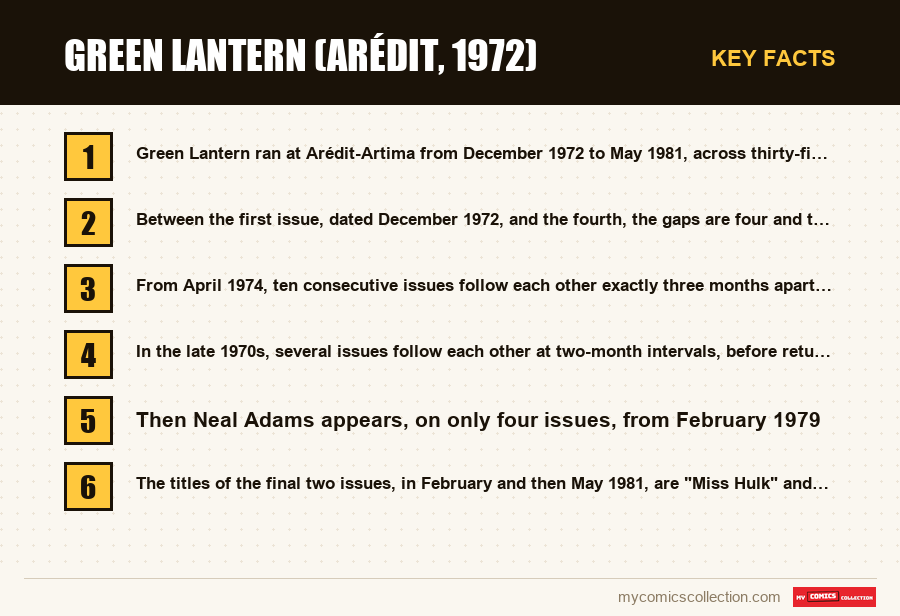
Green Lantern ran at Arédit-Artima from December 1972 to May 1981, across thirty-five issues numbered with no break at all. The title names the star, not the contents: the titles recorded in the catalogue mix war stories, westerns, a Christmas tale and, toward the end, characters from another publishing house. Completing the series therefore means checking each issue against its actual contents, not against the promise of its cover.
You have a stack of these green issues, you want to know what you are missing, and you run into an obstacle that the numbering does not reveal: two copies of the same series can have almost nothing in common. One tells a space adventure, the other a battle on the Nile. This variety is not an accident confined to a few isolated issues: it is the rule of the series, and it is what makes sorting it difficult.
As always on this guide, only verified information (creators, issue numbers, dates) is stated as fact; the analysis is our own, with no reproduction of artwork or protected dialogue.
A cover title that does not describe the contents
Let us start with the observation that should guide all your sorting. Of the thirty-five titles the catalogue associates with this series, only five name the hero or his civilian identity: "Hal Jordan en prison", "Deux Green Lantern dans la famille", "Green Lantern un jour, Green Lantern toujours", "La fin de Green Lantern" and "Le premier Green Lantern". In other words, fewer than one issue in six explicitly announces a story about the ring-bearer.
The other thirty titles tell something else. "Churchill à Omdurman" belongs to military historical fiction. "Victoire sur les Sioux" and "Le dernier cheval sur Terre" are western titles. "Médaille de bravoure" and "Fumée noire" belong to the war-story register. "Rudolph spécial géant" is a Christmas tale. These titles are not poetic periphrases for a cosmic adventure: they point to entirely distinct genres, housed under a superhero cover.
For a collector, the consequence is practical and immediate. Sorting by number gives you the order of publication, but tells you nothing about what you are holding. If you are looking for the ring-bearer's adventures, the numbering is of no help; if you are looking for war stories drawn in those years, you will find some here without the magazine's title ever having suggested it.
Reading the creators to guess the contents
The catalogue gives only one story title per issue, whereas a magazine of this format contained several. The full contents therefore have to be recorded from the copy itself. But the creators' names are more talkative than the title, and they are the best clue you have at a distance.
Look at who signs the art when the title leaves the superhero register. Sam Glanzman, Ric Estrada, Bill Ely, Norman Maurer, Joe Certa: these are names associated with war stories, westerns and adventure strips, not with science fiction in tights. On the scripts, the catalogue shows Robert Kanigher alongside the usual names. This coherence between the title and the signatures is your cross-check: when both point the same way, you know what to expect before even opening the issue.
Three issues deserve a separate mention on this front: Sam Glanzman appears there as both writer and artist. A complete author in an anthology magazine translated from another language almost always signals a short story reprinted as is, and that is the kind of detail that helps you identify a segment when the pagination has been reworked.
A quarterly rhythm, with two tightenings
The series takes time to find its pace. Between the first issue, dated December 1972, and the fourth, the gaps are four and then five months: a cautious start, closer to a test than to a launch. That is also why the very first issues are the hardest to find grouped together.
Then comes a period of remarkable regularity. From April 1974, ten consecutive issues follow each other exactly three months apart, always in the same publication months. For anyone reconstructing the series, this phase is the most comfortable: the lots in circulation often cover it in one block, because readers of the time were subscribers who kept issues in whole runs.
The pace then quickens. In the late 1970s, several issues follow each other at two-month intervals, before returning to the quarterly rhythm until the May 1981 close. This temporary tightening is useful to know: it means one calendar year can carry five issues instead of four, and that a lot sold as a "full year" is not necessarily complete.
The handover between artists
If you have to remember a single turning point, it is the one in the artists. Gil Kane is present on almost all of the first twenty-five issues, with one exception. His signature is therefore the default marker of the first half of the series, and his absence from an issue in that range is a signal: the contents of that one were put together differently.
Then Neal Adams appears, on only four issues, from February 1979. It is a narrow window, and the most sought-after of the whole series by readers attached to this period of the character. Four issues out of thirty-five means that a collection assembled by chance at flea markets has statistically little chance of containing all of them: if you are targeting this sequence, target it by name rather than hoping to stumble on it.
Mike Grell then takes over and sees the last seven issues through to the end. His arrival overlaps Adams's departure on one issue, which makes it a convenient transition marker when you are dating a copy whose cover is illegible.
Titles that speak of the hero, and what they promise
Among the five titles that name the star, two raise a question of identity: "Deux Green Lantern dans la famille" and "Le premier Green Lantern" both suggest the presence of another ring-bearer than the one on the poster. A third, "Le péril jaune", refers to the ring's legendary weakness. These titles are the most sought after when a buyer is looking for material on the character's mythology rather than an isolated adventure.
Two others play on ending and beginning again: "La fin de Green Lantern" appears in the middle of the series, and "Green Lantern un jour, Green Lantern toujours" a few issues earlier. A closing title in the middle of a run that will continue for years is a useful reminder: a French title does not reflect the original narrative order, it reflects an editor's choice for a cover.
The rest of the vocabulary leans clearly toward space: rings of Saturn, Martians, Venusian statues, world builders, cosmic opera. These titles are probably the closest to the expected register, but they do not name the hero, and nothing in the data allows us to say who holds the lead role in each of them.
Do you collect this series?
Track what you own, what you are missing and what your collection is worth. 7-day trial.
Start my trial →
The last two issues, and what they signal
The end of publication holds the most telling surprise. The titles of the final two issues, in February and then May 1981, are "Miss Hulk" and "Thor le fils d'Odin". These are characters from a rival publishing house to the one that created the ring-bearer. On art, the catalogue shows, for this stretch, names of illustrators more usually associated with the publications of that other house.
Do not over-interpret: the data records a title and signatures, not a licensing contract or an editorial policy. But for the collector, the raw fact is enough. It means the last issues of this series can be interesting pieces, for a collection organised by character, well outside the shelf where you would have filed them.
It also means, more prosaically, that these two issues are frequently misdescribed by sellers, who stop at the magazine's title. It is one of the rare cases where an imprecise listing works in your favour.
Recognising the edition and checking the contents
Before buying, systematically ask for a photo of the contents page or of the inside page that announces the segments, not just the cover. On this series in particular, the cover is the least reliable piece of information on the issue: we have just seen that it promises a ring-bearer where the catalogue records a western or a war story.
Then check that the issue number matches the publication date. The series has no numbering gap from the first to the thirty-fifth, and each issue corresponds to a single publication month. If a seller announces an issue number and a date that do not fit the sequence, you have either a re-collation or a data-entry error: in both cases, ask for an additional photo.
One last point of method, often overlooked. Creators' names circulate in several spellings in the catalogues, even within the same series: one writer appears here with an abbreviated first name, there in full. When you search for an issue by its author, search both forms, or you will wrongly conclude that it does not exist.
The condition of the issue and the pitfalls of buying
In this format, two defects almost single-handedly decide the grade, and they should be photographed separately: the state of the central fold, which governs how the pages lie flat, and the sharpness of the green flat colours on the cover, which tolerate light exposure very poorly. A copy whose spine is still firm and whose green is rich sits at the top of the range, even if it shows reading wear elsewhere.
The pitfall specific to this series lies elsewhere. Grouped lots are often assembled in blocks of consecutive numbers, which seems reassuring; but since the contents are heterogeneous, a consecutive block does not guarantee continuity of reading. You could buy five issues in sequence and obtain no complete story of the hero at all. Ask for the titles before validating, not for the lot's number range.
Be wary too of listings that present the series as a homogeneous set devoted to the character. This is most often not a deliberate deception but an inference drawn from the title. It nevertheless leads to overvaluing issues whose contents fall outside the expected register, and to undervaluing those whose title seems off-topic even though they rank among the most sought after.
Completing the series, tracking its value, and what to keep in mind
The good news is that there is no phantom issue to hunt down: the sequence is continuous, and a complete collection is a reachable goal without the chase for unobtainable rarities. The difficulty is spread unevenly across two areas. The very beginning, because of its spaced-out publication and launch print runs. And the short window of the four issues drawn by Neal Adams, which concentrates demand.
For value, reason in ratios rather than absolute figures. An early issue in fine condition ordinarily trades at several times the price of a mid-series issue in the same condition, and the gap widens further on the Adams sequence. Conversely, issues with non-superhero contents form the least strained segment of the market: these are the ones to buy first if you want to build the series without putting yourself under pressure, and saving them for last would be a methodological error.
What to keep in mind fits in a single sentence: on this series, the number identifies the copy but not the story. Keep your inventory with one column for the title recorded on the issue and one for the artists, and you will finally know what you own.
Frequently asked questions
The catalogue records thirty-five issues, from the first dated December 1972 to the last dated May 1981, with no numbering gap at all. A complete collection is therefore a defined goal, with no unobtainable issue to hunt down. The difficulty lies in the condition of the early issues rather than in their existence.
Because the magazine's title names its cover star, not its contents. The recorded titles include "Victoire sur les Sioux" and "Le dernier cheval sur Terre", and the artists credited on these issues do indeed come from westerns and war comics. The full contents still have to be checked on the copy.
The short sequence drawn by Neal Adams, which covers only four issues from February 1979, concentrates most of the demand. Next come the very first issues, penalised by their spaced-out launch publication. The rest of the series is found without particular difficulty.
Yes. The catalogue associates this title with the second-to-last issue, dated February 1981, and the last one carries "Thor le fils d'Odin". These characters come from another publishing house. The data records the title and the signatures, nothing more: do not read into it which editorial agreement made it possible.
Ask for a photo of the contents page or of the inside titles, never the cover alone. Then cross-check the announced title with the credited artists: when both point to the same genre, the information is confirmed. And check that the announced issue number fits the expected publication date in the sequence.